ICAEW charts of the week 2026

Every week I prepare a chart on the economy or the public finances for the Institute of Chartered Accountants in England and Wales.

For the latest chart visit the ICAEW website.

Visit ICAEW News for the latest updates on accounting, finance and tax.
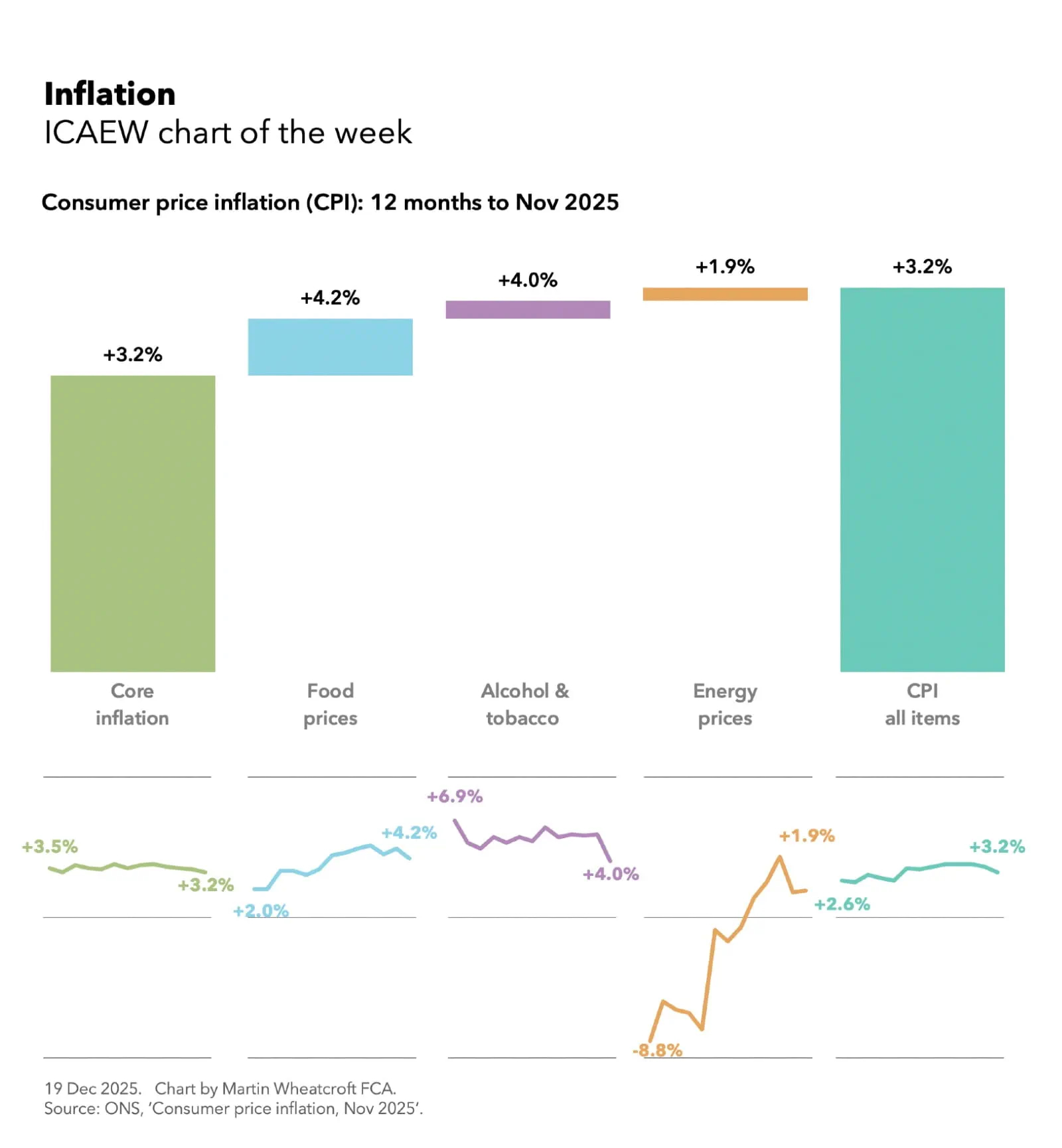
ICAEW chart of the week: Inflation

The Bank of England’s Christmas present to the nation of a cut in interest rates prompts my chart of the week for ICAEW to take a look at what is going under the hood of inflation.

According to the latest release from the Office for National Statistics (ONS), prices in the UK rose by 3.2% over the course of the 12 months to November 2025. 

My chart for ICAEW this week analyses this in more detail, breaking down the 3.2% annual rise in the consumer price inflation (CPI) index over the 12 months to November 2025. It shows that core inflation rose by 3.2%, while prices for food, alcohol and tobacco, and energy increased by 4.2%, 4.0% and 1.9% respectively.

Last year’s CPI was 2.6% in the year to November 2024, when core inflation, food, alcohol and tobacco, and energy inflation of 3.5%, 2.0%, 6.9% and -8.8% contributed 2.7%, 0.2%, 0.3% and -0.6% to the total increase respectively (taking into account their respective weightings). This compares to the 12 months to November 2025 – as shown in the chart – when core inflation, food, alcohol and tobacco, and energy inflation of 3.2%, 4.2%, 4.0% and 1.9% contributed 2.5%, 0.5%, 0.1% and 0.1% respectively to the total increase in the CPI.

Core inflation covers almost four-fifths of the goods and services that make up the CPI index and is therefore a better indicator of underlying trends, as it excludes food, alcohol and tobacco, and energy – some of more volatile components of consumer spending. The gradual trend downwards from 3.5% in the 12 months to November 2024 to 3.2% in the 12 months to November 2025 is therefore a positive sign that overall inflation is on its way back to being in the Bank of England’s target range of 2% plus or minus 1%.

However, there is still some concern about the rate of services inflation (a subcomponent of core inflation) which has remained relatively high at 4.4% in the 12 months to November 2025. While this is an improvement over the 5.0% comparative for a year ago, the Bank of England will want to see this come down further in the new year if they are going to go beyond the interest rate cut announced yesterday.

Many of our individual experiences of inflation are likely to feel worse than this given that food prices (including non-alcoholic beverages) have increased by 4.2% over the past 12 months, with some foodstuffs having increased by a lot more. According to the ONS, beef costs 27.7% more than a year ago, chocolate is up 17.3%, coffee is up 14.5% and butter is up 12.1% – all noticeable increases to most consumers. The positive news is that although annual food price inflation accelerated from 2.0% a year ago to a peak of 5.1% in the 12 months to August 2025, it has started to slow again since then.

Alcohol and tobacco prices constitute an even smaller component of the index (about 4% compared with the 11% represented by food) but are very visible to consumers who indulge. The positive news for those individuals is that the annual rate of increase in these prices has slowed from 6.9% a year ago to 4.0% in the 12 months to November 2025, with the latter comprising a 3.8% increase in the prices of alcoholic beverages and 4.2% in tobacco prices.

Energy comprises just over 6% of the overall index but its volatility can still have a significant influence on the overall index despite that weighting. This time last year energy prices had fallen by 8.8% over the previous 12 months, pulling down the overall rate of inflation by 0.6 percentage points. This year energy prices are up 1.9%, contributing 0.1% to the overall rise.

The good news was that the downward trend in inflation, particularly core inflation, was thought sufficiently positive to enable the Monetary Policy Committee (MPC) of the Bank of England to vote for a cut in interest rates in December. However, the close vote suggests that the MPC would like to see a further slowdown in the rate at which prices are rising before going further.

This chart was originally published by ICAEW.

ICAEW chart of the week: Net migration

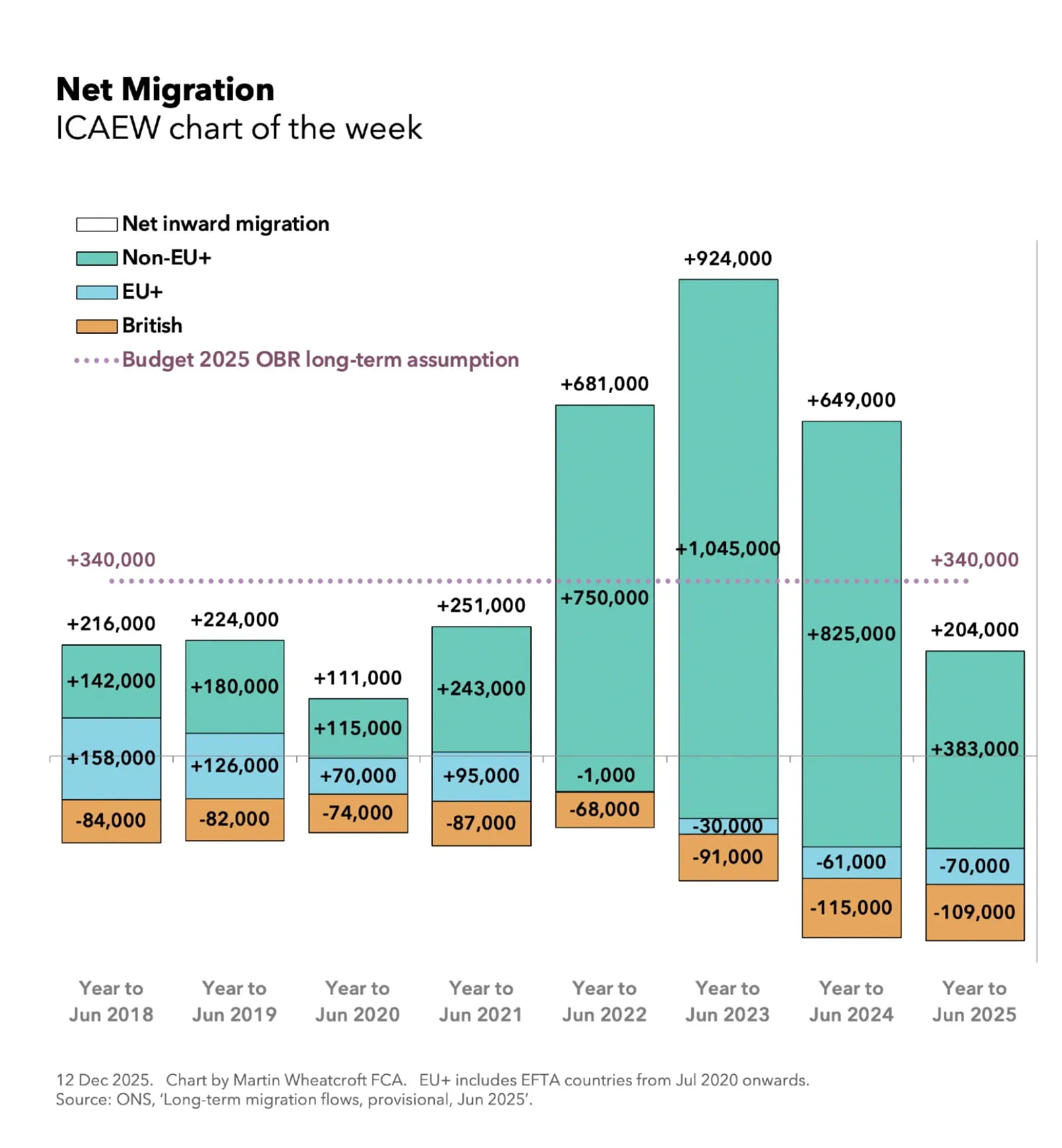
Our chart this week illustrates the fall, rise and fall again of net inward migration over the past eight years and asks whether it will bounce back to hit the OBR’s long-term assumption by the end of the decade.

The eight-year period presented in our chart this week has seen significant change in the movement of people to and from the UK. The end of free movement for citizens of EU and EFTA countries (other than Ireland) after Brexit was followed by the introduction of a points-based immigration system, disruption to international movements of people caused by the pandemic, the resettlement of significant numbers of Ukrainians, Afghans and Hong Kong British Overseas Subjects, and then a clamp-down on immigration at the end of the last government that has continued under the current government.

These factors can be seen in the provisional and otherwise heavily caveated numbers from the Office for National Statistics (ONS) illustrated by the chart. Overall net inward migration fell from 216,000 and 224,000 in the years to June 2018 and 2019 to 111,000 in the year to June 2020, rose to 251,000, 681,000 and 924,000 in the years to June 2021, 2022, and 2023 respectively, and then fell to 649,000 and then 204,000 in the years to June 2024 and 2025. A net total over eight years of 3,260,000 additional people living in the UK.

Not shown on the chart are the gross totals for immigration and emigration over the eight years to June 2025, with the former adding up to +7,962,000 (757,000, 821,000, 736,000, 818,000, 1,167,000, 1,467,000, 1,299,000 and 897,000 respectively) and the latter to -4,702,000 (541,000, 597,000, 625,000, 567,000, 486,000, 543,000, 650,000 and 693,000).

The chart highlights net inward migration from outside the European Union single market area was a key driver over the eight years to June 2025 with 3,683,000 net additions to the UK population (142,000, 180,000, 115,000, 243,000, 750,000, 1,045,000, 825,000, and 383,000 respectively). Over the same period, net immigration from the EU and EFTA countries turned into net emigration, reducing the net additions to the UK population to 287,000 (+158,000, +126,000, +70,000, +95,000, -1,000, -30,000, -61,000 and -70,000), while there was a contraction and then expansion in the 710,000 net number of Brits leaving the UK to live abroad (84,000, 82,000, 74,000, 87,000, 68,000, 91,000, 115,000, and 109,000).

The large rise and then sharp fall in net inward migration in the last five years of the chart up to June 2025 was mainly driven by those coming from outside the EU and EFTA. Net inward migration in this group for work-related reasons (including dependents) increased and then fell over the five years to June 2025 (59,000, 184,000, 359,000, 381,000, 107,000), while those arriving for study-related reasons (including dependents) also rose and fell (59,000, 265,000, 382,000, 244,000, 144,000). 

Net long-term arrivals under resettlement schemes, principally from Hong Kong, Afghanistan and Ukraine, also rose and fell in the five years to June 2025 (10,000, 151,000, 125,000, 52,000 and 21,000), while the net inflow of asylum seekers increased over the same period (38,000, 70,000, 84,000, 77,000 and 90,000).

The chart includes the OBR’s long-term assumption in Budget 2025 for net inward migration to recover to 340,000 a year by the end of the five-year forecast period in 2030/31. As the OBR calculates that most immigrants make a net positive contribution to the UK economy in the years following their arrival, a lower net inflow of people into the UK than projected could have an adverse impact on the amount of headroom the Chancellor has against her fiscal rules.

So, while ministers and civil servants at the Home Office may be congratulating themselves about the sharp fall in the number of people coming to live in the UK, their colleagues at HM Treasury may be less cheerful.

ICAEW chart of the week: Budget 2025 debt blues

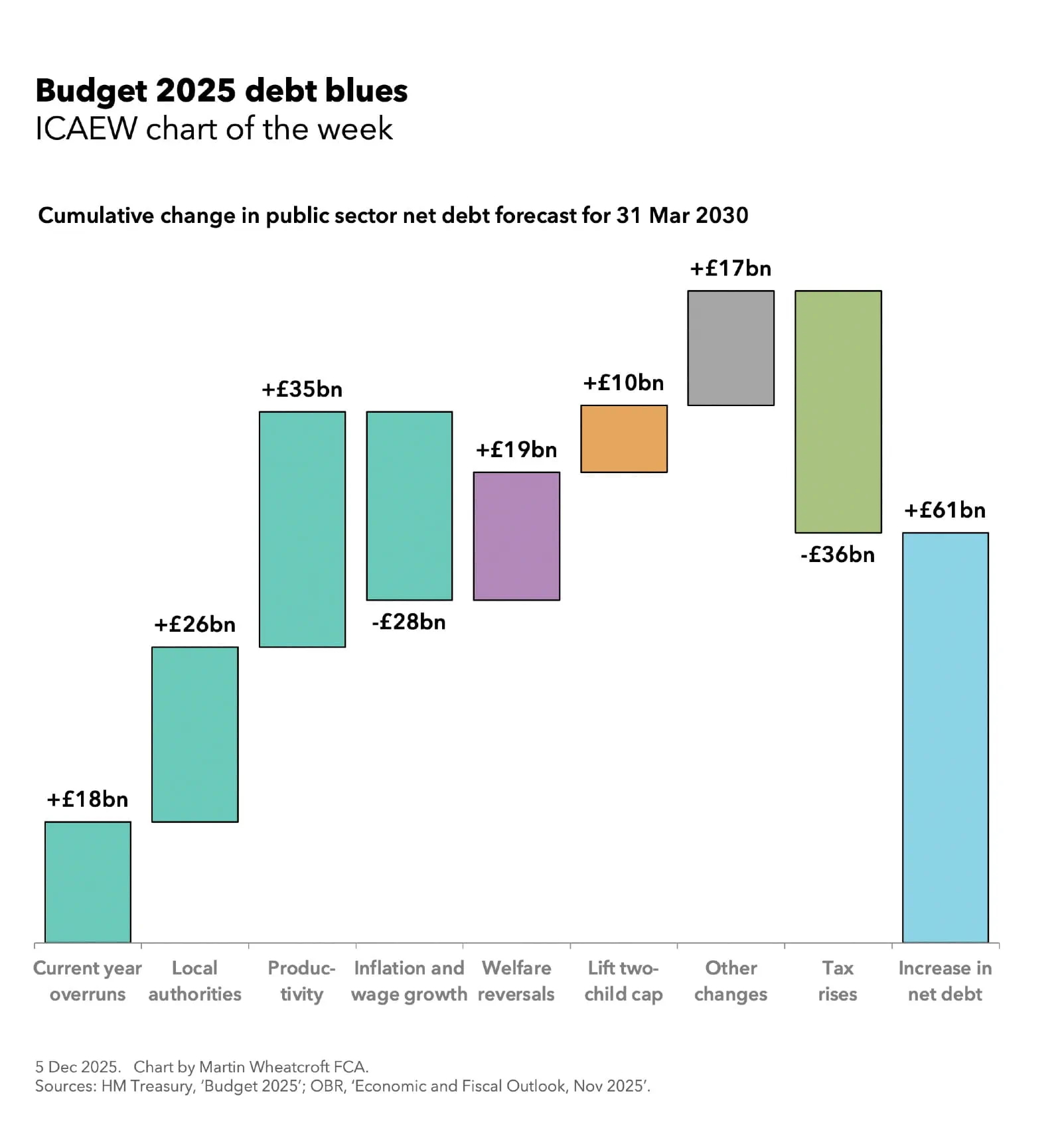
My chart for ICAEW this week illustrates how despite being a “tax-raising Budget”, the cumulative net effect of all the changes announced last week is to add £61bn to the public sector net debt forecast for 31 March 2030.

ICAEW chart of the week: Budget 2025 debt blues. 

Step chart showing the cumulative change in public sector net debt forecast for 31 Mar 2030. 

Forecast variations split into four columns in a single colour (teal)

Current year overruns: +£18bn. 
Local authorities: +£26bn. 
Productivity: +£35bn. 
Inflation and wage growth: -£28bn. 

Government policy measures in four different colours (purple, orange, grey, green). 

Welfare reversals: +£19bn. 
Lift two-child cap: +£10bn. 
Other changes: +£17bn. 
Tax rises: -£36bn. 

Total bar in blue. 

Increase in net debt: +£61bn. 


5 Dec 2025. Chart by Martin Wheatcroft FCA. 
Sources: HM Treasury, 'Budget 2025'; OBR, 'Economic and Fiscal Outlook, Nov 2025'.

While my chart for ICAEW last week looked at the impact of Budget 2025 on 2029/30, the fourth year of the fiscal forecast used for the Chancellor’s fiscal rules, this week’s focus is on the cumulative effect of the changes made between now and 31 March 2030.

The first four bars of our step chart analyse the OBR’s forecast revisions, starting with extra borrowing to fund the expected budget overrun in the current financial year (2025/26) of £18bn (technically a £21bn higher deficit less a £3bn opening adjustment). This is followed by more borrowing to fund higher local authority spending of £26bn over four years (an average of £6.5bn a year) and to cover cumulative lower receipts of £35bn from downgrading the productivity growth assumption (£2bn a year rising to £16bn by 2029/30). This is then offset by £28bn over four years from the impact of inflation and wage growth on receipts exceeding the impact of inflation and other cost pressures on public spending.

Borrowing over the next four years is then increased by £19bn (just under £5bn a year on average) to cover the government’s welfare reversals over the summer – the restoration of the winter fuel allowance to many pensioners and the decision not to proceed with eligibility restrictions for disability benefits that were needed to make the Spring Statement add up.

The decision to lift the two-child benefit cap adds another £10bn (£2.5bn a year on average) to projected debt over the next four years, while other policy measures and working capital movements are expected to add £17bn (£11bn and £6bn respectively) on top of that.

A £36bn net reduction in debt from higher tax receipts net of indirect effects over the next four years (zero in 2026/27, £4bn in 2027/28, £10bn in 2028/29, and £22bn in 2029/30) reduces the cumulative impact to £61bn, with the £3,391bn forecast for 31 March 2030 at the time of the Spring Statement back in March 2025 being revised up to £3,452bn in the Autumn Budget 2025.

Perhaps the most surprising aspect of this analysis is the £26bn revision to the forecast for local government spending. While not as large as the well-publicised impact of productivity downgrades on the OBR’s fiscal forecast, it highlights some fundamental bookkeeping issues in how the government manages the public finances. A monthly financial consolidation process that excludes local government, schools and many other public bodies means the Office for National Statistics (ONS) and HM Treasury rely on forecasts and estimates instead of actual data when reporting the monthly public sector finances, exacerbated by the use of the four different accounting frameworks across the public sector and the local audit crisis in England that has created a large backlog in local authority audited financial statements.

The OBR states: “Recent substantial revisions to LA borrowing estimates and outturns, which reflect ongoing challenges in obtaining timely and high-quality estimates particularly for expenditure by local authorities. The ONS, the Ministry of Housing, Communities and Local Government, the Treasury and the OBR have formed a joint Local Government Financial Information Taskforce to investigate and address these concerns, with the overall objective of improving the flow of data to the ONS and the accuracy of our forecast.”

Meanwhile, the backloading of tax rises means that although the forecast is for a current budget surplus in 2029/30 and for a reduced overall deficit in that year, the summer welfare reversals, lifting of the two-child benefit cap, and other policy changes all require more borrowing before the tax rises kick in. 

The 2025 Budget provides very mixed messages about the UK public finances’ prospects. There is more borrowing over the next three years before tax rises fully kick-in, while at the same time there are significant risks that mean the government could be back here again next year or the year after to ask for more money.

If ever a Chancellor could really do with some good economic news, it is probably in the coming year.

This chart was originally published by ICAEW.

ICAEW chart of the week: Autumn Budget 2025

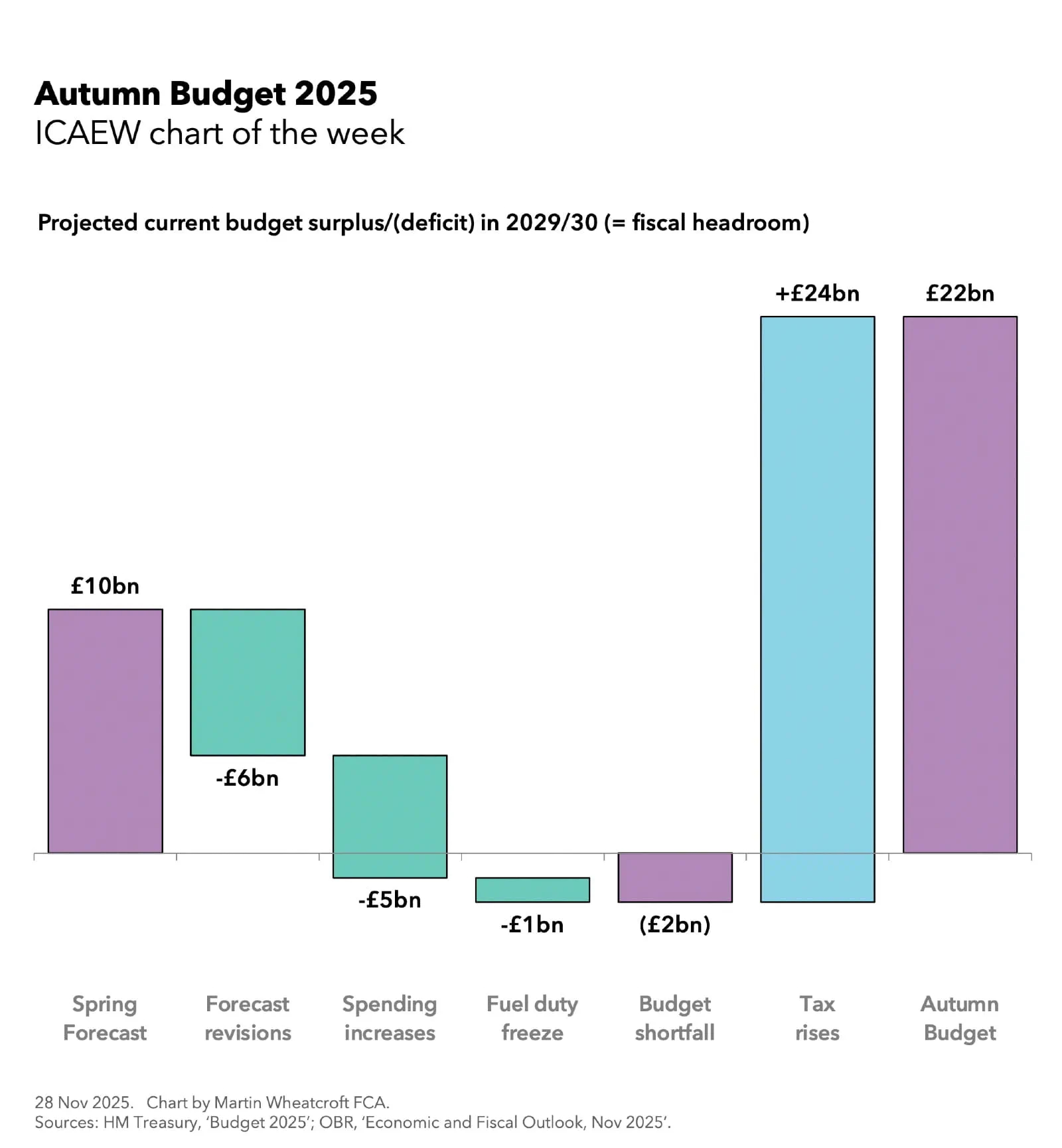
My chart this week for ICAEW looks at how the Chancellor used tax rises to refill and increase her budget headroom after forecast revisions and spending increases eliminated the projected current budget surplus for 2029/30.

ICAEW chart of the week: Autumn Budget 2025. 

A step chart showing the change in the projected current budget surplus/(deficit) in 2029/30 (= fiscal headroom). 

Spring Forecast: £10bn. 
Forecast revisions: -£6bn. 
Spending increases: -£5bn. 
Fuel duty freeze: -£1bn. 

= Budget shortfall (£2bn). 

Tax rises: +£24bn. 

= Autumn Budget: £22bn. 

28 Nov 2025. Chart by Martin Wheatcroft FCA. 
Sources: HM Treasury, 'Budget 2025'; OBR, 'Economic and Fiscal Outlook, Nov 2025'.

The chart shows how the projected current budget surplus of £10bn in 2029/30 was reduced by £6bn of Office for Budget Responsibility (OBR) forecast revisions, by £5bn of spending increases announced in the Autumn Budget, and by £1bn from the freezing of fuel duties for yet another year.

Together these reduced the Chancellor’s headroom against her primary fiscal rule (to be in a current budget surplus by the fourth year of the fiscal forecast) from £10bn to minus £2bn – in effect breaching her fiscal rule before taking account of tax rises.

The Chancellor has then restored – and increased – her fiscal headroom to £22bn through a long list of tax rises that are anticipated to generate £24bn more in receipts in 2029/30.

Forecast revisions

The rumoured forecast downgrade from the OBR of £6bn in 2029/30 turned out to be much less significant than expected. 

The OBR cut its receipts forecast for 2029/30 by £16bn a year because of weaker assumed productivity growth. But this was more than offset by a £30bn increase from higher nominal wages and prices, driven by both inflation and real wage growth, to add £14bn to receipts in that year – an increase not a decrease to the receipts side of the forecast.

This was offset by £20bn in higher current spending, of which £6bn was from higher uprating of welfare benefits and growth in claimants and caseloads, £6bn from government policy reversals on the winter fuel allowance and disability benefits, £4bn in higher debt interest, £2bn in higher local government spending, and £2bn in other changes.

The resulting deterioration of £6bn in the projected current budget surplus for 2029/30 was £14bn smaller than the £22bn deterioration anticipated by the Institute for Fiscal Studies (IFS) in its pre-Budget forecast (as used in our chart of the week on the Autumn Budget hole). The principal driver was £22bn in incremental receipts from higher inflation and higher real wage growth less £6bn in higher spending for similar reasons.

Because departmental budgets for 2026/27, 2027/28 and 2028/29 set out in the Spending Review earlier this year have not been increased for this higher level of inflation, the risk is that future Budgets will need to top up the amounts allocated to departments to deal with cost pressures that are likely to arise.

Spending increases

Current spending is projected to increase by £5bn in 2029/30, comprising £3bn to cover the annual cost of abolishing the two-child benefit cap, £1bn in higher debt interest, and £1bn in net other changes in non-interest current spending.

The OBR also announced that it had reduced its underspend assumption for departmental budgets during the latest spending review period (2026/27 to 2028/29 for current spending) by an average of £4bn a year to reflect the increased pressures on budgets from higher inflation. There was no similar adjustment to 2029/30 current spending as it is not covered by the spending review, but there is a risk that a similar adjustment may be needed by the time of the 2027 spending review. 

Fuel duty freeze

Freezing fuel duties has become a consistent feature of Budgets since 2011, with the effect of reducing annual tax receipts in real terms by just under £1bn a year.

Given the current Chancellor has chosen to continue this practice in two successive Budgets, it is disappointing that fiscal forecasts have not reflected the anticipated £3bn additional reduction in tax receipts in 2029/30 if fuel duty is frozen again in the next three Budgets.

Tax rises

The Chancellor announced a total of £27bn in tax rises in the Budget (£26bn if the fuel duty freeze effective tax cut is netted off), but this is expected to generate £24bn in incremental tax receipts once behavioural responses and other indirect economic effects are adjusted for.

These tax rises are expected to generate the following amounts per year by 2029/30:

  • £8bn from extending the freezing of personal allowances (more ‘fiscal drag’).
  • £5bn from restricting the use of salary-sacrifice schemes to make pension contributions.
  • £2bn from increased income tax rates on property, savings and dividends.
  • £1.5bn from changes to writing-down allowances.
  • Just under £1.5bn from a mileage-based charge on electric cars.
  • Just over £1bn from gambling duty reform.
  • Just under £1bn from capital gains tax on employee ownership trusts.
  • Just under £0.5bn from a high value council tax surcharge.
  • Around £4.5bn from other tax measures.
  • £2bn from improved tax compliance and collection.

Higher headroom  

The Chancellor chose to increase headroom against her principal (current budget) fiscal rule from £10bn last year to £22bn and to increase headroom in her secondary (debt) fiscal rule from £15bn to £24bn. 

These are both positive in that they provide a much bigger cushion against potential forecast downgrades in the spring or autumn next year, reducing the risk of another round of significant tax rises in the Chancellor’s third Budget in 2026. It also helps that she is likely to gain around £15bn of extra headroom as the main fiscal rule moves to being tested in the third year of the forecast, which comes with a margin of permitted current budget deficit up to a maximum of GDP.

However, significant downside risks remain, so this outcome is far from assured. The Chancellor still faces the challenge of reviving a weak economy and delivering substantial efficiency savings if she is to keep public spending under control in the absence of more fundamental reform. That task is made harder by the risk of bailouts for local authorities and universities, and by continued pressure on the welfare budget.

This chart was originally published by ICAEW.

ICAEW chart of the week: Controlling for debt

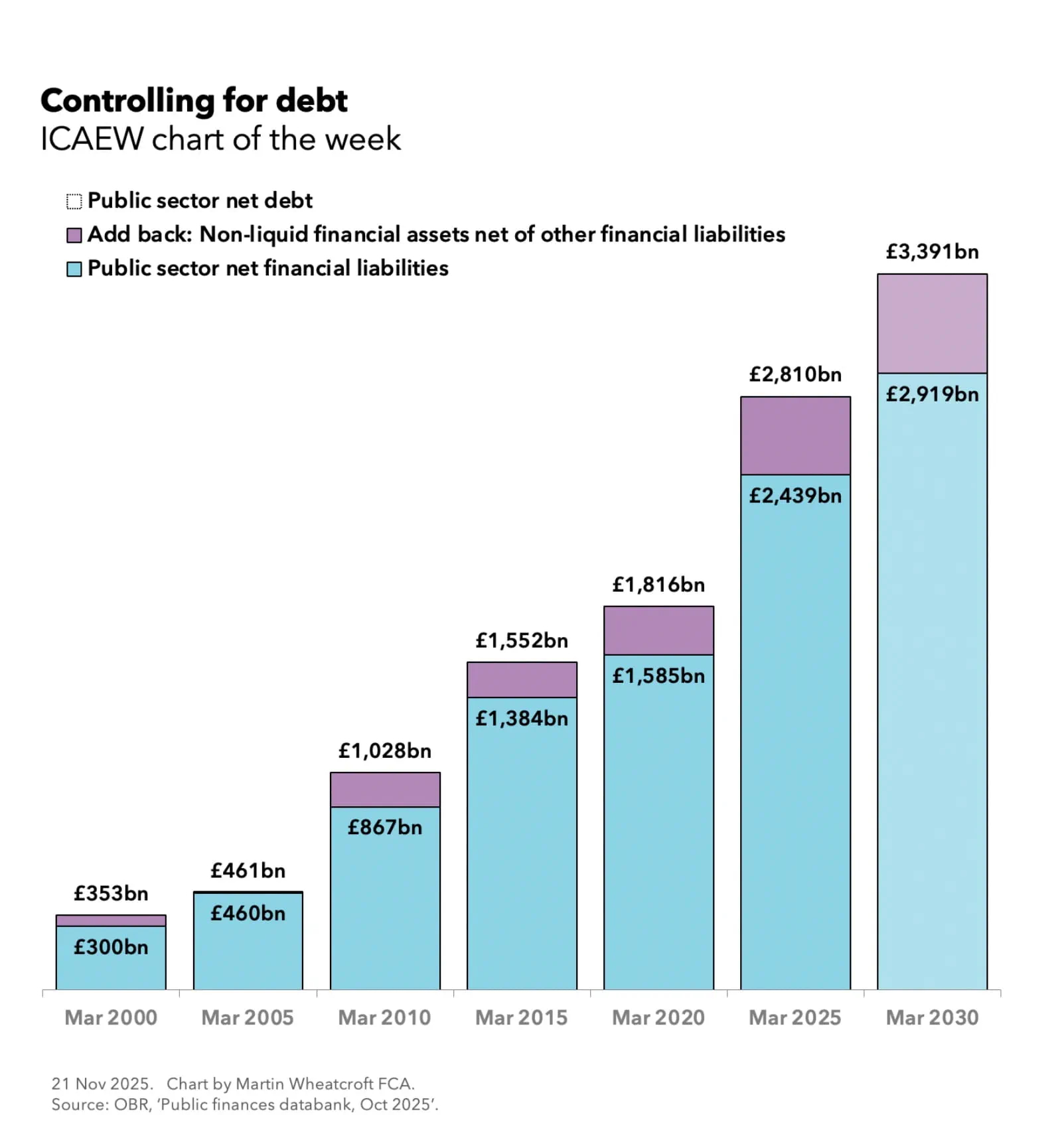
My chart for ICAEW this week shows how the high level of public debt is the main factor shaping next week’s Autumn Budget.

ICAEW chart of the week: Controlling for debt. 

Seven column chart showing public sector net financial liabilities and public sector net debt, with the difference (the add back of non-liquid financial assets net of other financial liabilities) shown without numbers. 

Public sector net financial liabilities: £300bn, £460bn, £867bn, £1,384bn, £1,585bn, £2,439bn and £2,919bn in Mar 2000, 2005, 2010, 2015, 2020, 2025 and 2030 respectively. 

Public sector net debt: £353bn, £461bn, £1,028bn, £1,552bn, £1,816bn, £2,810bn and £3,391bn in Mar 2000, 2005, 2010, 2015, 2020, 2025 and 2030 respectively. 

21 Nov 2025. Chart by Martin Wheatcroft FCA. 
Source: OBR, 'Public finances databank', Oct 2025.

In the run up to next week’s Autumn Budget it has become clear that the Chancellor has very little room for manoeuvre. 

In past fiscal events, a moderate downgrade in the economic and fiscal forecasts (see last week’s chart of the week) would typically be dealt with by allowing borrowing to rise, albeit in combination with a small cut in planned public spending (often to capital expenditure) and perhaps some minor tax rises. 

This time is different. Borrowing – the normal safety valve for adverse forecast changes – is constrained by the existing high level of debt and by government’s existing plan to borrow substantial sums over the next five years, as illustrated by our chart of the week.

As my chart for ICAEW sets out, public sector net debt has risen over the past quarter of a century from £353bn on 31 March 2000 to £461bn in 2005, £1,028bn in 2010, £1,552bn in 2015, £1,816bn in 2020 and £2,810bn in 2025. It is forecast to rise further to £3,391bn on 31 March 2030.

Although the planned increase of £581bn over the coming five years is less than the £994bn increase over the previous five years, the latter included both the pandemic and an unexpected energy crisis.

The chart also shows how public sector net financial liabilities (PSNFL), the measure of debt that the Chancellor uses for her fiscal rules, increased from £300bn on 31 March 2000 to £2,439bn on 31 March 2025, with a planned rise of £480bn to £2,919bn due to take place on 31 March 2030.

The Chancellor’s debt fiscal rule is for the ratio of PSNFL to GDP starting to fall by 2029/30, or – in other words – for the rate at which debt is increasing to be slower than the rate of growth in the economy in four years’ time. The hope is that the borrowing the government is doing now to invest in infrastructure and economic development will speed up economic growth over that time, but unfortunately that is not yet showing up in the forecasts, which are going in the opposite direction.

With higher borrowing ruled out, the next option would be to look at spending. This also looks difficult as the Spending Review earlier this year locked in departmental budgets for the next few years (to 2028/29 for current spending and to 2029/30 for capital investment). Likewise, significant cuts in welfare spending also appear unlikely given the government’s failure to persuade its MPs to back a plan to cut back on disability and illness benefits and hints that the government wants to lift the two-child benefit cap. The Chancellor could potentially re-open the Spending Review, but that would risk spending going up not down given the continued pressures on health and the criminal justice systems, not to mention the international pressure from President Trump and others to accelerate increases in defence spending.

With other options such as raising the level of net inward migration also ruled out, that leaves taxation as the only real lever available to the Chancellor. 

The flood of speculation ahead of next week’s Autumn Budget 2025 has ranged from manifesto-busting increases in one of the ‘big three’ taxes (income tax, VAT and national insurance) and fiscal drag (from the extension of freezes in tax allowances), to a long list of tax raising ideas to bring in just a little bit more money here and there that might together add up to a substantial amount.

At this point it seems that little can be ruled out.

This chart was originally published by ICAEW.

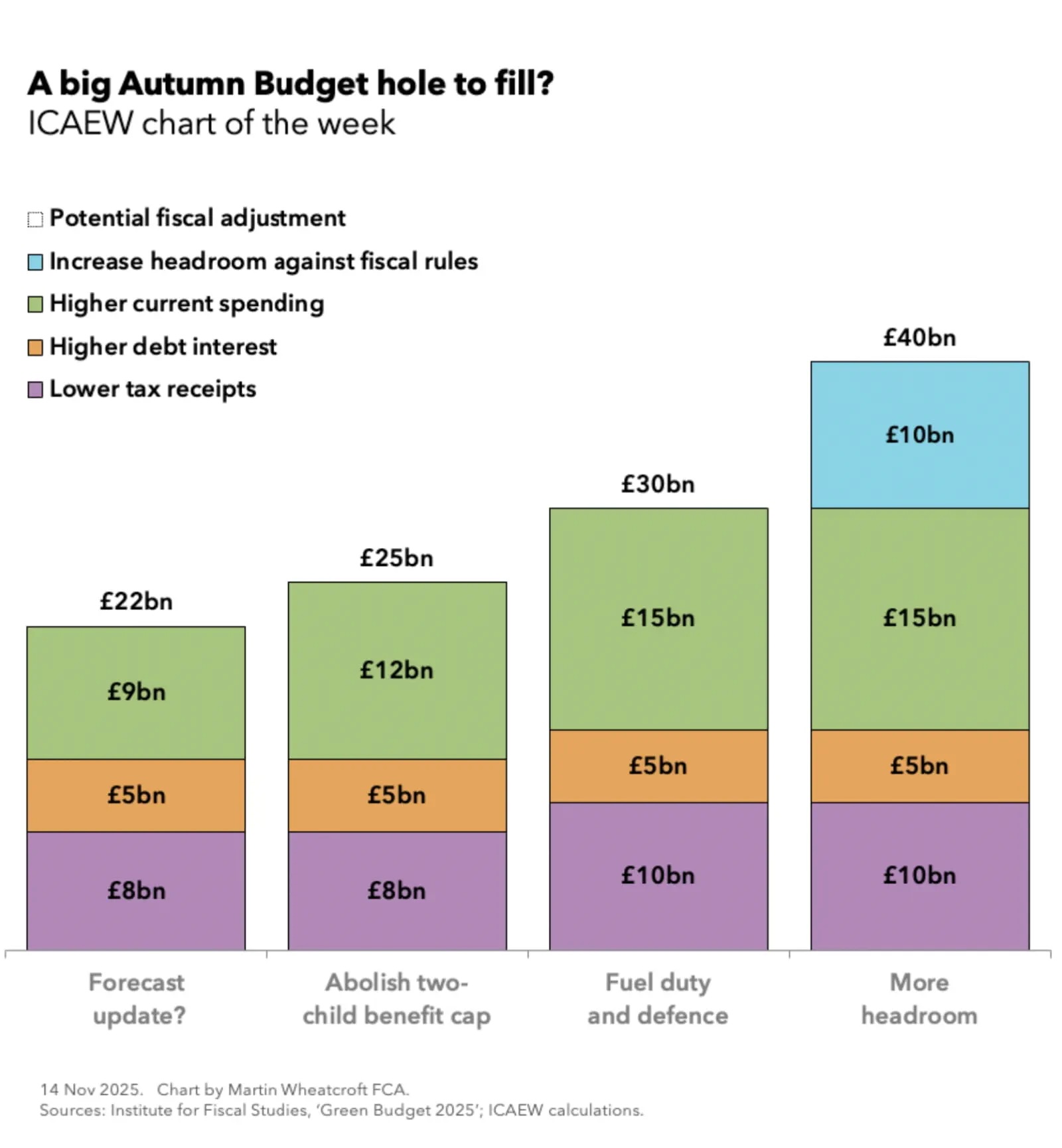
ICAEW chart of the week: A big Autumn Budget hole to fill?

My chart for ICAEW this week takes a look at the £40bn ‘hole’ in the public finances that the Chancellor may have to fill when she presents the Autumn Budget 2025 to Parliament on Wednesday 26 November.

ICAEW chart of the week: A big Autumn Budget hole to fill? 

A column chart showing four cumulative scenarios: 

1. Forecast update?: £8bn lower tax receipts + £5bn higher debt interest + £9bn higher current spending = £22bn potential fiscal adjustment. 

2. Abolish two-child benefit cap: £8bn lower tax receipts + £5bn higher debt interest + 129bn higher current spending = £25bn potential fiscal adjustment. 

3. Fuel duty and defence: £10bn lower tax receipts + £5bn higher debt interest + £15bn higher current spending = £30bn potential fiscal adjustment. 

4. More headroom: £10bn lower tax receipts + £5bn higher debt interest + £15bn higher current spending + £10bn increase headroom against fiscal rules = £40bn potential fiscal adjustment. 

14 Nov 2025. Chart by Martin Wheatcroft FCA. 
Sources: Institute for Fiscal Studies, 'Green Budget 2025'; ICAEW calculations.

There are two really big questions that most of us have for the Chancellor about the Autumn Budget 2025. Firstly, just how much money does she need to find? Secondly, where is she is going to find it?

My chart for ICAEW this week focuses on the first question – how much will the Chancellor need to find (in tax rises or spending cuts) to stick within her fiscal rules?

Speculation ranges from just under £20bn a year up to as much as £50bn depending on who you talk to, with the consensus being somewhere in the region of £30bn or £40bn.

The starting point for the chart is the official OBR projection that the Chancellor has already received. As we don’t have access to that, we have cribbed from the Institute for Fiscal Studies (IFS) Green Budget 2025 report, an independent ‘green paper’ pre-legislative report that provides an in-depth analysis of the economic and fiscal situation facing the UK that also takes a look at potential options available to the Chancellor. 

Based on an updated economic forecast prepared by Barclays, the IFS think that the OBR’s March 2025 projected current budget surplus of £10bn in 2029/30 could be revised down to a projected current budget deficit of £12bn – a £22bn deterioration.

The numbers calculated by the IFS indicate £8bn lower tax receipts, £5bn higher debt interest, and £9bn higher current spending. The lower tax receipts and higher debt interest reflect a less favourable economic outlook than anticipated by the OBR back in March, while the latter consists of £1bn from the partial roll-back of cuts to the winter fuel allowance, £5bn from the failure to enact previously planned cuts to disability benefits, and £3bn from the effect of higher than previously forecast inflation on the uprating of the state pension and other welfare benefits.

If the OBR’s updated projections were to align with this scenario, then the Chancellor would need to find £22bn to get back to a projected current budget surplus of £10bn in 2029/30, assuming she decides again to give herself £10bn of headroom against her primary fiscal rule of a current budget balance.

We don’t know how these numbers compare with the numbers that the OBR are working on, but we do know that the OBR has been reviewing its assumptions for productivity growth, where it has proved consistently over-optimistic in previous forecasts. The IFS estimate that just a 0.1 percentage point downgrade in annual productivity growth would reduce the current budget balance by around £7bn in 2029/30, highlighting how sensitive the numbers are to relatively small changes. The IFS assume a downgrade of between 0.1 and 0.2 percentage points in their projection, although some rumours suggest the OBR has been considering a downgrade of as much as 0.3 percentage points.

The Chancellor has dropped a clear hint that she is going to abolish the two-child limit in the Autumn Budget as part of the government’s efforts to tackle child poverty, with the IFS and the Resolution Foundation both estimating that this could cost the exchequer between £3bn and £4bn a year by 2029/30. This would take the potential ‘hole’ up to £25bn.

For the purposes of the chart, I have also added in £5bn for further policy changes. Firstly, there is a good chance that the Chancellor will choose to make the existing 5p ‘temporary’ cut in fuel duties permanent at a cost of £2bn a year. This is currently scheduled to be reversed on 1 April 2026, alongside the expected end of the annual freeze in fuel duties – a measure that, if continued, could cost a further £3 billion a year by 2029/30.

The government is also under significant pressure – from President Trump and other NATO allies in particular – to accelerate increases in the defence budget to meet the new NATO target for spending on defence and security of 3.5% of GDP. Although the NATO target includes capital expenditure (which is not part of the current budget surplus or deficit), we have included a proxy amount of £3bn a year by 2029/30 for additional operating expenditure on defence.

This brings the potential funding requirement to roughly £30 billion, if the Chancellor aims to maintain £10bn of headroom against her fiscal rule of achieving a current budget balance in the fourth year of the forecast.

Unfortunately, as the government has discovered over the past year, such a small margin – less than 0.3% of GDP – is hugely problematic. Relatively small changes in the OBR’s assumptions or in actual economic performance can easily use up all the headroom, leading (as we have seen) to endless speculation about what the Chancellor is going to have to do to bring the public finances back under control. 

The Chancellor is therefore expected to provide herself with a bigger cushion to reduce the risk of having to come back to raise taxes for a third time. The chart thinks she is likely to choose to double the level of headroom as a minimum – from £10bn to £20bn – with some economic commentators suggesting that an even larger cushion might be necessary.

The IFS point out in their report that extra headroom may be needed in any case because of the Chancellor’s second ‘debt’ fiscal rule, which is for public sector net financial liabilities to be falling as a share of GDP by the fourth year of the fiscal forecasts. Although she could cut the capital expenditure already budgeted for 2029/30 to remain within the fiscal rule, the Chancellor has said she wishes to avoid doing so.

Whatever happens, it looks like the Autumn Budget 2025 is going to be a pretty big deal.

This chart was originally published by ICAEW.

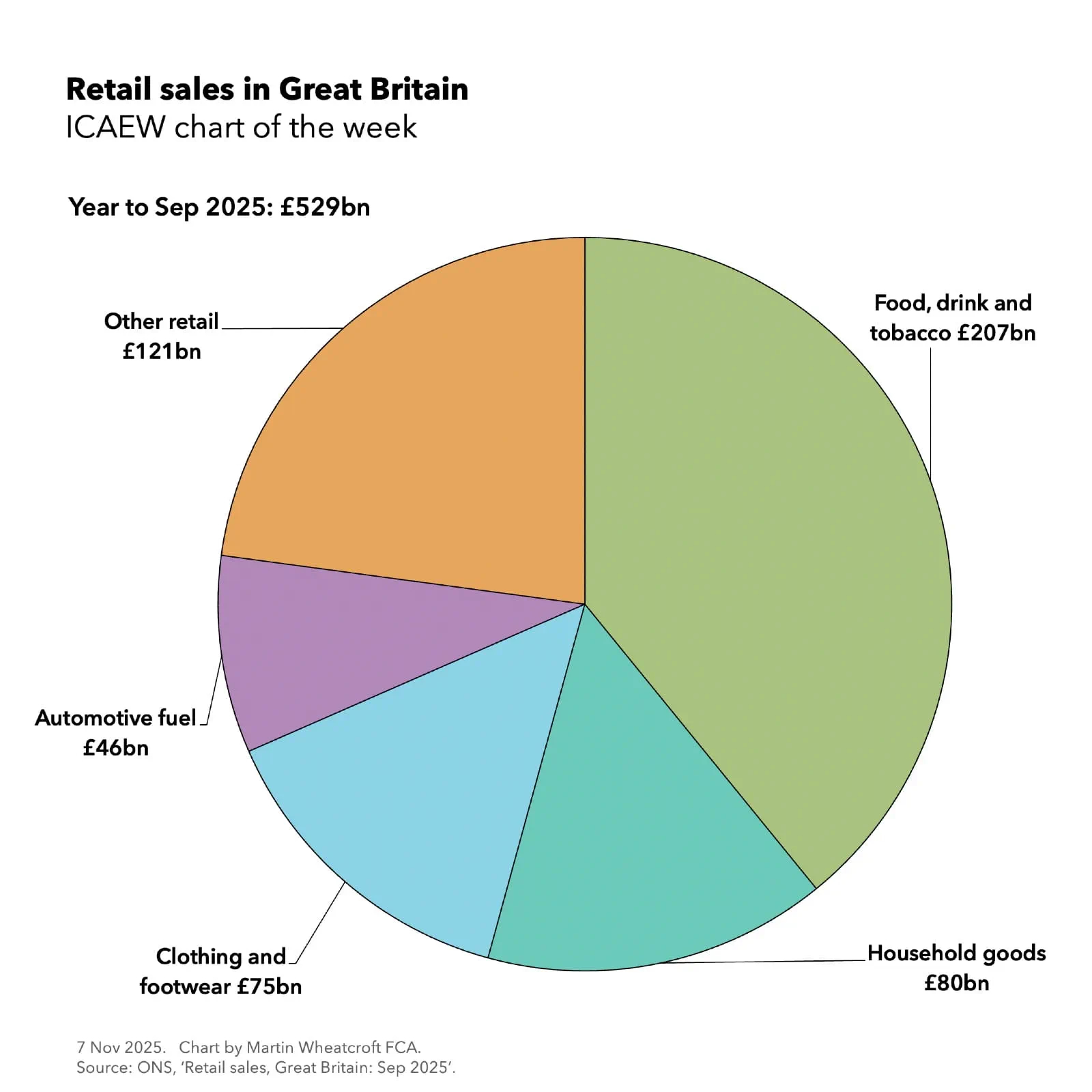
ICAEW chart of the week: Retail sales in Great Britain

My chart for ICAEW this week breaks down the £529bn of sales made by retailers in England, Wales and Scotland in the year to September 2025.

ICAEW chart of the week: Retail sales in Great Britain. 

Pie chart showing the breakdown of retail sales in the year to Sep 2025 of £529bn. 

Food, drink and tobacco £207bn. 
Household goods £80bn. 
Clothing and footwear £75bn. 
Automotive fuel £46bn. 
Other retail £121bn. 

7 Nov 2025. Chart by Martin Wheatcroft FCA. 
Source: ONS, 'Retail sales, Great Britain: Sep 2025'.

Retail sales are a core component of the economy, and my chart for ICAEW this week takes a look at the total amount of sales made by retailers over the past year. 

According to the Office for National Statistics (ONS), total sales of £529bn in Great Britain between October 2025 and September 2026 comprised £207bn (39%) of food, drinks and tobacco, £80bn (15%) of household goods, £75bn (14%) of clothing and footwear, £46bn (9%) in automotive fuel, and £121bn (23%) in other retail categories.

This £529bn in sales is equivalent to around £10bn a week on average and represents around 18% of overall economic activity in England, Wales and Scotland by value.

The ONS also analyses the data by type of store, with £410bn and £119bn generated in sales by large (100 employees or more) and small (99 employees or fewer) retail businesses respectively, while around £132bn or 25% of retail sales are now transacted online.

Supermarkets and other ‘predominately’ food stores made sales of £209bn last year (of which £20bn or 10% was online), while textile, clothing and footwear stores recorded £57bn (£16bn or 28% online), household goods stores recorded £37bn (£9bn or 24% online), department and other non-specialised stores recorded £39bn (£10bn or 26% online) and all other stores generated £70bn (£15bn or 21% online). Internet, mail order, and other ‘non-store’ retailers (such as market stalls) made £70bn (£62bn online). None of the £46bn in petrol and diesel sales were reported as being online.

According to the ONS, seasonally adjusted retail sales volumes in September 2025 are at their highest level since 2022 but 1.6% lower than in February 2020 prior to the pandemic.

This decline in the amount of ‘stuff’ being bought by British consumers despite a growing population is primarily a reflection of the squeeze on household budgets from the cost-of-living crisis combined with relatively weak growth in household incomes over the last few years.

The concern for many retailers in the next few weeks will therefore be not only what business tax measures might be announced in the Autumn Budget 2025, but also the effect that other tax measures might have on household disposable incomes and, hence, the ability and willingness of consumers to spend their money in the shops and online.

This chart was originally published by ICAEW.

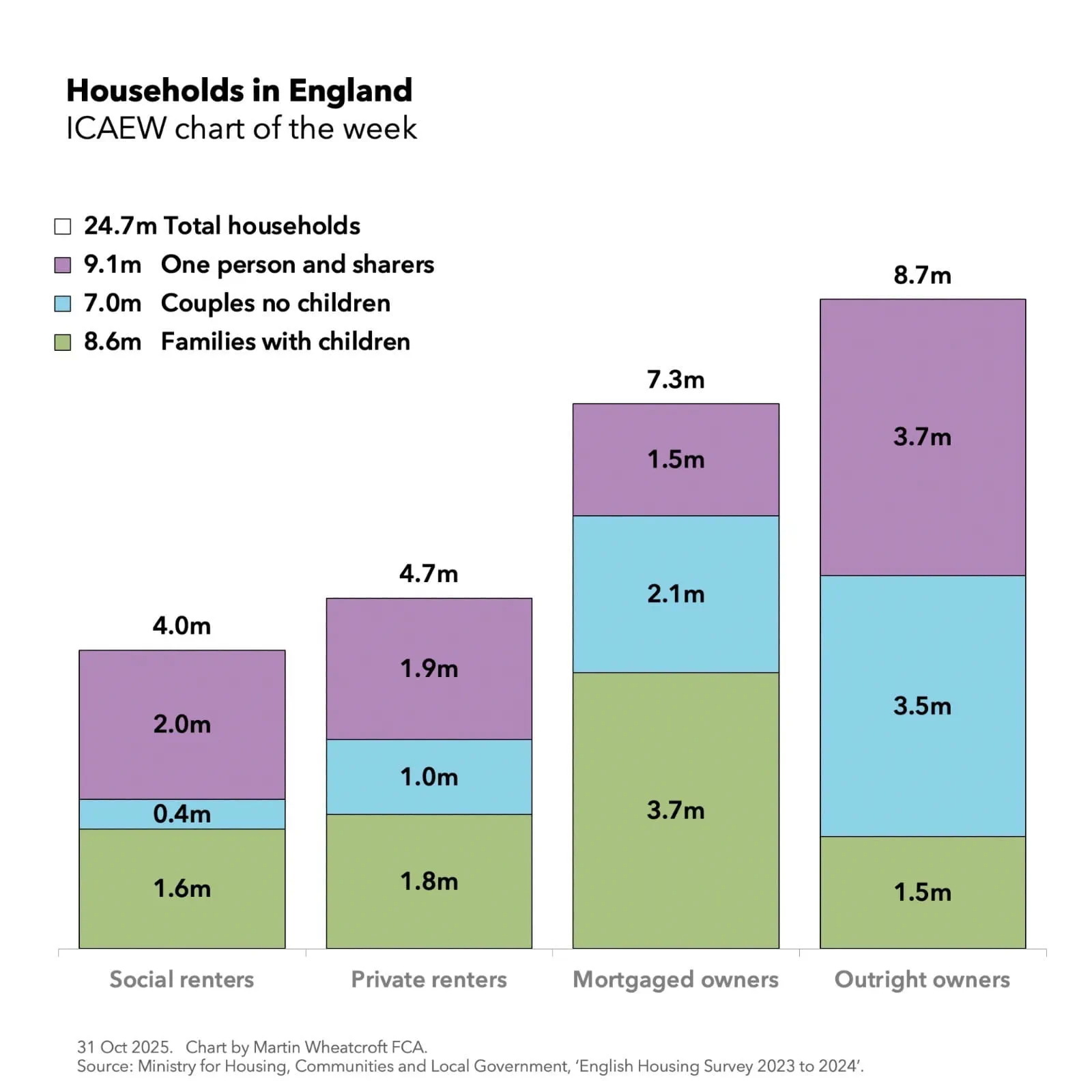
ICAEW chart of the week: Households in England

The recent passing of the Renters’ Rights Act 2025 prompts my chart of the week for ICAEW to take a look at just how many households there are in England.

ICAEW chart of the week: Households in England. 

Four-column chart with three categories in each column. 

Social renters: 1.6m families with children + 0.4m couples no children + 2.0m one person and sharers = 4.0m total. 

Private renters: 1.8m families with children + 1.0m couples no children + 1.9m one person and sharers = 4.7m total. 

Mortgaged owners: 3.7m families with children + 2.1m couples no children + 1.5m one person and sharers = 7.3m total. 

Outright owners: 1.5m families with children + 3.5m couples no children + 3.7m one person and sharers = 8.7m total. 

Total (shown in legend): 8.6m families with children + 7.0m couples no children + 9.1m one person and sharers = 24.7m total households. 

31 Oct 2025. Chart by Martin Wheatcroft FCA. 

Source: Ministry for Housing, Communities and Local Government, 'English Housing Survey 2023 to 2024'.

The Renters’ Rights Act 2025 was given royal assent on 27 October, providing a range of new protections for tenants of private sector landlords in England. Its passing prompted us to ask just how many private sector tenancies will be affected by these changes once they are introduced into law.

My chart for ICAEW this week illustrates that there were 24.7m households in England in 2023/24 according to the Ministry of Housing, Communities and Local Government. Of these, 4.0m, or 16% of households, were in social housing (2.5m housing association and 1.5m local authority properties), 4.7m, or 19%, were tenants of private sector landlords, 7.3m, or 30%, were in properties owned with a mortgage, and 8.7m or 35% were in properties owned outright.

The chart also shows a breakdown of the 8.6m families with children (1.6m social renters, 1.8m private renters, 3.7m mortgaged owners and 1.5m outright owners), 7.0m couples with no children (0.4m, 1.0m, 2.1m and 3.5m respectively), and 9.1m one person or shared households (2.0m, 1.9m, 1.5m and 3.7m respectively).

The 8.6m family households comprised 5.7m couples with children, 2.5m lone parents with children, and 0.4m two or more family households, while the 9.1m one person or shared households comprised 8.5m one person households (4.5m female and 4.0m male) and 0.6m shared households containing two or more lone persons.

The 4.0m social renter households, 4.7m private renters, 7.3m mortgaged owners and 8.7m outright owners comprise 8.6m, 10.7m, 19.6m and 16.0m people respectively – the latter reflecting the older demographic where we see more outright ownership, fewer children and a higher proportion living alone.

For both tenants and their landlords, the Renters’ Rights Act 2025 will result in significant changes to their contractual arrangements and legal rights. The measures include new restrictions on no fault evictions, the end of fixed-term tenancies, limitations on rent increases, a new ombudsman, a requirement on landlords to register their properties, more rights to have pets, higher property standards, deadlines for rectifying hazards, an end to discrimination against those on benefits or who have children, an end to post-advertisement bidding wars, strengthened local authority enforcement, and the ability for rent repayment orders to be recovered from superior landlords.

This chart was originally published by ICAEW.

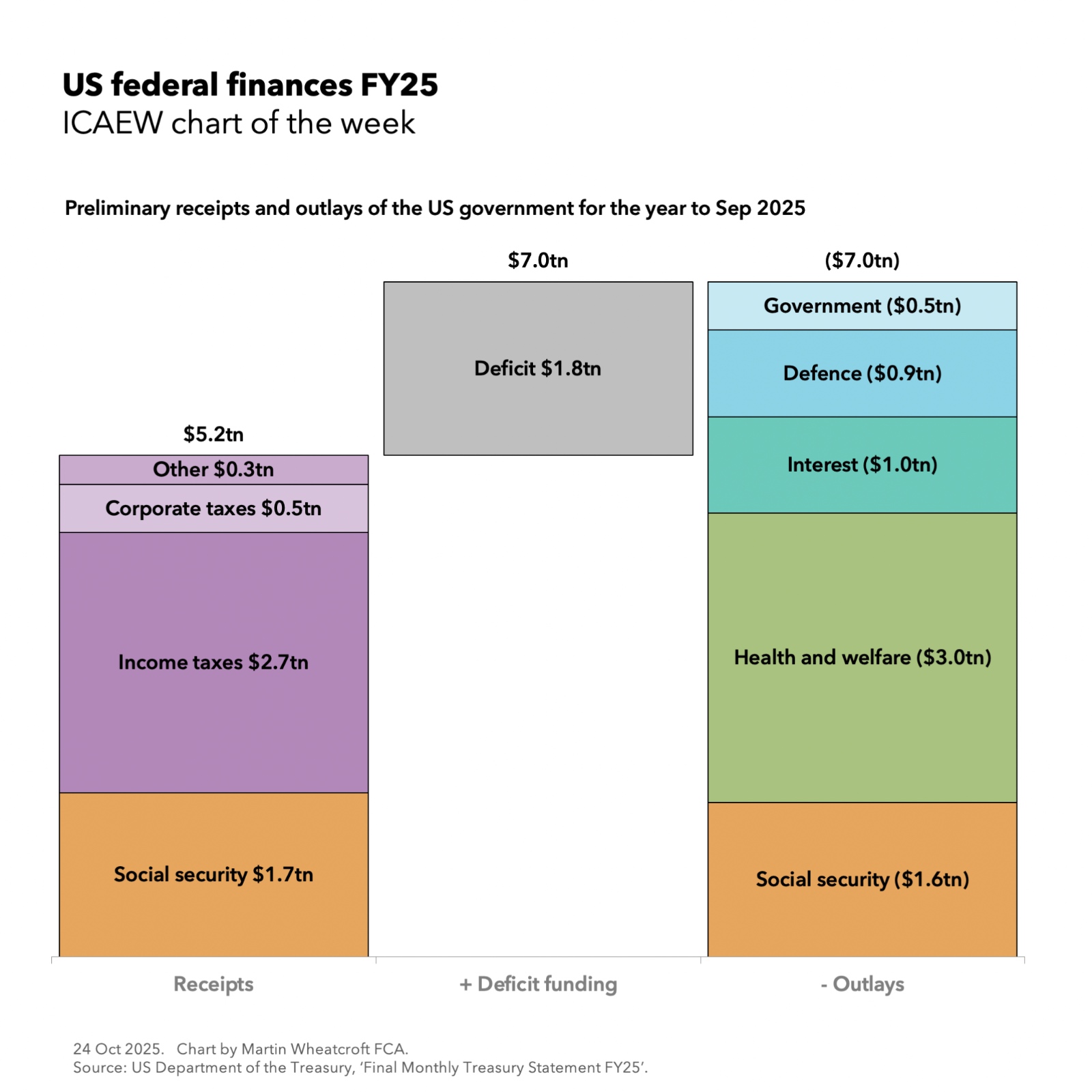
ICAEW chart of the week: US federal finances FY25

My chart for ICAEW this week looks at how the US federal government is funded and what it spends its money on.

ICAEW chart of the week: US federal finances FY25. 

A three-column chart showing the preliminary receipts and outlays of the US government for the year to Sep 2025. 

(First column) Receipts: Social security $1.7tn + Income taxes $2.7tn + Corporate taxes $0.5tn + Other $0.3tn = $5.2tn. 

(Middle column) + Deficit funding $1.8tn = $7.0tn. 

(Third column) - Outlays: Social security ($1.6tn) + Health and welfare ($3.0tn) + Interest ($1.0tn) + Defence ($0.9tn) + Government ($0.5tn) = ($7.0tn). 

24 Oct 2025. Chart by Martin Wheatcroft FCA. 
Source: US Department of the Treasury, 'Financial Monthly Treasury Statement FY25'.

The US federal government financial year ends in September each year and our chart this week takes a look at the provisional monthly receipts and payments statement for September 2025 (FY25).

According to preliminary numbers from the Bureau of the Fiscal Service, part of the US Department of the Treasury, the US federal government collected $5.2tn (17% of GDP or $1,275 per person per month) in taxes during the year ended 30 September 2025 and paid out $7.0tn (23% of GDP or £1,710 per person per month). 

The shortfall of $1.8tn (6% of GDP or £435 per person per month) was funded by borrowing.

As our chart illustrates, the federal government’s tax receipts of $5.2tn comprised $1.7tn (6% of GDP or $425 per person per month) from social security contributions, $2.7tn (9% or $655) from income taxes, $0.5tn (1% or $110) from corporate taxes, and $0.3tn (1% or $85) from customs duties, excise taxes, and miscellaneous taxes.  

Outlays comprised $1.6tn (5% of GDP or $385 per person per month) on social security programmes (principally pensions and unemployment insurance), $3.0tn (10% or $745) on health care programmes and subsidies (principally Medicare for retirees, Medicaid for children, the poor and those with disabilities, and Affordable Care Act subsidies for lower earners), $1.0tn (3% or $235) on net debt interest, $0.9tn (3% or $225) on US Department of Defense military expenditures, and $0.5tn (2% or $120) on the federal government excluding the military.

These numbers are (for the most part) cash receipts and payments. The US federal government’s accrual-based audited financial statements, prepared in accordance with standards issued by the US Governmental Accounting Standards Board, are normally published in the following February.

They may also seem quite low when compared with the UK’s public finances for example, but that is primarily because they exclude receipts and payments by the states, counties and city governments that provide most public services in the US in addition to their own welfare programmes.

Despite that, it may still be surprising to see how little the federal government costs once welfare programmes, debt interest and military programmes are excluded – just $0.5tn or $120 per person, less than 2% of GDP. This is the result of benefits of scale, a strong economy and the decentralised nature of government in the US.

Having said that, policymakers are concerned about rising debt interest and a widening deficit, which is expected to grow further in 2026 as the current administration’s tax cuts take effect and outweigh the planned spending reductions for FY26.

For more information about the US federal finances, visit FiscalData on the US Department of the Treasury website.

This chart was originally published by ICAEW.