What COVID-19 means for the future of tax

This article features in the May 2021 edition of TAXline, ICAEW Tax Faculty’s monthly magazine. One article is freely available each month.

With the pandemic increasing pressure on public finances, could this prompt overdue discussions on tax reform? ICAEW’s Head of Tax Frank Haskew and independent adviser Martin Wheatcroft reflect on recent announcements and challenges facing the Chancellor.

With the UK’s deficit set to increase to £2.5tn by 2023, the fact that tax revenues do not cover public spending is starker than ever. However, the problem of balancing the books far predates COVID-19

An aging population coupled with funding and tax administrative decisions made many decades ago have meant that the gap has been slowly but inexorably widening. Frank Haskew, Head of Tax at ICAEW, says: “Since the turn of the century, we have been running deficits almost every year. The fact is that we’re not raising enough tax meet to our day-to-day spending commitments.”

Martin Wheatcroft, an independent adviser and author on public finances who works closely with ICAEW, explains: “People are living longer which is a good thing, but it has a financial impact. For example, the NHS spends an average of £80 a month on 18-year-olds, while for 80-year-olds that cost is more than £500. The perennial issue is that we don’t have a clear long-term strategy for how the government, or any government, plans to deal with that.”

To balance the books, the primary strategy of governments has been to grow the economy and have a moderate level of inflation to inflate away debt. However, financial crises and recessions have meant that in the past decade growth has been a lot weaker than expected. George Osborne, for example, was forced to leave the Exchequer without fulfilling his pledge of eliminating the deficit due to the underperformance of the economy. “When you combine the demographic pressures with slower economic growth then it’s a difficult situation,” says Wheatcroft.

Paying for coronavirus

Into this strained situation enters a global pandemic and its huge financial repercussions. Alongside the severe and prolonged impact on economic activity, stimulus and support packages are expected to add between £0.5tn–£1tn onto UK debt in the next few years. 

Ahead of the Budget in March, the expectation was that the Chancellor would be looking for ways to raise revenues to help cover the costs of COVID. However, the measures announced will not do so – in the short term at least.

“It’s fair to say that there was no serious attempt to tackle a growing fiscal deficit in the Red Book,” says Haskew. “The 2019 manifesto pledge that there would be no rise in VATincome tax or national insurance means that the Chancellor is prevented from the most obvious, and quick, ways in which to raise revenues.”

The flagship measure for revenue raising in the Budget was the increase to corporation tax rates. However, as the change will not come into effect until 2023, this will not provide a quick cash injection. Haskew also argues that the fiscal impact may not be significant. “The potential corporation tax revenues over the forecast period are pretty much balanced by the cost of the super deduction. In overall terms any difference is probably loose change,” he says.

Wheatcroft believes the measure gives an indication of the government’s medium-term plans. “One of the more positive things you can do in the medium term to get your public finances under control is encourage stronger economic growth. By taking action on corporation tax the government wants to try and at least stabilise the situation.” 

Reallocating spending

Evidence for where the Chancellor is securing finance in the short term can be seen in the integrated defence review published on 16 March, which confirmed that the size of the army would be further reduced by 2025. “Since the 1950s the UK has cut defence spend from 10% of GDP down to 2%. Reallocating that finance to healthcare that has helped successive governments avoid increasing taxes,” explains Wheatcroft. “However, with defence spend now just above the NATO minimum, there’s no further capacity and taxes are going to have to go up at some point.” 

Haskew agrees: “The measures announced so far are just nibbling at the edges of the problem. The UK has a strategic question as to whether it tackles the deficit and if so how. Since the start of the pandemic there’s been suggestions from some commentators that capital gains tax and inheritance tax might rise, and other have proposed wealth taxes, but we saw none of those suggestions in the Budget. It shows just how hard it is to raise taxes.”

The need for change

There are a number of areas of the UK tax system that have been ripe for reform for many years, including the differences between the taxation of the employed and self-employed. “We’ve had a position of significant difference between these two types of taxpayer for 20 years and more. Successive governments, of every political hue, have identified it as a concern but never successfully addressed it,” says Haskew. 

He cites Philip Hammond’s attempt to make relatively modest changes to national insurance contributions for the self-employed in 2017, which were reversed within a week. 

Wheatcroft, meanwhile, points to the perennial thorny issue of business rates and the interim review published as part of HM Treasury’s Tax Day announcements on 23 March. “Everybody was in total agreement that it’s a bad tax and needs reform, but they were also very unhappy about the main alternative option,” he says. “There’s definitely an inertia bias when it comes to changing taxes because it is so difficult. It’s much easier to stay with the current ones, simply because they already exist and they are collecting revenue, however imperfectly.”

Haskew agrees: “These cases highlight that a lot of the structural problems in the tax system have become so ingrained that trying to change them is almost impossible.”

Catalyst for reform

Decisions on how to balance the books have been getting increasingly difficult year on year, but could the dramatic impact of the pandemic provide the impetus for the government to set out a long-term vision of how to tackle the deficit and for Rishi Sunak to make some brave choices?

“From a public support point of view, this past Budget was politically the best possible time to raise taxes, with everyone understanding the financial impact of the interventions that the government has had to take,” says Wheatcroft. “However, from an economic perspective it would be the worst time. At the moment the government wants to do everything possible to encourage a strong economic recovery. This is probably why the government took the opportunity to pre-announce raising corporation tax rates now, rather in three years’ time immediately prior to a general election.”

Wheatcroft suggests that the Chancellor has potentially another 12 months of political goodwill in which to implement changes and suggests that Tax Day is a good indication of travel. “The very fact of having a Tax Day announcing the consultations and setting out a 10-year strategy, which it did last year, is a positive sign of longer-term thinking,” he says.

Haskew believes that now is the time to start having a national conversation about the future of tax and cites a Treasury Committee report, Tax after coronavirus, published on 1 March as a step in the right direction. “It’s a really interesting report because there was a consensus among the cross-party members about proposals to try and address some of these issues,” he says. 

“The deficit and tax reform are more than political issue, so reaching a consensus was really encouraging,” he says. “We have this growing problem as a nation, so what are we going to do about it? These things need to be debated, to see whether we can reach some consensus about the best way of raising tax without harming productivity.”

This article was originally published by ICAEW.
ICAEW chart of the week: The debt of G7 nations

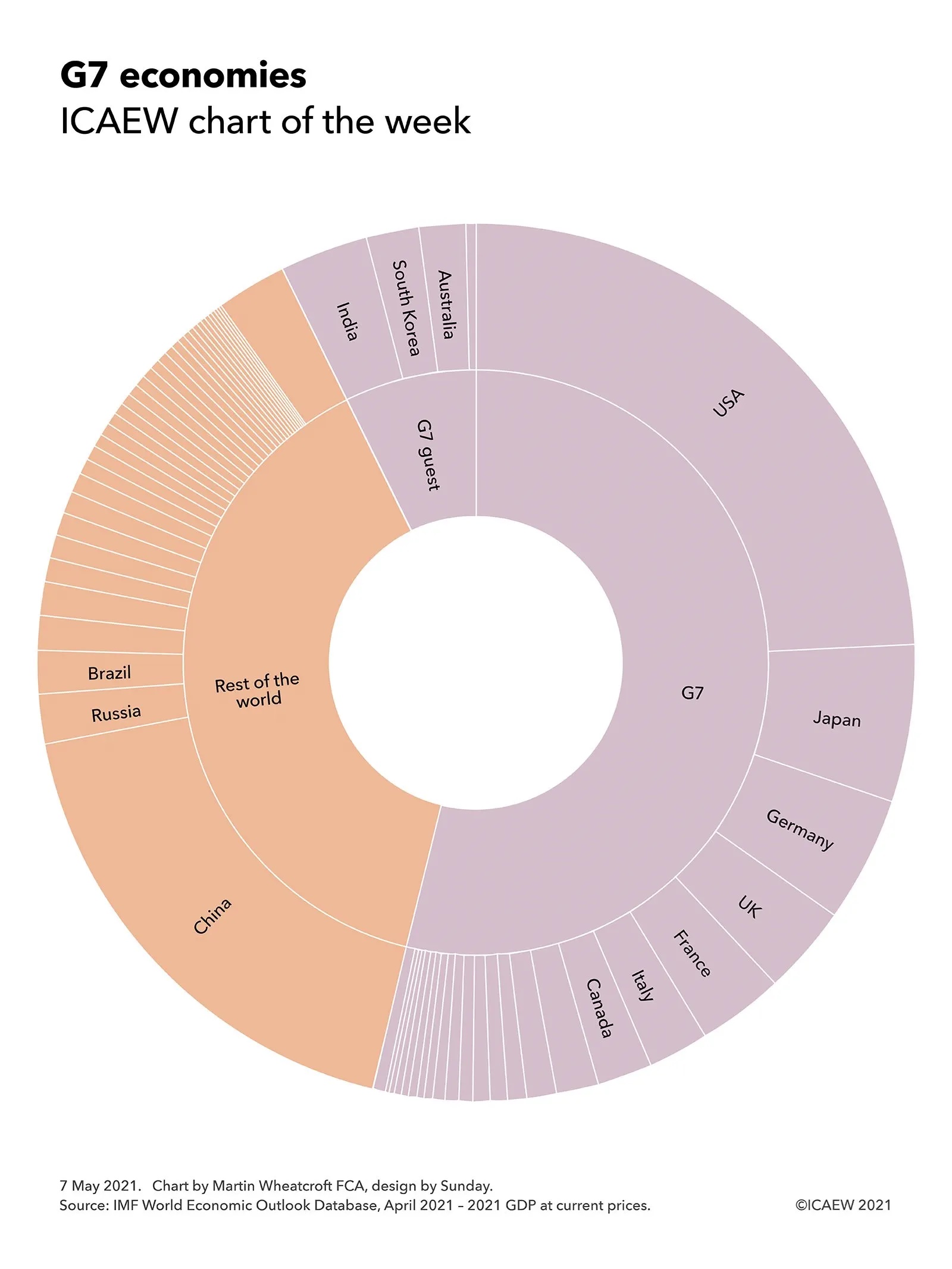
This week’s chart looks at how the pandemic has driven government debt levels higher, a topic that will be on the agenda at the G7 summit in Cornwall in six weeks’ time.

2019 General Government Net / GDP plus forecast change over 2020 and 2021:

Canada 23% + 14% = 37%
Germany 41% +11% = 52%
UK 75% + 22% = 97%
France 89% + 17% = 106%
USA 83% + 26% = 109%
Italy 122% + 22% = 144%
Japan 150% + 22% = 172%

The #icaewchartoftheweek is on the topic of government debt, looking at the indebtedness of the seven nations that comprise the G7 together with the EU. 

The strength (or otherwise) of public finances will underlie many of the discussions at the upcoming G7 summit in Cornwall in June as countries decide how best to deal with the coronavirus pandemic, achieving net-zero carbon and the COP26 goals, strengthening defence and security, and economic recovery. All of these are likely to require significant public investment at a time when public finances have been hit hard from a combination of the financial crisis just over a decade ago and the coronavirus pandemic over the past year.

Perhaps best-placed amongst the G7 are Canada and Germany, with stronger public balance sheets than their peers putting them in a better position to fund public investment. Canada’s general government net debt to GDP ratio (the net debts of the federal government, provincial governments and local authorities combined compared with Canadian GDP) is forecast to increase from 23% at 31 December 2019 to 37% at 31 December 2021, while Germany’s general government net debt to GDP ratio is forecast to increase from 41% to 52% over the same period.

The UK is next with its general government net debt up from 75% of GDP to a forecast 97% of GDP, followed by France with its net debt increasing from 89% in December 2019 to a forecast 106% of GDP for the end of 2021. The USA is expected to overtake France with its major stimulus packages seeing debt rise from 83% as a proportion of GDP to 109% by the end of this year. The biggest ratios within the G7 are Italy, which is expected to increase from 122% to 144%, while Japan is expected to rise from 150% to 172% of GDP.

Not shown on the chart are G7 guest nations this year: Australia (up from 26% to a forecast 49% of GDP) and South Korea (12% to 23%) are both in relatively strong public finance positions, while India (74% to 99%) is in a more challenging fiscal situation.

Despite the differences in debt levels, there will be a commonality amongst all the nations present in needing to find money to deal with increased pressure on public services and social security systems as populations age, for public investment in achieving net zero and in infrastructure more generally, to fund defence in an increasingly unstable global security environment and in economic stimulus to restart economies as they reopen, not to mention the need to replace tax income on fossil fuels as they are eliminated over the coming decades.

The signs are that tax reform will play a larger part in discussions than it may have done previously, with the USA’s suggestion for a minimum corporation tax indicative of a move to limit tax competition between nations and work more collaboratively to capture tax receipts from increasingly mobile global corporations and individuals.

Hence while many of the headlines from the G7 summit are likely to be focused on the heads of government talking about the global response to the coronavirus pandemic, the global security situation and global plans to deliver net zero, the side room containing finance ministers discussing global taxation and global public investment may be just as consequential. 

This chart was originally published by ICAEW.

March fiscal deficit hits £28bn as departments rush to spend capital budgets

The UK reported a £28.0bn fiscal deficit in March 2021, bringing the total shortfall for 2020-21 to £303.1bn. The last month of the financial year saw net investment of £10.3bn, up from a monthly average of £4.0bn over the previous eleven months.

The latest public sector finances released on Friday 23 April reported a deficit of £28.0bn for March 2021, as COVID-related spending continued to weigh on the public finances. This brought the cumulative deficit for the financial year to £303.1bn, £246.0bn more than the £57.1bn reported for the same period last year.

The combination of receipts down 5%, expenditure up 27% and net investment up 25% has resulted in a deficit for the twelve months to March 2021 that is more than five times as much as the budgeted deficit of £55bn for the whole of the 2020-21 financial year set in the Spring Budget in March, despite interest charges being lower by 25%.

The deficit is smaller than the £354.6bn forecast by the Office for Budget Responsibility (OBR) in March as the economy has been less damaged than was feared, despite the extended lockdown during the final quarter of the financial year. However, some of this difference relates to spending that has been deferred into the following financial year, while the provisional numbers also exclude £27bn of bad debts on COVID-related lending that were included in the OBR forecast.

Falls in VAT, corporation tax and income tax receipts and the waiver of business rates were the principal driver of lower tax revenues over the last twelve months, while large-scale fiscal interventions have resulted in much higher levels of expenditure. 

Net investment is greater than last year (mostly as planned), while the interest expense line has benefited from ultra-low interest rates. March 2021 saw a return to the traditional end-of-financial-year rush to get capital budgets spent, with net investment spending of £10.3bn in March contrasting with an average of £4.0bn over the previous eleven months.

Public sector net debt increased to £2,141.7bn or 97.7% of GDP, an increase of £344.0bn from the start of the financial year. This reflected £40.9bn of additional borrowing over and above the deficit, much of which has been used to fund coronavirus loans to businesses and tax deferral measures. Although net debt was reported as exceeding 100% of GDP at various points during the financial year, slightly improved GDP numbers have kept the ratio below that point.

The cash outflow (the ‘public sector net cash requirement’) for the month was £16.4bn, increasing the cumulative total cash outflow for 2020-21 to £339.0bn. This is a significant increase over the cumulative net cash outflow of £17.2bn reported for 2019-20.

Caution is needed with respect to the numbers published by the ONS, which are expected to be repeatedly revised as estimates are refined and gaps in the underlying data are filled.

The ONS made a number of revisions to prior month and prior year fiscal numbers to reflect revisions to estimates and changes in methodology. These had the effect of reducing the reported fiscal deficit in the first eleven months from £278.8bn to £275.1bn and the reported deficit for 2019-20 from £57.7bn to £57.1bn.

This article was originally published by ICAEW.

ICAEW chart of the week: personal tax bands

This week’s chart examines the complexity in the tax system and potential options for reform by looking at the number of tax bands for salaried employees across the UK.

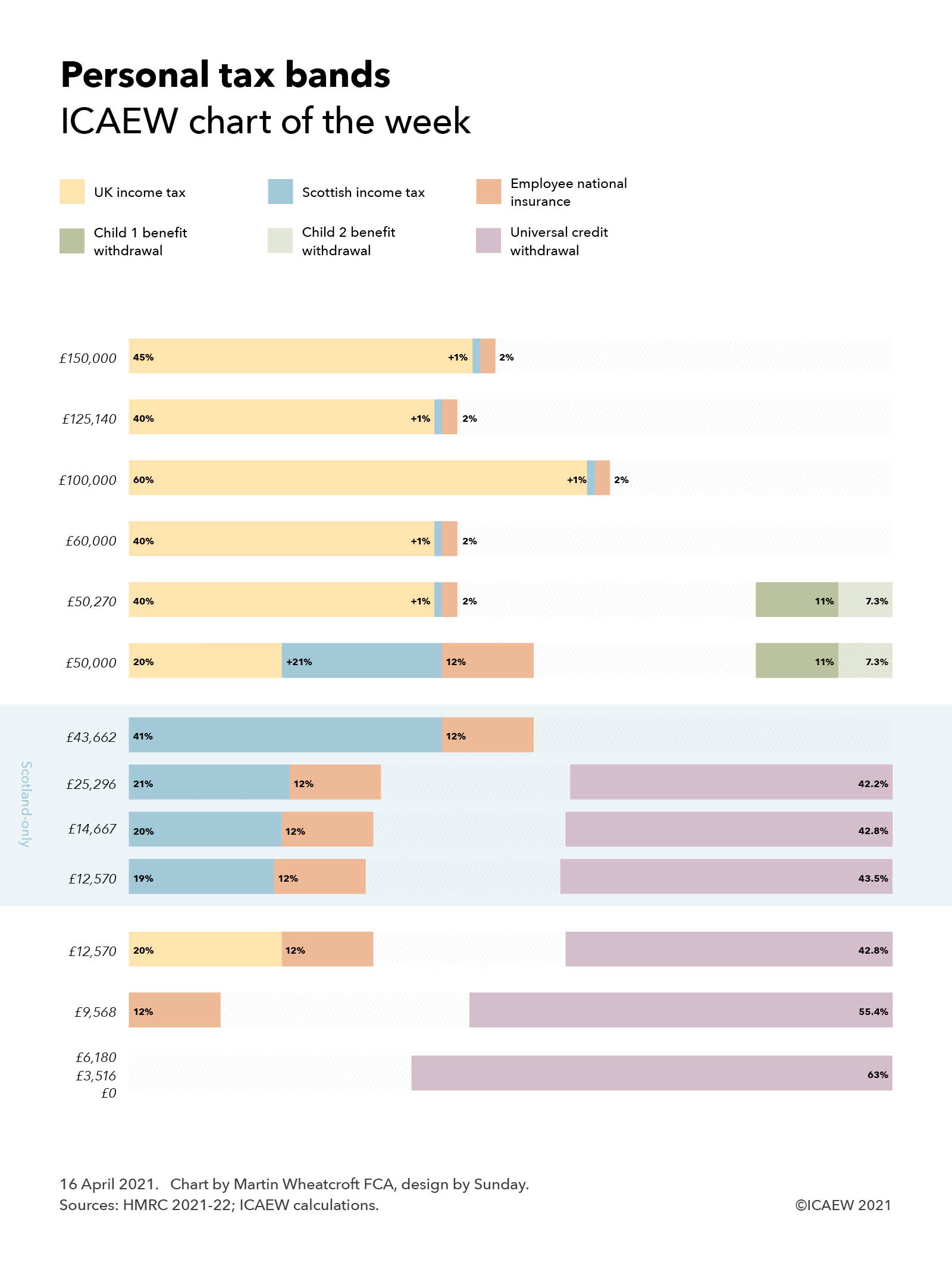
Chart showing personal tax bands from £150,000 (45% UK income tax +1% Scottish income tax + 2% Employee national insurance) down to £0.

See text for more details.

The new tax year saw the introduction of an additional tax band to the UK system of personal taxation, bringing the total number to nine tax bands in England, Wales and Northern Ireland and twelve in Scotland.

The #icaewchartoftheweek continues on the theme of complexity in the tax system and potential options for tax reform by looking at the number of tax bands for salaried employees, with up to nine tax bands in England, Wales and Northern Ireland and up to twelve in Scotland.

Although the advertised personal tax allowance of £12,570 a year suggests that individuals only start to pay tax above that point, in practice ‘taxation’ in its wider sense can start from as little as £0, which is when some of those claiming universal credit start to have their benefits withdrawn at a rate of 63p in the pound. The threshold is £0 for those without dependent children, £3,516 for those on housing benefit and with dependent children or limited capability to work, or £6,180 for those with dependent children or limited capability to work who are not on housing benefit. The rate of withdrawal is even higher for those receiving council tax benefit, with an additional 20% or more levied on incomes above a certain level until it is fully clawed back – the details vary by council.

Tax in its more formal sense starts at £9,568 when employee national insurance of 12% starts to be levied. Although ‘constitutionally’ different in how the money collected is used and its role in entitlement to the state pension, in substance it operates as an income tax in all but name.

Income tax itself starts to be levied on earnings above £12,570 at a basic rate of 20%, adding to national insurance to give a marginal tax rate of 32% for those not on universal credit and 74.8% for those who are.

For those in England, Wales and Northern Ireland this tax band goes from £12,570 up to £50,000 but in Scotland, there are intermediate tax bands, with a lower rate of income tax of 19% between £12,570 and £14,667, 20% between £14,667 and £25,926, 21% between £25,926 and £43,662, and 41% above £43,662 when the higher rate of Scottish income tax kicks in.

The new tax band this year arises because the government failed to increase the £50,000 threshold at which child benefit is withdrawn from the higher-earning parent to align with the increase in the higher rate tax threshold to £50,270. This means the insertion of a new tax band between £50,000 and £50,270 as the government starts to withdraw entitlement to ‘universal’ child benefit of £21.15 a week for the eldest child and £14.00 a week for remaining children by collecting an additional tax of 11% for the eldest child and 7.3% for the second and each of any subsequent children.

Above £50,270, the higher rate of income tax of 40% starts to be levied in England, Wales and Northern Ireland, but the marginal rate of national insurance reduces to 2% meaning that this is a 10% increase from 32% to 42% in the combined marginal rate – at least assuming you don’t have children! This rate also applies to those with children from £60,000 up until £100,000 when the marginal rate jumps to 62% (63% in Scotland) as the personal income tax allowance is gradually withdrawn. The marginal rate reverts to 42% (43%) from £125,140 before increasing to 47% (48%) for those on the 45% top rate of income tax above £150,000.

While devolution has led to some of the complexity, this probably hasn’t been helped by the perennial tendency of governments to find ever more complicated approaches to extract additional money from taxpayers without touching the headline rates of tax – for example through the ‘withdrawal’ of the personal tax allowance, which in substance operates as an additional 20% tax payable by those earning between £100,000 and £125,140.

The consequence of this tinkering with the tax systems means there are now nine different tax bands in England, Wales and Northern Ireland with marginal tax rates of 0%, 12%, 32%, 32% + 11% (or more) for higher-earning parents, 42% + 11% (or more) for higher-earning parents, 42%, 62%, 42% and 47%. In Scotland there are twelve: 0%, 12%, 31%, 32%, 33%, 53%, 53% + 11% (or more) for higher earning parents, 43% + 11% (or more) for higher earnings parents, 43%, 63%, 43% and 48%. 

Such a complex system invites the question of how it might be reformed, with the possibility of increasing the national insurance threshold to align with the income tax personal allowance being actively discussed in recent years to eliminate one of the bands. However, this now seems less likely than it once did since the pandemic caused such damage to the public finances. Other ideas have included aligning the 40% higher rate and 45% top rate of income tax (either up or down depending on political preference) or ‘folding’ in the personal tax allowance withdrawal into the tax system as part of the higher or top tax rates in conjunction with a reform to tax thresholds.

However, another option would be to add even more complexity, a real possibility now the Welsh government has obtained devolved powers to adjust its income tax rates and thresholds like Scotland, albeit powers that have thankfully not been used so far.

Either way, the nirvana that some tax reformers aspire to of a single flat rate of income tax applying to all earnings seems more remote than ever. One can but dream!

This chart was originally published by ICAEW.
ICAEW chart of the week: personal taxation by legal form

ICAEW’s chart this week compares the differences in the tax payable depending on legal form – an area ripe for reform in theory, but much more difficult in practice.

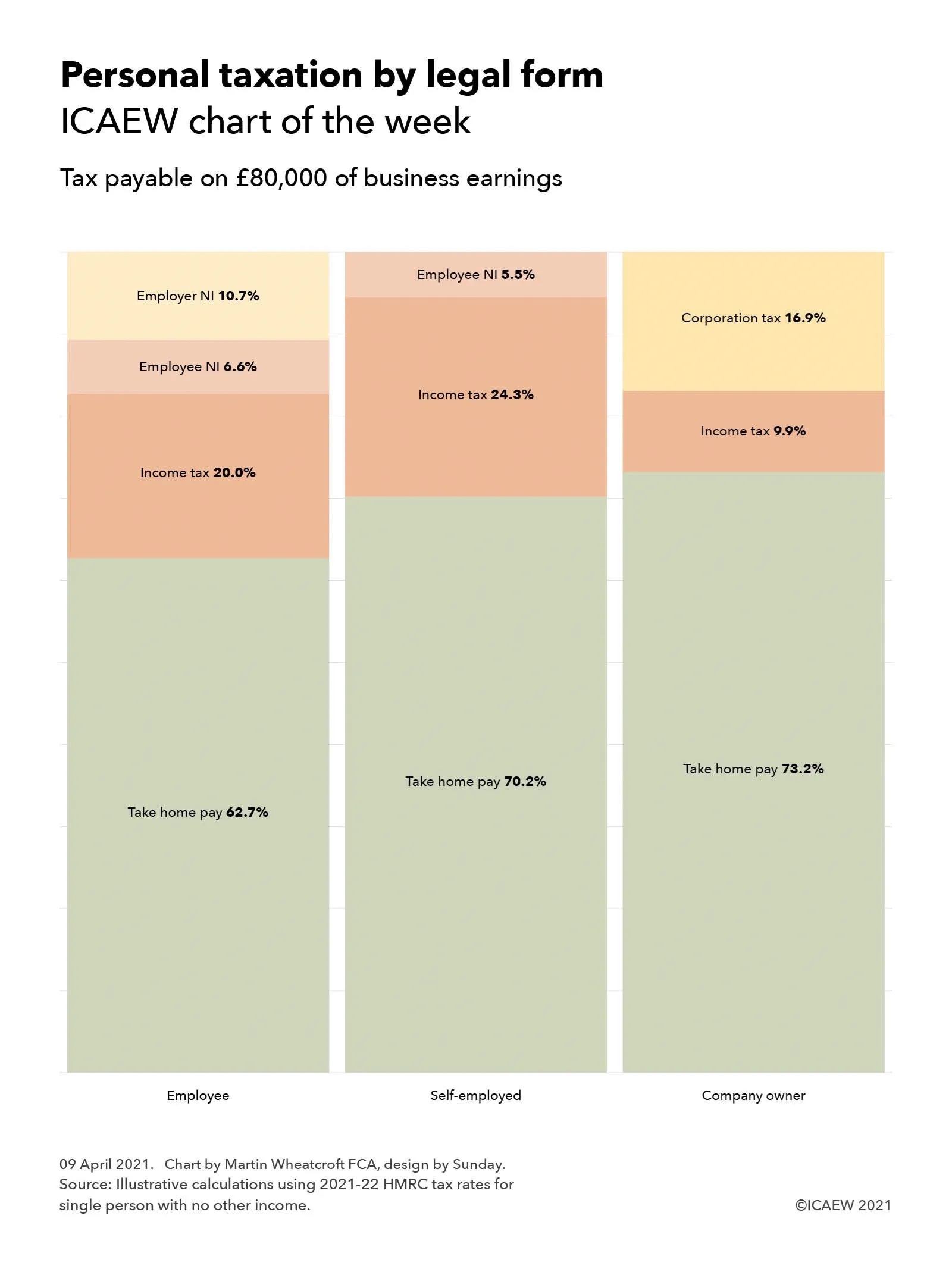
Chart showing tax payable on £80,000 of business earnings:

Employee - income tax: 20.0%, employee NI 6.6%, employer NI 10.7% - take home pay 62.7%.

Self-employed - income tax: 24.3%, employee NI 5.5% - take home pay 70.2%.

Company owner - income tax 9.9%, corporation tax 16.9% - take home pay 73.2%.

Comments by the Chancellor last year suggested he might tackle one of the thorniest challenges in the UK tax system – the differences in tax paid by individuals depending on the legal form through which they conduct their business activities. However, as the controversy over IR35 has demonstrated, a significant amount of political capital is likely to be needed if changes are to be made.

The #icaewchartoftheweek provides an illustrative example of just how significant the differences can be, with £80,000 in business earnings attracting an effective tax rate of 37.3% if paid to an employee on a salary of £71,460, 29.8% if paid to an individual who is self-employed or in a partnership, or 26.8% if earned through a company and distributed as dividends. 

(It is important to note that this is a theoretical illustrative example for a single person with no other earnings and not paying any pension contributions, with the company owner in the example paying a salary equivalent to the secondary threshold for national insurance before paying the rest as dividends. Actual amounts of tax paid will of course depend on both business and individual circumstances, which can vary significantly.)

The last decade or so has seen a significant increase in the numbers of people becoming self-employed or conducting business through their own companies, and the tax authorities have been concerned about the loss in tax that has followed. One way they have sought to tackle this is by removing the tax benefits of being self-employed or operating through a company from some people, which is the approach adopted by IR35. Coming into force this month, IR35 in effect creates a new legal status of ‘deemed employee’ for tax purposes, reclassifying individuals back into the scope of employment taxes. This has proved highly controversial, accompanied as it is by extensive compliance requirements and general unhappiness by those determined to be subject to it.

Another potential approach would be to change the taxes and tax rates applying to three different forms – either by reducing the taxes on employees or by increasing them on the self-employed or those operating through companies. The former seems unlikely given the state of the public finances, but the challenge in increasing rates can be extremely politically difficult, as former Chancellor Philip Hammond found a few years ago when he proposed a relatively modest increase in the amount of national insurance to be paid by the self-employed.

Whether current Chancellor of the Exchequer Rishi Sunak will take forward a suggestion he made last year when he announced the self-employed income support scheme last year that taxes on the self-employed might rise is yet to be seen. However, what is likely is that this and future Chancellors will continue to look at this particular aspect of the tax system and wonder how they might collect a little more from the ranks of the self-employed and company owners. 

This chart was originally published by ICAEW.
ICAEW chart of the week: Metropolitan France

This week’s chart examines how France inserted a layer of regional administration between the national government in Paris and the 96 departments in mainland France and Corsica.

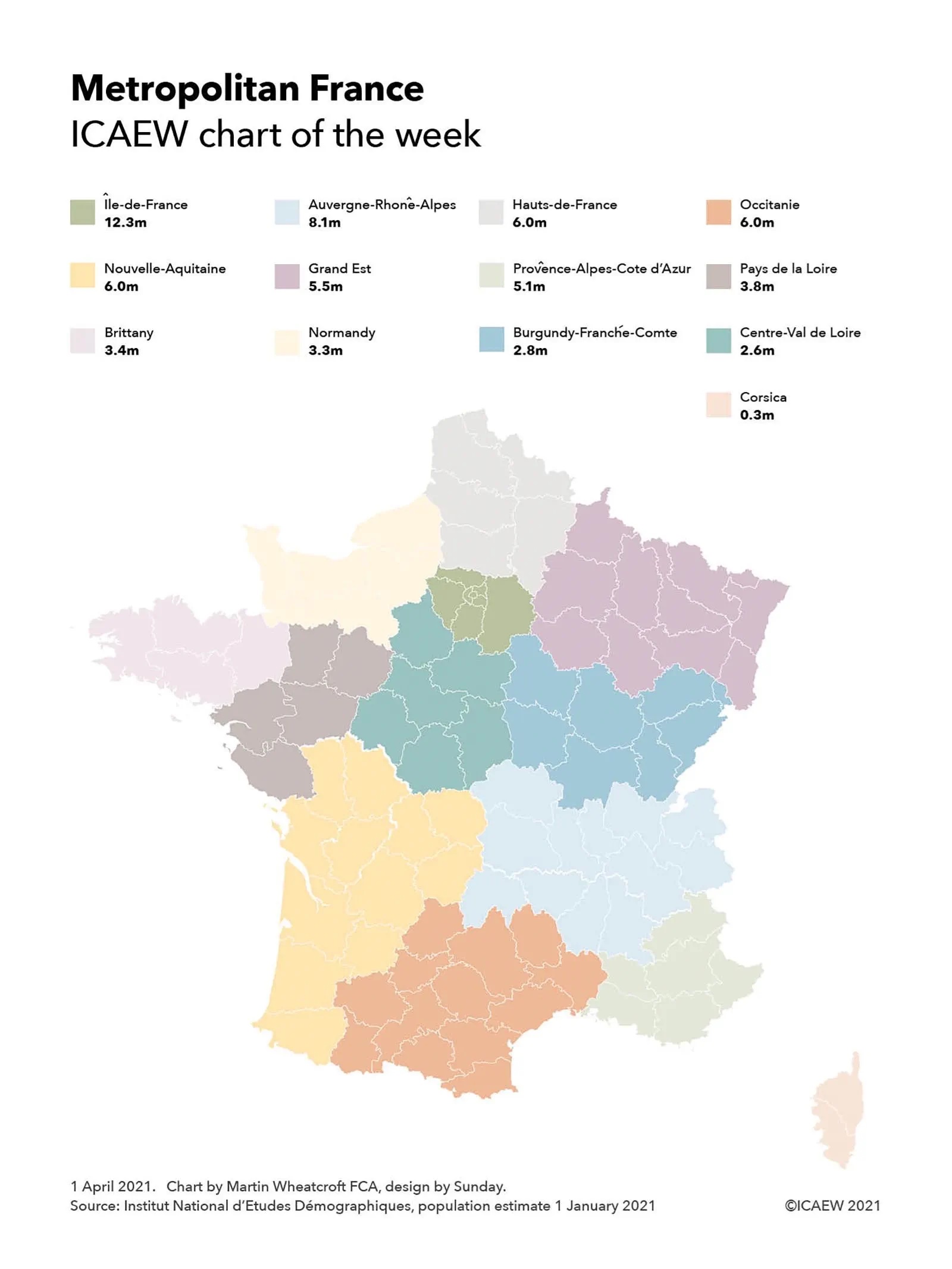
Map of Metropolitan France divided into 12 mainland regions and Corsica, subdivided into departments.

Île de France 12.3m people
Auverne-Rhône-Alps 8.1m
Hauts-de-France 6.0m
Occitanie 6.0m
Nouvelle-Aquitaine 6.0m
Grand Est 5.5
Provence-Alpes-Côte D'Azur 5.1m
Pays le la Loire 3.8m
Brittany 3.4m
Normandy 3.3m
Burgundy-Franché-Comte 2.8m
Centre-Val de Loire 2.6m
Corsica 0.3m

France’s regional tier of government was created in 1982 with 22 regions in Metropolitan France (ie mainland France and Corsica) and has generally seen to be a success. However, it was concluded that there were too many regions, resulting in a consolidation in 2015 into the current 13 regions, as illustrated by the #icaewchartoftheweek.  

The regions range in size from the 12.3m population eight-department Île de France that includes Paris, to the 2.6m six-department Centre – Val de Loire region in mainland France and the 0.3m two-department Corsica region. This excludes the five overseas one-department regions of Guadeloupe, French Guiana, Réunion, Martinique and Mayotte. 

Regional councils in mainland France and the assembly in Corsica can raise taxes and control substantial budgets, in particular over education and infrastructure investment, as well as having some regulatory powers (but not statutory law-making powers). Elections are on a proportional representation system, with regional presidents chosen by the elected councillors or assembly members.

The establishment of the regions has been part of a process of devolving power from the central government, moving away from the highly centralised control exercised since the French Revolution, which saw the establishment of departments, broadly equivalent to county councils in England. Although each of the 96 departments in Metropolitan France has an elected departmental council and president, many responsibilities for local administration (such as policing) still sit with departmental prefects and subprefects that are appointed by the central government. The lowest tier of local government comprises 36,552 communes, each with an elected council and mayor, with the exception of central Paris, Lyon and Marseille that are further divided into municipal arrondissements.

The comprehensive reforms adopted in France for regional government contrast with the patchwork approach in England, where regional authorities in the form of metropolitan councils were abolished in 1986, only to see a regional tier return in 2000 with the creation of the Greater London Authority. This has been followed over the last decade by the establishment of 10 regional combined authorities, comprising Greater Manchester (2011), Liverpool City Region (2014), Sheffield City Region (2014), North East (2014), West Yorkshire (2014), Tees Valley (2016), West Midlands (2016), West of England (2017), Cambridgeshire & Peterborough (2017) and North of Tyne (2018).

The stop-start approach in England has involved a process of negotiation between central and local government on whether to establish regional combined authorities in particular areas, with a number of proposals across the country under consideration. However, even if they are approved, this will still leave many parts of the country without a regional tier of government. The elections in May in England will therefore see elections for regional authorities only in some areas (including the first-ever elected mayor of West Yorkshire), for between one and three different tiers of local government, and for police & crime commissioners outside of Greater London and Greater Manchester. A rather complex picture!

Back in France, the regional elections scheduled for March have had to be postponed. Instead, a new set of regional administrations across the entirety of Metropolitan France are expected to be elected in June 2021.

This chart was originally published by ICAEW.
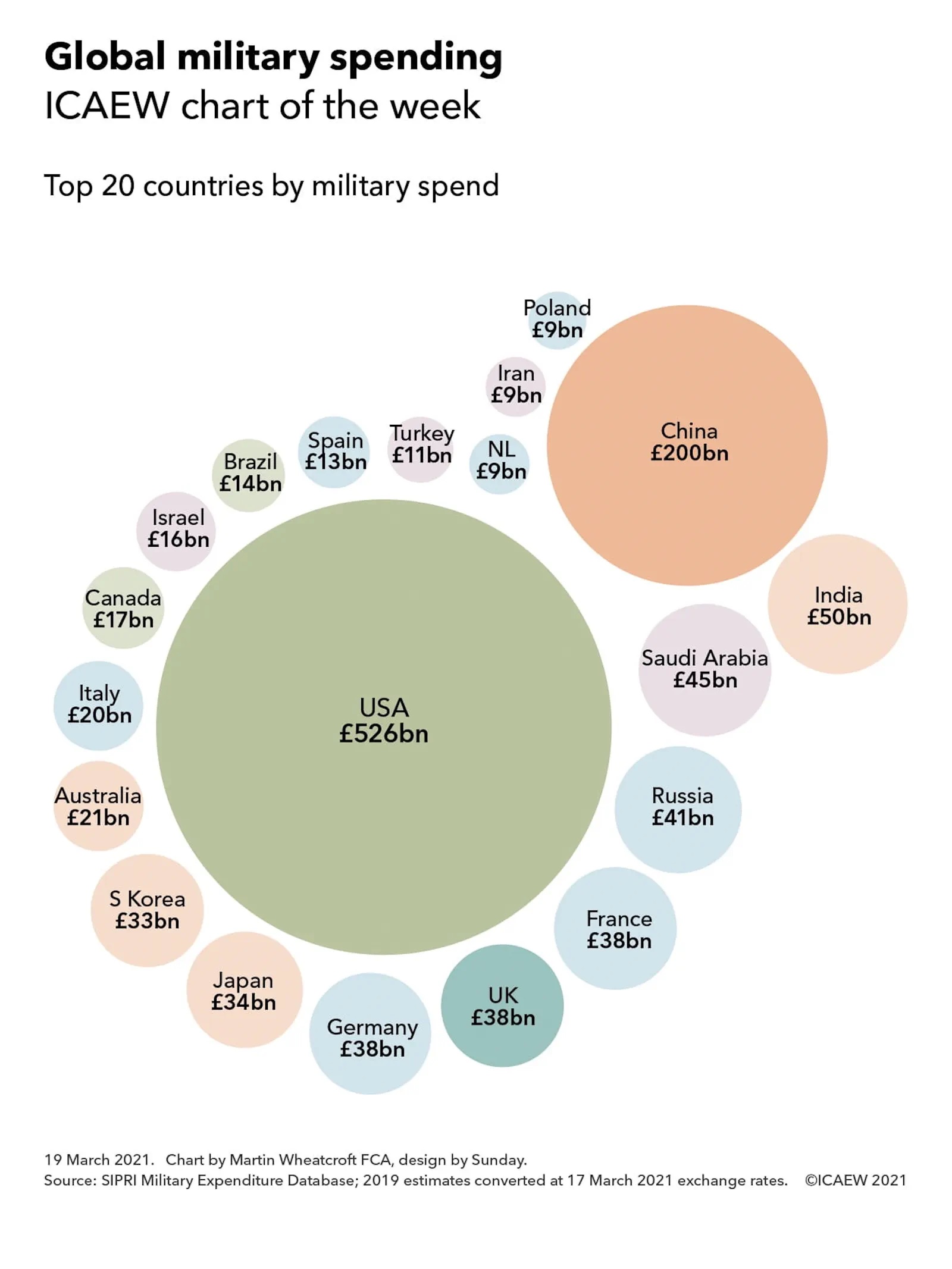
ICAEW chart of the week: global military spending

19 March 2021: The UK’s Integrated Review is the inspiration for this week’s chart, illustrating the 20 countries around the world that spend the most on their militaries.

Chart showing global military spending in 2019 led by USA (£526bn) and China (£200bn) followed by 18 other countries - see text below the chart for details.

The UK Government launched its Integrated Review of Security, Defence, Development and Foreign Policy on 16 March 2021, setting out a vision for the UK’s place in the world following its departure from the European Union and in the context of increasing international tensions and emerging security threats.

At the core of the Integrated Review is security and defence, and ICAEW’s chart of the week illustrates one aspect of that by looking at military spending around the world. 

The chart shows spending by the top 20 countries, which together comprise in the order of £1.2tn of estimated total military spending of around £1.4tn to £1.5tn globally in 2019 – an almost textbook example of the 80:20 rule in action.

More than a third of the total spend is incurred by just one country – the USA – which spent in the order of £526bn in 2019 converted at current exchange rates. The next biggest were China and India at £200bn and £50bn respectively, although differences in purchasing power mean that they can afford many more soldiers, sailors and aircrew for the same amount of money. This is followed by Saudi Arabia (£45bn), Russia (£41bn), France (£38bn), the UK (£38bn), Germany (£38bn), Japan (£34bn), South Korea (£33bn), Australia (£21bn), Italy (£20bn), Canada (£17bn), Israel (£16bn), Brazil (£14bn), Spain (£13bn), Turkey (£11bn), the Netherlands (£9bn), Iran (£9bn) and Poland (£9bn).

Exchange rates affect the relative orders of many countries in the list, for example between Russia, France, the UK and Germany which can move up or down according to movements in their currencies, while there are a number of caveats over the estimates used given the different structures of armed forces around the world and a lack of transparency in what is included or excluded in defence budgets in many cases.

In addition, the use of in-year military spending does not necessarily translate directly into military strength. Military capabilities built up over many years or in some cases (such as the UK) over many centuries need to be taken into account, as do differing levels of technological development and spending on intelligence services, counter-terrorism and other aspects of security. Despite these various caveats, estimated military spending still provides a useful proxy in understanding the global security landscape and in particular highlights the UK’s position as a major second-tier military power – in the top 10 countries around the world.

Global Britain in a Competitive Age: the Integrated Review of Security, Defence, Development and Foreign Policy sets out some ambitious objectives for security and defence, which it summarises as follows: “Our diplomatic service, armed forces and security and intelligence agencies will be the most innovative and effective for their size in the world, able to keep our citizens safe at home and support our allies and partners globally. They will be characterised by agility, speed of action and digital integration – with a greater emphasis on engaging, training and assisting others. We will remain a nuclear-armed power with global reach and integrated military capabilities across all five operational domains. We will have a dynamic space programme and will be one of the world’s leading democratic cyber powers. Our diplomacy will be underwritten by the credibility of our deterrent and our ability to project power.”

The estimates of military spending used in the chart were taken from the Stockholm International Peace Research Institute (SIPRI)’s Military Expenditure Database, updated to current exchange rates.

This chart was originally published by ICAEW.
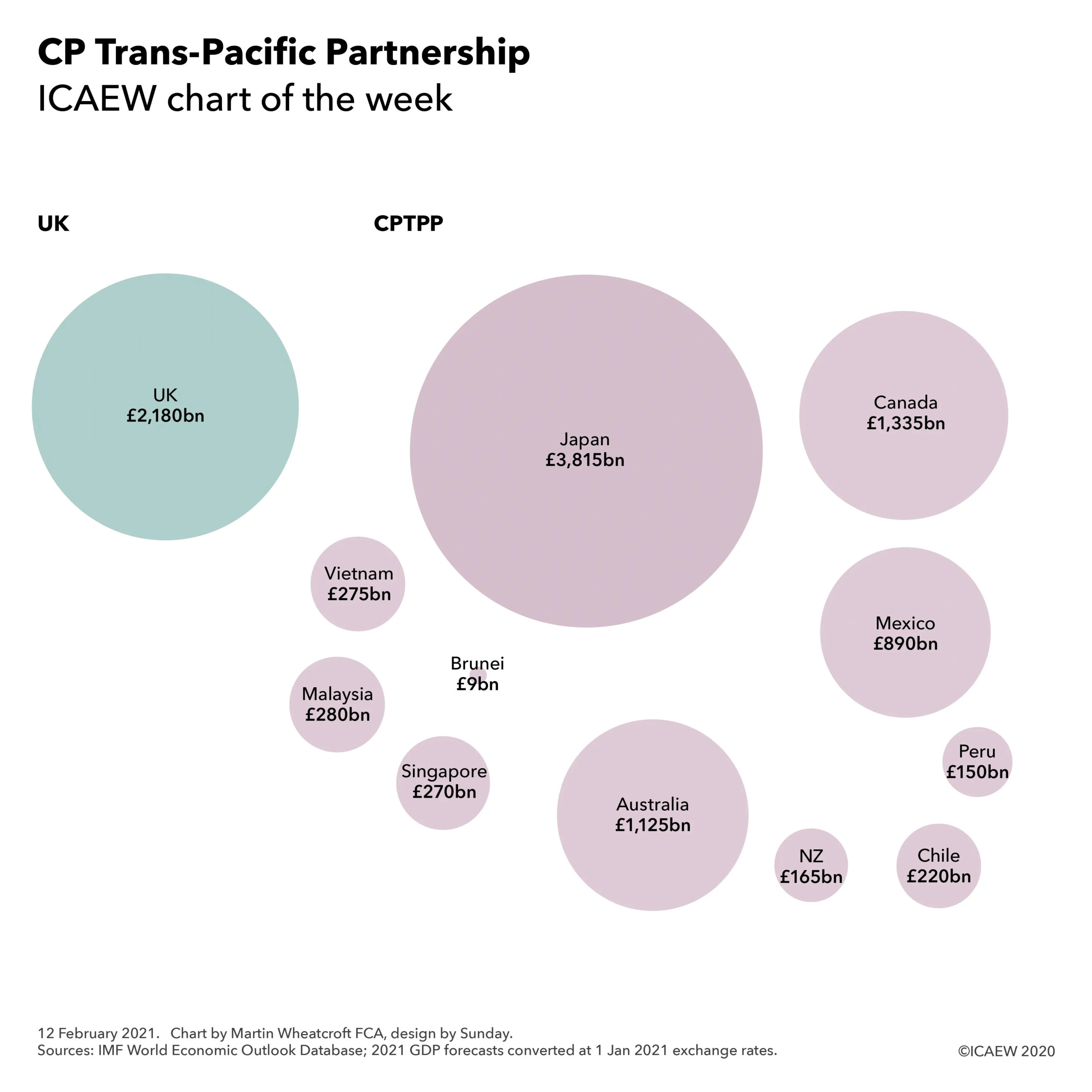
ICAEW chart of the week: CP Trans-Pacific Partnership

12 February 2021: The UK wrote to New Zealand at the start of this month formally requesting permission to apply for membership of the Comprehensive and Progressive Trans-Pacific Partnership. What is the CPTPP and what opportunities would joining provide to the UK?

The #icaewchartoftheweek is on the UK’s application to join the Comprehensive and Progressive Trans-Pacific Partnership (CPTPP), a group of eleven countries on the other side of the world. This trade organisation was established to improve trade links between countries surrounding the Pacific, reducing trade barriers between the countries involved and aligning regulations in areas such as intellectual property. 

It is sometimes described as the third largest free-trade area in the world, after the US-Mexico-Canada Free Trade Agreement (USMCA, formerly NAFTA) and the EU-EEA-Switzerland Common Market, but it is important to understand that it is much less integrated than a customs union (with shared tariffs), a common market (with fuller regulatory alignment) or an economic union (such as the highly integrated EU Single Market with unified standards and regulations). 

According to IMF forecasts for 2021, Japan is the largest economy in the CPTPP with GDP of £3,815bn, while Brunei is the smallest with GDP of £9bn. The other members are Canada (£1,335bn), Australia (£1,125bn), Mexico (£890bn), Malaysia (£280bn), Vietnam (£275bn), Singapore (£270bn), Chile (£220bn), New Zealand (£165bn) and Peru (£150bn). This compares with a forecast of £2,180bn for UK GDP in 2021.

Membership is not exclusive, with CPTPP members involved in a number of other multilateral free trade agreements. Canada and Mexico are also members of USMCA. Malaysia, Singapore, Vietnam and Brunei are members of the 10-nation Association of South East Asian Nations (ASEAN), which in turn has free trade agreements with Japan, Australia and New Zealand, China, India and South Korea. Mexico, Peru and Chile are members of the four-nation Pacific Alliance with Columbia. In addition, China is leading the formation of the Regional Comprehensive Economic Partnership which includes all of the non-Americas members of the CPTPP in addition to China, South Korea and the other members of ASEAN.

The CPTPP replaced the original proposal for a Trans-Pacific Partnership (TPP) that would have included the US, but the remaining nations decided that it was still worthwhile pursuing a revised trade arrangement even after the US withdrew its application four years ago. A new administration could see the USA change its mind and seek to join the CPTPP after all.

Why does the UK want to join a trade pact on the other side of the world? The immediate trade benefits are likely to be relatively modest given the distances involved and which are likely to be secured through bilateral trade agreements already under discussion.

One reason is likely to be geo-political, as membership would strengthen relationships with allies in the Pacific, advancing the UK Government’s ‘global Britain’ agenda. There may also be an advantage in being directly involved in the development of international trade policy in the Pacific region which contains the two largest individual economies in the world (the US and China), potentially influencing trade policy across the planet.

Of course, part of the motivation might be less about trade in the Pacific and more about trade across the Atlantic. After all, if the US were to join the CPTPP, the UK’s membership might provide a base from which to eventually develop a more comprehensive bilateral free trade agreement. This could fulfil a key strategic objective of improving trade ties with the USA by going around the world, albeit in a lot more than 80 days!

This chart was originally published by ICAEW.

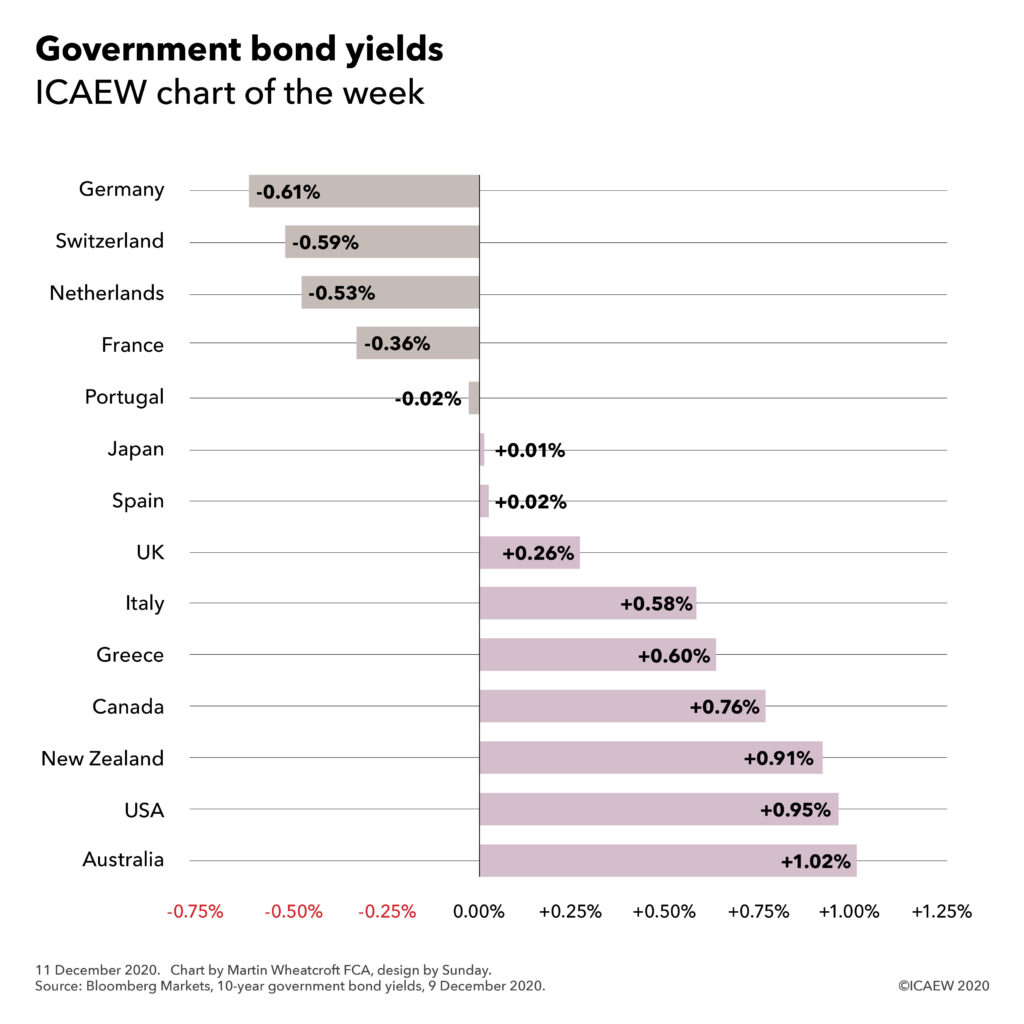
ICAEW chart of the week: Government bond yields

11 December 2020: Ultra-low or negative yields provide governments with an opportunity to borrow extremely cheaply, but what will happen if and when interest rates rise?

Government 10-year bond yields

Germany -0.61%, Switzerland -0.59%, Netherlands -0.53%, France -0.36%, Portugal -0.02%, Japan +0.01%, Spain +0.02%, UK +0.26%, Italy +0.58%, Greece +0.60%, Canada +0.76%, New Zealand +0.91%, USA +0.95%, Australia +1.02%

On 9 December, the benchmark ten-year government bond yield for major western economies ranged from -0.61% for investors in German Bunds through to 0.95% for US Treasury Bonds and 1.02% for Australia Government Bonds, as illustrated in the #icaewchartoftheweek.

One of the more astonishing developments of the last decade or so has been the arrival of an era of ultra-low or negative interest rates, even as governments have borrowed massive sums of money to finance their activities. This is not only a consequence of weak economic conditions and the slowing of productivity-led growth, but it has also been driven by the monetary policy actions of central banks through quantitative easing operations that have driven down yields by buying long-term fixed interest rate government bonds in exchange for short-term variable rate central bank deposits.

For bond investors this has been a wild ride, with the value of existing bonds sky-rocketing as central banks have come calling to buy a proportion of their holdings, crystallising their gains. The downside is the extremely low yields available to debt investors on fresh purchases of government bonds, which in some cases involve paying governments for the privilege of doing so.

Yields vary according to maturity, with yields on UK gilts ranging from -0.08% on two-year gilts through to 0.26% for 10-year gilts (as shown in the chart) up to 0.81% on 30-year gilts. In practice, the UK issues debt with an average maturity between 15 and 20 years, so the current average cost of its financing is higher than that shown in the chart at between 0.48% and 0.77% being the yields on 15-year and 20-year gilts respectively. This has the benefit of locking in low interest rates for longer, in contrast with most of the other countries shown that tend to issue debt with an average maturity of less than ten years.

Quantitative easing complicates the picture, as by repurchasing a significant proportion of government debt and swapping it for central bank deposits, central banks have reversed the security of fixed interest rates locked in to maturity with a variable rate exposure that will hit the interest line immediately if rates change. 

In theory, this should not be a problem, as higher interest rates are most likely to accompany stronger economic growth and hence higher tax revenues with which to pay the resultant higher debt interest bills, but in practice treasury ministers are not so sanguine. In leveraging public balance sheets to finance their responses to COVID-19 – on top of the legacy of debt from the financial crisis – governments have significantly increased their exposure to movements in interest rates, just as other fiscal challenges are growing more pressing.

Expect to hear a lot more over the coming decade about the resilience of public finances as governments seek to reduce gearing and reduce their vulnerability to the next unexpected crisis, whenever that may occur.

This chart was originally published on the ICAEW website.

Cancelled Budget must not be allowed to delay infrastructure plans

29 September 2020: Recently published figures show that the Government burnt through £224bn in the five months to August 2020. This should not stand in the way of an investment-led economic recovery, according to ICAEW’s Public Sector team.

The latest public sector finances for August 2020 published by the Office for National Statistics (ONS) on Friday 25 September 2020 reported a deficit of £35.9bn in August 2020, a cumulative total of £173.7bn for the first five months of the financial year.

Falls in VAT, corporation tax and income tax drove lower receipts, while large-scale fiscal interventions resulted in much higher levels of expenditure. Net investment is greater than last year, as planned, while the interest line has benefited from ultra-low interest rates.

Public sector net debt increased to £2,023.9bn or 101.9% of GDP, an increase of £223.4bn from the start of the financial year and £249.5bn higher than in August 2019. This reflects £49.7bn of additional borrowing over and above the deficit, most of which has been used to fund coronavirus loans to business and tax deferral measures.

Image of table showing public sector finances for month of August and for 5 months to August 2020, together with variances against last year. Click on the link at the end of the article for a readable version.

The combination of receipts down 12%, expenditure up 35% and net investment up 40% has resulted in a deficit for the five months to August 2020 that is more than three times the budgeted deficit of £55bn for the whole of the 2020-21 financial year set in the Spring Budget in March, despite interest charges being lower by 34%. The cumulative deficit is more than six times as much as for the same five-month period last year.

Cash funding (the ‘public sector net cash requirement’) for the five months was £224.0bn, compared with £5.8bn for the same period in 2019.

Interest costs have fallen despite much higher levels of debt, with extremely low interest rates benefiting both new borrowing to fund government cash requirements and borrowing to refinance existing debts as they have been repaid.

Some caution is needed with respect to the numbers published by the ONS, which are expected to be repeatedly revised as estimates are refined and gaps in the underlying data are filled. In particular, the OBR points out that the ONS has yet to record any allowance for losses that might arise on the more than £100bn of tax deferrals, loans and guarantees provided to support businesses through the pandemic. 

Alison Ring FCA, director for public sector at ICAEW, commented: “The government continued to haemorrhage cash in August, despite furloughed employees returning to work and the warm weather encouraging people to spend money outside their homes. The Chancellor’s Eat Out to Help Out subsidy may have hit the headlines, but at £522m it was only a fraction of the total spending in the year to date of £470.5bn. Large sums were also spent on Test & Trace and PPE, as well on fiscal interventions such as the coronavirus job retention scheme.

While the decision to postpone the Budget until the Spring is understandable given the economic uncertainties as we enter the next phase of the pandemic, we hope that this will not mean further delays for the National Infrastructure Strategy and the green-lighting of infrastructure projects across the country, which will be vital for an investment-led economic recovery.”

Image of table showing public sector finances for each month to August 2020 and to August 2019. 

Click on the link at the end of the article for a readable version.

The ONS made several revisions to prior month and prior year fiscal numbers to reflect revisions to estimates and changes in methodology and classification. These had the effect of reducing the reported fiscal deficit in 2019/20 from £59.7bn to £55.8bn and in 2018/19 from £41.0bn to £38.8bn. There was a reduction of £12.7bn in the estimated deficit in the first four months of the current financial year from that reported last month primarily because of overestimating central government procurement in those months.

This article was originally published by ICAEW.