ICAEW chart of the week: UK government major projects portfolio

Our chart this week is based on the Institute for Government’s recently published Whitehall Monitor 2022, illustrating how the government has already started on many of the major projects that form part of the Levelling Up White Paper.

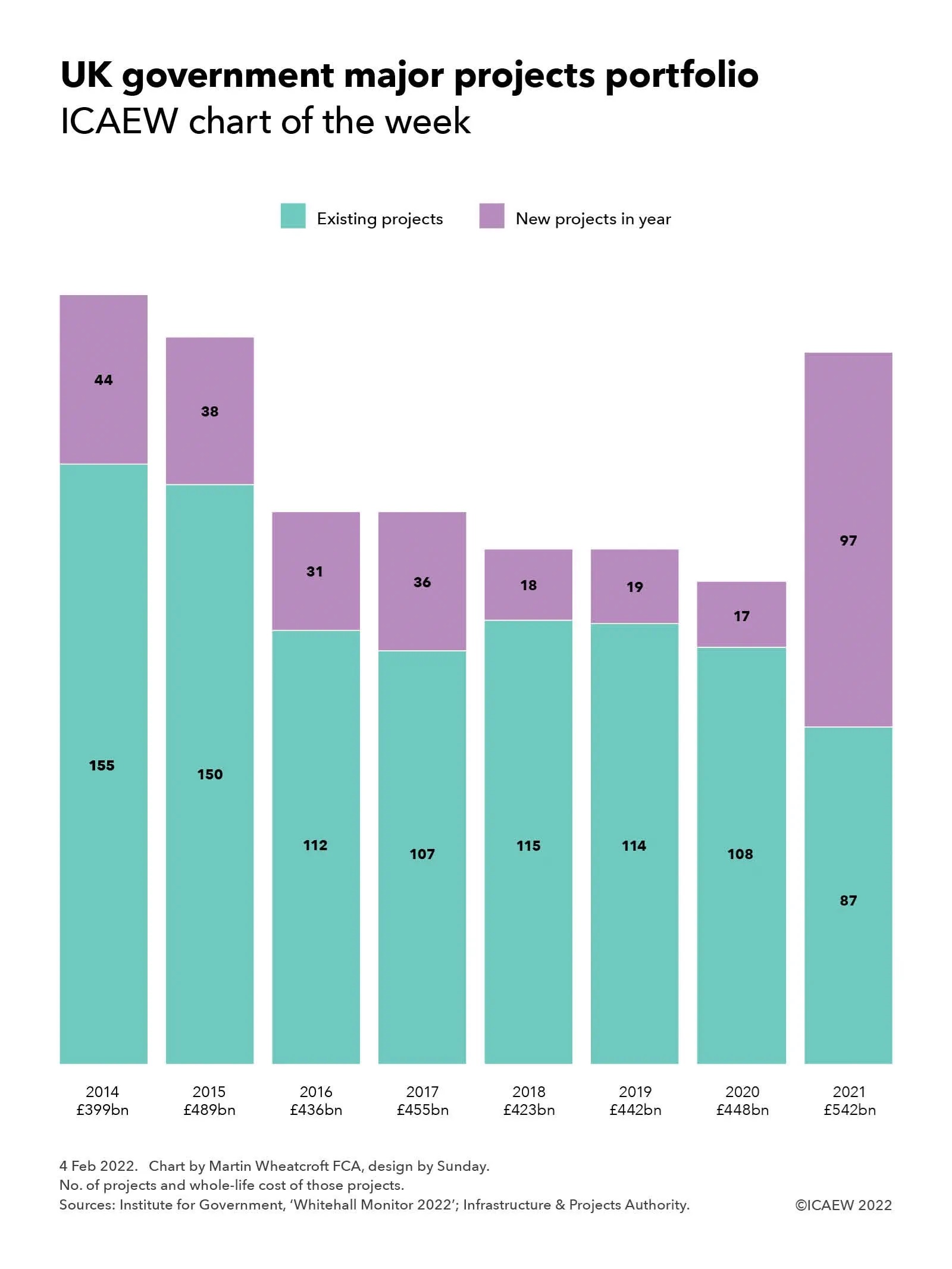
Column chart showing numbers of major projects together with the whole-life cost of those projects

2014: 158 existing projects + 44 new projects (£399bn)
2015: 150 existing + 38 new (£489bn)
2016: 112 existing + 21 new (£436bn)
2017: 107 existing + 36 new (£455bn)
2018: 115 existing + 18 new (£423bn)
2019: 114 existing + 19 new (£442bn)
2020: 108 existing + 17 new (£448bn)
2021: 87 existing + 97 new (£542bn)

On 31 January 2022, the Institute for Government (IfG) published its latest annual Whitehall Monitor, an authoritative compendium of analysis about the functions and effectiveness of central government that makes for compelling reading and contains some great charts to bring to life what would otherwise be pretty dry content.

Our chart this week draws on a couple of the IfG’s charts from pages 60 and 61 in the 2022 edition that take a look at the activities of the Infrastructure and Projects Authority (IPA). One of the IPA’s key roles is to support central government departments with their most expensive and complex projects. As the chart highlights, there was a sizeable jump in 2021 with 97 new projects added to the 87 existing projects brought forward from previous years, bringing the estimated whole-life cost of the projects being supported by the IPA to £542bn, up from £448bn in 2020.

According to the IfG, the major projects portfolio includes infrastructure developments such as the creation of a Midlands Rail Hub, large-scale programmes to improve public services such as the recruitment of 20,000 police officers by 2023, and military projects such as building a new medium-lift helicopter. This is the largest number of new items added to the portfolio in a single year since the publication of the IPA’s first annual report in 2013, with many of the projects now branded as part of the Levelling Up agenda. For comparison, fewer than 20 projects were added to the portfolio each year between 2018 and 2020. The government is currently managing 184 major projects – about 1.5 times as many as it did the year before and the portfolio is now at its largest size since 2015.

From a conventional perspective it may seem strange that the government started many of the projects in its just published Levelling Up White Paper as much as a year before setting out the plan that they form part of, but in practice the main components, such as new investment in transport infrastructure outside London and the South East, have been known for some time – as has the additional capital expenditure funding that has been provided to departmental budgets. What is new is the insight into the metrics that the government intends to use to assess the effectiveness of its levelling up plans by 2030, with 12 key objectives to be achieved.

However, as discussed in ICAEW’s Autumn Budget and Spring Budget coverage last year, much tighter budget settlements for day-to-day spending mean that departments could struggle to deliver major projects successfully given all the other pressures they are under as well as rapidly rising input costs, with the IfG commenting that: “Ministers should be careful to maintain enough administrative resources in their departments to help officials undertake these projects well, on time and to budget.”

The chart illustrates how following the IPA’s inception in 2013, there were 155 existing projects carried forward into 2014 and 44 new projects that year, a total of 199 with a whole-life cost of £399bn. This was followed by 188 projects in 2015 (150 existing and 38 new) of £489bn, 143 in 2016 (112 + 31) of £436bn, 143 in 2017 (107 + 36) of £455bn, 133 in 2018 (115 + 18) of £423bn, 133 in 2019 (114 + 19) of £442bn, 125 in 2022 (108 + 17) of £448bn and 184 projects in 2021 (87 existing + 97 new) with a whole-life cost of £542bn.

The IfG says: “Major reform is needed for government to respond to crises like the pandemic while simultaneously delivering long-term policy goals. Whitehall Monitor 2022 reveals how the government has been handling the Covid crisis while at the same time trying to make progress on priorities such as levelling up and hitting net zero. New employment support schemes and the vaccination programme were delivered rapidly, but progress on pre-pandemic priorities was limited.”

The report also warns that without fundamental reform – such as clarifying ministerial and civil service accountability, better data, improving transparency and ensuring a targeted workforce plan underpins its goal of up to 55,000 civil service job cuts by 2025 – government will continue being knocked off course when faced with shocks to the system. The IfG concludes that whatever happens as a result of the prime minister’s current troubles, with a looming cost-of-living crisis, ongoing COVID-19 challenges, and crunch Brexit deadlines and decisions ahead, 2022 will bring further strain.

The Levelling Up White Paper sets out some big aspirations, but the jury is still out as to whether they can be delivered.

This chart was originally published by ICAEW.

ICAEW chart of the week: UK quarterly public finances

Our chart this week looks at the fiscal forecast for the final quarter of the government’s financial year ending in March 2022.

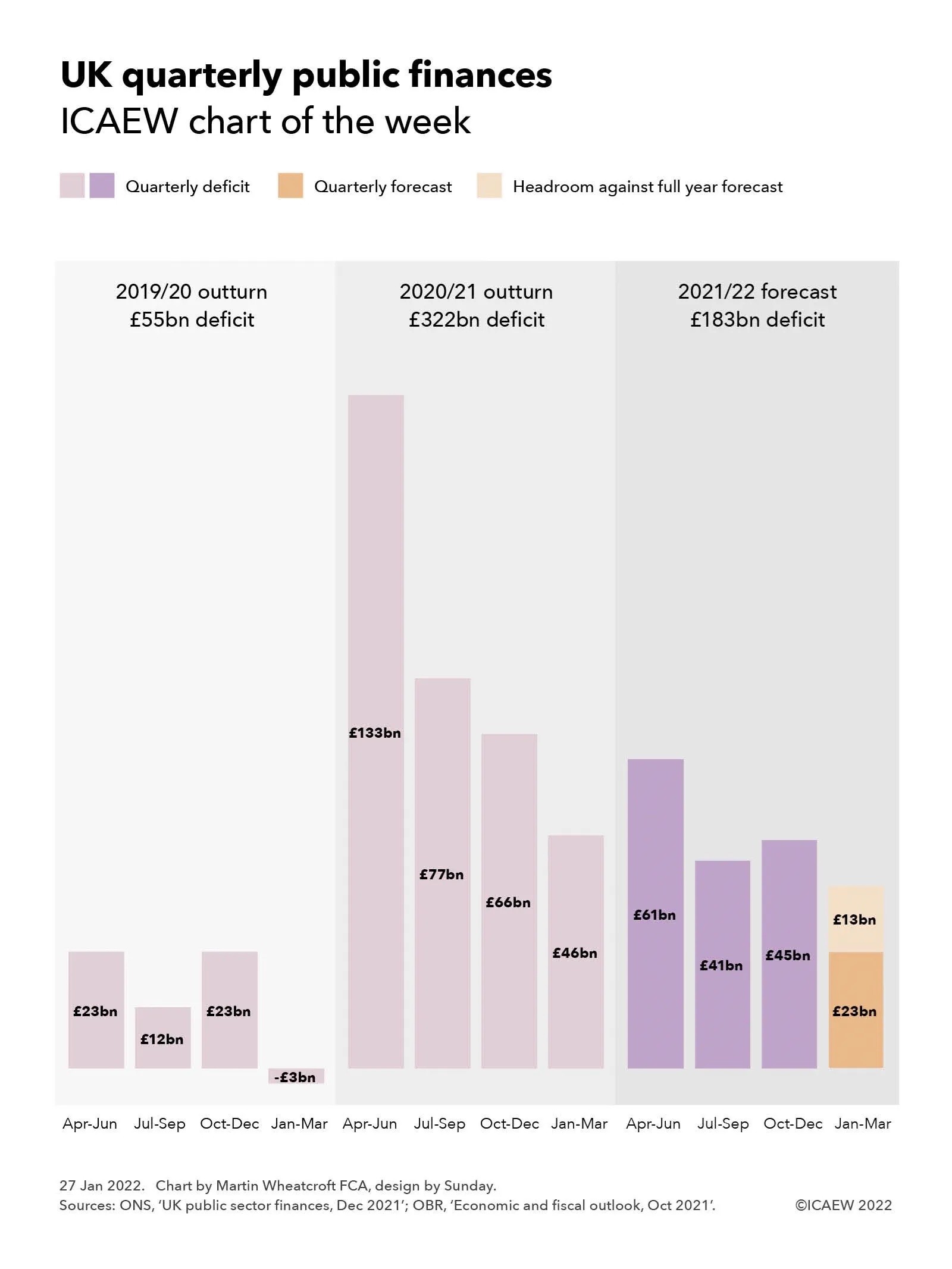
Column chart showing quarterly deficits:

2019/20 outturn £55bn deficit: Apr-Jun £23bn, Jul-Sep £12bn, Oct-Dec £23bn, Jan-Mar -£3bn

2020/21 outturn £322bn deficit: Apr-Jun £133bn, Jul-Sep £77bn, Oct-Dec £66bn, Jan-Mar £46bn

2021/22 forecast £183bn deficit: Apr-Jun £61bn, Jul-Sep £41bn, Oct-Dec £45bn, Jan-Mar £23bn, with £13bn headroom

The December 2021 public sector finances published by the Office for National Statistics (ONS) on Tuesday 25 January provided numbers for the first three quarters of the current financial year. As our chart this week illustrates, this leaves the final quarter still to go, with £13bn of headroom against the official forecast prepared by the Office for Budget Responsibility (OBR) at the time of the Autumn Budget and Spending Review 2021 back in October.

To put the current fiscal year into context, our chart shows how the deficit of £55bn in 2019/20 comprised quarterly deficits of £23bn for April to June 2019, £12bn for July to September 2019 and £23bn for October to December 2019 less a surplus of £3bn for January to March 2020. Although there was some impact from the pandemic on the last month of that financial year, it broadly provides an indication of a ‘normal’ pattern of deficits across the year, with the second quarter and more especially the fourth quarter benefiting from self assessment tax receipts – the latter despite typically higher levels of capital expenditure in the run up to the end of the financial year.

This was followed by the first full year of the pandemic and associated lockdowns which saw tax receipts fall significantly and expenditures rise dramatically, resulting in an unprecedented peacetime deficit of £322bn in 2020/21, comprising £133bn, £77bn, £66bn and £46bn for the four quarters respectively.

The current forecast is also on course for a pretty eye-watering deficit, which despite being substantially below that seen last year is forecast to be as much as £183bn. The provisional numbers for the first three quarters of 2021/22 of £61bn, £41bn and £45bn respectively are currently £13bn below the October forecast, implying an equivalent amount of headroom for the final quarter, assuming the OBR’s forecast deficit of £23bn for the fourth quarter proves to be accurate.

In practice, it would be surprising if the fourth quarter did come in on target other than by coincidence. Better than expected tax revenues are expected to continue to reduce the deficit over the final quarter but this is likely to be offset to a greater or lesser extent by higher interest costs on index-linked debt driven by rising inflation. There are also significant uncertainties around expenditures given the continuation of pandemic restrictions into January and the potential for further interventions to support businesses and individuals struggling financially as a consequence.

There have been suggestions that this headroom of £13bn is a ‘windfall’ that the Chancellor should use to support households expected to be hit by a greater than 50% rise in energy prices from April 2022 as discussed in last week’s chart of the week.

However, this perspective has also been contradicted by Carl Emmerson, Deputy Director at the Institute for Fiscal Studies (IFS), who is reported to have commented: “While borrowing last month was in line with the Budget forecast, over the first nine months of 2021/22 it is now £13bn below that forecast for the same period in the October Budget – £147bn instead of the £160bn expected in October. The latest improvement to borrowing over this period has been driven by higher-than-expected corporation tax being paid by some very large companies.

“Some have suggested better borrowing figures provide the Chancellor room to act on the cost of living by, for example, delaying the rise in National Insurance contributions planned for April. The truth is these figures make no difference to that calculation. Mr Sunak certainly could find money to delay tax rises or find other one-off ways of supporting living standards such as uprating benefits in April with a more up-to-date measure of inflation. But the long-run pressures on public services, especially health and social care, remain just the same and tax rises are likely to be needed if these are to be met. If he acts now on the cost of living, Mr Sunak will also need to find a credible means of committing to taking tough action on the public finances in the not too distant future.”

Even if the deficit does come in below the official forecast of £183bn, it will still be at a much higher level than that expected before the pandemic, when the forecast deficits for 2019/20, 2020/21 and 2021/22 were £47bn, £55bn and £67bn respectively compared with the much larger numbers reported in our chart. A variance of £13bn is also relatively small in the context of the £547bn increase in public sector net debt between March 2020 and December 2021.

All this suggests that the next fiscal event scheduled for 23 March 2022 is likely to take on even more importance as the Chancellor seeks to navigate between the rock of fiscal responsibility and a hard place of a cost of living crisis.

This chart was originally published by ICAEW.

IFRS 16: A lot of effort, but a great opportunity too

In an article for Room 151, ICAEW Public Sector Director, Alison Ring writes that bringing leases onto the balance sheet from 1 April provides council finance teams with a real “opportunity” to help councillors better understand the scale and scope of local authority finances.

The introduction of International Financial Reporting Standard 16 ‘Leases’ (IFRS 16) on 1 April 2022 will have a significant impact on many local authority balance sheets as well as require a huge effort from council finance teams.

Many finance officers will be glad just to get the work needed to comply with IFRS 16 done, but they should also grasp the opportunity to use the comprehensive review of contracts they are undertaking to educate council leadership teams and councillors on the scale and scope of the local authority finances they are responsible for.

Capturing lease contracts

IFRS 16 abolishes the distinction between off-balance sheet ‘operating leases’ and on-balance sheet ‘finance leases’ and brings almost all leases longer than a year onto the balance sheet. The deadline for public sector entities to become compliant with the standard is April this year, so local authorities need to ensure they are not caught out.

The purpose of IFRS 16 is to provide financial statement users with a better understanding of the resources available to an organisation by requiring assets utilised via contractual arrangements to be recorded on balance sheets alongside legally-owned assets. This will cover many leased office buildings, that will now need to be included in the primary financial statements, rather than being disclosed in the operating lease note towards the end of the accounts.

The standard captures most contracts that give the right to use an asset for a period of time of more than one year, as well as lease arrangements where that right is “embedded” into a larger contract. The latter was already the case for embedded rights that met the old criteria to be treated as finance leases, including many private-finance initiative contracts started a decade or two ago, but IFRS 16 means that other types of lease arrangement will need to be identified and—if they meet the criteria—capitalised as an asset and a related lease liability.

Identifying lease assets

In theory, finance teams should have all the information they need to calculate the amounts to record for both asset and liability sides of the balance sheet, as well as recording depreciation and interest in place of lease payments in the expenditure statement.

However, in practice there needs to be a thorough exercise to review thousands of contracts to see if they are leases or contain embedded lease arrangements that fall within the scope of IFRS 16.

In addition to office buildings, there will be a range of assets to identify, ranging from office equipment to vehicle fleets, to leased facilities and equipment. This is not just about reviewing the legal text of contracts, but also involves working with operating departments to understand whether there is a right to use an asset.

Fortunately, there are two main exemptions that should make this exercise easier, with contracts with a term of 12 months or less or below a de minimus value in the order of £3,500 excluded completely.

Unlike in the private sector, the requirement to revalue local authority assets within the balance sheet adds to the complications that finance teams face. This is in addition to the raft of information required for disclosure purposes, such as sub-leasing arrangements, sale and leaseback transactions and variable lease payments.

There will also be challenges in accounting for lease modifications, where a change to the original terms and conditions requires a reassessment of the carrying value for an asset and its associated lease liability, based on the new pattern of lease payments and discount rate.

Beefing up management controls

The good news is that this exercise, while onerous, has benefits too. Creating an inventory of contracts with key terms identified and understood provides a resource that can be used for other purposes, including controlling costs and monitoring financial exposures.

A more comprehensive understanding of the assets in use across the organisation will help in ensuring that resources are being fully utilised for the benefit of service users and council taxpayers.

Processes to vet new contracts for their accounting implications also provide an opportunity to beef up risk management controls. And there may be opportunities to renegotiate contract terms such as lease lengths and renewal options, or to identify contracts that are no longer needed and that can be dispensed with.

Just as importantly, IFRS 16 implementation provides finance teams with a real opportunity to educate council leadership teams and councillors on the finances of the organisations they are responsible for.

Not only is there a need to explain the accounting change and what this means for the financial statements, but the outputs of the implementation exercise can be used to help those charged with governance to better understand the scale and scope of contracting undertaken, the nature of the assets available to be utilised and, most importantly, the commitments and risks that have been made to suppliers and to service users.

There is a temptation to see IFRS 16 as a problem, and I can understand why yet another major compliance exercise may not be embraced with overwhelming enthusiasm. However, I believe that this particular problem is an opportunity – one that should definitely be grasped.

This article was originally published by Room 151.

December public finances: rising debt interest costs offset higher tax revenues

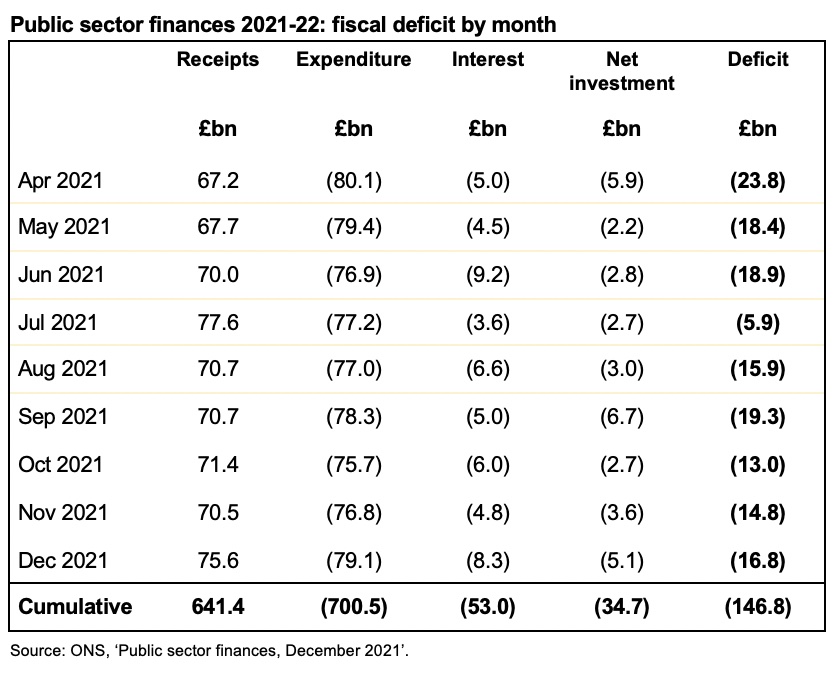
December’s deficit of £16.8bn saw both a rise in tax revenues and in interest on inflation-linked debt as pressure grows on the Chancellor to address energy price hikes and rising prices in the shops.
The public sector finances for December 2021 released on Tuesday 25 January 2022 reported a monthly deficit of £16.8bn. This was £7.6bn lower than the £24.4bn reported for December 2020 but £11bn higher than the £5.8bn deficit reported for December 2019.

This brings the cumulative deficit for the first nine months of the financial year to £146.8bn compared with £276.1bn and £58.4bn for the same period last year and the year before that respectively.

Public sector net debt increased from £2,321.8bn at the end of November to £2,339.9bn or 96% of GDP at the end of December. This is £205.5bn higher than at the start of the financial year and an increase of £546.8bn from March 2020. As a proportion of GDP, debt is the highest it has been since March 1963, almost 60 years ago.

The deficit for the month was in line with the revised forecast for 2021/22, published by the Office for Budget Responsibility (OBR) alongside last October’s Autumn Budget and Spending Review 2021, although higher than forecast interest charges on index-linked debt offset the benefit of higher than forecast tax revenues.

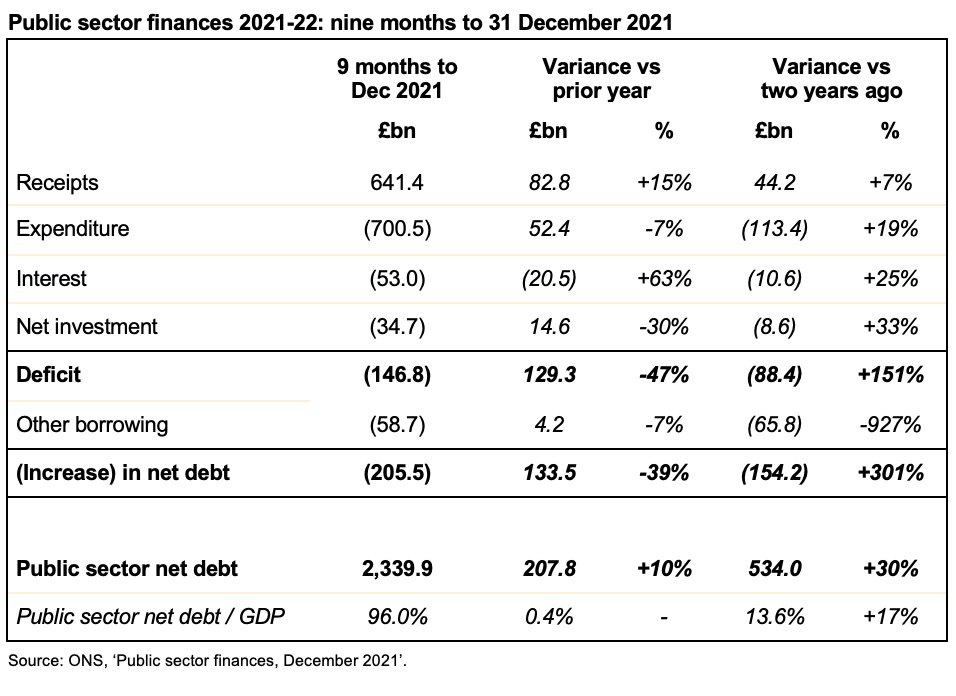
Cumulative receipts in the first three quarters of the 2021/22 financial year amounted to £641.4bn, £82.8bn or 15% higher than a year previously, but only £44.2bn or 7% above the level seen in the first three quarters of 2019/20. At the same time, cumulative expenditure excluding interest of £700.5bn was £52.4bn or 7% lower than the first nine months of 2020/21, but £113.4bn or 19% higher than the same period two years ago.

Interest amounted to £53bn in the nine months to December 2021, £20.5bn or 63% higher than the same period in 2020/21, principally because of the effect of higher inflation on index-linked gilts. Interest costs were £10.6bn or 25% more than in the equivalent nine months ended 31 December 2019.

Cumulative net public sector investment in the three quarters to December 2021 was £34.7bn. This was £14.6bn or 30% less than the £49.3bn reported for the first nine months of last year, which included around £17bn of COVID-19-related lending that the government does not expect to recover. Investment was £8.6bn or 33% more than two years ago, principally reflecting greater capital expenditures, including on HS2.

The increase in debt of £205.5bn since the start of the financial year comprises the deficit of £146.8bn and £58.7bn in other borrowing. The latter was used to fund lending to banks through the Bank of England’s Term Funding Scheme, lending to businesses overseen by the British Business Bank (including bounce-back and other coronavirus loans), student loans, and other cash requirements, net of the receipt of taxes deferred last year and loan repayments.

Martin Wheatcroft FCA, external advisor on public finances to ICAEW, said: “Today’s numbers highlight the impact inflation is having on the public finances, with higher tax revenues collected in December offset by the rising cost of index-linked debt. We expect interest charges to increase further in the next few months as the time lag on index-linked debt catches up with the current 7.5% rate of RPI.

“With borrowing costs low and headroom in forecasts for the next financial year, the temptation will be to delay fixing the public finances in order to tackle the immediate hit to household budgets from anticipated energy prices hikes and higher prices in the shops, so pressure on the Chancellor to postpone or phase in April’s national insurance rise is likely to grow.”

Table showing receipts, expenditure, interest, net investment, deficit, other borrowing the increase in net debt for the 9 months to Dec 2021 and public sector net debt and public sector net debt / GDP at 31 Dec 2021 together with variances versus prior year and two years ago.

Click on link at the end of this article to the version of this article on the ICAEW website which has a readable version of this table.

Caution is needed with respect to the numbers published by the ONS, which are expected to be repeatedly revised as estimates are refined and gaps in the underlying data are filled.

The ONS made a number of revisions to prior month and prior year fiscal numbers to reflect revisions to estimates. These had the effect of decreasing the reported fiscal deficit for the eight months to November 2021 from £136bn to £130bn and the deficit for the year ended 31 March 2021 from £321.9bn to £321.8bn.

Table showing receipts, expenditure, interest, net investment and the deficit for each of the 9 months to Dec 2021.

Click on link below to the version of this article on the ICAEW website which has a readable version of this table.

This article was originally published by ICAEW.

EU fiscal consultation

Input into ICAEW’s response to the future of the EU Economic Governance Framework.

I recently contributed to ICAEW’s response to a consultation on the future of the EU Economic Governance Framework by Dr Susanna Di Feliciantonio, ICAEW’s Head of European Affairs.

To read more see Susanna’s article about the consultation response.

ICAEW chart of the week: UK population projections 2020 to 2045

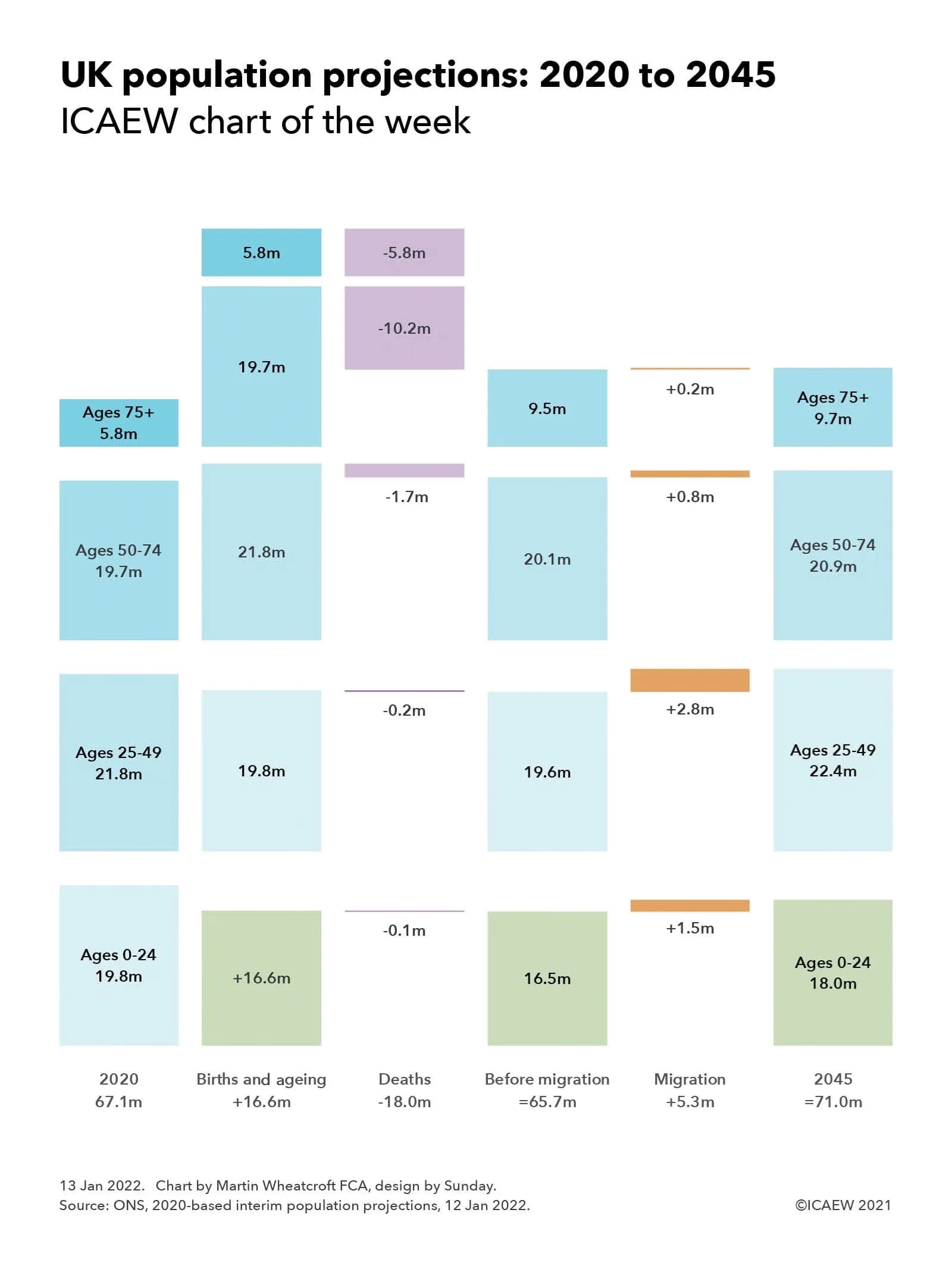
Our chart this week is based on the latest population projections for the UK, with an expected 67% increase in the number of people over the age of 75 and a fall in the number under the age of 25 over the next quarter of a century.

Chart illustrating how population of 67.1m people in 2020 (19.8m ages 0-24, 21.8m ages 25-49, 19.7m ages 50-74, 5.8m ages 75+) changes over the 25 years with 16.6m births, 18.0m deaths and 5.3m net migrants to get to 71.0m in 2024 (18.0m ages 0-24, 22.4 ages 25-49, 20.9m ages 50-74 and 9.7m ages 75+). For more detail see the text.

The Office for National Statistics (ONS) released 2020-based interim population projections on 12 January 2022 providing an insight into how the population of the UK is expected to change over the next 100 years. They are interim because they don’t include the results of the 2021 Census (which is still being worked on), but they do reflect updated assumptions from the 2018-based projections.

The main differences from the previous projections are a lower fertility rate (revised down from 1.78 to 1.59 per woman) reducing the numbers of births significantly, and slight reductions in anticipated life expectancy (from 82.8 years to 82.2 for males and from 85.7 to 85.3 for females) increasing the number of deaths. This has been partly offset by an increase in net annual long-term international migration from 190,000 a year to 205,000 a year, with a central projection last time of 72.8m people in 2045 revised down to 71.0m. The population is then expected to gradually increase to a peak of 71.8m in 2081, before declining back to 71.0m in 2120.

Our chart focuses on the first 25 years of the projections, illustrating how each generation is expected to change over that time. Overall, the estimated population of 67.1m in June 2020 is expected to change by 16.6m births (an average of around 665,000 a year) less 18.0m deaths (720,000 a year), which would result in a fall of 1.4m (55,000 a year) to 65.7m in 2045, at least before taking into account the effects of migration. Estimated net immigration of 5.3m (230,000 a year until 2026, then 205,000 a year) is expected to mean that the population will instead increase, reaching 71.0m in 2045.

There were an estimated 19.8m 0-24 year-olds in 2020, but in a quarter of a century they will all be in the 25-49 age group and so those under 25 will be formed from the 16.6m projected to be born in the 25 years from 2020, which after around 65,000 deaths would be 16.5m before taking account of migration. Some will leave the country and others will arrive, with a projected 1.5m net addition to take the total to 18.0m in 2045, a reduction of 1.8m compared with the previous cohort.

For the 19.8m under-25s in 2020 moving up a cohort to the 25-49 age group in 2045, deaths of 0.2m would reduce this to 19.6m before taking account of net inward migration of 2.8m to get to a projected 22.4m. This is a net increase of 0.6m compared with the previous generation of 21.8m. That generation, which would be aged 50-74 a quarter of a century later, would be reduced by 1.7m deaths to arrive at 20.1m before adding a net 0.8m from migration to get to 20.9m, a 1.2m increase over the 19.7m who were aged 50-74 in 2020.

A much greater proportion of this cohort will not be around in 2045, with a projected 10.2m deaths reducing numbers to 9.5m before adding 0.2m from net inward migration to arrive at a projected total of 9.7m. This is a 67% increase over the current generation of over-75s of 5.8m, with all bar the 38,000 expected to be over 100 in 2045 expected to have passed on, barring major developments in medical science. This compares with the approximately 15,000 people over the age of 100 in 2020.

Overall the rate of increase in the UK population is expected to fall from an estimated 0.4% a year in 2020 to 0.15% by 2045, an average of 0.2% over the coming quarter of a century. This compares with growth rates of 0.6% to 0.8% a year experienced in the last couple of decades, which has been a key driver of economic growth in that time.

The substantial increase in the numbers aged 75 and over is of course a hugely positive development as more people live much longer lives than in previous generations. However, this will have huge implications for the public finances given the cost implications of providing health services, social care and pensions to older generations, particularly those over the age of 75. With proportionately fewer workers (even with planned increases in the retirement age) this is expected to drive higher levels of taxation over the next quarter of a century without much higher levels of economic growth than are currently anticipated.

Fortunately a quarter of a century provides opportunity for governments to address the financial challenges posed by our success in extending lives if they are willing to do so, even with the added debt arising from the pandemic, which is why ICAEW continues to argue for the development of a long-term fiscal strategy to put the public finances on a sustainable path. Such a strategy could make a significant difference to the prosperity of future generations.

This chart was originally published by ICAEW.

ICAEW chart of the week: Government borrowing rates

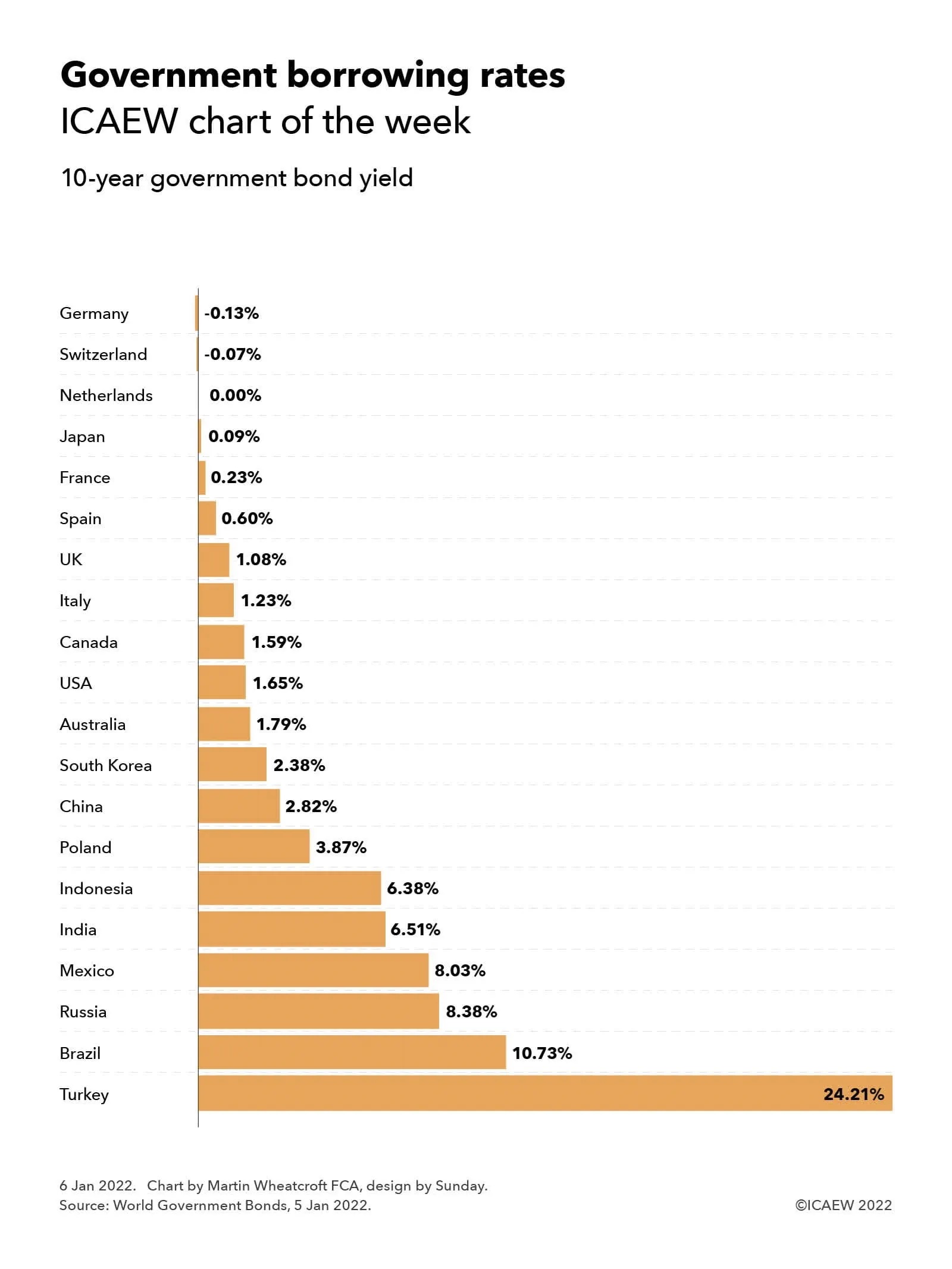
Our first chart of 2022 highlights how the cost of government borrowing remains extremely low for most of the 21 largest economies in the world, despite the huge expansion in public debt driven by the pandemic.

Government 10-year bond yields: Germany -0.13%, Switzerland -0.07%, Netherlands 0.00%, Japan 0.09%, France 0.23%, Spain 0.60%, UK 1.08%, Italy 1.23%, Canada 1.59%, USA 1.65%, Australia 1.79%, South Korea 2.38%, China 2.82%, Poland 3.87%, Indonesia 6.38%, India 6.51%, Mexico 8.03%, Russia 8.38%, Brazil 10.73%, Turkey 24.21%.

Our chart of the week illustrates how borrowing costs are still at historically low rates for most of the 21 largest national economies in the world, with negative yields on 10-year government bonds on 5 January 2022 for Germany (-0.13%) and Switzerland (-0.07%), approximately zero for the Netherlands, and yields of sub-2.5% for Japan (0.09%), France (0.23%), Spain (0.60%), the UK (1.08%), Italy (1.23%), Canada (1.59%), the USA (1.65%), Australia (1.79%) and South Korea (2.38%).

This is despite the trillions added to public debt burdens across the world over the past couple of years as a consequence of the pandemic, including the $5trn added to US government debt since March 2020 (up from $17.6trn to $22.6trn owed to external parties) and the more than £500bn borrowed by the UK government (public sector net debt up from £1.8trn to £2.3trn) for example.

Yields in developing economies are higher, although China (2.82%) and Poland (3.87%) can borrow at much lower rates than Indonesia (6.38%), India (6.51%), Mexico (8.03%), Russia (8.37%) and Brazil (10.73%). The outlier is Turkey (24.21%), which is experiencing some difficult economic conditions at the moment. Data was not available for Saudi Arabia, the 19th or 20th largest economy in the world, which has net cash reserves.

With inflation higher than it has been for several years, real borrowing rates are negative for most developed countries, meaning that in theory it would make sense for most countries to continue to borrow as much as they can while funding is so cheap. However, in practice fiscal discipline appears to be reasserting itself, with Germany, for example, planning on returning to a fully balanced budget by the start of next year and the UK targeting a current budget surplus within three years.

For many policymakers, the concern is not so much about how easy it is to borrow today, but the prospect of higher interest rates multiplied by much higher levels of debt eating into spending budgets just as they are looking to invest to grow their economies over the rest of the decade. Despite that, with the pandemic still raging and an emerging cost of living crisis, there may well be a temptation to borrow ‘just one more time’ to support struggling households over what is likely to be a difficult start to 2022.

This chart was originally published by ICAEW.

Public debt at highest level for almost 60 years

While November’s deficit of £17.4bn is in line with expectations, public sector net debt is up by more than half a trillion pounds since the start of the pandemic and as a proportion of GDP, debt is the highest it has been since March 1963.


The public sector finances for November 2021 released on Tuesday 21 December reported a monthly deficit of £17.4bn – £4.8bn lower than the £22.2bn reported for November 2020 but £11.8bn higher than the £5.6bn deficit reported for November 2019.

This brings the cumulative deficit for the first eight months of the financial year to £136.0bn compared with £251.7bn and £52.5bn for the same period last year and the year before that respectively.

Public sector net debt increased from £2,283.0bn at the end of October to £2,317.7bn or 96.1% of GDP at the end of November. This is £183.3bn higher than at the start of the financial year and an increase of £524.6bn over March 2020. As a proportion of GDP, debt is the highest it has been since March 1963, almost 60 years ago.

The increase in public sector net debt of £34.7bn in the month reflects borrowing to finance the deficit of £17.4bn and £26.9bn in the final tranche of the Bank of England’s Term Funding Scheme, offset by repayments in coronavirus lending as well as other net movements.

As in previous months this financial year, the deficit came in below the forecast for 2021-22 prepared by the Office for Budget Responsibility (OBR) in March 2021 but was in line with the OBR’s revised forecast issued in October 2021 alongside the Autumn Budget and Spending Review 2021.

Cumulative receipts in the first eight months of the 2021-22 financial year amounted to £560.7bn, £71.4bn or 15% higher than a year previously, but only £31.2bn or 6% above the level seen a year before that in 2019-20. At the same time cumulative expenditure excluding interest of £622.7bn was £44.4bn or 7% lower than the first eight months of 2020-21, but £102.1bn or 20% higher than the same period two years ago.

Interest amounted to £44.2bn in the eight months to October 2021, £14.6bn or 49% higher than the same period in 2020-21, principally because of higher inflation affecting index-linked gilts. Despite debt being 29% higher than two years ago, interest costs were only £5.0bn or 13% more than the equivalent eight months ended 30 November 2019.

Cumulative net public sector investment in the eight months to November 2021 was £29.8bn. This was £14.5bn less than the £44.3bn reported for the first eight months of last year, which included around £17bn or so of coronavirus lending that is not expected to be recovered. Investment was £7.6bn or 34% more than two years ago, principally reflecting a higher level of capital expenditure, in particular on investment in HS2.

Debt increased by £183.3bn since the start of the financial year, £47.3bn more than the deficit. This reflects funding to cover outflows on lending, including to banks through the Term Funding Scheme, lending to businesses through the British Business Bank, and student loans, offset by the receipt of taxes deferred last year and the repayment of coronavirus loans taken out during the pandemic.

Commenting on the figures Alison Ring, ICAEW Public Sector and Taxation Director, said: “While the numbers for November are in line with expectations, it’s notable that debt has risen both in cash terms and as a proportion of GDP, and at 96.1% is the highest it has been for almost 60 years. The monthly deficit of £17.4bn is below the peaks of last year but still substantially above the pre-pandemic position.

“Despite the rise in interest rates earlier this month, the Chancellor is still able to take advantage of historically-low borrowing costs if he wants to provide support to businesses adversely affected by the Omicron variant and prevent further scarring to the economy. His concern will be how to do so without stoking inflation, which is expected to head even higher over the next few months.”

Table showing receipts, expenditure, interest, net investment, deficit, other borrowing the increase in net debt for the 8 months to Nov 2021 and public sector net debt and public sector net debt / GDP at 30 Nov 2021 together with variances versus prior year and two years ago.

Click on link at the end of this article to the version of this article on the ICAEW website which has a readable version of this table.

Caution is needed with respect to the numbers published by the ONS, which are expected to be repeatedly revised as estimates are refined and gaps in the underlying data are filled.

The ONS made a number of revisions to prior month and prior year fiscal numbers to reflect revisions to estimates. These had the effect of decreasing the reported fiscal deficit for the seven months to October 2021 from £127.3bn to £118.6bn and the deficit for the year ended 31 March 2021 from £323.1bn to £321.9bn.

Table showing receipts, expenditure, interest, net investment and the deficit for each of the 8 months to Nov 2021.

Click on link below to the version of this article on the ICAEW website which has a readable version of this table.

This article was originally published by ICAEW.

ICAEW chart of the week: Bounce Back Loans

My chart this week is on Bounce Back Loans, one of the principal sources of financial support for businesses during the first year of the pandemic and the subject of a recent investigation by the National Audit Office.

Chart analysing Bounce Back Loans of £47bn by region and by recoverability.

London £11bn, South £10bn, Midlands & East £11bn, North £9bn, Scotland, Wales & Northern Ireland £6bn.

Repaid £2bn, recoverable £28bn, bad debts £12bn, fraud £5bn.

The recent publication of the Department for Business, Energy & Industrial Strategy (BEIS) accounts for 2020-21 contained an assessment of the losses expected on the financial provided to businesses through the Bounce Back Loan Scheme (BBLS), the Coronavirus Business Interruption Loan Scheme (CBILS), the Coronavirus Large Business Interruption Loan Scheme (CLBILS) and the Future Fund. This was followed by an updated report from the National Audit Office (NAO) on the administration of the scheme and the potential losses to the taxpayers.

The largest of these schemes was BBLS, with Bounce Back Loans of up to £50,000 provided to eligible businesses to help them weather the first lockdown in the second quarter of 2020, before being extended to the whole of the 2020-21 financial year. In the end, around a quarter of businesses took out a Bounce Back Loan, comprising 1.5m loans for a total of £47bn at an interest rate of 2.5% repayable over six years. The interest in the first year was covered by the government, with no repayments due in that period. 

Businesses can extend the loans to ten years through the Pay As Your Grow option, as well as being allowed up to one six month payment holiday and three interest-only payments to provide flexibility without going into default.

The seven main UK banks provided around 90% of the loans by value, with the rest provided by other banks and non-bank lenders, such as peer-to-peer lenders. Each participating financial institution was provided with a 100% guarantee by the government to cover any amounts not repaid. Half a million or nearly 35% of the loans were for the maximum amount of £50,000 (adding up to £27bn) with £18bn lent out between £10,000 and £50,000 and £2bn lent for amounts between £2,000 (the minimum possible) and £10,000.

As the chart illustrates, the geographical distribution of loans was weighted towards the south and centre of England, with £11bn borrowed by businesses in London, £10bn in the South (£6.5bn South East and £3.6bn South West) and £11bn in the Midlands & East (£3.8bn West Midlands, £2.9bn East Midlands and £4.5bn East of England), a total of £32bn. The balance of £15bn was split between £9bn in the North (£3.2bn Yorkshire & the Humber, £4.8bn North West and £1.3bn North East) and £6bn in the other nations of the UK (£2.7bn Scotland, £1.6bn Wales and £1.3bn Northern Ireland).

More than 90% of the loans, amounting to £40bn, went to micro-businesses, ie businesses with turnover below £632,000.

BEIS have estimated in their 2020-21 financial statements that they do not expect 37% of the loans with a value of £17bn to be repaid, comprising £12bn in estimated bad debts and £5bn in estimated losses from fraud, although the NAO says that these numbers are highly uncertain at this stage. With £2bn already repaid, this leaves £28bn believed to be recoverable over the remainder of the six years of the loans (or 10 years for those that are extended).

The fraud estimate, for 11% of the loans with a value of £4.9bn, was based on a sample of 1,067 loans as at 31 March 2021, but a subsequent analysis in October 2021 suggests that the level of fraud may be lower at around 7.5% of loans and so there is some hope that BEIS and the British Business Bank will be able to reduce the amount they will have to reimburse to participating banks under the 100% guarantees.

However, as the NAO reports, these guarantees mean participating banks have no financial incentive to chase repayment and it has raised concerns that insufficient resources are being dedicated by BEIS and the British Business Bank to recovering outstanding amounts. 

The challenge for government is that many businesses have not been able to get back to their pre-pandemic level of operation and so there is a need to be sensitive, whilst at the same time seeking to protect public money and tackle those who made fraudulent claims.

This chart was originally published by ICAEW.

Deficit in line with expectations at £19bn but public debt jumps by £69bn

The monthly public sector deficit was flat at £18.8bn in October but a last-minute rush by banks to access cheap finance caused public sector net debt to jump by £68.7bn to £2,277.6bn.


The public sector finances for October 2021 released on Friday 18 November reported a monthly deficit of £18.8bn, slightly better than the £19.0bn reported for October 2020 but higher than the £11.6bn deficit in October 2019.

This brings the cumulative deficit for the first seven months of the financial year to £127.3bn compared with £230.7bn last year and £46.9bn for the equivalent period two years ago.

Public sector net debt increased from £2,208.9bn at the end of September to £2,277.6bn or 95.1% of GDP at the end of October. This is £141.8bn higher than at the start of the financial year and an increase of £484.5bn over March 2020.

The increase in public sector net debt of £68.7bn in the month includes £57.3bn to funding lending to banks who rushed to borrow under the ‘Term Funding Scheme with additional incentives for SMEs’ (TFSME) before the extended drawdown period ended on 31 October 2021. A further £26.9bn will be recorded in November for cash movements after the cut-off date, bringing the total amount financed through the TFSME to £193.4bn on 10 November 2021.

As in previous months this financial year, the deficit came in below the forecast for 2021-22 prepared by the Office for Budget Responsibility (OBR) in March 2021 but was in line with the OBR’s revised forecast issued in October 2021 alongside the Autumn Budget and Spending Review 2021.

Cumulative receipts in the first seven months of the 2021-22 financial year amounted to £489.0bn, £65.7bn or 16% higher than a year previously, but only £23.7bn or 5% above the level seen a year before that in 2019-20. At the same time cumulative expenditure excluding interest of £548.2bn was £39.3bn or 7% lower than the first seven months of 2020-21, but £92.5bn or 20% higher than the same period two years ago.

Interest amounted to £39.3bn in the seven months to October 2021, £14.2bn or 57% higher than the same period in 2020-21, principally because of higher inflation affecting index-linked gilts. Despite debt being 24% higher than two years ago, interest costs were only £2.6bn or 7% more than the equivalent seven months ended 31 October 2019.

Cumulative net public sector investment in the seven months to October 2021 was £28.8bn. This was £12.6bn less than the £41.4bn in the first seven months of last year, which included around £17bn on coronavirus lending that is not expected to be recovered. Investment was £9.0bn or 45% more than two years ago, principally reflecting a higher level of capital expenditure.

Debt increased by £141.8bn since the start of the financial year, £14.5bn more than the deficit. This reflects funding to cover outflows on lending to business, including to banks through the Term Funding Scheme, and student loans offset by the receipt of taxes deferred last year and the repayment of coronavirus loans taken out during the course of the pandemic.

Alison Ring, ICAEW Public Sector Director, said: “Today’s public finance numbers show a deficit of £18.8bn in October, which is in line with the revised forecasts published by the Office for Budget Responsibility last month. The deficit has stopped growing now that the furlough and other pandemic support schemes have finished.

“However, a last-minute rush by banks to obtain cheap loans for small and medium enterprises, before the application deadline on 31 October, caused government debt to jump by £68.7bn last month. These loans should help businesses navigate choppy economic waters with rapidly rising inflation, as well as supply chain and staffing challenges. Nonetheless, the Chancellor will need to continue watching events closely to see if he will need to reintroduce any pandemic support schemes.”

Table showing receipts, expenditure, interest, net investment, deficit, other borrowing the increase in net debt for the 7 months to Oct 2021 and public sector net debt and public sector net debt / GDP at 31 Oct 2021 together with variances versus prior year and two years ago.

Click on link at the end of this article to the version of this article on the ICAEW website which has a readable version of this table.

Caution is needed with respect to the numbers published by the ONS, which are expected to be repeatedly revised as estimates are refined and gaps in the underlying data are filled.

The ONS made a number of revisions to prior month and prior year fiscal numbers to reflect revisions to estimates. These had the effect of increasing the reported fiscal deficit for the six months to September 2021 from £108.1bn to £108.5bn and the deficit for the year ended 31 March 2021 from £319.9bn to £323.1bn.

Table showing receipts, expenditure, interest, net investment and the deficit for each of the 7 months to Oct 2021.

Click on link below to the version of this article on the ICAEW website which has a readable version of this table.

This article was originally published by ICAEW.