ICAEW chart of the week: UK International Reserves

We take a look at the UK’s official international reserves that are held to safeguard sterling and support monetary policy.

Step chart showing components of the UK International Reserves.

Gross reserves: £101bn foreign currency securities and deposits, £36bn IMF, £15bn gold, £23bn other instruments.

Liabilities: (£109bn) other instruments

Net reserves: £66bn

Our chart this week is on the UK International Reserves, which comprise foreign currency securities and deposits, gold, investments in the International Monetary Fund (IMF), and other financial instruments primarily used to manage sterling as a national currency and support monetary policy.

As illustrated by the chart, the combined total of UK government and Bank of England international gross reserves was £175bn at 31 March 2022, comprising £101bn in foreign currency securities and deposits, £36bn invested in the IMF, £15bn in gold and £23bn in other financial instruments. This was offset by £109bn in liabilities to arrive at net reserves of £66bn.

According to the Bank of England, the £101bn in foreign currency securities consisted of £75bn in bonds and notes issued by foreign governments, £15bn in foreign government money market investments, £6bn in foreign central bank deposits and £5bn in private sector securities. The £36bn invested the IMF comprises £6bn in IMF reserves (effectively the IMF’s share capital) and £31bn in Special Drawing Rights (SDRs), a government-specific financial asset underpinned by a basket of currencies (US dollar, Euro, Chinese Yuan, Japanese Yen and sterling). The UK government also owned or had rights to 9,976,041 fine troy ounces of gold worth £15bn on 31 March 2022, while other financial instruments of £23bn included £20bn of claims against counterparties on account of reverse repo transactions.

Reserve assets were offset by £109bn in liabilities, comprising loans and securities used to finance reserve assets, repo obligations, and derivative financial instruments including foreign currency forwards, cross currency interest rate swaps and sterling interest rate swaps.

Not shown in the chart is the split between the UK government’s net reserves of £66bn, consisting of £151bn in gross assets less £85bn in liabilities, and the Bank of England’s approximately zero net reserve position, consisting of £24bn in gross assets (£12bn in foreign currency securities and bonds plus £12bn in other financial instruments) less £24bn in liabilities.

The Bank of England manages both its own foreign currency reserves, used to support its monetary policy objectives of controlling inflation, and the UK government’s international reserves, most of which sit in the Exchange Equalisation Account established in 1932 to provide a fund that can be used, when necessary, to regulate the exchange value of sterling. In normal circumstances the Bank of England’s main objectives in managing the reserves are to ensure the liquidity of sterling, the liquidity and security of the reserve assets themselves, and to ensure the reserves are managed in a cost-effective way.

In normal circumstances, the reserves are not used to actively intervene in foreign exchange markets, but are kept ‘in reserve’ on a precautionary basis in case there is any change in exchange rate policy in the future or in the event of any unexpected shocks. More prosaically, they are used to provide foreign currency services for government departments and agencies needing to transact in foreign currencies, as well as to buy, hold and sell SDRs as required by the UK’s membership of the IMF.

Although relatively small in the context of over £1trn a year in UK public spending and £2.3trn in public sector net debt, the UK’s international reserves provide HM Treasury and the Bank of England with a substantial amount of firepower in the foreign exchange markets should there ever be a need to intervene to support sterling. Fortunately, almost all of the foreign currency securities and deposits held in the reserves are invested in governments and central banks of allied countries, a contrast to the position of Russia, which has seen a substantial proportion of its international reserves frozen following its invasion of Ukraine.

One piece of good news amid all the economic gloom at the moment is that the UK International Reserves aren’t hitting the headlines. Because when they do, you really will know that all is not well.

This chart was originally published by ICAEW.

ICAEW chart of the week: US proposed federal budget 2023

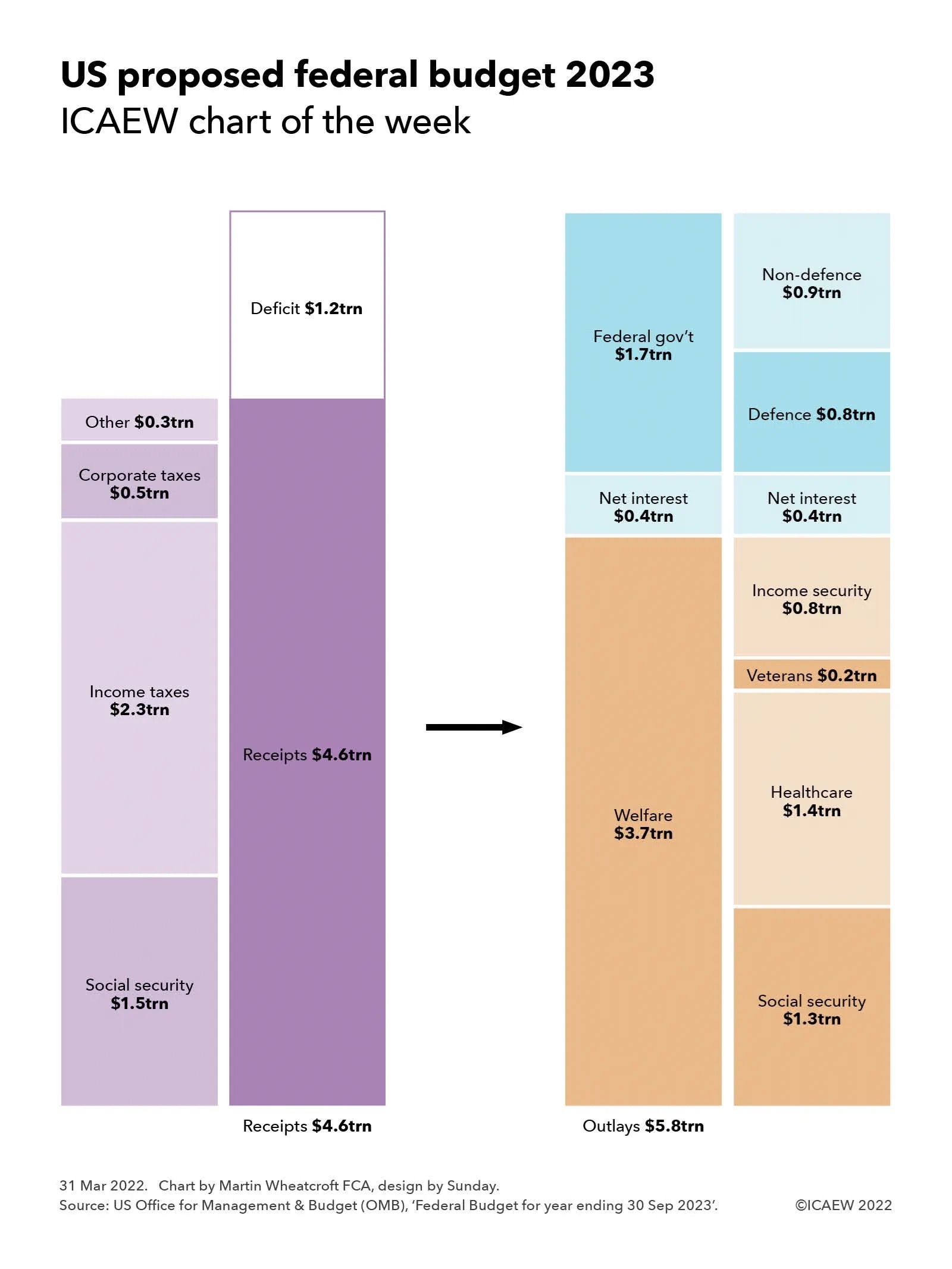
Our chart this week illustrates the $5.8tn federal budget for the 2023 fiscal year proposed by President Biden to Congress for approval – a process that will not be straightforward.

Chart illustrating the 2023 US federal budget proposal.

Receipts $4.6tn + Deficit $1.2tn = Outlays $5.8tn.

Receipts comprise social security $1.5tn, income taxes $2.3tn, corporate taxes $0.5tn and other $0.3tn.

Outlays comprise welfare $3.7tn (social security $1.3tn, healthcare $1.4tn, veterans $0.2tn, income security $0.8tn), net interest of $0.4tn and federal government spending of $1.77tn (defence $0.8tn, non-defence $0.9tn).

The US Office for Management and Budget (OMB) has just published President Biden’s proposal for the Budget of the United States Government, Fiscal Year 2023, which commences on 1 October 2022.

Federal spending proposed of $5.8tn comprises $3.7bn of ‘mandatory’ spending, primarily on welfare programmes, $0.4tn on debt interest, and $1.7tn of ‘discretionary’ spending. Welfare spending includes $1.3tn on social security, $1.4tn on healthcare (Medicare and Medicaid), $0.2tn on support to veterans, and $0.8tn on income security and other programmes.

This is a $60bn reduction from the $5.9tn forecast for the current financial year ending on 30 September 2022, with increases in social security ($99bn), Medicare and Medicaid ($67bn), interest ($39bn) and defence ($29bn), offset by a reduction of $280bn in income security (primarily pandemic support) and $14bn in non-defence departmental spending. This compares with the $6.8trn spent in the fiscal year ended 30 September 2021 at the height of the pandemic.

Receipts are forecast at $4.6tn, comprising social security payroll taxes of $1.5tn, federal income taxes of $2.3tn, corporate taxes of $0.5tn, and other taxes $0.3tn, resulting in a deficit of $1.2tn to be funded by borrowing.

Receipts are forecast to be $201bn higher than the $4.4tn forecast for the current financial year, with social security receipts up $64bn, income taxes up $82bn and corporate taxes up $118bn, offset by a fall of $63bn in other receipts. This primarily relates to economic factors as the US emerges from the pandemic but, as has been publicly reported, also involves higher taxes on ‘billionaires’, among other tax measures.

With pandemic income security and furlough programmes no longer required, the deficit has fallen from $2.8tn in 2021 to $1.4tn in the current year and a proposed $1.2tn in the next, before increasing to $1.8tn in 2032, reflecting increases in both receipts and spending over the coming decade.

The budget documents prepared by the OMB focus in particular on the major plans to improve infrastructure embodied in the bipartisan Infrastructure Investment and Jobs Act 2021, as well as further investment in defence, in lowering health and social care costs for individuals, in improving housing, pre-school and college education, and in reducing energy costs by combating climate change. The OMB suggests that there is some prudence in the budget given the uncertainties about whether proposed tax rises will obtain political support from within Congress, with an indication that this will be used to reduce the federal deficit even further if all the proposed tax rises are enacted into law.

For President Biden, this is his last budget proposal before the mid-term elections in November, when there is a possibility that the Democrats might lose control of one, or even both, houses of Congress. This makes it particularly important to his ability to deliver his domestic agenda.

This chart was originally published by ICAEW.

ICAEW chart of the week: Spring Statement 2022

This week we look at the Spring Statement, where the story is all about inflation as the Chancellor responded to the pressures that have contributed to the cost of living crisis.

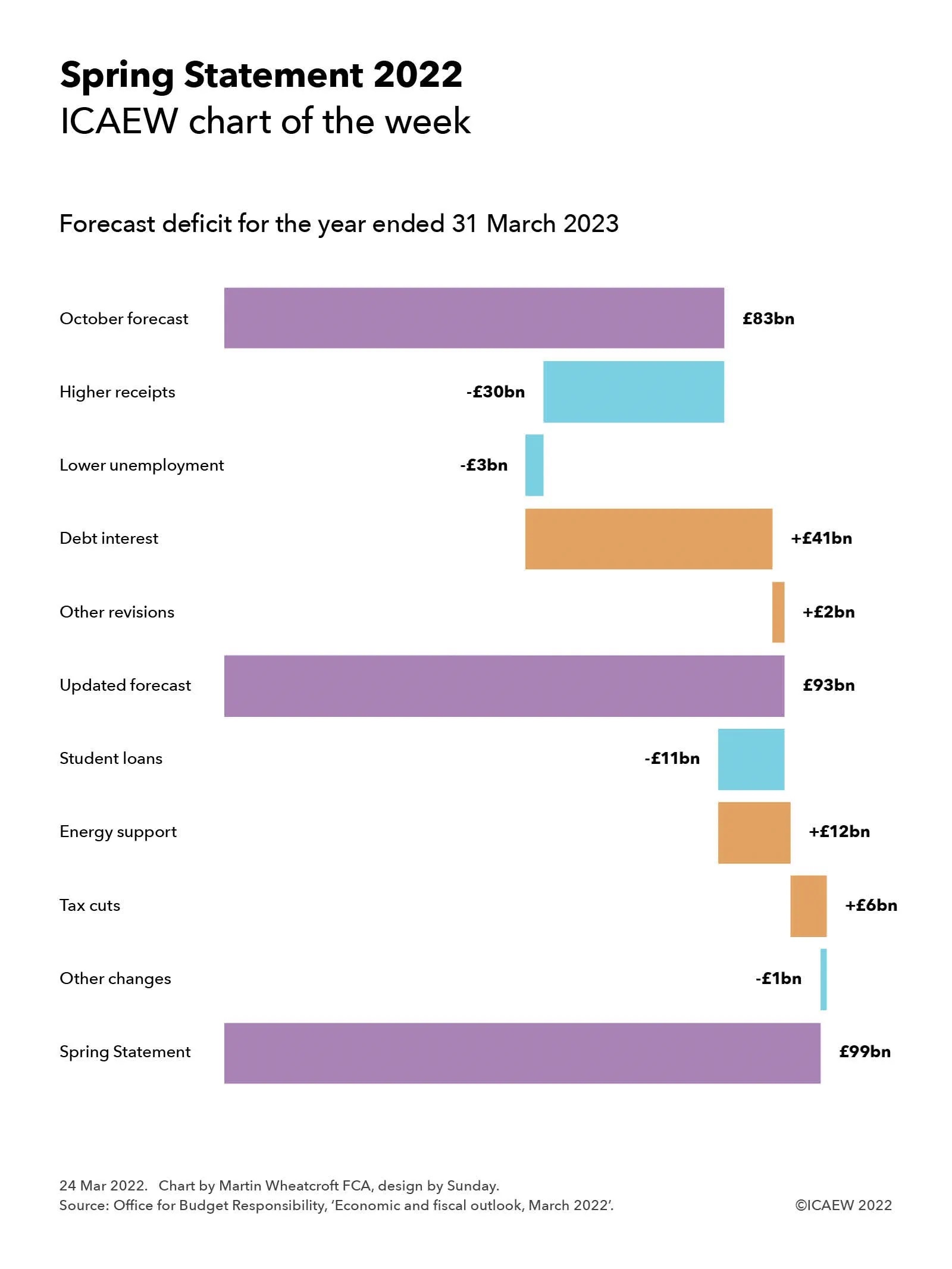
Step chart showing changes from the October forecast for the deficit in 2022/23 and the revised Spring Statement forecast for the same period.

October forecast £83bn - higher receipts £30bn - lower unemployment £3bn + debt interest +£41bn + other revisions £2bn = updated forecast of £93bn.

The - student loans £11bn + energy support £12bn + tax cuts £6bn - other changes £1bn = Spring Statement forecast of £99bn.

What Chancellor Rishi Sunak had originally hoped would be a short report to Parliament on the latest economic and fiscal forecasts turned into a fully-fledged fiscal event as he responded to a ‘cost of living’ crisis that is expected to put severe pressure on household budgets and is risking the viability of many businesses. The Office for Budget Responsibility (OBR) estimates that the Chancellor’s energy support package and tax cuts will cover around a third of the decline in living standards expected in the coming financial year.

Inflation is now centre stage in a way that it hasn’t been since the 1970s.

Our chart summarises the changes in the forecast for fiscal deficit the coming financial year commencing on 1 April 2022, showing how last October’s forecast of a £83bn shortfall between receipts and expenditure has increased to a £99bn shortfall in the latest forecasts by the OBR.

The good news is that the economic recovery from the pandemic has been stronger than previously thought, with the pandemic support measures such as the furlough scheme being rewarded with stronger tax receipts coming through into the forecasts. An extra £30bn is expected in 2022/23, complemented by lower unemployment than expected, which also reduces the forecast for welfare spending by an estimated £3bn.

Offsetting that is a huge rise in interest costs. This is driven by a sharp rise in the retail prices index (RPI), to which a substantial proportion of the government’s debt is linked, combined with higher interest rates as the Bank of England attempts to prevent inflation rising even further. These factors add an extra £41bn to the forecast interest bill for next year, bringing it up to £83bn, three and a half times the £24bn in 2020/21 and more than 50% higher than the £54bn now expected for the current financial year. Interest in subsequential financial years has been revised up by around £9bn a year on the basis (the forecasters hope) that inflation is brought back under control in 2023/24.

Other changes to the fiscal forecast add £2bn to the deficit forecast, bringing it up to £93bn before taking account of policy decisions announced since last October. The first, which for some reason was not highlighted by the Chancellor in his speech, was the impact of increasing the amounts that graduates will have to repay on their student loans, reducing the anticipated bad debt write-off in 2022/23 by £11bn from the estimate made last October.

The Chancellor did talk about the energy support package that he announced last month as the energy prices rises coming in April were announced. However, he did not add to that package directly – instead choosing to announce tax cuts of about £6bn in 2022/23. The main element is an increase from July of around £3,000 in the threshold at which National Insurance is payable by employees, which will benefit many low to middle income families, but not (as the Institute for Fiscal Studies, the Resolution Foundation and others have pointed out) the very poorest that will be hit hardest by price rises. More than two thirds of the benefit will go to higher income households.

Overall, the OBR says the energy support package and tax cuts together will offset around a third of the fall in living standards that is expected in the coming year.

Other policy changes amounting to around £1bn were offset by indirect effects of £2bn, resulting in a net £1bn benefit to bring the forecast deficit to £99bn, some £16bn higher in total than that predicted in October.

These numbers don’t include the 1p cut in the basic rate of income tax from 6 April 2024 that was also announced by the Chancellor. This is expected to cost around £6bn a year in lower tax receipts, but is expected to be more than offset by the effect of freezing both income tax and national insurance thresholds (expected to bring in somewhere in the region of £18bn extra a year). In effect, the Chancellor has chosen to bank the ‘benefit’ of higher inflation on his decision to freeze thresholds.

The big question is whether the Chancellor will be able to hold off from providing further support to households and businesses for the rest of the financial year. Most commentators appear to suggest that it is likely that he will return to the despatch box in the House of Commons before the next round of energy prices rises in October in order to make further announcements.

This article was originally published by ICAEW.

A Spring Statement dominated by inflation

Tax plans brought forward as Chancellor Rishi Sunak seeks to limit spending commitments and build fiscal headroom ahead of the Autumn Budget.

Inflation dominated the Spring Statement as the Chancellor added to his support package for households and businesses facing rapidly rising prices but held off giving any extra money for public services.

Despite a major tax cut from raising National Insurance thresholds, the OBR estimates that the measures announced by the Chancellor for the coming financial year will offset around a third of the fall in living standards. This will leave household budgets to take most of the strain of the rapidly rising prices, with the potential that the government will need to intervene again later in the year as the impact becomes clearer.

The biggest individual change in the government’s spending plans is the bill for interest on central government debt, which increases from £24bn in 2020/21 to £54bn this year and a forecast of £83bn for 2022/23. This is the biggest driver of an increase in the forecast deficit for next year from last October’s forecast of £62bn to a revised forecast of £99bn, despite an £11bn boost from restructuring the system for student loans that could see graduates paying back their loans almost up until retirement.

Despite the increase in the coming financial year, the OBR expects the deficit in the rest of the forecast period to be lower than before, with the projected deficits in the subsequent four years up to 2026/27 down from £62bn, £46bn, £46bn and £44bn to £50bn, £37bn, £35bn and £32bn – a net improvement of £11bn a year on average. 

Higher tax receipts are the primary driver of a reduced forecast for public sector net debt at 31 March 2027 of £2,480bn, down from a previous forecast of £2,567bn, but still £687bn higher than the £1,793bn at 31 March 2020. The impact on the debt-to-GDP ratio is greater, with lower cash outflows and higher GDP driven by inflation combining to reduce the ratio from a previous forecast of 88% in 2027 to 83%, reversing a significant proportion of the increase caused by the pandemic.

The OBR calculates that the Chancellor has about £30bn of headroom against his fiscal targets, giving him more capacity to provide additional support for households and businesses later in the year if he thinks it necessary. Given the uncertainties surrounding the potential impact of Russia’s invasion of Ukraine on the UK economy, it is perhaps understandable for Rishi Sunak to want to accelerate the reduction in debt in relation to the size of the economy and build greater fiscal resilience. However, he will be conscious of the risk of a recession if households cut back their spending in the domestic economy by too much.

Other than some welcome additional funding to tackle fraud, there was no significant additional funding for departments or local authorities who will need to stick within their original budgets set by the three-year Spending Review announced last October. This could result in ‘unplanned austerity’ as they seek to find savings to offset rising costs, in particular the government’s capital investment plans, where the cost of building infrastructure is likely to increase significantly, potentially jeopardising priorities such as levelling up.

Alison Ring, Director of Public Sector and Taxation, commented: “The story of the Spring Statement is inflation, which is driving a sharp fall in living standards and is causing the interest bill on public debt to multiply. The government has responded with a package of measures that the OBR estimates offset about a third of the decline, but this still leaves household budgets exposed to the effect of rapidly rising prices. The Chancellor’s focus on building up fiscal resilience suggests he may be trying to preserve some firepower for possible further interventions later in the year.

“With public finances in a better shape than previously forecast, the Chancellor will hope that he is going to be able to make good on his pledge to cut income tax in 2024.”

This article was originally published by ICAEW.

Spring Statement: what the new measures will mean

ICAEW Insights quotes me in an article on the Spring Statement 2022:

“Despite its impact on the government’s interest bill, there is a major benefit to inflation in that it helps bring down the debt-to-GDP ratio more quickly, providing the Chancellor more space to intervene to help with the cost of living,” Martin Wheatcroft, public finance adviser to ICAEW, explains.

According to the OBR, the new measures announced in the Spring Statement, along with the existing package announced previously, should offset around a third of the increase in costs that households are facing, leaving them with the burden of the other two-thirds, Wheatcroft says. “I think we should expect further measures from the Chancellor in the summer or autumn as the impacts on households become more apparent.”

Wheatcroft adds that it is likely that some of the announcements included in the Spring Statement were brought forward to ease tensions with backbenchers. “With members of his own party pressing for a delay in the NIC increase, I suspect the Chancellor felt pressure to bring forward measures that he may have been saving for later in the year, in particular his planned cut to income tax in 2024 and a tax plan that was likely set for a summer release ahead of the Autumn Budget.”

To read the full article, click here.

Public finances raise hopes for Spring Statement giveaway

February’s £13.1bn deficit was offset by revisions to prior month estimates, boosting public finances and putting further pressure on the Chancellor to provide more help to households and businesses facing rapidly rising prices.

The public sector finances for February 2022, released on Tuesday 22 March 2022, reported a deficit for the month of £13.1bn. This was an improvement of £2.4bn from the deficit of £15.4bn reported for February 2021, but £12.8bn worse than the £0.4bn deficit reported for February 2020.

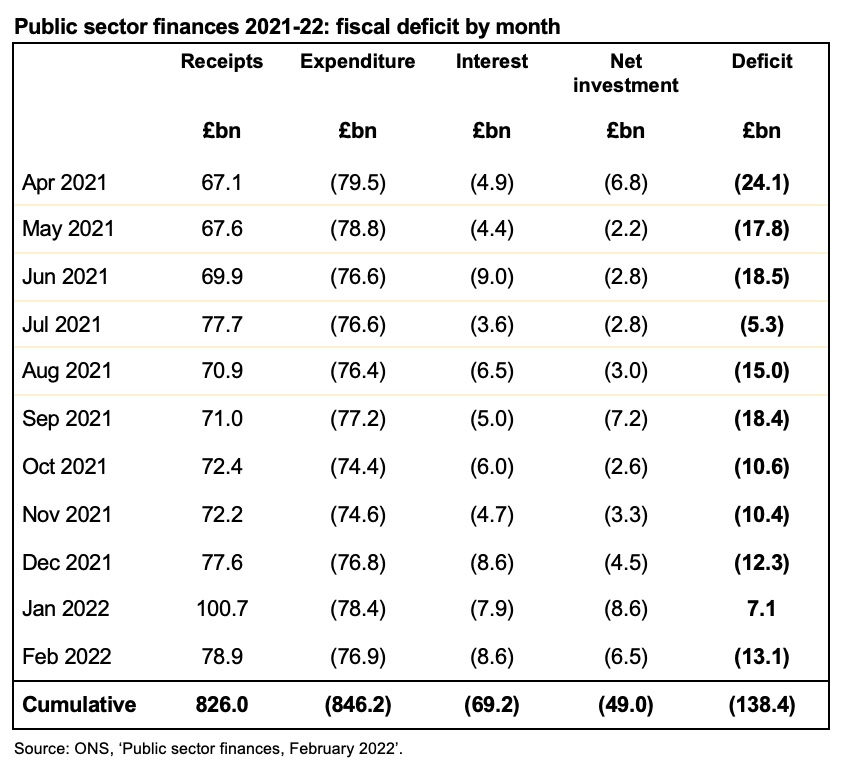
The cumulative deficit of £138.4bn for the first 11 months of the 2021/22 financial year was £0.1bn less than that reported last month, as the £13.1bn deficit for February was offset by £13.2bn in revisions to prior month estimates.

Public sector net debt increased by £6.6bn from £2,320.2bn at the end of January to £2,326.8bn or 94.7% of GDP at the end of February, with tax and loan recoveries partly offsetting the deficit for the month. Despite that, debt is £192.4bn higher than at the start of the financial year and £533.7bn higher than March 2020.

The year-to-date deficit of £138.4bn compares with a cumulative deficit for the first 11 months of the financial year of £290.9bn in 2020/21 and £48.7bn in 2019/20. This was £25.9bn below the forecast published by the Office for Budget Responsibility alongside last October’s Autumn Budget and Spending Review 2021, with higher-than-forecast tax receipts being partially offset by higher-than-forecast interest charges on index-linked debt. Both are driven by higher rates of inflation, which takes more time to feed through to non-interest expenditure. This suggests that the deficit for the full year could end up somewhere in the region of £30bn below the official forecast of £183bn.

Cumulative receipts in the first 11 months of the 2021/22 financial year amounted to £826.0bn – £104.7bn or 15% higher than a year previously but £69.3bn or 9% above the level seen in the first 11 months of 2019/20. At the same time, cumulative expenditure excluding interest of £846.2bn was £65.1bn or 7% lower than the same period last year, but £127.4bn or 18% higher than two years ago.

Interest amounted to £69.2bn in the eleven months to 28 February 2022, which was £29.4bn or 74% higher than the same period in 2020/21, principally because of the effect of higher inflation on index-linked gilts. Interest costs were £17.8bn or 35% more than in the equivalent 11-month period ended 29 February 2020.

Cumulative net public sector investment up to February 2022 was £49.0bn. This was £12.1bn or 20% below the £29.7bn reported for the first 11 months of last year, which included around £17bn of COVID-19 related lending that the government does not expect to recover. Investment was £13.8bn or 39% more than two years ago, principally reflecting greater capital expenditures, including on HS2.

The increase in debt of £192.4bn since the start of the financial year comprises the cumulative deficit of £138.4bn and £54.0bn in other borrowing. The latter has been used to fund lending to banks through the Bank of England’s Term Funding Scheme, lending to businesses via the British Business Bank (including bounce-back and other coronavirus loans), student loans and other cash requirements, net of the recovery of taxes deferred last year and loan repayments.

Alison Ring OBE FCA, Public Sector and Taxation Director for ICAEW, says: “Today’s numbers show the impact inflation is having on the public finances as it continues to drive both tax receipts and interest costs higher. The deficit for the financial year is expected to be around £30bn lower than October’s official forecast of £183bn, while tomorrow’s Spring Statement forecasts could see a smaller deficit next year than the £62bn expected before the pandemic.

“Uncertainty about the impact of the war in Ukraine on the UK means it will be extremely difficult for the Chancellor to gauge the level of intervention needed to support households and businesses facing rocketing energy prices if he’s to avoid a recession that could permanently damage the economy and the public finances, and still leave room for tax cuts in the Autumn Budget.”

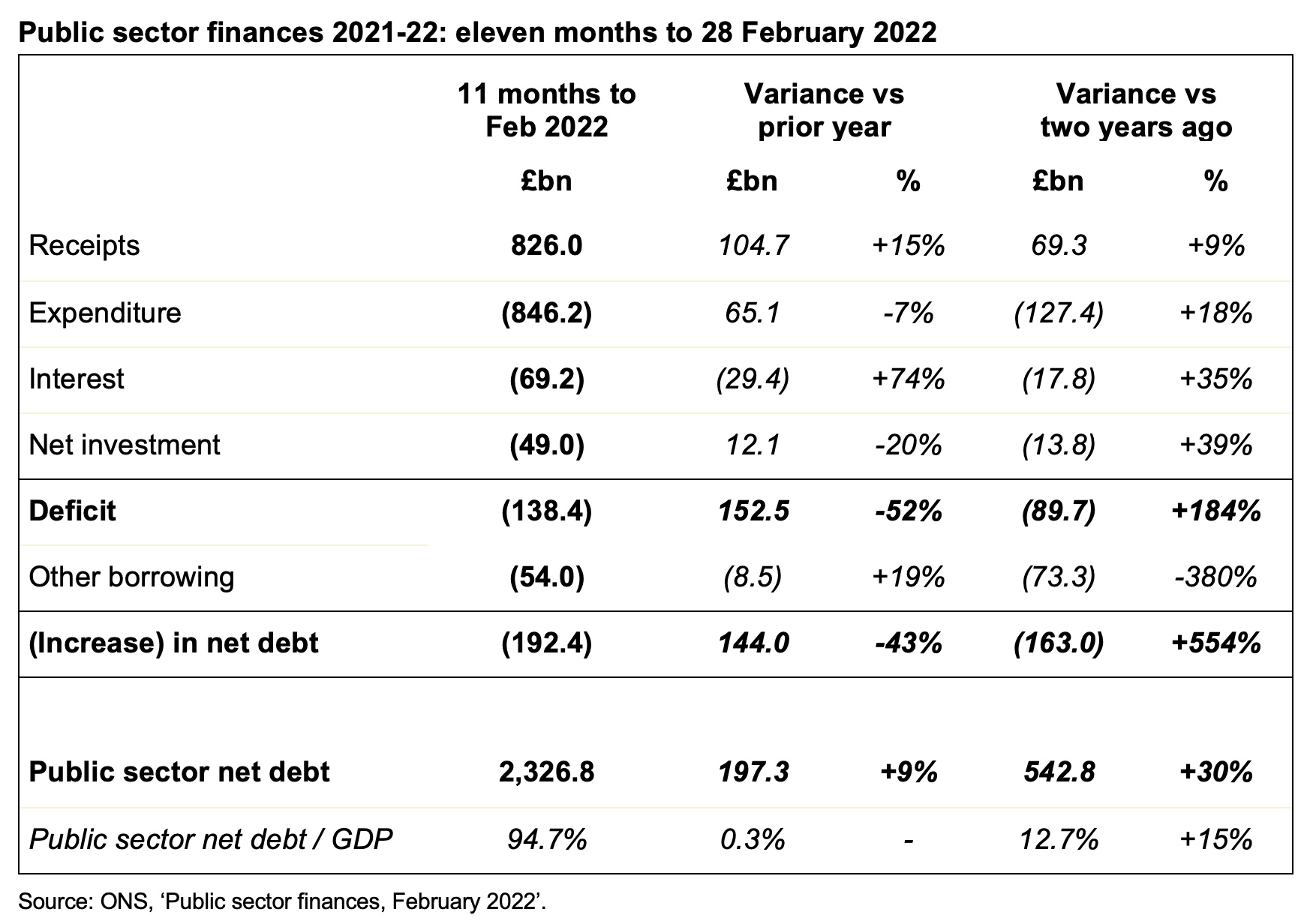
Table showing cumulative 11 month numbers and variances against prior year and two years ago. All amounts in £bn, with negative numbers in brackets (costs / negative variances).

Receipts 826.0: 104.7 +15% better than prior year; 69.3 +9% versus two years ago

Expenditure (846.2): 65.1 -7%; (127.4) +18%

Interest (69.2): (29.4) +74%; (17.8) +35%

Net investment (49.0): 12.1 -20%; (13.8) +39%

Subtotal Deficit (138.4): 152.5 or -52% lower than the prior year; (89.7) +184% higher than two years ago

Other borrowing (54.0): (8.5) +19%; (73.3) -380%

Total (Increase) in net debt (192.4): 144 -43%; (163.0) +554%

Also:

Public sector net debt 2,326.8: 197.3 or +9% higher than prior year and 542.8 +30% higher than two years ago

Public sector net debt / GDP 94.7%: 0.3% or 0% higher than prior year; 12.7% or +15% higher than two years ago.

Caution is needed with respect to the numbers published by the Office for National Statistics (ONS), which are expected to be repeatedly revised as estimates are refined and gaps in the underlying data are filled.

The ONS made a number of revisions to prior month and prior year fiscal numbers to reflect revisions to estimates. These had the effect of decreasing the reported fiscal deficit for the 10 months to January 2022 by £13.2bn from £138.5bn to £125.3bn and reducing the deficit for the year ended 31 March 2021 by £4.1bn from £321.9bn to £317.8bn.

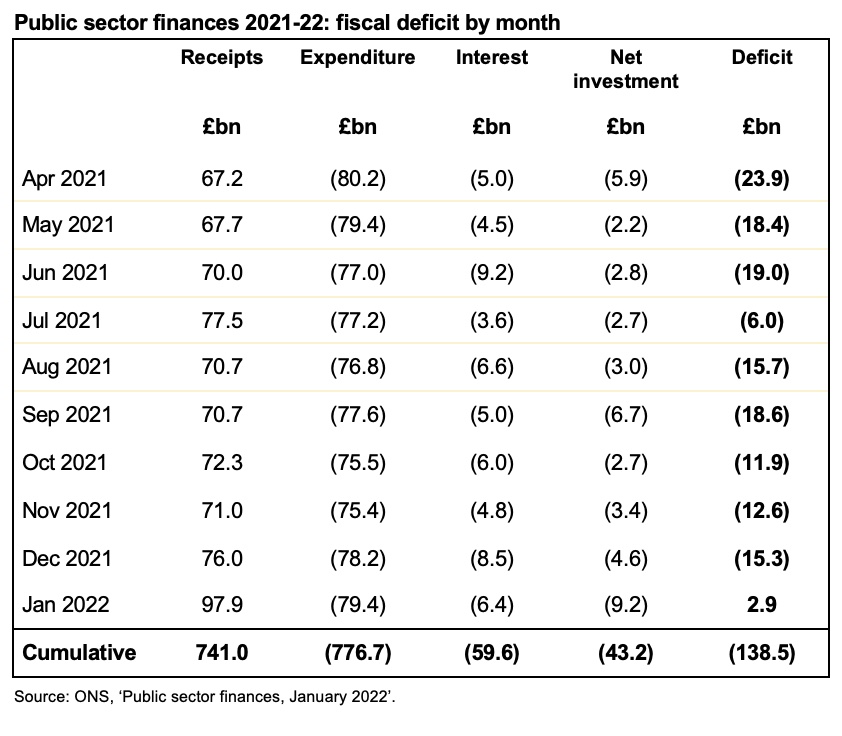
Table showing receipts, expenditure, interest, net investment and the deficit by month from Apr 2021 to Feb 2022.

Click on link below to the article on the ICAEW website for a readable version of this table.

This article was originally published by ICAEW.

ICAEW chart of the week: pre-Spring Statement debt forecast

This week’s chart reviews the sharp increase in the national debt to GDP ratio as we reflect on the challenges facing Chancellor Rishi Sunak.

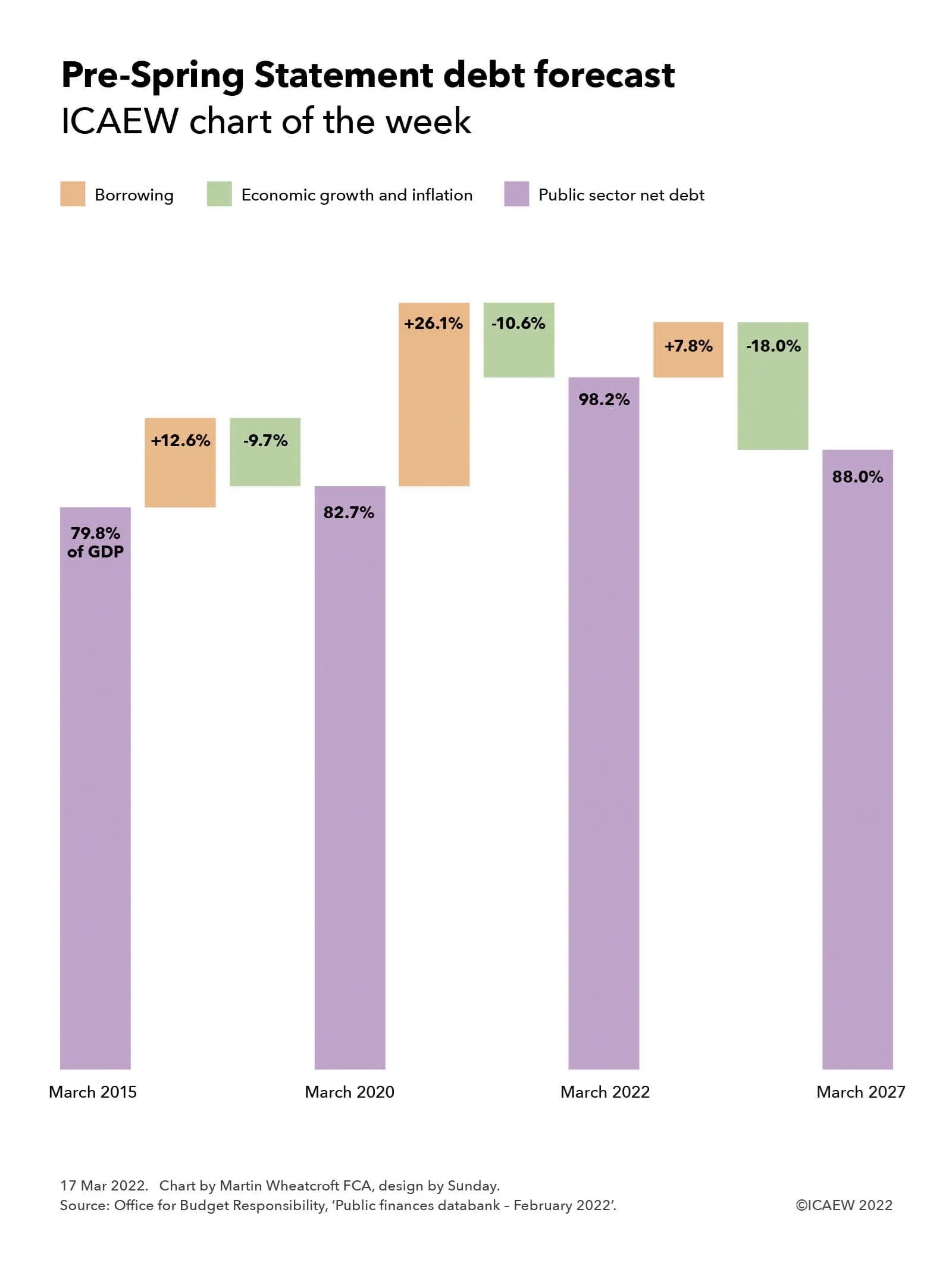
Step chart showing changes in the debt to GDP ratio.

March 2015: 79.8% +12.6% borrowing -9.7% economic growth and inflation = 82.7% in March 2020.

82.7% + 26.1% - 10.6% = 98.2% in March 2022

98.2% + 7.8% - 18.0% = 88.0% forecast for March 2027.

Better tax receipts and higher inflation are expected to contribute to an improvement in the fiscal forecasts that will accompany the Spring Statement on 23 March 2022, further increasing the pressure on the Chancellor to do more to support households and businesses facing spiralling energy prices and a cost-of-living crisis.

Our chart this week is based on the latest official forecast for public sector net debt prior to its update on 23 March 2022 at the Spring Statement. The chart highlights how it took five years for debt to increase from 79.8% to 82.7% as a share of GDP before leaping to a projected 98.2% over the two years to 31 March 2022 and then falling to a projected 88.0% at 31 March 2027.

The debt to GDP ratio is probably the most important key performance indicator used by most governments to assess their public finances, so much so that when ministers talk about reducing debt, they do not mean paying back the amounts owed to debt investors (unless they are in the German government). Instead, governments in most developed countries aim to borrow at a slower rate than the increase in the size of the economy, allowing the combination of economic growth and inflation to offset the often-significant sums of cash required to finance the shortfall between tax receipts and public spending.

This objective has been difficult to achieve over the past decade of low economic growth and low inflation, as illustrated by the increase in the UK’s debt to GDP ratio from 79.8% to 82.7% between 31 March 2015 and 2020. In cash terms, public sector net debt increased by £261bn from £1,532bn to £1,793bn over that five-year period, equivalent to 12.6% of a year’s GDP. The debt to GDP ratio only went up by 2.9 percentage points, with economic growth and inflation offsetting the increase in the amounts owed by the equivalent of 9.7% of GDP. (The objective would have been achieved but for a quirk in the choice of GDP measure used for this calculation by the Office for National Statistics in the UK, which is ‘mid-year GDP’; at 31 March 2020 this encompassed both the last six months of 2019/20 before the pandemic but also the first six months of 2020/21 and the lockdowns that occurred during that time, reversing some of the economic growth experienced in the preceding five years.)

The chart goes onto illustrate how the more than half a trillion pounds (£576bn or 26.1% of GDP) borrowed by the government in just two years over the course of the pandemic is partially offset by the economic recovery and a great deal more inflation, reducing the impact on the debt to GDP ratio by the equivalent of 10.6%.

Debt as a share of GDP over the next five years is then expected to decline, with a projected net addition of £198bn (7.8% of GDP) expected to be added to debt according to last October’s forecast. Projected public sector net debt of £2,567bn at 31 March 2027 is currently expected to be lower in proportion to the size of the economy at 88.0% of GDP, as the post-pandemic recovery and already forecast higher rates of inflation cause GDP to rise at a faster rate than the government can borrow, resulting in a reduction equivalent to 18.0% of GDP.

The official projections for the current financial year, prepared last October by the Office for Budget Responsibility (OBR), are expected to be revised upwards to incorporate the stronger tax receipts reported in recent monthly public sector finance reports and higher levels of GDP from even higher rates of inflation than previously expected. These effects are likely to combine to reduce the 98.2% of GDP forecast for debt for the end of March 2022 by several percentage points.

There is a much greater deal of uncertainty about how the OBR’s medium-term projections will deal with the potential future path of the pandemic, the cost-of-living squeeze on household incomes, and the effect of the war in Ukraine and sanctions on Russia on UK businesses. This is in addition to its normal difficulty in both measuring and forecasting the trillions of financial transactions that are undertaken every year in an economy of more than 67m people.

Many economic commentators expect stronger tax receipts and higher inflation to flow through to the projections for the next five years, even after taking account of the increased interest costs that come from higher rates of inflation and higher interest rates and the already announced package of support measures for households struggling with energy price rises. This should in theory result in a substantial improvement in the projected debt to GDP ratio in March 2027 from the 88.0% previously forecast, but what we won’t know until the Spring Statement is to what extent Chancellor Rishi Sunak intends to spend some of that improvement.

Mixed signals mean that it is difficult to tell to whether there will be an improvement to the support package to households facing large rises in their energy costs and the prices they pay for food and other essentials, whether the Chancellor will also choose to reduce fuel duties to help motorists, and how far he will opt to support businesses affected by substantially higher input costs in addition to the knock-on effects of the war in Ukraine and sanctions on Russia. Not to mention the political pressure on the Chancellor to announce increases in the defence budget now rather than waiting for the Autumn Budget.

For what was envisioned as a quiet fiscal occasion dealing with routine revisions to the fiscal forecasts, the Spring Statement has turned into a significant fiscal event. After all, even if the Chancellor decides to do nothing, that will still be a choice, with major implications for the public finances and the UK economy.

As the sage once said (or possibly didn’t), we live in fiscally interesting times.

This chart was originally published by ICAEW.

ICAEW chart of the week: NZ government balance sheet

Our chart this week delves into New Zealand’s public finances, one of the very few developed countries to have a government balance sheet with positive net assets.

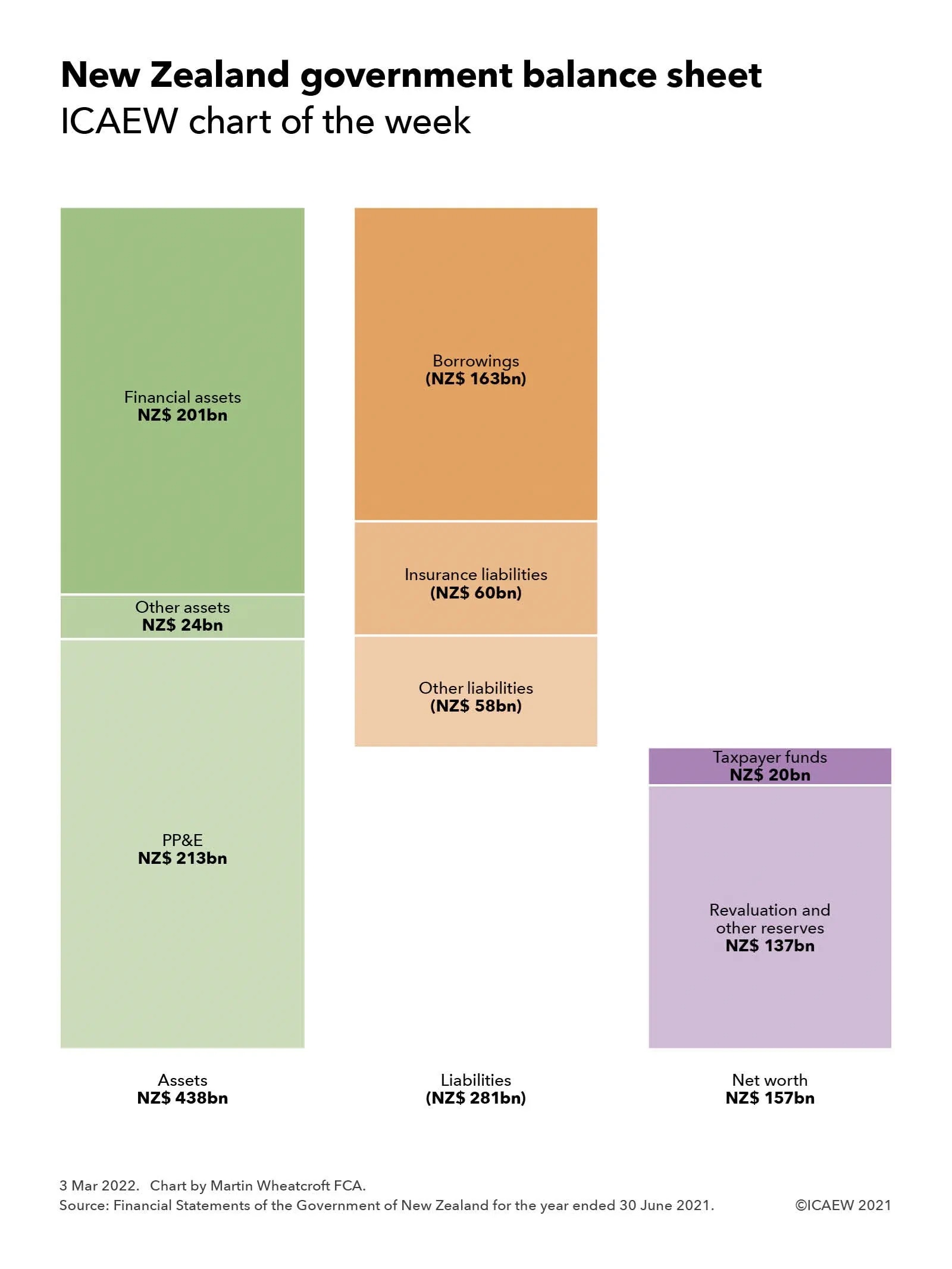
Step chart illustrating New Zealand government balance sheet.

Assets NZ$438bn = PP&E NZ$ 213bn + Other assets NZ$ 24bn + Financial assets NZ$ 201bn.

Liabilities NZ$ 281bn = Borrowings NZ$ 163bn + Insurance liabilities NZ$ 60bn + Other liabilities NZ$ 58bn.

Net worth NZ$ 157bn = Taxpayer funds NZ$ 20bn + Revaluation and other reserves NZ$ 137bn.

The signing of the UK-New Zealand Free Trade Agreement on 28 February 2022 prompted us to take a look at New Zealand’s public finances, one of the few developed countries with public assets in excess of public liabilities, and a pioneer of accruals accounting in government.

Our chart this week summarises the total crown balance sheet reported in the Financial Statements of the Government of New Zealand for the year ended 30 June 2021, comprising assets of NZ$438bn (£223bn) less liabilities of NZ$281bn (£143bn) to give net worth of NZ$157bn (£80bn).

New Zealand is a leading country in adopting accruals accounting for use in government, with the financial statements prepared in accordance with New Zealand-adopted accruals-based International Public Sector Accounting Standards (IPSAS), which are aligned with IFRS with some adaptation for the public sector. The New Zealand government not only uses IPSAS for financial accounting and reporting, similar to how the UK’s Whole of Government Accounts is based on IFRS, but they also use these standards for budgeting, management accounting and fiscal target setting. This contrasts with the UK, which uses a distinct UK-specific ‘resource’ accounting framework for budgeting and management accounting, and the statistics-based National Accounts system for fiscal target setting.

The asset side of the balance sheet includes NZ$213bn (£109bn) of property, plant and equipment, other non-financial assets of NZ$24bn (£12bn) and financial assets of NZ$201bn (£102bn). The latter includes marketable securities, student loans, residential loans and other financial investments in addition to receivables and cash.

Liabilities include NZ$163bn (£82bn) of borrowings, insurance liabilities of NZ$ 60bn (£31bn) and other liabilities of NZ$58bn (£30bn). Insurance liabilities are relatively high compared with many other countries as a consequence of New Zealand’s unique national no-fault accident compensation scheme that covers everyone in the country, including visitors.

Net worth is made up of taxpayer funds of NZ$20bn (£10bn) and reserves of NZ$137bn (£70bn), with the latter comprising a property revaluation reserve of NZ$134bn (£68bn) and minority interests of NZ$6bn (£3bn) less negative reserves of NZ$3bn (£1bn) principally relating to defined benefit retirement plans and veterans disability entitlements.

With a population of 5.1m, net worth on a per capita basis at 30 June 2021 is equivalent to approximately NZ$31,000 (£16,000) per person, comprising NZ$86,000 (£44,000) in assets per person less NZ$55,000 (£28,000) in liabilities per person. This compares with the approximate negative net worth of £37,000 per person based on the UK Whole of Government Accounts at 31 March 2019, comprising £31,000 in assets per person less £68,000 in liabilities per person.

While some caution needs to be taken in comparing these amounts given differences in accounting policies and the exclusion of local government from the New Zealand numbers, they do provide an insight into how on a proportional basis the New Zealand public sector is much better capitalised than the UK public sector.

While there are significant differences between the economies of New Zealand and the UK that no doubt explain the respective strengths and weaknesses of their public balance sheets, the presence of accountants in New Zealand’s highest office, most recently Sir John Key (prime minister 2008-2016), may also have something to do with it.

This chart was originally published by ICAEW.

Boost to tax revenues is a dilemma for the Chancellor

January’s public sector finance surplus of £2.9bn was driven by a boost to tax revenues as inflation drove up VAT receipts and self assessment income grew, putting further pressure on Chancellor Rishi Sunak to increase support to households facing huge rises in energy prices.

The public sector finances for January, released on 22 February, reported a surplus for the month of £2.9bn. This was an improvement of £5.4bn from the deficit of £2.5bn reported for January 2021, but £7bn smaller than the £9.9bn surplus reported for January 2020.

Total receipts were £97.9bn in January, up from £76.0bn in the previous month.

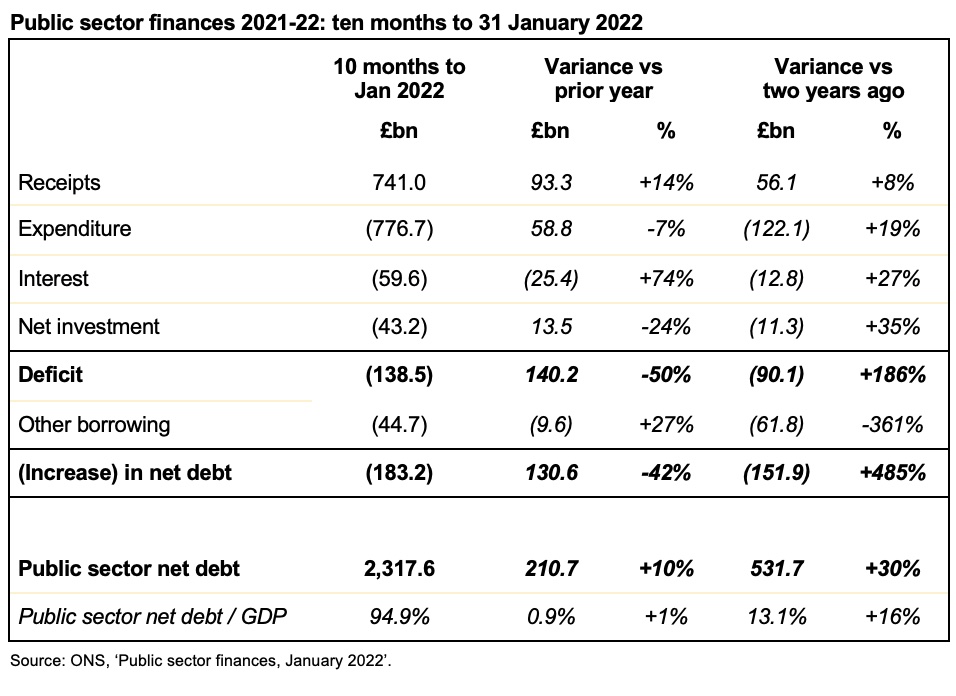
Public sector net debt fell from £2,339.7bn at the end of December to £2,317.6bn or 95% of GDP at the end of January, with tax and loan recoveries supplementing the surplus for the month. Despite that, debt is £210.7bn higher than at the start of the financial year and £524.5bn higher than in March 2020.

The cumulative deficit for the first 10 months of the financial year was £138.5bn, compared with £278.7bn and £48.4bn for the same period last year and the year before that respectively.

This was £17.7bn below the forecast published by the Office for Budget Responsibility (OBR) alongside last October’s Autumn Budget and Spending Review 2021, although higher than forecast tax receipts were partially offset by higher than forecast interest charges on index-linked debt. Both are driven by higher rates of inflation, which takes more time to feed through to non-interest expenditure.

Cumulative receipts in the first 10 months of the 2021/22 financial year amounted to £741bn, £93.3bn or 14% higher than a year previously, but only £56.1bn or 8% above the level seen in the first 10 months of 2019/20. At the same time, cumulative expenditure excluding interest of £776.7bn was £58.8bn or 7% lower than the same period last year, but £122.2bn or 19% higher than two years ago.

Interest amounted to £59.6bn in the 10 months to January 2022, £25.4bn or 74% higher than the same period in 2020/21, principally because of the effect of higher inflation on index-linked gilts. Interest costs were £12.8bn or 27% more than in the equivalent 10-month period ended 31 January 2020.

Cumulative net public sector investment up to January 2022 was £43.2bn. This was £13.5bn or 24% below the £56.7bn reported for the first 10 months of last year, which included around £17bn of COVID-19-related lending that the government does not expect to recover. Investment was £11.3bn or 35% more than two years ago, principally reflecting greater capital expenditures, including on HS2.

The increase in debt of £183.2bn since the start of the financial year comprises the cumulative deficit of £138.5bn and £44.7bn in other borrowing. The latter has been used to fund lending to banks through the Bank of England’s Term Funding Scheme, lending to businesses via the British Business Bank (including bounce-back and other coronavirus loans), student loans, and other cash requirements, net of the recovery of taxes deferred last year and loan repayments.

Alison Ring OBE FCA, Public Sector and Taxation Director for ICAEW, said: “The strong tax receipts reported today will provide a welcome respite for the public finances, reducing the shortfall in the government’s income compared with its expenditure from previous forecasts. However, the deficit is still on track to be the third highest ever recorded in peacetime, while public debt is more than half a trillion pounds higher than it was at the start of the pandemic.

“The challenge for Sunak will be balancing the strong pressures on him to increase the support package for households facing rapidly rising energy costs and retail prices, with the need to strengthen the resilience of the public finances in the face of a great deal of economic uncertainty and increasing global security concerns. The Chancellor will be acutely aware that while inflation is adding to tax revenues today it will go on to add to public spending tomorrow”.

Table showing receipts, expenditure, interest, net investment, deficit, other borrowing the increase in net debt for the 10 months to Jan 2021 and public sector net debt and public sector net debt / GDP at 31 Jan 2021 together with variances versus prior year and two years ago.

Click on link at the end of this article to the version of this article on the ICAEW website which has a readable version of this table.

Caution is needed with respect to the numbers published by the ONS, which are expected to be repeatedly revised as estimates are refined and gaps in the underlying data are filled.

The ONS made a number of revisions to prior month and prior year fiscal numbers to reflect revisions to estimates. These had the effect of decreasing the reported fiscal deficit for the nine months to December 2021 from £146.8bn to £141.4bn and increasing the deficit for the year ended 31 March 2021 from £321.8bn to £321.9bn.

Table showing receipts, expenditure, interest, net investment and the deficit for each of the 10 months to Jan 2021.

Click on link below to the version of this article on the ICAEW website which has a readable version of this table.

This article was originally published by ICAEW.

ICAEW chart of the week: National Insurance Fund 2020-21

We take a look at the Great Britain National Insurance Fund, illustrating how the balance in the fund grew from the equivalent of 4.2 months of annual payments to 4.6 months over the course of 2020-21.

Step chart showing movements in the Great Britain National Insurance Fund in 20201/21.

Opening balance £37bn (4.2 months of payments) + receipts £140bn - NHS £26bn - payments £109bn = closing balance £42bn (4.6 months of payments).

One of the many myths about the UK’s public finances is around the use of the word ‘fund’. This is often assumed to imply there is a pot of money set aside to cover spending requirements, when in practice it tends to refer to a budget allocation. An example is the National Productivity Investment Fund that was announced in 2016, which turned out to refer to unallocated amounts within the government’s budget for capital expenditure over several years.

Despite this terminology there are some actual ‘funds’ that have a legal basis and which have money in them, such the Contingencies Fund, where cash of £425bn passed through its accounts in response to the pandemic last year (up from £17bn in the previous year). However, net assets remained unchanged by this tidal wave of money at just £2m, highlighting how many such funds are principally mechanisms to facilitate the flow of money around government on the way to its intended destination.

The Great Britain National Insurance Fund and the Northern Ireland National Insurance Fund are perhaps the most well known of these funds, being the source of payments for the state pension and contributory welfare benefits. Surprisingly, there is a balance in these funds, which caused some excitement in a House of Lords debate last year when a peer decided that this was a pot of money that could be used to fund more spending.

Before getting too excited, it is important to understand that although the £42bn in the Great Britain National Insurance Fund sounds like a large amount of money, the reality is that it is more akin to a float, representing less than five months’ worth of annual payments from the fund and a relatively small fraction of the trillions of pounds in future payments expected to be paid out of the fund over the next quarter of a century and beyond. Likewise for the £1bn in the Northern Ireland National Insurance Fund.

In addition, when you delve into the accounts, you discover that most of the balances are invested in HM Treasury’s Debt Management Account, which are in effect intercompany balances (or ‘intra-government’ to be more technically accurate).

As our chart illustrates, the Great Britain National Insurance Fund had a balance of £37bn on 1 April 2020, equivalent to about 4.2 months of expenditure in the 2019/20 financial year. National Insurance receipts in Great Britain (ie, not including Northern Ireland) amounted to £140bn during 2020/21, including £3bn from other tax receipts to make up for contributions not received for those on statutory maternity, paternity, parental or bereavement pay.

Some £26bn of the national insurance contributions was deducted and sent off to help pay for the NHS, reducing the amount added to the fund to £114bn, while payments from the fund during the year amounted to £109bn. The latter comprised £100.4bn for the state pension, £5.2bn to cover contributory welfare benefits (employment and support allowance and jobseeker’s allowance), £0.9bn in administration costs, £0.8bn in bereavement and maternity allowances, £0.7bn in transfers to the Northern Ireland equivalent fund, £0.5bn in redundancy payments and £0.2bn in other payments.

The £5bn or so of surplus was added to the balance of the fund, taking it to £42bn at 31 March 2021, equivalent to 4.6 months of annual payments.

To be fair to the noble lord concerned, it might well be possible to use some of the money in the fund by reducing the effective float balance by a month or two, at least on a one-off basis. However, in the context of public spending in excess of £1.2tn a year and public sector net debt of £2.3tn, it is not likely to go that far!

This chart was originally published by ICAEW.