ICAEW chart of the week: G7 economic growth

The latest IMF economic forecasts put the UK at the bottom of the pile in 2023, but our chart this week elevates the UK to fifth place out of seven by looking at average growth for the four years from 2020 to 2023.

Chart presenting economic growth for the G7 in 2020, 2021, 2022, 2023 and the average over four years.

USA: -3.4%, +5.7%, +3.7%, +2.3%, average +2.0%
Canada: -5.2%, +4.6%, +3.9%, +2.8%, average +1.4%
Germany: -4.6%, +2.8%, +2.1%, +2.7%, average +0.7%
France: -8.0%, +7.0%, +2.9%, +1.4%, average +0.7%
UK: -9.3%, +7.4%, +3.7%, +1.2%, average +0.6%
Japan: -4.5%, +1.6%, +2.4%, +2.3%, average +0.4%
Italy: -9.0%, +6.6%, +2.3%, +1.7%, average +0.2%

Recent media reports have contrasted the government’s boast of being the best performing economy in the G7 in 2021 with the latest forecasts from International Monetary Fund (IMF) that suggest the UK economy will be bottom of the same league in 2023. Our chart this week attempts to take a step back and look at the overall picture by illustrative average economic growth by the G7 nations over the four years between 2020 and 2023.

These numbers are based on the IMF’s World Economic Outlook and the accompanying World Economic Outlook Database that were published on 19 April, setting out economic forecasts for the world economy over the next few years.

According to the IMF, the USA is the best performing economy in the G7, with average annual economic growth of +2.0% over the period from 2020 to 2023. An economic contraction of 3.4% in 2020 was more than offset by a rebound of 5.7% in 2021, followed by forecast growth of 3.7% in 2022 and 2.3% in 2023. Canada is not far behind, with an average growth of 1.4% over the four years, comprising respectively -5.2%, +4.6%, +3.9% and +2.8% in 2020, 2021, 2022 and 2023.

Germany and France fare pretty similarly to each other, with Germany projected to experience marginally above 0.7% average growth and France marginally below. The patterns are different, however, with Germany having suffered a less severe economic hit during 2020 followed by moderate growth (-4.6%, +2.8%, +2.1%, 2.7%), while France was hit much harder by the pandemic followed by a much stronger rebound before a return to lower growth in 2023 (-8.0%, +7.0%, +2.9%, +1.4%).

The UK is in fifth place in this league table, but at 0.6% average economic growth over the four years selected this is only slightly less than Germany and France. With an economic contraction in 2020 of 9.3%, the UK suffered more severely from the pandemic than the other members in the G7 (although this is partly because of differences in statistical methodologies) but then saw the biggest rebound in 2021 with growth of 7.4%. Growth this year is forecast by the IMF to be 3.7% before falling to an (unfortunately) more typical level of 1.2% in 2023.

Vying for the wooden spoon are Japan and Italy, with Japan continuing a long period of low growth and a slower recovery from the pandemic than the others to average 0.4% a year (-4.5%, +1.6%, +2.4%, +2.3%). Italy secured the bottom position by virtue of being hit hardest by the pandemic and having less of a rebound than others (-9.0%, +6.6%, +2.3%, +1.7%), a net average growth rate of 0.2% over the four-year period.

For those that follow this particular league table, there is a hope that slightly stronger growth than the IMF has forecast could move the UK up one or two places above France and/or Germany. However, the bigger concern for most of us is about the downside risks to the global and UK economies from the war in Ukraine, rampant inflation, and a global cost of living crisis. These may put back even further any hope of returning the UK and other developed economies to a pre-financial crisis path of moderate economic growth.

This chart was originally published by ICAEW.

ICAEW chart of the week: UK International Reserves

We take a look at the UK’s official international reserves that are held to safeguard sterling and support monetary policy.

Step chart showing components of the UK International Reserves.

Gross reserves: £101bn foreign currency securities and deposits, £36bn IMF, £15bn gold, £23bn other instruments.

Liabilities: (£109bn) other instruments

Net reserves: £66bn

Our chart this week is on the UK International Reserves, which comprise foreign currency securities and deposits, gold, investments in the International Monetary Fund (IMF), and other financial instruments primarily used to manage sterling as a national currency and support monetary policy.

As illustrated by the chart, the combined total of UK government and Bank of England international gross reserves was £175bn at 31 March 2022, comprising £101bn in foreign currency securities and deposits, £36bn invested in the IMF, £15bn in gold and £23bn in other financial instruments. This was offset by £109bn in liabilities to arrive at net reserves of £66bn.

According to the Bank of England, the £101bn in foreign currency securities consisted of £75bn in bonds and notes issued by foreign governments, £15bn in foreign government money market investments, £6bn in foreign central bank deposits and £5bn in private sector securities. The £36bn invested the IMF comprises £6bn in IMF reserves (effectively the IMF’s share capital) and £31bn in Special Drawing Rights (SDRs), a government-specific financial asset underpinned by a basket of currencies (US dollar, Euro, Chinese Yuan, Japanese Yen and sterling). The UK government also owned or had rights to 9,976,041 fine troy ounces of gold worth £15bn on 31 March 2022, while other financial instruments of £23bn included £20bn of claims against counterparties on account of reverse repo transactions.

Reserve assets were offset by £109bn in liabilities, comprising loans and securities used to finance reserve assets, repo obligations, and derivative financial instruments including foreign currency forwards, cross currency interest rate swaps and sterling interest rate swaps.

Not shown in the chart is the split between the UK government’s net reserves of £66bn, consisting of £151bn in gross assets less £85bn in liabilities, and the Bank of England’s approximately zero net reserve position, consisting of £24bn in gross assets (£12bn in foreign currency securities and bonds plus £12bn in other financial instruments) less £24bn in liabilities.

The Bank of England manages both its own foreign currency reserves, used to support its monetary policy objectives of controlling inflation, and the UK government’s international reserves, most of which sit in the Exchange Equalisation Account established in 1932 to provide a fund that can be used, when necessary, to regulate the exchange value of sterling. In normal circumstances the Bank of England’s main objectives in managing the reserves are to ensure the liquidity of sterling, the liquidity and security of the reserve assets themselves, and to ensure the reserves are managed in a cost-effective way.

In normal circumstances, the reserves are not used to actively intervene in foreign exchange markets, but are kept ‘in reserve’ on a precautionary basis in case there is any change in exchange rate policy in the future or in the event of any unexpected shocks. More prosaically, they are used to provide foreign currency services for government departments and agencies needing to transact in foreign currencies, as well as to buy, hold and sell SDRs as required by the UK’s membership of the IMF.

Although relatively small in the context of over £1trn a year in UK public spending and £2.3trn in public sector net debt, the UK’s international reserves provide HM Treasury and the Bank of England with a substantial amount of firepower in the foreign exchange markets should there ever be a need to intervene to support sterling. Fortunately, almost all of the foreign currency securities and deposits held in the reserves are invested in governments and central banks of allied countries, a contrast to the position of Russia, which has seen a substantial proportion of its international reserves frozen following its invasion of Ukraine.

One piece of good news amid all the economic gloom at the moment is that the UK International Reserves aren’t hitting the headlines. Because when they do, you really will know that all is not well.

This chart was originally published by ICAEW.

ICAEW chart of the week: Spring Statement 2022

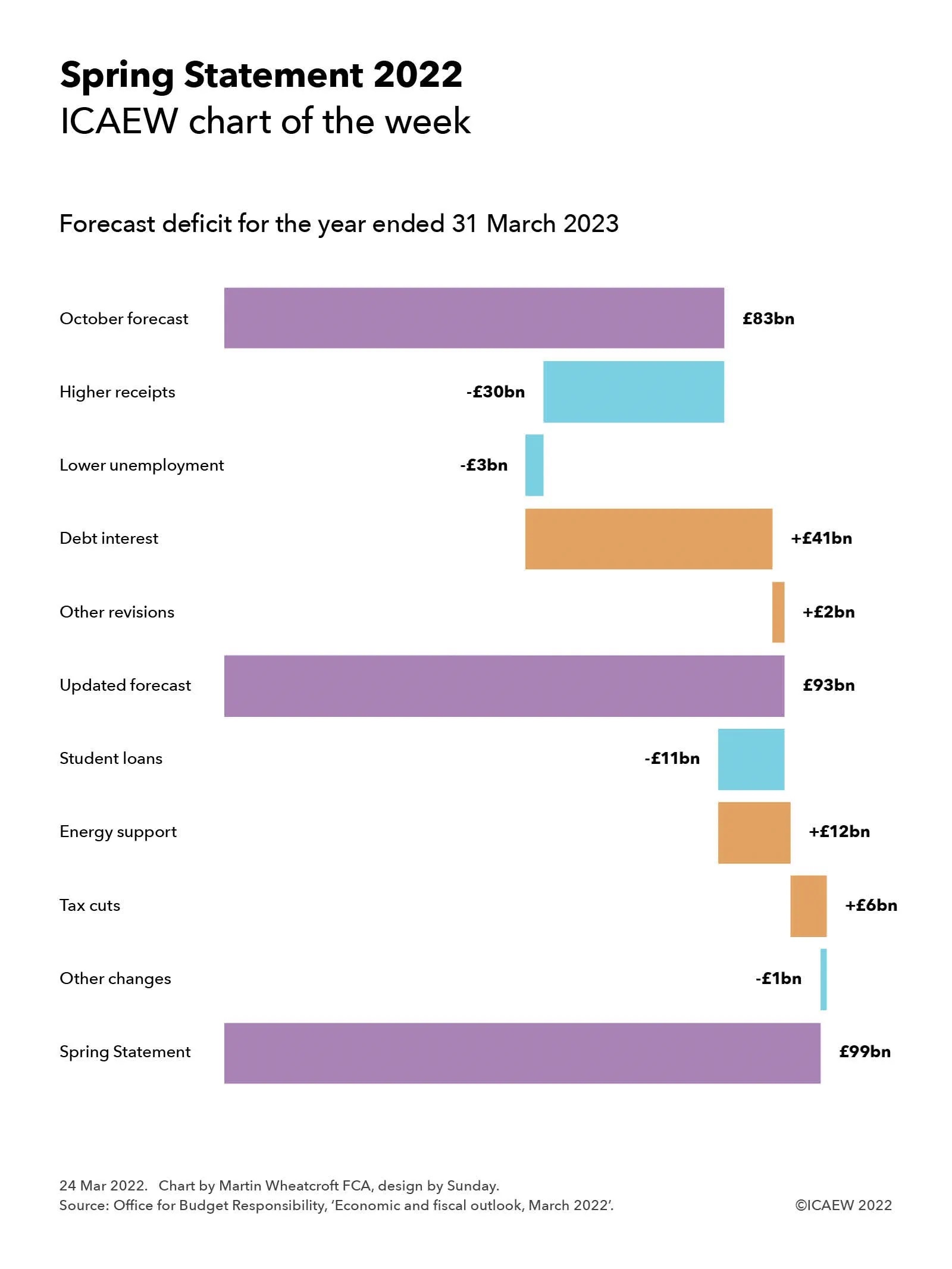
This week we look at the Spring Statement, where the story is all about inflation as the Chancellor responded to the pressures that have contributed to the cost of living crisis.

Step chart showing changes from the October forecast for the deficit in 2022/23 and the revised Spring Statement forecast for the same period.

October forecast £83bn - higher receipts £30bn - lower unemployment £3bn + debt interest +£41bn + other revisions £2bn = updated forecast of £93bn.

The - student loans £11bn + energy support £12bn + tax cuts £6bn - other changes £1bn = Spring Statement forecast of £99bn.

What Chancellor Rishi Sunak had originally hoped would be a short report to Parliament on the latest economic and fiscal forecasts turned into a fully-fledged fiscal event as he responded to a ‘cost of living’ crisis that is expected to put severe pressure on household budgets and is risking the viability of many businesses. The Office for Budget Responsibility (OBR) estimates that the Chancellor’s energy support package and tax cuts will cover around a third of the decline in living standards expected in the coming financial year.

Inflation is now centre stage in a way that it hasn’t been since the 1970s.

Our chart summarises the changes in the forecast for fiscal deficit the coming financial year commencing on 1 April 2022, showing how last October’s forecast of a £83bn shortfall between receipts and expenditure has increased to a £99bn shortfall in the latest forecasts by the OBR.

The good news is that the economic recovery from the pandemic has been stronger than previously thought, with the pandemic support measures such as the furlough scheme being rewarded with stronger tax receipts coming through into the forecasts. An extra £30bn is expected in 2022/23, complemented by lower unemployment than expected, which also reduces the forecast for welfare spending by an estimated £3bn.

Offsetting that is a huge rise in interest costs. This is driven by a sharp rise in the retail prices index (RPI), to which a substantial proportion of the government’s debt is linked, combined with higher interest rates as the Bank of England attempts to prevent inflation rising even further. These factors add an extra £41bn to the forecast interest bill for next year, bringing it up to £83bn, three and a half times the £24bn in 2020/21 and more than 50% higher than the £54bn now expected for the current financial year. Interest in subsequential financial years has been revised up by around £9bn a year on the basis (the forecasters hope) that inflation is brought back under control in 2023/24.

Other changes to the fiscal forecast add £2bn to the deficit forecast, bringing it up to £93bn before taking account of policy decisions announced since last October. The first, which for some reason was not highlighted by the Chancellor in his speech, was the impact of increasing the amounts that graduates will have to repay on their student loans, reducing the anticipated bad debt write-off in 2022/23 by £11bn from the estimate made last October.

The Chancellor did talk about the energy support package that he announced last month as the energy prices rises coming in April were announced. However, he did not add to that package directly – instead choosing to announce tax cuts of about £6bn in 2022/23. The main element is an increase from July of around £3,000 in the threshold at which National Insurance is payable by employees, which will benefit many low to middle income families, but not (as the Institute for Fiscal Studies, the Resolution Foundation and others have pointed out) the very poorest that will be hit hardest by price rises. More than two thirds of the benefit will go to higher income households.

Overall, the OBR says the energy support package and tax cuts together will offset around a third of the fall in living standards that is expected in the coming year.

Other policy changes amounting to around £1bn were offset by indirect effects of £2bn, resulting in a net £1bn benefit to bring the forecast deficit to £99bn, some £16bn higher in total than that predicted in October.

These numbers don’t include the 1p cut in the basic rate of income tax from 6 April 2024 that was also announced by the Chancellor. This is expected to cost around £6bn a year in lower tax receipts, but is expected to be more than offset by the effect of freezing both income tax and national insurance thresholds (expected to bring in somewhere in the region of £18bn extra a year). In effect, the Chancellor has chosen to bank the ‘benefit’ of higher inflation on his decision to freeze thresholds.

The big question is whether the Chancellor will be able to hold off from providing further support to households and businesses for the rest of the financial year. Most commentators appear to suggest that it is likely that he will return to the despatch box in the House of Commons before the next round of energy prices rises in October in order to make further announcements.

This article was originally published by ICAEW.

A Spring Statement dominated by inflation

Tax plans brought forward as Chancellor Rishi Sunak seeks to limit spending commitments and build fiscal headroom ahead of the Autumn Budget.

Inflation dominated the Spring Statement as the Chancellor added to his support package for households and businesses facing rapidly rising prices but held off giving any extra money for public services.

Despite a major tax cut from raising National Insurance thresholds, the OBR estimates that the measures announced by the Chancellor for the coming financial year will offset around a third of the fall in living standards. This will leave household budgets to take most of the strain of the rapidly rising prices, with the potential that the government will need to intervene again later in the year as the impact becomes clearer.

The biggest individual change in the government’s spending plans is the bill for interest on central government debt, which increases from £24bn in 2020/21 to £54bn this year and a forecast of £83bn for 2022/23. This is the biggest driver of an increase in the forecast deficit for next year from last October’s forecast of £62bn to a revised forecast of £99bn, despite an £11bn boost from restructuring the system for student loans that could see graduates paying back their loans almost up until retirement.

Despite the increase in the coming financial year, the OBR expects the deficit in the rest of the forecast period to be lower than before, with the projected deficits in the subsequent four years up to 2026/27 down from £62bn, £46bn, £46bn and £44bn to £50bn, £37bn, £35bn and £32bn – a net improvement of £11bn a year on average. 

Higher tax receipts are the primary driver of a reduced forecast for public sector net debt at 31 March 2027 of £2,480bn, down from a previous forecast of £2,567bn, but still £687bn higher than the £1,793bn at 31 March 2020. The impact on the debt-to-GDP ratio is greater, with lower cash outflows and higher GDP driven by inflation combining to reduce the ratio from a previous forecast of 88% in 2027 to 83%, reversing a significant proportion of the increase caused by the pandemic.

The OBR calculates that the Chancellor has about £30bn of headroom against his fiscal targets, giving him more capacity to provide additional support for households and businesses later in the year if he thinks it necessary. Given the uncertainties surrounding the potential impact of Russia’s invasion of Ukraine on the UK economy, it is perhaps understandable for Rishi Sunak to want to accelerate the reduction in debt in relation to the size of the economy and build greater fiscal resilience. However, he will be conscious of the risk of a recession if households cut back their spending in the domestic economy by too much.

Other than some welcome additional funding to tackle fraud, there was no significant additional funding for departments or local authorities who will need to stick within their original budgets set by the three-year Spending Review announced last October. This could result in ‘unplanned austerity’ as they seek to find savings to offset rising costs, in particular the government’s capital investment plans, where the cost of building infrastructure is likely to increase significantly, potentially jeopardising priorities such as levelling up.

Alison Ring, Director of Public Sector and Taxation, commented: “The story of the Spring Statement is inflation, which is driving a sharp fall in living standards and is causing the interest bill on public debt to multiply. The government has responded with a package of measures that the OBR estimates offset about a third of the decline, but this still leaves household budgets exposed to the effect of rapidly rising prices. The Chancellor’s focus on building up fiscal resilience suggests he may be trying to preserve some firepower for possible further interventions later in the year.

“With public finances in a better shape than previously forecast, the Chancellor will hope that he is going to be able to make good on his pledge to cut income tax in 2024.”

This article was originally published by ICAEW.

Spring Statement: what the new measures will mean

ICAEW Insights quotes me in an article on the Spring Statement 2022:

“Despite its impact on the government’s interest bill, there is a major benefit to inflation in that it helps bring down the debt-to-GDP ratio more quickly, providing the Chancellor more space to intervene to help with the cost of living,” Martin Wheatcroft, public finance adviser to ICAEW, explains.

According to the OBR, the new measures announced in the Spring Statement, along with the existing package announced previously, should offset around a third of the increase in costs that households are facing, leaving them with the burden of the other two-thirds, Wheatcroft says. “I think we should expect further measures from the Chancellor in the summer or autumn as the impacts on households become more apparent.”

Wheatcroft adds that it is likely that some of the announcements included in the Spring Statement were brought forward to ease tensions with backbenchers. “With members of his own party pressing for a delay in the NIC increase, I suspect the Chancellor felt pressure to bring forward measures that he may have been saving for later in the year, in particular his planned cut to income tax in 2024 and a tax plan that was likely set for a summer release ahead of the Autumn Budget.”

To read the full article, click here.

Public finances raise hopes for Spring Statement giveaway

February’s £13.1bn deficit was offset by revisions to prior month estimates, boosting public finances and putting further pressure on the Chancellor to provide more help to households and businesses facing rapidly rising prices.

The public sector finances for February 2022, released on Tuesday 22 March 2022, reported a deficit for the month of £13.1bn. This was an improvement of £2.4bn from the deficit of £15.4bn reported for February 2021, but £12.8bn worse than the £0.4bn deficit reported for February 2020.

The cumulative deficit of £138.4bn for the first 11 months of the 2021/22 financial year was £0.1bn less than that reported last month, as the £13.1bn deficit for February was offset by £13.2bn in revisions to prior month estimates.

Public sector net debt increased by £6.6bn from £2,320.2bn at the end of January to £2,326.8bn or 94.7% of GDP at the end of February, with tax and loan recoveries partly offsetting the deficit for the month. Despite that, debt is £192.4bn higher than at the start of the financial year and £533.7bn higher than March 2020.

The year-to-date deficit of £138.4bn compares with a cumulative deficit for the first 11 months of the financial year of £290.9bn in 2020/21 and £48.7bn in 2019/20. This was £25.9bn below the forecast published by the Office for Budget Responsibility alongside last October’s Autumn Budget and Spending Review 2021, with higher-than-forecast tax receipts being partially offset by higher-than-forecast interest charges on index-linked debt. Both are driven by higher rates of inflation, which takes more time to feed through to non-interest expenditure. This suggests that the deficit for the full year could end up somewhere in the region of £30bn below the official forecast of £183bn.

Cumulative receipts in the first 11 months of the 2021/22 financial year amounted to £826.0bn – £104.7bn or 15% higher than a year previously but £69.3bn or 9% above the level seen in the first 11 months of 2019/20. At the same time, cumulative expenditure excluding interest of £846.2bn was £65.1bn or 7% lower than the same period last year, but £127.4bn or 18% higher than two years ago.

Interest amounted to £69.2bn in the eleven months to 28 February 2022, which was £29.4bn or 74% higher than the same period in 2020/21, principally because of the effect of higher inflation on index-linked gilts. Interest costs were £17.8bn or 35% more than in the equivalent 11-month period ended 29 February 2020.

Cumulative net public sector investment up to February 2022 was £49.0bn. This was £12.1bn or 20% below the £29.7bn reported for the first 11 months of last year, which included around £17bn of COVID-19 related lending that the government does not expect to recover. Investment was £13.8bn or 39% more than two years ago, principally reflecting greater capital expenditures, including on HS2.

The increase in debt of £192.4bn since the start of the financial year comprises the cumulative deficit of £138.4bn and £54.0bn in other borrowing. The latter has been used to fund lending to banks through the Bank of England’s Term Funding Scheme, lending to businesses via the British Business Bank (including bounce-back and other coronavirus loans), student loans and other cash requirements, net of the recovery of taxes deferred last year and loan repayments.

Alison Ring OBE FCA, Public Sector and Taxation Director for ICAEW, says: “Today’s numbers show the impact inflation is having on the public finances as it continues to drive both tax receipts and interest costs higher. The deficit for the financial year is expected to be around £30bn lower than October’s official forecast of £183bn, while tomorrow’s Spring Statement forecasts could see a smaller deficit next year than the £62bn expected before the pandemic.

“Uncertainty about the impact of the war in Ukraine on the UK means it will be extremely difficult for the Chancellor to gauge the level of intervention needed to support households and businesses facing rocketing energy prices if he’s to avoid a recession that could permanently damage the economy and the public finances, and still leave room for tax cuts in the Autumn Budget.”

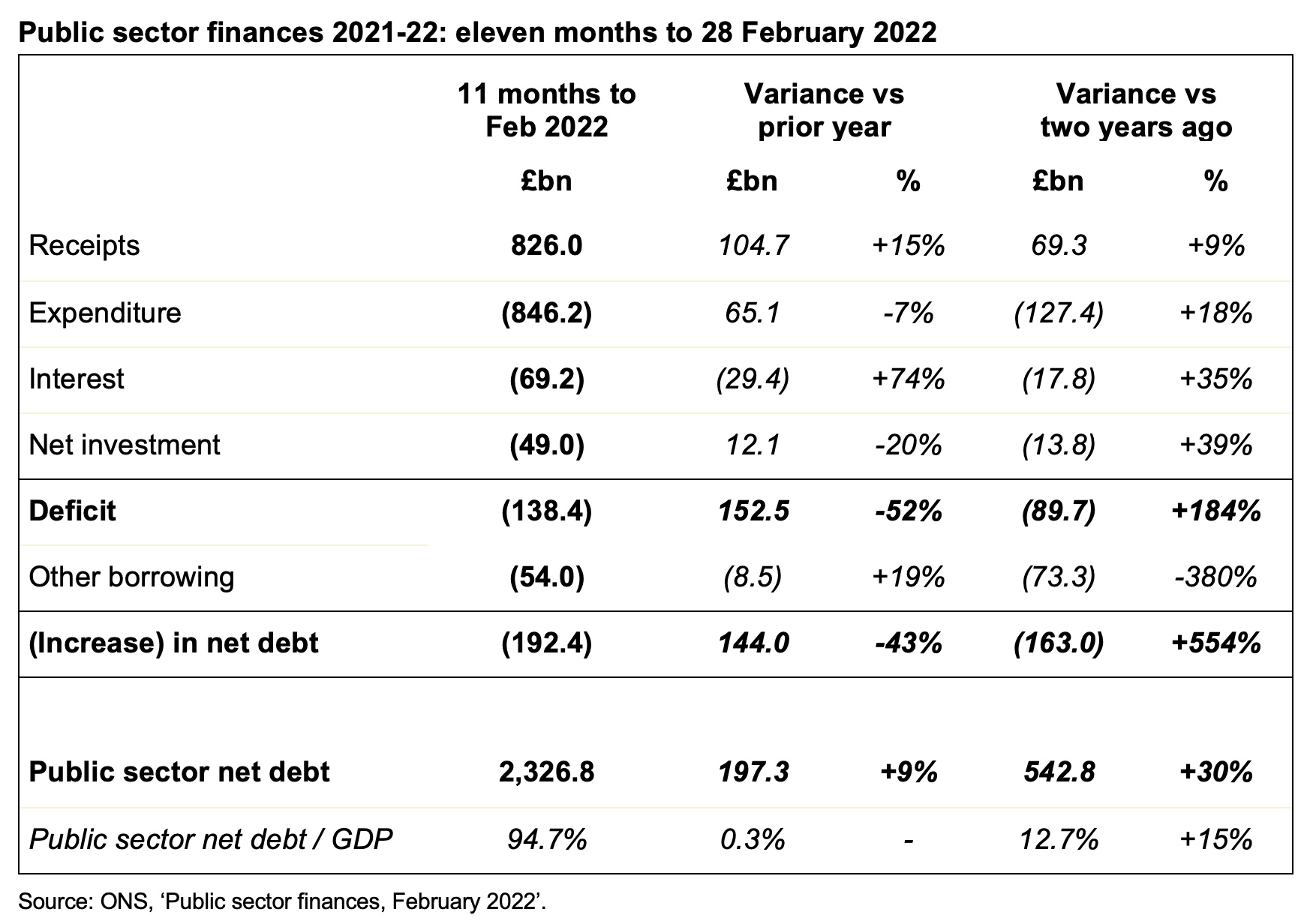
Table showing cumulative 11 month numbers and variances against prior year and two years ago. All amounts in £bn, with negative numbers in brackets (costs / negative variances).

Receipts 826.0: 104.7 +15% better than prior year; 69.3 +9% versus two years ago

Expenditure (846.2): 65.1 -7%; (127.4) +18%

Interest (69.2): (29.4) +74%; (17.8) +35%

Net investment (49.0): 12.1 -20%; (13.8) +39%

Subtotal Deficit (138.4): 152.5 or -52% lower than the prior year; (89.7) +184% higher than two years ago

Other borrowing (54.0): (8.5) +19%; (73.3) -380%

Total (Increase) in net debt (192.4): 144 -43%; (163.0) +554%

Also:

Public sector net debt 2,326.8: 197.3 or +9% higher than prior year and 542.8 +30% higher than two years ago

Public sector net debt / GDP 94.7%: 0.3% or 0% higher than prior year; 12.7% or +15% higher than two years ago.

Caution is needed with respect to the numbers published by the Office for National Statistics (ONS), which are expected to be repeatedly revised as estimates are refined and gaps in the underlying data are filled.

The ONS made a number of revisions to prior month and prior year fiscal numbers to reflect revisions to estimates. These had the effect of decreasing the reported fiscal deficit for the 10 months to January 2022 by £13.2bn from £138.5bn to £125.3bn and reducing the deficit for the year ended 31 March 2021 by £4.1bn from £321.9bn to £317.8bn.

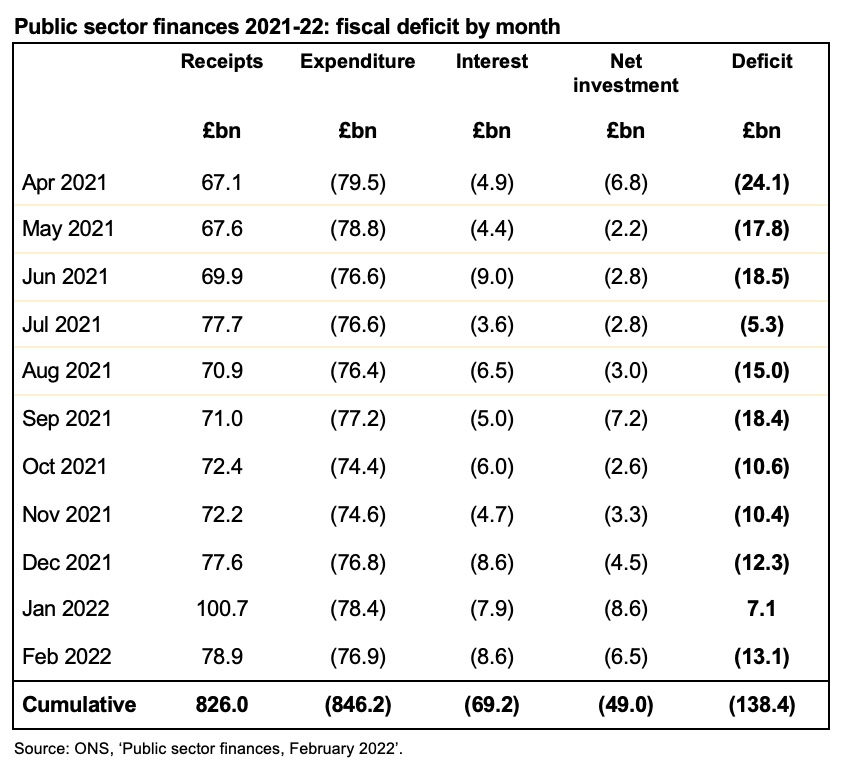
Table showing receipts, expenditure, interest, net investment and the deficit by month from Apr 2021 to Feb 2022.

Click on link below to the article on the ICAEW website for a readable version of this table.

This article was originally published by ICAEW.

ICAEW chart of the week: Europe’s gas supply

Our chart this week looks at Europe’s natural gas supply and its current reliance on Russian gas to keep homes warm, businesses operating and gas-fired power plants generating.

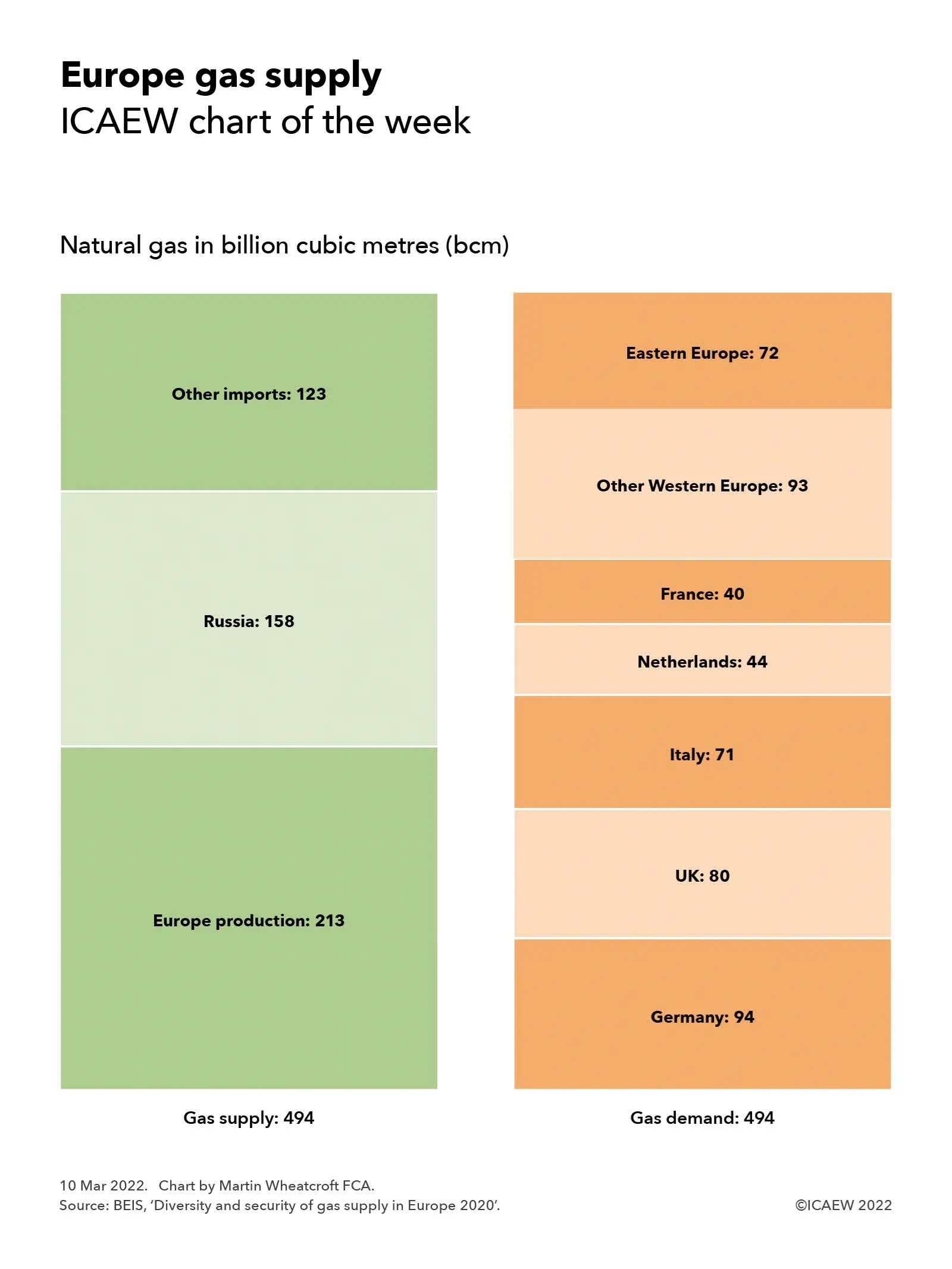
Two-column chart on Europe's supply of natural gas in billion cubic metres (bcm) in 2020.

Gas supply of 494bn, comprising Europe production of 213bcm, imports from Russia 158bcm and other imports of 123bcm.

Gas demand: Germany 94bcm, UK 80bcm, Italy 71bcm, Netherlands 44bcm, France 40bcm, other Western Europe 93bcm, Eastern Europe 72bcm.

Europe’s gas supply in 2020 amounted to 494 billion cubic metres (bcm) of natural gas, comprising 213bcm (43%) of domestic production (principally from the North Sea), 158bcm (32%) imported from Russia, and 123bcm (25%) imported from other sources.

For this purpose, Europe excludes Russia, Belarus and Ukraine and these numbers also don’t take account of movements into and out of gas storage. For reference, 1bc) = 38.2 petajoules (PJ) = 10.6 terawatt hours (TWh) = 36.2trn British Thermal Units (BTU).

The biggest users of gas are Germany, the UK, Italy, Netherlands and France, which consumed approximately 94bcm, 80bcm, 71bcm, 44bcm and 40bcm respectively, together adding up to 329bcm or 67% of the total. Other western European countries consumed 93bcm of gas in 2020, including Spain (32bcm), Belgium (18bcm), Austria (9bcm), Portugal (6bcm), Greece (6bcm), Ireland (5bcm), Norway (5bcm), Switzerland (4bcm) and Denmark (3bcm).

Eastern European countries consumed 72bcm, including Poland (22bcm), Romania (12bcm), Hungary (11bcm), Czechia (9bcm), Slovakia (5bcm) and Bulgaria (3bcm). The Baltic states together consumed 4bcm.

Domestic production of 213bcm includes 116bcm from Norway, 41bcm from the UK and 24bcm from the Netherlands, almost all of which was supplied through a network of pipelines starting under the North Sea. The next largest producer was Romania with 9bcm.

The majority of Russia’s supply (around 140bcm) was sent through pipelines into eastern Europe, Germany and Italy, and from there onto western European countries. The balance of around 18bcm was supplied by tankers filled with liquefied natural gas (LNG).

Some of the remaining imports were also supplied by pipelines, in particular from Algeria, Libya and Turkey, but the majority was purchased as LNG on the world market from suppliers including the USA, Qatar, Kuwait, UAE, Nigeria and Trinidad & Tobago among others.

Removing Russia from the gas supply chain will not be easy, especially as the largest consumer of gas – Germany – has no LNG terminals and currently relies on pipelines for almost all of its gas supply.

Despite that, European leaders are working on plans to do so, with the International Energy Agency (IEA) recently publishing a 10-point plan to reduce Europe’s reliance on Russian gas.

This chart was originally published by ICAEW.

ICAEW chart of the week: UK Armed Forces

Our chart of the week puts the spotlight on defence, illustrating how the UK’s regular forces have more than halved over the past 40 years. The big question is, are further reductions planned over the next few years still realistic in light of the invasion of Ukraine by Russia?

Filled area chart showing decline of the UK armed forces from 338,000 in 1981 to 149,280 in 2021.

Army - down 50% from 166,000 to 82,230 soldiers

Royal Navy (including Royal Marines) - down 54% from 74,300 to 33,850 sailors and marines

Royal Air Force - down 64% from 93,500 to 33,200 aviators.

The post-Cold War ‘peace dividend’ has been reflected in a decline in defence spending over the past 40 years, accompanied by fewer soldiers, aviators, sailors and marines, as illustrated by our chart of the week. This shows how regular force numbers have fallen from 338,800 on 1 April 1981 (comprising 166,000 in the Army, 74,300 in the Royal Navy, including the Royal Marines, and 93,500 in the Royal Air Force) to 149,280 on 1 April 2021 (comprising 82,230 soldiers, 33,850 sailors and marines and 33,200 aviators). 

There has been a small rise in numbers in the past couple of years as improvements to recruitment have helped bring the armed forces up to its planned complement.

The substantial falls in service personnel numbers since the 1980s have been accompanied by significant reductions in the numbers of tanks, ships and aircraft in operation – although technological and warfare developments mean that modern defence equipment is much more powerful than its predecessors. The two Queen Elizabeth-class aircraft carriers recently commissioned by the Royal Navy are a case in point.

The numbers in the chart exclude Army, Navy and Air Reserves of 37,420, Ghurkas of 4,010 and other military personnel of 8,170, at 1 April 2021. Also not included are civilians working for the Ministry of Defence or for the security services, who are also important parts of the UK’s national defence and security capability.

Last year’s Integrated Review of Security, Defence, Development and Foreign Policy included plans for greater investment in military equipment and cyber warfare, but it also set out further reductions in regular force numbers, with the Army expected to reduce to fewer than 75,000 by 2024.

Whether these plans will be revised in the context of a war in Europe remains to be seen, but it seems likely that the government will, at the very least, need to re-evaluate its plans. This may have implications for public finances as pressure will probably grow for spending on defence to increase from the £46bn – just under 2% of GDP – budgeted in the current financial year. 

However, as the pandemic has perhaps demonstrated, the costs of being inadequately prepared for future eventualities – both in lives and money – could end up being significantly greater in the long run.

This chart was originally published by ICAEW.

Boost to tax revenues is a dilemma for the Chancellor

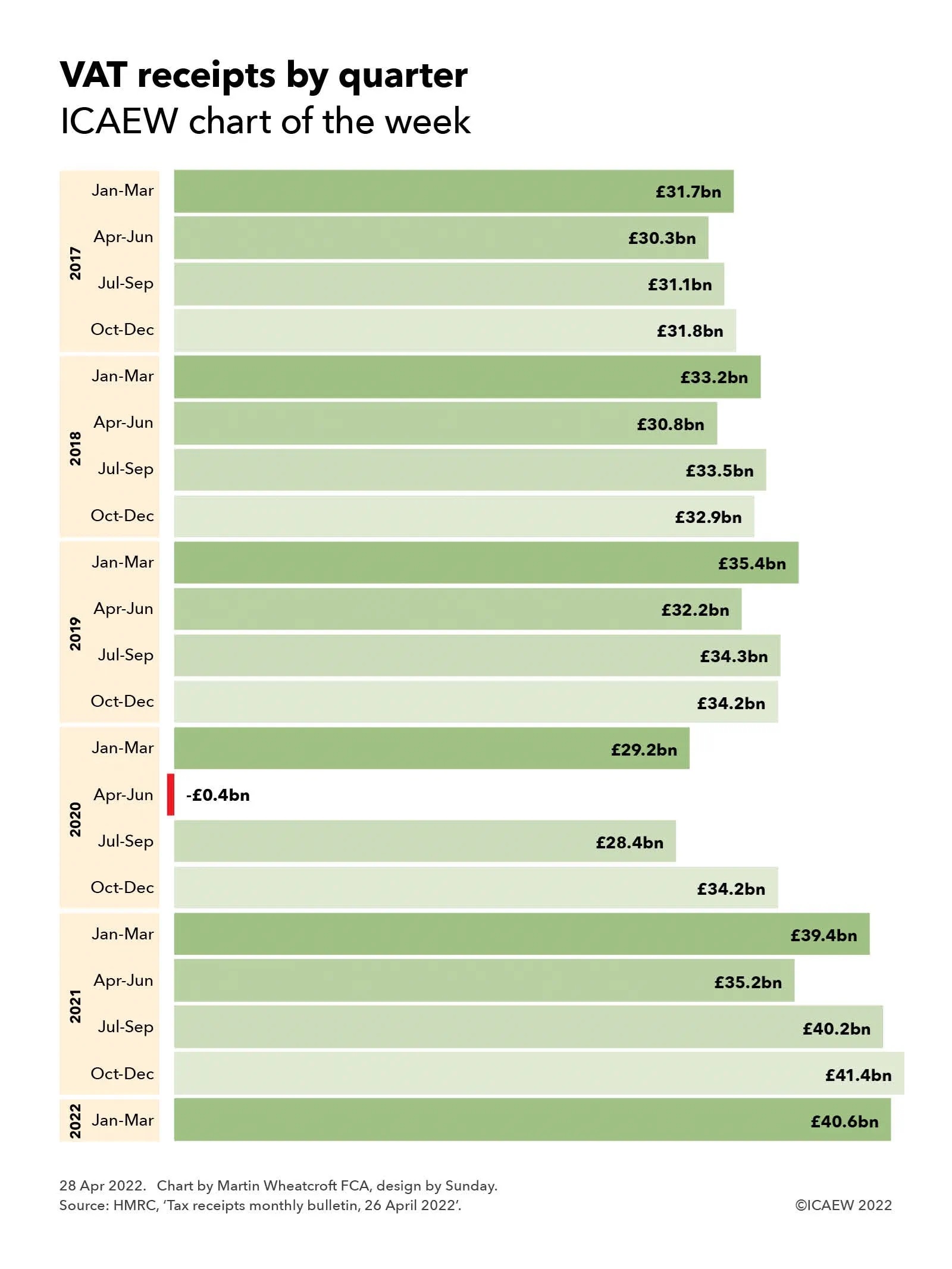
January’s public sector finance surplus of £2.9bn was driven by a boost to tax revenues as inflation drove up VAT receipts and self assessment income grew, putting further pressure on Chancellor Rishi Sunak to increase support to households facing huge rises in energy prices.

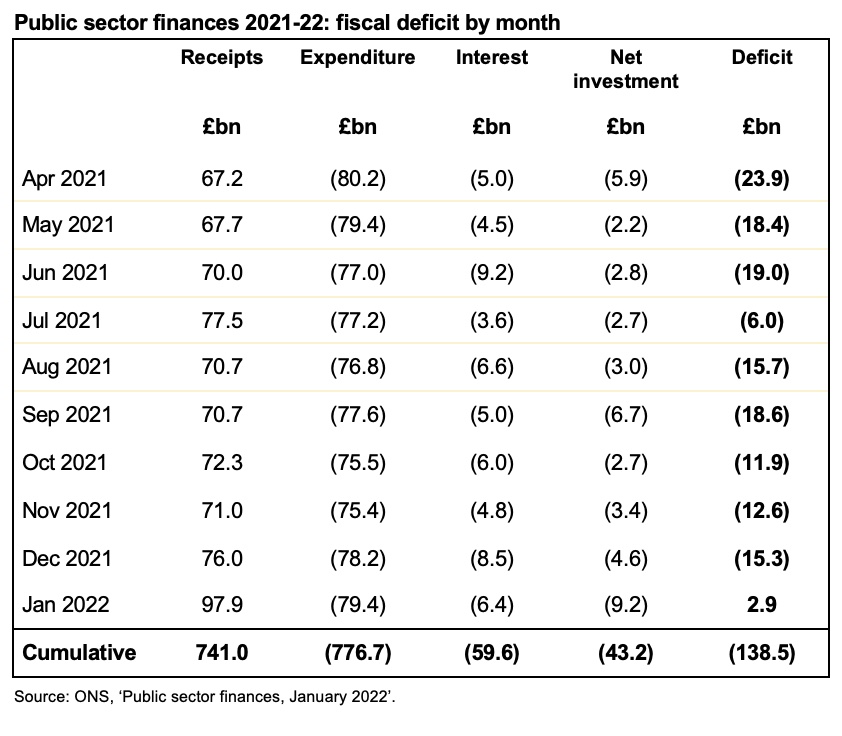
The public sector finances for January, released on 22 February, reported a surplus for the month of £2.9bn. This was an improvement of £5.4bn from the deficit of £2.5bn reported for January 2021, but £7bn smaller than the £9.9bn surplus reported for January 2020.

Total receipts were £97.9bn in January, up from £76.0bn in the previous month.

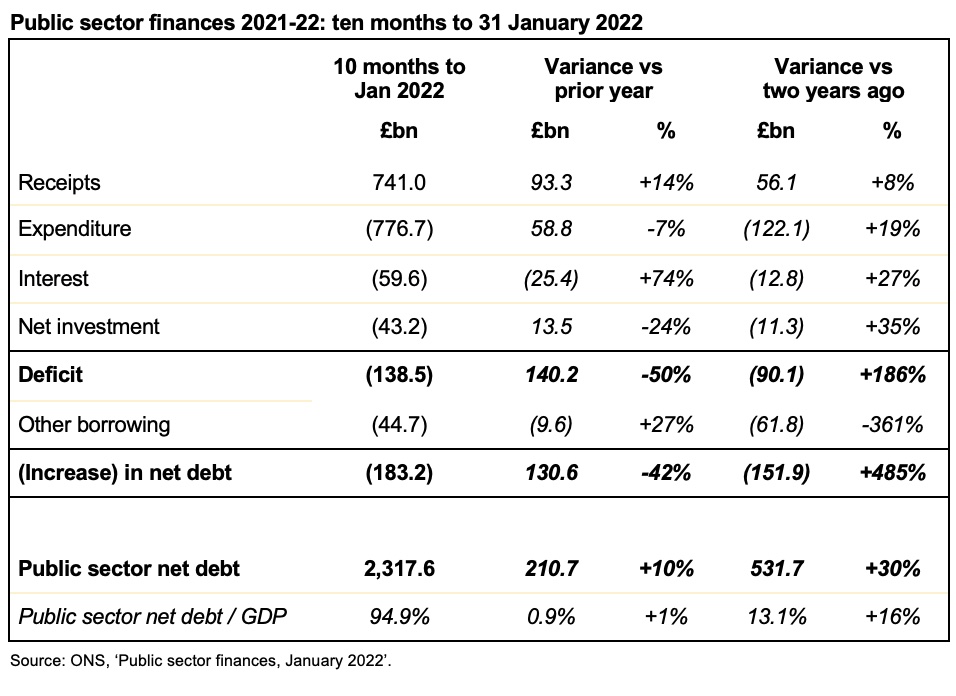
Public sector net debt fell from £2,339.7bn at the end of December to £2,317.6bn or 95% of GDP at the end of January, with tax and loan recoveries supplementing the surplus for the month. Despite that, debt is £210.7bn higher than at the start of the financial year and £524.5bn higher than in March 2020.

The cumulative deficit for the first 10 months of the financial year was £138.5bn, compared with £278.7bn and £48.4bn for the same period last year and the year before that respectively.

This was £17.7bn below the forecast published by the Office for Budget Responsibility (OBR) alongside last October’s Autumn Budget and Spending Review 2021, although higher than forecast tax receipts were partially offset by higher than forecast interest charges on index-linked debt. Both are driven by higher rates of inflation, which takes more time to feed through to non-interest expenditure.

Cumulative receipts in the first 10 months of the 2021/22 financial year amounted to £741bn, £93.3bn or 14% higher than a year previously, but only £56.1bn or 8% above the level seen in the first 10 months of 2019/20. At the same time, cumulative expenditure excluding interest of £776.7bn was £58.8bn or 7% lower than the same period last year, but £122.2bn or 19% higher than two years ago.

Interest amounted to £59.6bn in the 10 months to January 2022, £25.4bn or 74% higher than the same period in 2020/21, principally because of the effect of higher inflation on index-linked gilts. Interest costs were £12.8bn or 27% more than in the equivalent 10-month period ended 31 January 2020.

Cumulative net public sector investment up to January 2022 was £43.2bn. This was £13.5bn or 24% below the £56.7bn reported for the first 10 months of last year, which included around £17bn of COVID-19-related lending that the government does not expect to recover. Investment was £11.3bn or 35% more than two years ago, principally reflecting greater capital expenditures, including on HS2.

The increase in debt of £183.2bn since the start of the financial year comprises the cumulative deficit of £138.5bn and £44.7bn in other borrowing. The latter has been used to fund lending to banks through the Bank of England’s Term Funding Scheme, lending to businesses via the British Business Bank (including bounce-back and other coronavirus loans), student loans, and other cash requirements, net of the recovery of taxes deferred last year and loan repayments.

Alison Ring OBE FCA, Public Sector and Taxation Director for ICAEW, said: “The strong tax receipts reported today will provide a welcome respite for the public finances, reducing the shortfall in the government’s income compared with its expenditure from previous forecasts. However, the deficit is still on track to be the third highest ever recorded in peacetime, while public debt is more than half a trillion pounds higher than it was at the start of the pandemic.

“The challenge for Sunak will be balancing the strong pressures on him to increase the support package for households facing rapidly rising energy costs and retail prices, with the need to strengthen the resilience of the public finances in the face of a great deal of economic uncertainty and increasing global security concerns. The Chancellor will be acutely aware that while inflation is adding to tax revenues today it will go on to add to public spending tomorrow”.

Table showing receipts, expenditure, interest, net investment, deficit, other borrowing the increase in net debt for the 10 months to Jan 2021 and public sector net debt and public sector net debt / GDP at 31 Jan 2021 together with variances versus prior year and two years ago.

Click on link at the end of this article to the version of this article on the ICAEW website which has a readable version of this table.

Caution is needed with respect to the numbers published by the ONS, which are expected to be repeatedly revised as estimates are refined and gaps in the underlying data are filled.

The ONS made a number of revisions to prior month and prior year fiscal numbers to reflect revisions to estimates. These had the effect of decreasing the reported fiscal deficit for the nine months to December 2021 from £146.8bn to £141.4bn and increasing the deficit for the year ended 31 March 2021 from £321.8bn to £321.9bn.

Table showing receipts, expenditure, interest, net investment and the deficit for each of the 10 months to Jan 2021.

Click on link below to the version of this article on the ICAEW website which has a readable version of this table.

This article was originally published by ICAEW.

ICAEW chart of the week: Quarterly GDP per head

GDP statistics have become much more exciting, with low but steady growth in per capita GDP before the pandemic giving way to large swings as the economy adjusts to a major shock.

Column chart showing quarterly GDP per capita from Q1 2015 to Q4 2021 on a real-terms seasonally adjusted basis.

Showing steady growth each quarter to Q4 2109 before falling sharply in Q2 2020, recovering partway in Q3 2020 and more fully in Q2 2021 up to £8,820 in Q4 2021. This is about level with Q4 2017 and below Q1 2018 through Q4 2019.

GDP for the fourth quarter of 2021 was calculated to be £596bn by the ONS in its first estimate of this statistic measuring economic activity in the UK, bringing the provisional estimate for the full year to £2,318bn for the 2021 calendar year. On a per capita basis, this was equivalent to approximately £8,820 per person for the fourth quarter and £34,330 per person for the year.

The ICAEW chart of the week looks at how quarterly GDP has changed in real-terms over the past few years on a seasonally adjusted basis – demonstrating how boring GDP statistical releases were in the ‘before times’. Then, a relatively steady average per capita increase of approximately 0.3% each quarter reflected the low but steady level of economic growth that has been seen since the financial crisis. The arrival of the pandemic has seen all that change, with a collapse in GDP during the last half of 2020, followed by a stop-and-start recovery over the past few quarters, with provisional GDP estimate growing by 0.9% in the fourth quarter – faster than the pre-pandemic years, but slower than the revised 1.0% reported for Q3 and the 5.5% rise in Q2 of 2021.

The change in real-terms quarterly GDP per head in 2020 and 2021 illustrated by the chart were -2.7%, -19.5%, +17.4%, +1.3% and -1.3%, +5.5%, +1.0%, +0.9% respectively. It is, of course, always important to note that the statistics reported by the ONS are subject to frequent revision, especially when trying to count up the trillions of transactions entered into each quarter in a large and complex economy like the UK’s. The population estimates used for calculating per capita amounts are also likely to be revised, in particular once the results of the 2021 census are finalised in a few months’ time.

Despite the recovery in the last three quarters, GDP and GDP per capita remained below their peaks in the third quarter of 2019 and more significantly below the trend the economy was on.

With rapidly rising inflation, supply chain disruptions and uncertainty regarding how society will transition from a coronavirus pandemic to an endemic, the likelihood is that quarterly GDP releases are likely to continue to be observed with some excitement by economists (and the rest of us) for some time to come.

This chart was originally published by ICAEW.