ICAEW chart of the week: Long-term fiscal forecast

The chart this week highlights the difficult fiscal background facing an incoming prime minister as the OBR reports how a “riskier world and ageing population ultimately leave the public finances on unsustainable path”.

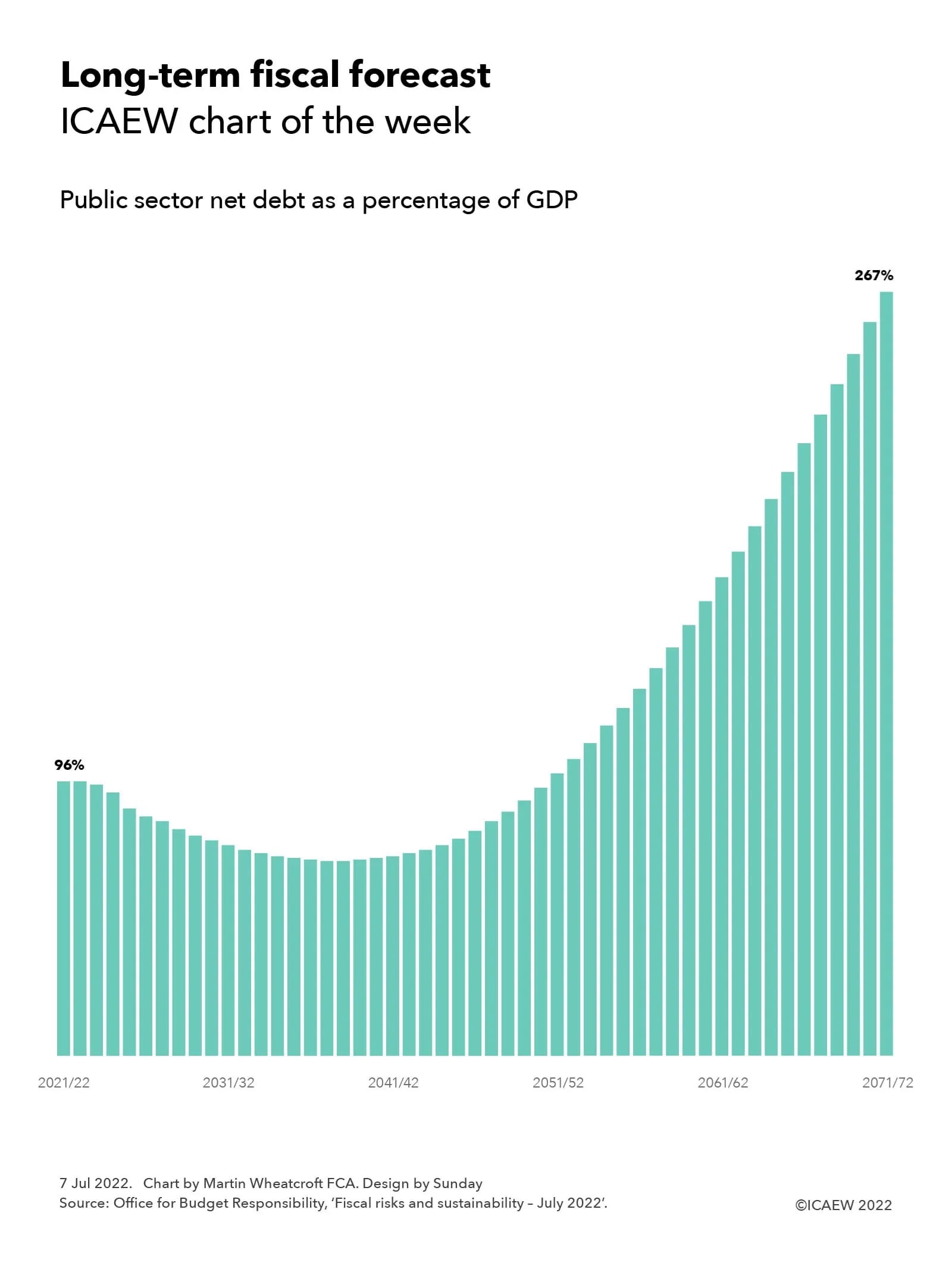
Column chart showing public sector net debt as a percentage of GDP from 2021/22 to 2071/22 per the OBR long-term forecast. Starts at 96% in 2021/22, declining to 68% in the mid-2030s and then rising up to 267% by 2071/72.

The publication of the Office for Budget Responsibility (OBR) of its combined fiscal risks and sustainability report on Thursday 7 July 2022 was overshadowed by events in Westminster, which is unfortunate given just how important the state of the public finances is to the success of future government administrations and to the country as a whole.

Setting out long-term fiscal forecasts for the next 50 years, the OBR has analysed threats posed by rising geopolitical tensions, higher energy prices, the pressures of an ageing population and the loss of motoring taxes, as well as risks such as cyber attacks, future economic shocks, higher defence spending, and global protectionism adversely affecting international trade.

The chart illustrates the baseline projections prepared by the OBR, which show public sector net debt as a share of GDP rising from 96% of GDP to 267% in 50 years’ time in 2071/72. This primarily reflects more people living longer with the consequent effect that has on public spending, in particular pensions, health and social care, combined with a declining proportion of working age adults who pay the most in taxes. The report also highlights the fiscal gap created by the loss of fuel duty and vehicle excise duty as petrol and diesel cars are replaced with electric vehicles.

The OBR’s Chair, Richard Hughes, commented how 20 years ago, “Government debt stood at 28% of GDP, the deficit was about 0.5% of GDP, the economy was growing at an average rate of 2.75%, and inflation was running at 1.3% – and the Treasury’s pioneering 50-year fiscal projections predicted that government debt this year, 2022, would stay just below 40% of GDP – consistent with the fiscal rules in place at the time.

“As we now know, debt this year is expected to be more than twice that, at 96% of GDP,” Hughes continued, highlighting how over the past two decades the UK economy has been buffeted by an unprecedented series of global shocks including a financial crisis, a pandemic, a major war on the European continent, and an energy crisis. 

Hughes commented: “Working away in the background as this series of crises unfolded were a set of longer-term pressures on the public finances and the number of people aged 65 and over rose by 3.5 million from 9.5 to 13 million people; we learned that global temperatures had already risen by 1°C and were on track to rise by 4°C by the end of this century; and having fallen from over 5% in 2002 to less than 0.5% in 2020, interest rates on government debt are now back up to 2%.”

One of the key drivers of the projection is the old-age dependency ratio, the number of those aged 65 and over to those aged 16 to 64, which is expected to rise from 0.31 in 2022 to 0.52 in 2072, with a low birth rate and inward migration insufficient to offset the increasing number of people living longer in retirement.

The report has stress tested the projections with a range of potential events that could make the financial position much worse, with different unpalatable scenarios seeing the ratio of debt to GDP rising to 288%, 304%, 317% or 437% in 2071/72, depending on the assumptions made. In the other direction, the OBR notes that 76,000 additional net inward migrants a year over 50 years would reduce the baseline projection for debt to GDP of 267% to 217% in 2071/72.

The next prime minister will inevitably focus on the many short-term challenges facing the government and the country, but the OBR report makes clear just how much a long-term fiscal strategy is needed to put the public finances onto a sustainable path.

This chart was originally published by ICAEW.

Alison Ring: don’t waste the huge effort you put into annual accounts

Council finance teams put a lot of time and resources into preparing financial statements each year but often the results are impenetrable. A focus on streamlining and clarity can make a huge difference, writes the ICAEW’s public sector director.

Getting the annual accounts finished and out of the way is a relief to most finance teams. It is a major undertaking to put together what can be a couple of hundred pages of detailed numerical content and getting your auditors to sign off on it all. Understandably, there is a temptation to just upload it to the website, forget about it for another year and move onto the budget, that bid for levelling up funding, or the many other priorities that are pushing up your to-do list.

But are you getting a full return on the investment you make into your annual report? The answer is almost certainly “no”. Unlike their corporate equivalents, local authority accounts are notoriously “impenetrable” and a difficult tool to use in communicating with stakeholders on the financial story of the year and how you are making progress in delivering on your strategic objectives.

The last thing you want to do is to use a long, complicated, and difficult to understand document as a tool for accountability, while for readers the challenge in trying to understand the finances of many local authorities is daunting. Ahead of them might be a 250-page document with over 150 pages of difficult-to-follow financial statements. To put it bluntly, who has the time to read all of that?

Concise and streamlined accounts

This contrasts with annual reports such as that recently published by the Government Legal Department (a non-ministerial department), where the financial statements including notes take up only 15 pages of an 80-page document. This is a much better vehicle for understanding the financial performance and position of, admittedly, a simpler organisation than most local authorities – but an example of how being concise and streamlined can make accountability that much easier to achieve.

It is almost two years since the conclusion in the Redmond Review that local authority accounts are “considered impenetrable to the public”. As finance leaders in the local government sector, this should concern us all.

Your accounts should help residents, councillors and councils understand the financial performance and position of the local authority. They should be the cornerstone of the evidence-based decision-making and strong financial management, essential for effective delivery of public services.

Unfortunately, impenetrable financial reports achieve none of the benefits that a well-designed annual report is capable of. Not only do they sap the resources of finance teams in preparing information that is not going to be used effectively, but they mean other ways have to be found to provide the financial transparency that councillors and others need to represent the interests of local residents effectively. Or (as many councillors tell us) not to have a full understanding of the finances at all.

Don’t wait for CIPFA/LASAAC Code improvements

While there is a real need to reform the Local Authority Accounting Code and the example financial statements in the code guidance notes – and CIPFA/LASAAC are working on that – there is no need to wait for that to happen. Yes, the complexity of the local authority finance system doesn’t help, but even so I have yet to read a set of local authority financial statements where I did not think there was something that the preparers could have done to make them more understandable and concise, while remaining compliant with the code.

Some local authorities have already been able to streamline their financial statements to good effect. Fife Council, for example, has been able to reduce the length of its annual report including the management commentary to only 68 pages, while Southwark Council worked with its auditors to reduce their document to 133 pages, which is notably short for a large London borough.

One mistake is to treat the example financial statements as currently devised as a template, rather than as a reference document covering almost every conceivable scenario. We too often see local authorities including boilerplate disclosures from the example financial statements even when not relevant. CIPFA has published helpful accounts streamlining guidance that advises moving away from the example financial statements to reduce the length of the report.

It is important though when conducting a streamlining exercise that you consider the needs of users. Shorter for the sake of it is counterproductive if it means the accounts are non-compliant or even more difficult to understand. For example, nothing useful is achieved by tiny font sizes or merging notes that don’t relate to each other.

Consider instead how you can structure your financial statements effectively. For example, in most circumstances there is no need for three separate notes to the cash flow statement when there is room in the primary statement itself. Could you move the more detailed financial instrument and pension disclosures to the back of the report so that the main balance sheet notes flow together more seamlessly? Have you “weeded” your accounting policies note as much as you can? It is surprising how many local authorities report a policy for contingent assets when there are none that (apparently) need disclosing.

Think about what users require

Streamlining should not mean losing important information – instead, it gives an opportunity to focus on what is important. Take out accounting policies that merely restate GAAP, or long expositions of credit risk on immaterial exposures that do not aid understanding, and instead provide more insightful disclosures that are specific to your local authority, perhaps such as the financial performance of council-owned businesses. Tables and charts can be used to communicate concisely, without compromising on the quality of the information provided.

Have you provided what is really needed, such as why investments have been recognised at amortised cost rather than fair value (or vice versa)? Or how you have calculated your Minimum Revenue Provision (MRP)? Despite its importance to council tax calculations, a recent review of a sample of local authority accounts by the ICAEW found that many did not disclose the MRP policy or the key judgements made in its calculation and, in the few instances where there was disclosure, the language used was often so technical as to be incomprehensible. Getting rid of jargon can help make it easier for councillors and residents to use the accounts.

A foundation for financial conversations with stakeholders

Local authorities are in theory much more transparent than their private sector comparators. Listed companies do not have to publish their budgets or internal financial reports, debate their financial decisions in meetings open to the public, nor allow their stakeholders the ability to inspect their detailed books and records.

Despite that we often hear the view that local authority finances are much more difficult to understand – a classic example of how greater quantity does not equal better quality.

Making the annual report and accounts a foundation for your financial communication is one way of addressing the deficit in understanding, and a way of getting a better return on all the effort you put into them. A good annual report should be an annually updated reference work that is actively used as the go-to place to find your strategy, how you monitor progress against your objectives, how you are managing risks, and the strength (or otherwise) of your financial position, as well as telling the story of the year in words and numbers.

Doing so may also help you get on the front foot with the new Office for Local Government, which is likely to become an avaricious consumer of your performance data once it gets up and running.

While we hope CIPFA/LASAAC’s project to improve the presentation of local authority financial statements will put understandability at its heart, that does not mean you should wait for developments. Not only can you make your annual report that much more usable through streamlining disclosures and improving clarity (potentially saving time by making it easier to prepare in the future), but you have an opportunity to use it to support better quality dialogue with your stakeholders.

If you don’t feel comfortable in presenting your annual report to your councillors as the one financial document that they need to read each year, then I would suggest that you are not doing it in the right way.

This article was originally published in Room 151.
ICAEW chart of the week: England and Wales Census 2021

The ICAEW chart of the week looks at the results of last year’s census, illustrating how the population of southern and central England has grown much faster than in the north of England and in Wales over the past decade.

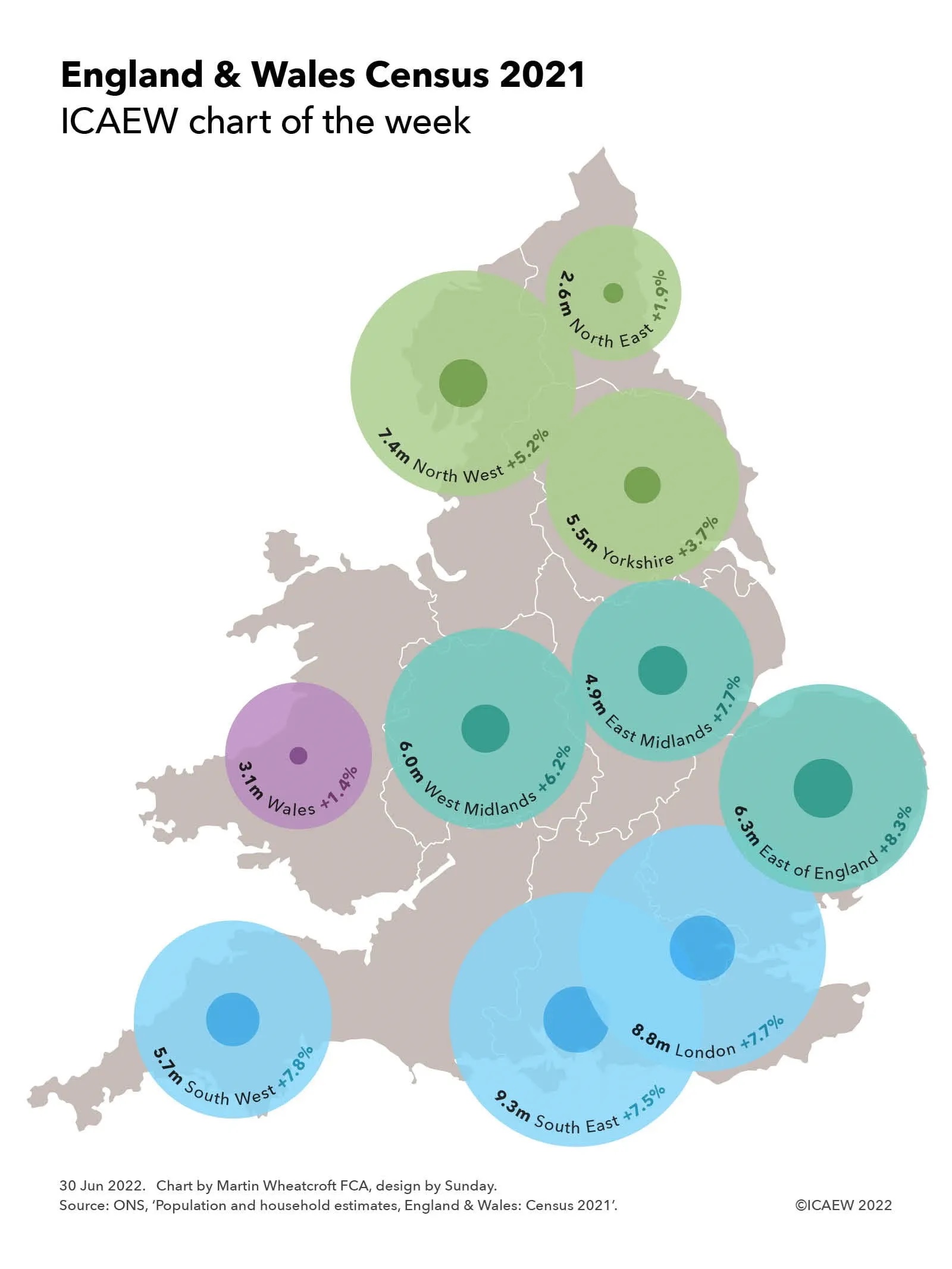
Bubble chart overlayed on a map of England & Wales scaled to population in each region with inner bubbles showing the increase in the last decade. 

North East 2.6m (+1.9%)
North West 7.4m (+5.2%)
Yorkshire 5.5m (+3.7%)

West Midlands 6.0m (+6.2%)
East Midlands 4.9m (+7.7%)
East of England 6.3m (+8.3%)

South West 5.7m (+7.8%)
South East 9.3m (+7.5%)
London 8.8m (+7.7%)

Wales 3.1m (+1.4%)

The Office for National Statistics (ONS) released the first results from Census 2021 in England and Wales on Tuesday 28 June, providing an initial snapshot of who we are and where we live across two of the four nations of the UK. It follows on from the initial release earlier this year of the Northern Ireland Census 2021, but we won’t see a full picture for the UK for some time as the 2022 census in Scotland was delayed until this year.

The chart highlights how the East of England was the fastest growing region in England, with its population growing by 8.3% to 6.3m between 2011 and 2021. This was followed by the South West (up 7.8% to 5.7m), London (up 7.7% to 8.8m), East Midlands (up 7.7% to 4.9m) and the South East (up 7.5% to 9.3m). The West Midlands grew less quickly (up 6.2% to 6.0m), but still by more than the North West (up 5.2% to 7.4m), Yorkshire (up 3.7% to 5.5m) and the North East (up 1.9% to 2.6m). The population of Wales only increased by 1.4% over 10 years to remain at 3.1m.

In total the population of England and Wales amounted to 59.6m in 2021. This was 6.3% higher than the 56.1m people living in the UK in 2011 and 14.6% higher than the 52.0m reported by the 2001 census. This reflects a slowing rate of growth in the last decade at 0.6% a year on average compared with the average rate of 0.8% seen between 2001 and 2011 and is substantially lower than the compound growth of 1.6% a year experienced over 120 years since the first official census in 1801 reported a population of 8.9m in England & Wales.

The ONS has published a breakdown of the population by age and sex by local authority, highlighting how the number of people has changed significantly in some parts of the country, such as Tower Hamlets (up 22% in 10 years), Dartford (up 20%), Barking and Dagenham (up 18%), Bedford (up 18%), Peterborough (up 17.5%), Central Bedfordshire and Tewkesbury (each up 16%) and Salford, Milton Keynes, Uttlesford, Vale of White Horse and Wokingham (each up by around 15%). The biggest falls were in Kensington and Chelsea (down 10%) and Westminster (down 7%), although there is some speculation that this was because of the pandemic as family and second homes elsewhere proved to be more attractive places to work from home during lockdown. This is unlikely to be the driver of decreases in some rural areas such as the 6% fall in Ceredigion in Wales or the 5% fall in Copeland in Cumbria, where long-term trends of population decline have continued.

The census has also confirmed how we are getting older on average, with a 20% increase in those aged 65 and over from 9.2m in 2011 to 11.1m in 2021. This continues to be a big driver for public finances, as more funding is needed to pay for pensions, health and social care at the expense of other public services.

There is still a lot of data crunching to do as the statisticians work through the more in-depth questions on the census, ranging from employment status, education and housing to ethnicity, religion, sexual orientation and gender identity among other characteristics – demographics in action and the likely source of future charts of the week.

This chart was originally published by ICAEW.

Economic storm clouds darken outlook for public finances

A slightly higher fiscal deficit for May and rising interest rates provide no comfort for the Chancellor as he considers how to respond to public sector wage demands.

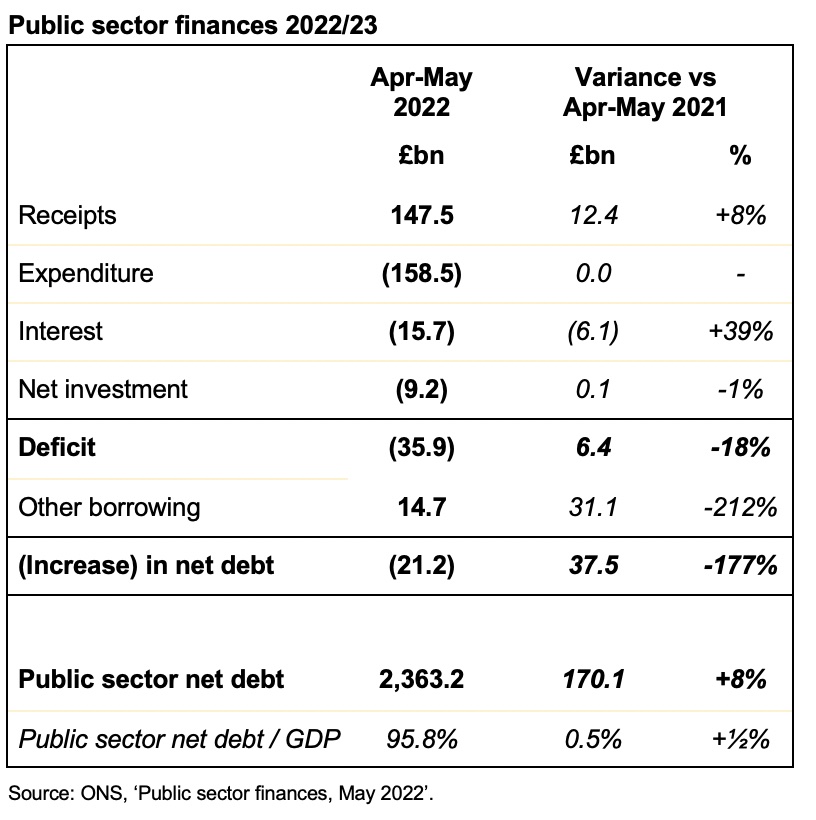
The monthly public sector finances released on Thursday 23 June 2022 reported a provisional deficit for the month of May 2022 of £14.0bn, an improvement from this time last year, but still £8.5bn higher than May 2019, the year before the pandemic.

Public sector net debt increased by £21bn from £2,342bn at the end of March 2022 to £2,363bn or 95.8% of GDP at the end of May. This is £570bn higher than 31 March 2020, reflecting the huge sums borrowed over the course of the pandemic.

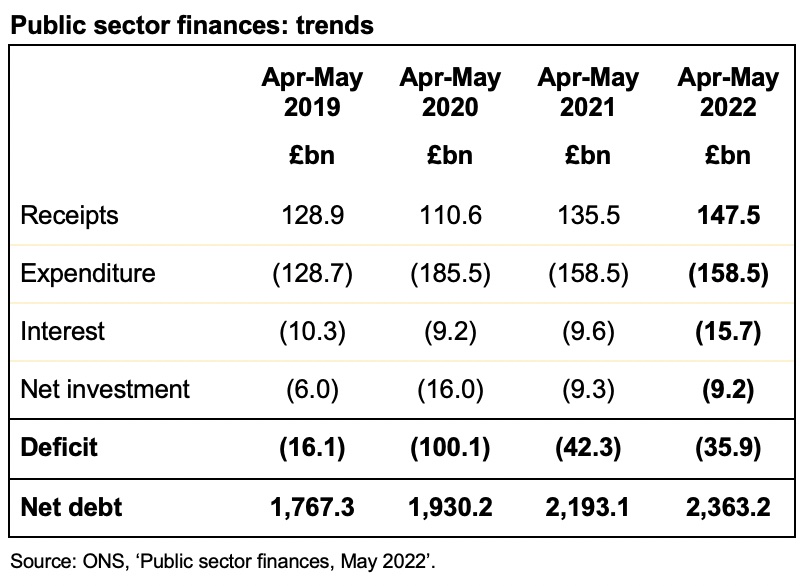
The deficit reported for the two months to May 2022 of £35.9bn was an improvement of £6.4bn from the deficit of £42.3bn reported for the months of April and May 2021, and £64.2bn better than the £100.1bn reported for April and May 2020. However, it was £19.8bn worse than the pre-pandemic deficit of £16.1bn for the two months to May 2019.

Tax and other receipts in the two months amounted to £147.5bn, £12.4bn or 9% higher than a year previously. This included higher income tax receipts from wage increases and bonuses as well as the new higher rate of national insurance, as well as higher VAT receipts driven by higher retail prices.

Expenditure excluding interest and investment for the year to date of £158.5bn was unchanged from the same period last year, as reduced spending on the pandemic including furlough programmes was offset by planned increases in spending announced in last year’s Spending Review and by additional support to households to help with their energy bills.

Interest amounted to £15.7bn in April and May, £6.1bn or 64% higher than the £9.6bn in the two months ended 31 May 2021, reflecting how higher interest rates and higher inflation are increasing the government’s cost of borrowing.

Net public sector investment in April and May 2022 was reported to be £9.2bn, which is £0.1bn lower than a year previously. This is slightly surprising given planned increases in capital expenditure as well as the subsidies given in the past two months to Bulb Energy, a failed energy supplier taken over by the government.

The increase in net debt of £21.2bn since the start of the financial year comprises the deficit for the month of £35.9bn less £14.7bn in net borrowing repayments. This reflects the recovery of loans to banks through the Bank of England’s Term Funding Scheme and of loans to businesses via the British Business Bank (including bounce-back and other coronavirus loans), offset by funding for student loans and other government cash requirements.

Alison Ring OBE FCA, Public Sector and Taxation Director for ICAEW, said: “A slightly higher deficit than expected in this month’s numbers and a rising interest bill will not provide any comfort for the Chancellor as he considers how to respond to public sector wage demands at the same time as attempting to build capacity for pre-election tax cuts next year.

The economic storm clouds hovering over the fiscal outlook, as living standards go into reverse and inflation erodes the extent of planned investment in local communities, are likely to make the government’s ambition to level up the country even more difficult to achieve.”

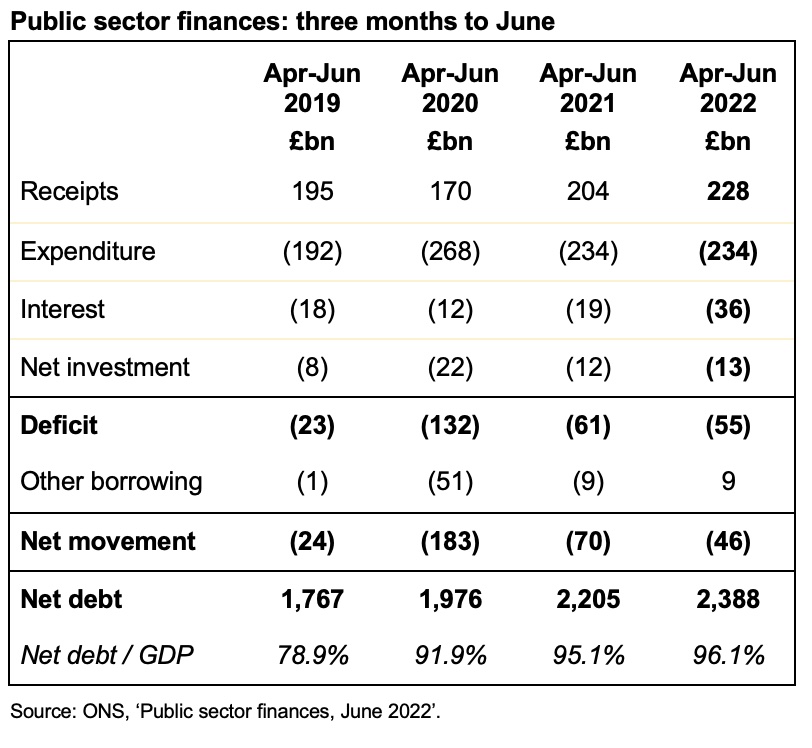
Table showing cumulative numbers for April and May 2022 and variances against the same period a year ago:

Receipts £147.5bn: £12.4bn or +8%
Expenditure (£158.5bn): £0.0bn
Interest (£15.7bn): (£6.1bn) or +39%
Net investment: (£9.2bn): £0.1bn or -1%
Deficit (£35.9bn): £6.4bn or -18%
Other borrowing: £14.7bn: £31.1bn or -212%
(Increase) in net debt: (£21.2bn): £37.5bn or -177%

Public sector net debt: £2,363.2bn: £170.1bn or +8%
Public sector net debt / GDP 95.8%: 0.5% or +0.5%

Caution is needed with respect to the numbers published by the ONS, which are expected to be repeatedly revised as estimates are refined and gaps in the underlying data are filled.

The ONS made several revisions to the prior period fiscal numbers to reflect revisions to estimates. These had the effect of increasing the reported fiscal deficit for the month of April 2022 by £3.3bn from £18.6bn to £21.9bn and decreasing the reported fiscal deficits for the 12 months to March 2022 by £0.9bn from £144.6bn to £143.7bn and for the year ended 31 March 2021 by £7.7bn from £317.3bn to £309.6bn.

Table showing receipts, expenditure, interest, net investment, deficit and net debt for April and May combined in 2019, 2020, 2021 and 2022 respectively.

For details, click on the link to the original article on the ICAEW website.

This article was originally published by ICAEW.

ICAEW chart of the week: Railway journeys

This week’s chart illustrates how railway strikes are not the only problem facing Great British Railways, the new publicly owned body being established to run the rail network from next April.

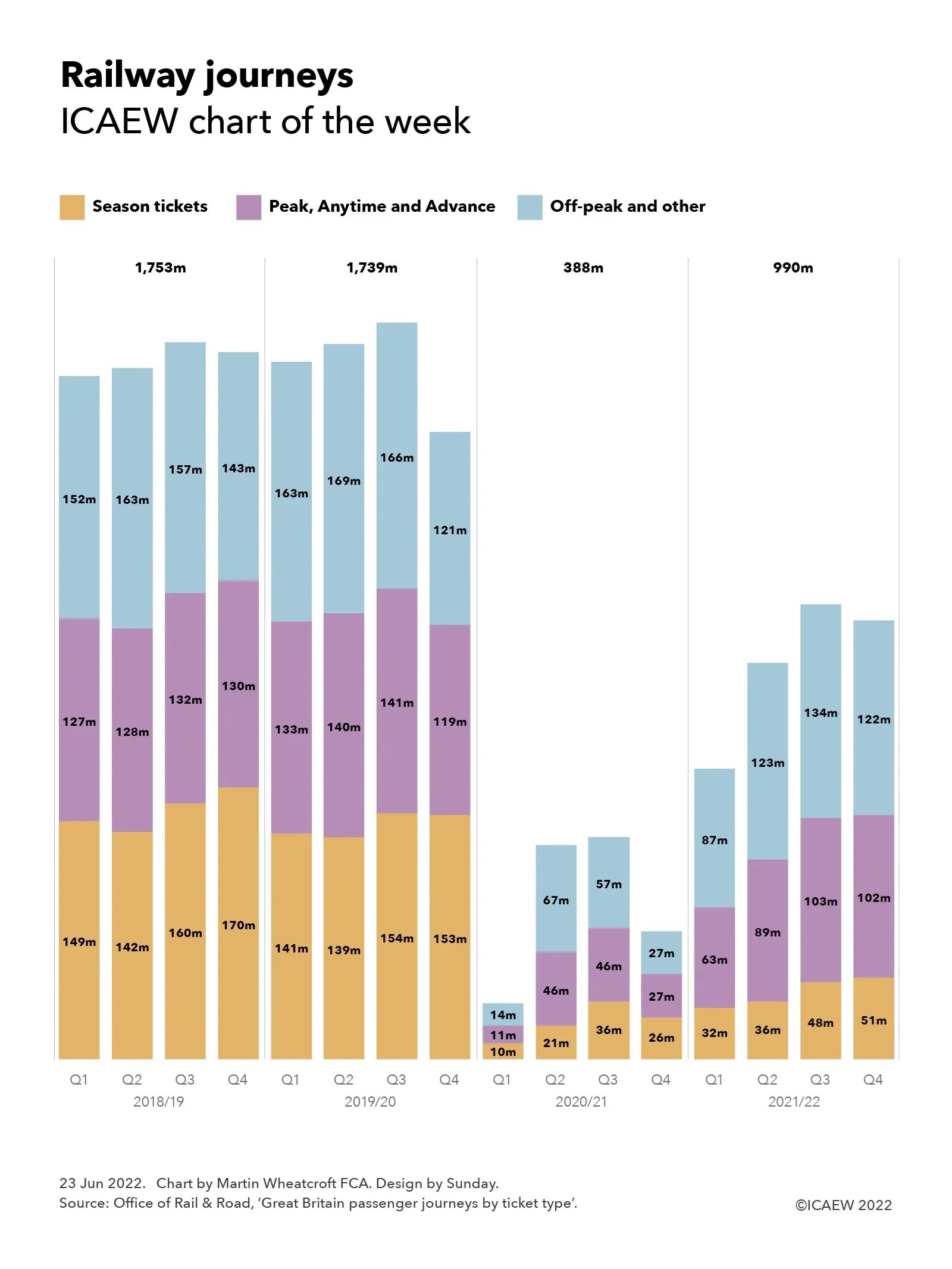
Column chart showing railway journeys in Great Britain by quarter from Q1 of 2018/19 to Q4 of 2021/22 split between season tickets; peak, anytime and advance; and off-peak and other. See text below for numbers.

The ICAEW chart of the week is on railway journeys in Great Britain over the past four financial years, highlighting how the number of trips on the network have fallen from a peak of 1,753m in 2018/19 to 1,739m in 2019/20 and 388m in 2020/21, before increasing to 990m in the most recent financial year ended 31 March 2022. These numbers exclude London Underground and light rail and tram systems in London and elsewhere, but they include London Overground.

Passenger numbers are well below pre-pandemic levels – a challenge with a government increasingly reluctant to plug the gap in passenger revenues with additional subsidies on an ongoing basis.

The biggest fall has been in trips using Season tickets, which at 51m during January through March 2022 were 70% below the 170m reported for the fourth quarter of 2018/19. Trips using Peak, Anytime and Advance tickets and Off-peak and other tickets in Q4 of 2021/22 were 22% and 15% down on the quarter ended 31 March 2019. The chart illustrates how travel patterns have changed as many more people work from home on a regular basis, especially regular commuters who have traditionally formed the backbone of rail passenger traffic.

These falls in usage – and in the associated revenue from ticket sales and other income – are likely to present a huge challenge for Great British Railways, the new public body scheduled to take over the running of the railways in England, Wales and Scotland from 1 April 2023 (not including Transport for London and light rail and tram systems). 

Great British Railways is taking on responsibility for the track and stations currently owned by Network Rail and for the running of train services too – with the train operating companies engaged to run services on its behalf under concession arrangements that expose the taxpayer to revenue risk. A difficult enough task at the best of times, but one made even more challenging by the consequences of the pandemic and with a shareholder in the form of a government keen to cut subsidies that have ballooned since the start of the pandemic.

As the chart shows, trips using Season tickets by quarter were 149m, 142m, 160m and 170m in 2018/19; 141m, 139m, 154m and 153m in 2019/20; 10m, 21m, 36m and 26m in 2020/21; and 32m, 36m, 48m and 51m in 2021/22. Trips using Peak, Anytime and Advance tickets were 127m, 128m, 132m and 130m in 2018/19; 133m, 140m, 141m and 119m in 2019/20; 11m, 46m, 46m and 27m in 2020/21; and 63m, 89m, 103m and 102m during 2021/22. Trips using Off-peak and other tickets were 152m, 163m, 157m and 143m in 2018/19; 163m, 169m, 166m and 121m in 2019/20; 14m, 67m, 57m and 27m in 2020/21; and 87m, 123m, 134m and 122m in 2021/22.

The recent strikes won’t help, especially if they recur over the summer. However, whatever happens, getting people back to using the railways is going to be a big task for the new team at Great British Railways – whether by persuading workers to return to the office, encouraging people out of their cars or by just enticing us all to let the train take the strain more often than we do at the moment.

This chart was originally published by ICAEW.

ICAEW chart of the week: Foreign travel

This week’s chart looks at the number of trips abroad by UK residents before, during and after the pandemic. Will travel chaos, the cost-of-living crisis and climate concerns prevent a full return to pre-pandemic levels?

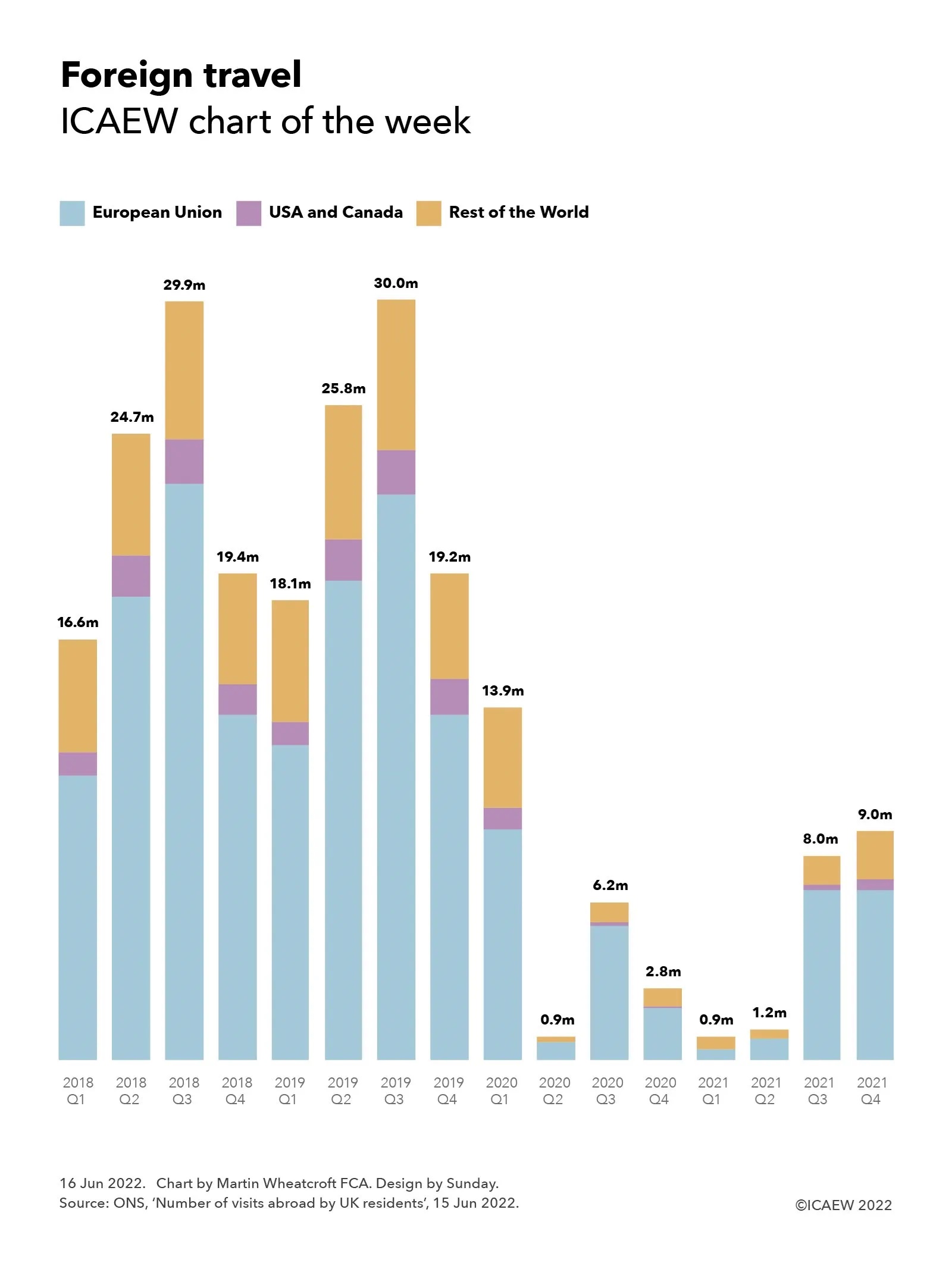
Column chart showing foreign travel by UK residents to the European Union, USA & Canada, and Rest of the World by quarter from 2018 Q1 to 2021 Q4. For numbers see text below.

The Office for National Statistics (ONS) issued detailed statistics on travel to and from the UK on 15 June 2022 highlighting how both inbound tourism and outbound foreign travel fell dramatically over the course of the pandemic.

As our chart illustrates, there were 90.6m visits abroad by UK residents in 2018 (16.6m, 24.7m, 29.9m and 19.4m in Q1: Jan-Mar, Q2: Apr-Jun, Q3: Jul-Sep and Q4: Oct-Dec respectively) and 93.1m in 2019 (18.1m, 25.8m, 30.0m and 19.2m), before dropping to 23.8m in 2020 (13.9m, 0.9m, 6.2m and 2.8m) and partially recovering to 19.1m in 2021 (0.9m, 1.2m, 8.0m and 9.0m).

Most journeys were, as you might expect, to our nearest neighbours in the European Union (led by Spain, France, Italy, and Ireland), with the USA and Canada being major destinations too. Other popular destinations visited included Turkey, India, Switzerland, the UAE, China, Mexico, Australia, Thailand and ‘cruises’.

For 2018 through 2020, around 63% of foreign trips were for holidays, 25% were to visit friends or relatives, 10% were for business and 2% were for other reasons. Unusually, in 2021 just 47% of visits were for holidays and proportionately a much higher 43% were to see friends or relatives, with 7% being business trips and 3% for other reasons.

The recent chaotic scenes at airports and flight cancellations may be one reason not to travel internationally at the moment, but there are big questions about whether our travel habits will return to the levels seen before the pandemic even when those problems are resolved. The fall in the value of the pound makes overseas trips even more expensive just as families are feeling a big squeeze in their incomes as inflation accelerates upwards. Virtual meetings are making business trips less necessary than before, while many individuals want to cut back on flying in order to do their bit to contribute to achieving net zero.

Despite that, substantial growth is expected in 2022 and 2023 in the number of visits abroad from the low base of 2020 and 2021 as – for many of us – the lure of distant (and not so distant) shores will just be too great to resist.

This chart was originally published by ICAEW.

ICAEW chart of the week: Whole of Government Accounts 2019/20

We take a look at the government balance sheet at 31 March 2020 this week, following publication by HM Treasury of the long-delayed 2019/20 audited financial statements for the UK public sector.

Step chart showing public assets £2,129bn, liabilities of (£4,973bn) and net liabilities of (£2,834bn).

Fixed assets £1,353bn, receivables & other £195bn, investments £323bn, financial assets £268bn.

Financial liabilities (£2,207bn), payables (£201bn), pensions (£2,190bn).

Taxpayer equity (£2,834bn).

HM Treasury was up in front of the Public Accounts Committee (PAC) this week to be grilled on the Whole of Government Accounts (WGA) for the year ended 31 March 2020. The first question posed by MPs was why it had taken more than 26 months to publish the audited financial statements for the UK public sector, unlocking a tale of woe regarding the pandemic, delays in central government reporting, even greater delays in local government, and problems in implementing a new consolidation system. 

For all that, the PAC expressed their appreciation for the contents of the WGA, which comprises a performance report, governance statements, financial statements prepared in accordance with International Financial Reporting Standards, an audit report and a reconciliation to the fiscal numbers reported by the Office for National Statistics. The UK is one of the leading governments around the world in preparing comprehensive financial reports similar to those seen in the private sector, and is the only one to attempt to incorporate local government as well as central government and public corporations.

Our chart summarises the balance sheet reported in the consolidated financial statements at 31 March 2020, when there were total assets of £2,139bn, total liabilities of £4.973bn and negative taxpayer equity of £2,834bn. These numbers do not reflect the more than half a trillion pounds borrowed since then which are likely to see the 2020/21 and 2021/22 WGA move even further into negative territory. 

On the positive side of the balance sheet were:

  • £195bn of receivable and other assets, comprising £160bn of trade and other receivables due within one year, £22bn of receivables due in more than year, £11bn of inventories and £2bn of assets held for sale;
  • £1,353bn of fixed assets, consisting of £676bn for infrastructure, £459bn of land and buildings, £77bn of assets under construction, £41bn of military equipment, £60bn of other tangible fixed assets, and £40bn of intangibles;
  • £323bn of investments, including £126bn of non-current loans and deposits, £77bn in student loans, £36bn in equity investments, £22bn invested in the IMF, £38bn in derivatives and other, and £24bn in investment property; and 
  • £268bn of current financial assets, of which £118bn were in debt securities, £74bn in loan balances due within one year, £38bn in cash and cash equivalents, £13bn in gold holdings, £13bn in IMF special drawing rights and £12bn in derivatives and other.

On the negative side, there were:

  • £2,207bn in financial liabilities, comprising £1,266bn in government securities (gilts and Treasury bills), £560bn of deposits owed to banks, £179bn owed to investors in National Savings & Investments, £78bn in bank and other borrowings, £74bn in banknotes and £50bn in derivatives and other financial liabilities;
  • £201bn of payables, including £66bn of accruals and deferred income, £55bn of trade and other payables, £42bn in lease obligations, £34bn in tax and duty refunds payable and £4bn in contract liabilities;
  • £2,190bn in net pension obligations, of which £2,062bn were for unfunded pension schemes (NHS £760bn, teachers £490bn, civil service £309bn, armed forces £233bn, police & fire £197bn, other £73bn) and £128bn for funded schemes (local government £359bn less £253bn = £106bn, and other funded schemes £106bn less £84bn = £22bn). This balance does not include the state pension, which is treated as a welfare benefit and not a liability for accounting purposes; and
  • £375bn in provisions for liabilities and charges, including £157bn for nuclear decommissioning, £86bn for clinical negligence, £39bn for EU liabilities, £31bn for the pension protection fund and £62bn in other provisions.

Net liabilities therefore amounted to £2,834bn, reflecting the general policy decision taken by successive governments not to fund liabilities in advance, but instead to rely on future tax revenues and borrowing to provide cash as needed to settle liabilities and other financial obligations and commitments. As Sir Tom Scholar, Permanent Secretary at HM Treasury, informed the PAC, this minimises the investment risks the government might otherwise be exposed to if it were to invest in (say) the stock market.

Cat Little, Head of the Government Finance Function, set out plans to bring down the time to prepare the WGA, to within 24 months for the 2020/21 WGA and to within 20 months for the 2021/22 WGA. This remains a long way off the long-term objective of producing the WGA within nine months of the balance sheet date.

While the numbers in these financial statements are now more than two years old, they are still extremely valuable in providing a baseline for the financial position of the UK public sector as the country headed into the pandemic. It is well worth a read if you have the time.

The Whole of Government Accounts 2019/20 is available online.

This chart was originally published by ICAEW.

ICAEW chart of the week: Public finances by region 2020/21

The ICAEW chart this week highlights how every single region and nation in the UK was in deficit in the first fiscal year of the pandemic.

Our chart this week highlights how every single region and nation in the UK was in deficit in the first fiscal year of the pandemic.

The Office for National Statistics (ONS) recently released an analysis of government revenue and expenditure by region and nation of the UK for the financial year ended 31 March 2021 – the first year of the pandemic. 

This was a year that saw public spending balloon to £1,112bn from £884bn in 2019/20 as the government splurged cash in response to the arrival of the coronavirus. At the same time, taxes and other income fell to £794bn in 2020/21 from £829bn the year before, while unprecedented levels of support to businesses and individuals prevented a much greater collapse in tax receipts. The resulting deficit of £318bn was the largest ever in peacetime.

The chart illustrates how every region incurred a deficit in 2020/21, with a deficit per head of approximately £800 in Greater London (revenue per head £18,440/expenditure per head £19,240), followed by £1,640 in the South East (£14,020/£15,660), £3,360 in the East of England (£11,940/£15,300), £5,000 in the South West (£10,940/£15,940), £5,140 in the East Midlands (£9,860/£15,000), £5,920 in Yorkshire and The Humber (£9,620/£15,540), £6,220 in the West Midlands Region (£9,380/£15,600), £6,580 in Scotland (£11,780/£18,360), £6,780 in the North West (£9,800/£16,580), £7,960 in the North East (£8,700/£16,660), £8,180 in Wales (£9,060/£17,240) and £9,500 in Northern Ireland (£8,740/£18,240). These numbers compare with an overall UK average deficit of approximately £4,740 per person, comprising per capita revenue of £11,840 less per capita spending of £16,580 based on a population of 67.1m.

The deficit in 2020/21 was so large that even London and the South East, which normally supply substantially more revenue to the government than they receive back in expenditure, saw the reverse this time. (In contrast, for example, with the surpluses of £4,520 and £2,180 per head respectively in 2019/20.)

Inclusive of pandemic spending, most regions ended up benefiting from government expenditure and welfare support of between £15,000 and £17,000 per person in the year, the outliers being Scotland and Northern Ireland, where spending exceeded £18,000 and London where it exceeded £19,000 per head. There is much wider range in the average for taxes and other income, from less than £9,000 per person in in the North East and Northern Ireland (more than 25% lower than the UK-wide average) up to more than £14,000 per head in the South East and more than £18,000 per head in London (more than 50% higher than the UK average).

For the public finances 2020/21 was a landmark year, in which exceptional levels of expenditure and an extraordinarily large deficit led to a significant increase in public debt. Despite that – as our chart illustrates – there continue to be significant economic and fiscal disparities across the regions and nations of the UK.

This chart was originally published by ICAEW.

ICAEW chart of the week: Inflation around the world

This week we look at how inflation is racing upwards across the world, with the UK reporting in April one of the highest rates of increase among developed countries.

Bar chart showing inflation rates by G20 country: Russia 17.8%, Nigeria 16.8%, Poland 12.4%, Brazil 12.1%, Netherlands 9.6%, UK 9.0%, Spain 8.3%, USA 8.3%, India 7.8%, Mexico 7.7%, German 7.4%, Canada 6.8%, Italy 6.0%, South Africa 5.9%, France 4.8%, South Korea 4.8%, Indonesia 3.5%, Switzerland 2.5%, Japan 2.4%, Saudia Arabia 2.3%, China 2.1%.

Inflation has increased rapidly over the last year as the world has emerged from the pandemic. A recovery in demand combined with constraints in supply and transportation has driven prices, with myriad factors at play. These include the effects of lockdowns in China (the world’s largest supplier of goods), the devastation caused by the Russian invasion in Ukraine (a major food exporter to Europe, the Middle East and Africa), and the economic sanctions imposed on Russia (one of the world’s largest suppliers of oil and gas).

As the chart shows, the UK currently has – at 9% – the highest reported rate of consumer price inflation in the G7, as measured by the annual change in the consumer prices index (CPI) between April 2021 and April 2022. This compares with 8.3% in the USA, 7.4% in Germany, 6.8% in Canada, 6.0% in Italy, 4.8% in France and 2.4% in Japan. 

The UK’s relatively higher rate partly reflects the big jump in energy prices in April from the rise in the domestic energy price cap, which contrasts with France, for example, where domestic energy price rises have been much lower (thanks in part to state subsidies). The UK inflation rate also hasn’t been helped by falls in the value of sterling, making imported goods and food more expensive.

Other countries shown in the chart include Russia at 17.8%, Nigeria at 16.8%, Poland at 12.4%, Brazil at 12.1%, Netherlands at 9.6%, Spain at 8.3%, India at 7.8%, Mexico at 7.7%, South Africa 5.9%, South Korea at 4.8%, Indonesia at 3.5%, Switzerland at 2.5%, Saudi Arabia at 2.3% and China at 2.1%. For most countries, the rate of inflation is substantially higher than it has been for many years, reflecting just how major a change there has been in a global economy that had become accustomed to relatively stable prices in recent years. 

This is not the case for every country, and the chart excludes three hyperinflationary countries that already had problems with inflation even before the pandemic, led by Venezuela with an inflation rate of 222.3% in April, Turkey with a rate of 70%, and Argentina at 58%.

Policymakers have been alarmed at the prospect of an inflationary cycle as higher prices start to drive higher wages, which in turn will drive even higher prices. For central banks that has meant increasing interest rates to try and dampen demand, while finance ministries have been looking to see how they can protect households from the effect of rising prices, particular on energy, whether that be by intervention to constrain prices, through temporary tax cuts, or through direct or indirect financial support to struggling households.

Here in the UK, both the Bank of England and HM Treasury have been calling for restraint in wage settlements as they seek to head off a further ramp-up in inflation. They hope that inflation will start to moderate later in the year as price rises in the last six months start to drop out of the year-on-year comparison and supply constraints start to ease, for example as oil and gas production is ramped up in the USA, the Middle East and elsewhere to replace Russia as an energy supplier, and as China emerges from its lockdowns.

Despite that, prices are likely to rise further, especially in October when the energy price cap is expected to increase by 40%, following a 54% rise in April. This is likely to force many to make difficult choices as household budgets come under increasing strain.

After all, inflation is much more than the rate of change in an arbitrary index; it has an impact in the real world of diminishing spending power and in eroding the value of savings. 

This chart was originally published by ICAEW.

ICAEW chart of the week: Global population

The ICAEW chart of the week looks at how the estimated global population of almost 8bn people is distributed around the world.

Bubble chart showing estimated global population of 7,995m in 2022: South Asia 1,894m, East Asia 1,671m, South East Asia 682m, Pacific 43m, Africa 1,419, Europe 592m, Middle East 357m, Eurasia 246m, North America 511m, South America 443m and Central America & Caribbean 97m.

UN projections show that the planetary population will reach approximately 7,955m in June this year, a 1.0% increase over the 7,875m estimate for June 2021.

The largest region on our chart is South Asia, which has 1,894m inhabitants, including 1,411m in India, 216m in Pakistan, 173m in Bangladesh, 40m in Afghanistan and 31m in Nepal. This is followed in size by the 1,671m people living in East Asia, including 1,432m in mainland China (currently the most populous country in the world), 126m in Japan, 52m in South Korea and 26m in North Korea.

Africa is the third largest region with 1,419m inhabitants, with 482m living in Eastern Africa (including Ethiopia 118m, Tanzania 67m, Kenya 56m, Uganda 50m, Mozambique 34m and Madagascar 29m), 424m in Western Africa (including Nigeria 217m, Ghana 32m, Côte d’Ivoire 27m and Niger 26m), 254m in Northern Africa (including Egypt 106m, Sudan 46m, Algeria 45m and Morocco 38m), 190m in Middle Africa (including the Democratic Republic of the Congo 95m, Angola 35m and Cameroon 27m), and 69m in Southern Africa (of which 60m are in South Africa).

Excluding Russia and Belarus, Europe has 592m people, including 444m in the 27 countries of the EU (including Germany 83m, France 66m, Italy 59m, Spain 46m and Poland 38m), 68m in the UK and 43m in Ukraine, although these numbers are all before taking account of the several million Ukrainians who have been forced to flee the war and are living temporarily in other countries. 

Eurasia, comprising the Commonwealth of Independent States of Russia, Belarus and the ‘stans’ of central Asia, has 246m inhabitants (including Russia 143m and Uzbekistan 34m), while the Middle East has an estimated 357m people (including Turkey 85m, Iran 85m, Iraq 44m, Saudi Arabia 36m and Yemen 32m.

North America has 511m inhabitants (USA 336m, Mexico 137m, Canada 38m), while 97m live in Central America (52m) and the Caribbean (45m), and 443m live in South America (including Brazil 217m, Colombia 51m, Argentina 46m, Peru 34m and Venezuela 34m).

South East Asia has 682m inhabitants, including 277m in Indonesia, 113m in the Philippines, 100m in Vietnam, 70m in Thailand, 56m in Myanmar and 34m in Malaysia. A further 43m people live in the Pacific region, of which 26m are in Australia. 

Although the rate of global population growth was projected to slow significantly in recent years, from 1.3% a year in 2000 when the population was 6.1bn, to 1.0% a year currently and to a forecast of around 0.7% in 20 years’ time, that still means that the number of people on the planet is expected to grow to around 9.8bn in 2050, placing even greater demands on natural resources than today. 

This highlights just how important achieving net zero and environmental sustainability is to the lives and wellbeing of future generations.

This chart was originally published by ICAEW.