ICAEW chart of the week: National Savings & Investments

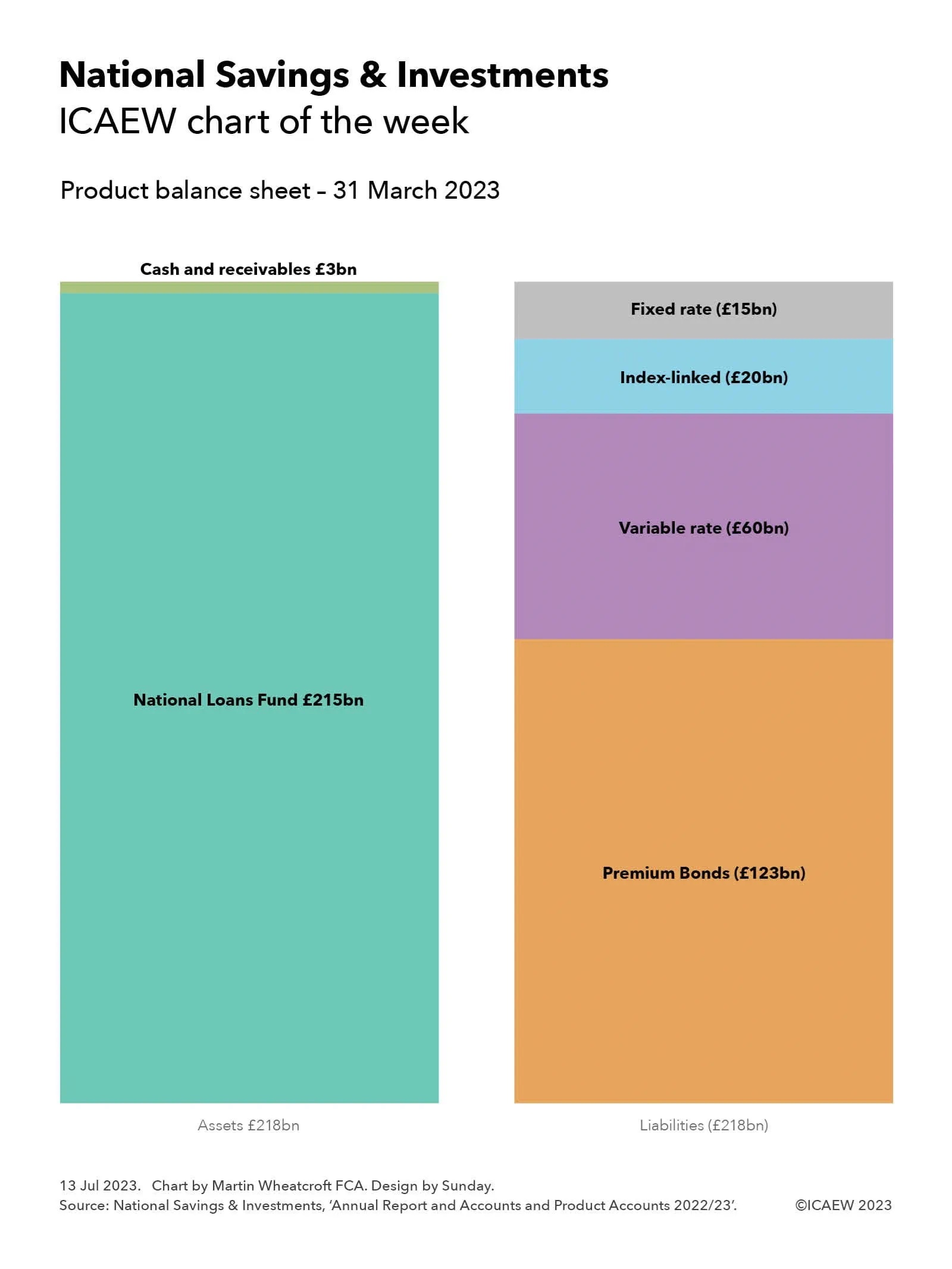
My chart this week is on the £218bn balance sheet of the state-owned retail financial institution that borrows from the public to help fund the UK government.

While the bulk of the UK national debt is financed through the sale of government bonds primarily purchased by institutional investors, the UK government also borrows money directly from the public through its in-house ‘bank’, National Savings & Investments (NS&I). 

Originally established as the Post Office Savings Bank in 1861, NS&I has a long history of funding the UK government, for example through the sale of war bonds direct to the public in the twentieth century. Today it is a non-ministerial department for its banking or ‘product’ activities, managed by an executive agency of HM Treasury of the same name.

As my chart this week illustrates, NS&I’s product assets as of 31 March 2023 of £218bn were balanced by its liabilities. As a government-backed financial institution, it is not technically a bank and so does not need to maintain equity reserves, unlike commercial banks.

The primary job of NS&I is to attract money from the public to help finance the government’s operations, with a total of £215bn lent to the National Loans Fund as of 31 March 2023. This lending formed the bulk of the NS&I’s product assets, with the balance of assets of £3bn comprising mostly cash together with some receivables.

Liabilities of £218bn on 31 March 2023 were owed to depositors, comprising £123bn in Premium Bonds, £60bn in other variable rate savings products, an estimated £20bn in Index-Linked Savings Certificates, and £15bn in fixed-interest certificates and bonds.

Premium Bonds were introduced in 1956 and (from the NS&I’s perspective) pay a variable rate of interest (currently 4.00%). From a savers’ perspective, however, bonds do not attract any interest at all and instead represent a refundable ticket to a regular tax-free prize draw, with a 22,000 to 1 chance of winning a prize each month, ranging from £25 up to £1m.

Other variable rate savings products include £32bn in on demand Direct Saver accounts that pay interest monthly (currently 3.40% gross/3.45% AER), £20bn on demand Income Bonds paid annually (currently 3.40%), £5bn in ISAs (paying 2.40%) and Junior ISAs (paying 3.65%), and £3bn in Investment Account (paying 0.85%) and legacy savings products that pay either 0.25% or 0%.

Index-Linked Savings Certificates of approximately £20bn (the exact number is not disclosed) are no longer on sale. They are of three years’ duration and can be rolled over by existing holders. These typically attract interest equivalent to Consumer Price Inflation + 0.01% AER, a very low amount in the last decade, but of course much more recently.

Fixed rate liabilities of £15bn principally comprise £12bn in Guaranteed Bonds, £2bn in Fixed Interest Savings Certificates and £1bn in Green Savings Bonds. Guaranteed Bonds are one-year fixed-term fixed interest accounts, with Guaranteed Income Bonds that today pay 3.90% gross/3.97% AER in monthly instalments and Guaranteed Growth Bonds that pay 4.00% on maturity, higher than previous issues. Three-year Fixed Interest Savings Certificates are no longer on sale but can be rolled over by existing holders, however savers can opt instead for three-year Green Savings Bonds, with issue 4 on sale at a fixed interest rate of 4.20% credited annually. 

The above numbers do not include NS&I’s separate executive agency operational balance sheet that comprised £0.18bn in assets, £0.15bn in liabilities and equity of £0.03bn on 31 March 2023.

The £218bn lent by the public to NS&I is equivalent to 7.7% of public sector gross debt of £2,836bn on 31 March 2023. While this may seem relatively small in comparison to the £1,320bn in British government securities (gilts) and other debt securities and loans that have been raised from institutional debt investors, or the £1,298bn in currency and central bank deposit liabilities, NS&I provides both a useful public service and a useful alternative source of funding.

Prime Minister Henry Temple (Viscount Palmerston) and Chancellor of the Exchequer William Gladstone would no doubt be extremely pleased to see that their creation was still funding the nation 162 years on. Even if, with £10bn in net new deposits received during the year ended 31 March 2023, it is an increasing liability.

This chart was originally published by ICAEW.

ICAEW chart of the week: How we spend our time

Time may be relative, but that doesn’t stop our national statisticians from attempting to track what we do each and every minute of the day.

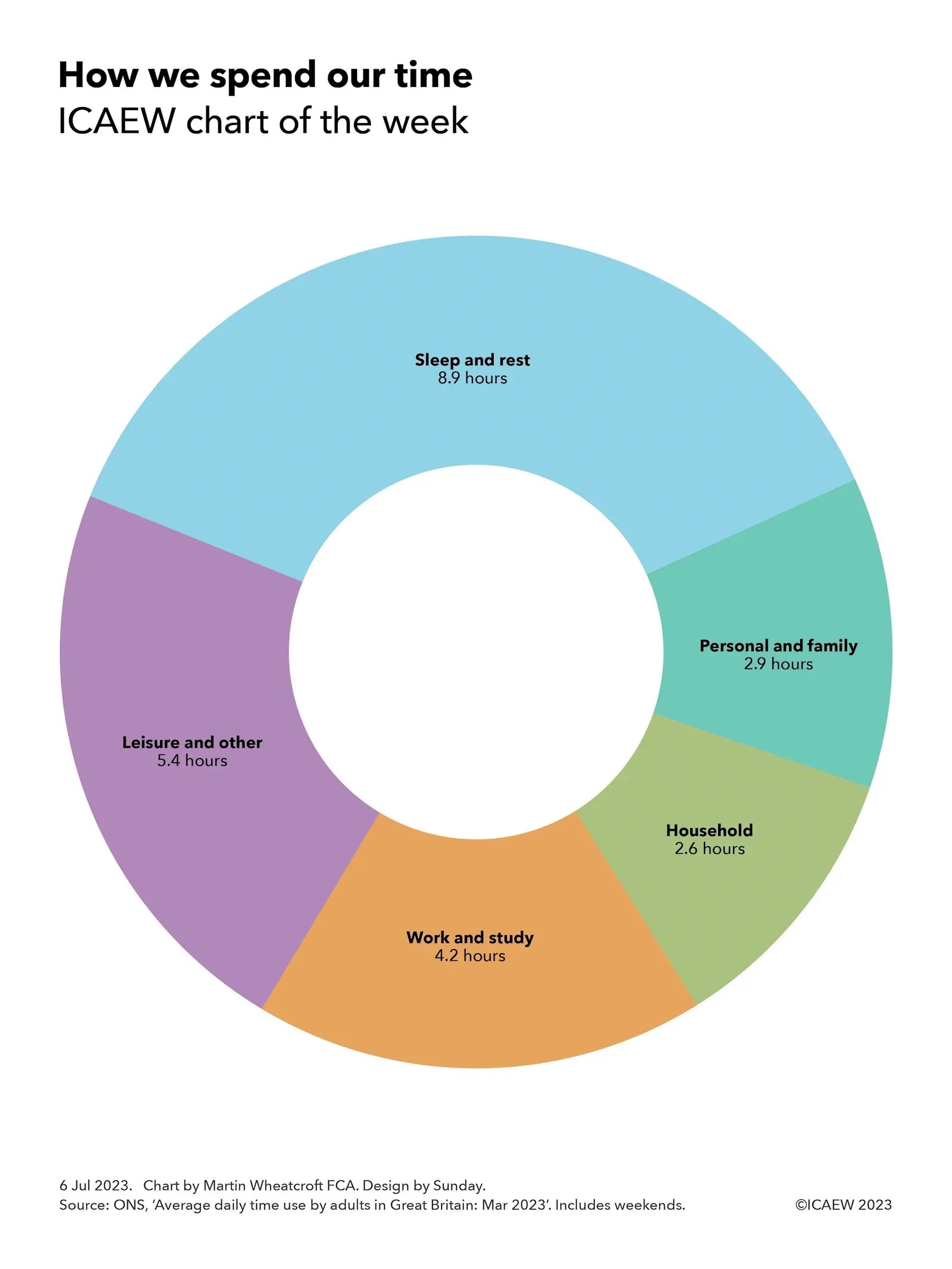
Doughnut chart adding up to 24 hours:

Sleep and rest: 8.9 hours
Personal and family: 2.9 hours
Household: 2.6 hours
Work and study: 4.2 hours
Leisure and other: 5.4 hours

According to the Office for National Statistics (ONS), adults in the UK spend 24 hours each day on a wide range of activities.

Our chart this week analyses how we spend our time divided into five broad categories, starting with sleep and rest, which takes up 8.9 hours a day on average, followed by 2.9 hours on average spent on personal and family activities. Unpaid household work takes up 2.6 hours, while work and study absorbs a further 4.2 hours, leaving an average of 5.4 hours for leisure and other activities.

These numbers are averages across the whole week, including weekends, and are based on all adults from the age of 18, including those who have retired.

The statistics are more detailed than shown in the chart with personal and family time of 2.9 hours breaking down into 2.4 hours on personal care, 0.4 hours on unpaid childcare, and 0.1 on unpaid adult care. Personal care in turn can be further analysed into 1.3 hours spent eating and drinking, 0.9 hours on washing, dressing, using the bathroom or self-grooming, 0.1 hours on medication or other health-related care, and 0.1 hours in other personal activities.

The average amount of time spent on work and study of 4.2 hours comprises an average of 1.0 hours travelling, 2.1 hours working away from home, 0.8 hours working from home, and 0.3 hours on study. 

Leisure and other activities of 5.4 hours a day include an average of 3.7 hours in entertainment, socialising and other free time, 0.8 hours using a computer or other device, 0.3 hours on exercise, sports and wellbeing, 0.2 hours on DIY or gardening, 0.1 hours volunteering and 0.3 hours on other activities.

These numbers are averages over the course of a year and how we spend our time will of course vary according to age, gender, employment or study status, physical health, lifestyle and personal interests, as well as by time of year such as when we are on vacation. 

The one constant, at least on our planet’s surface, is that we have only a total of 24 hours to work with. Within that limitation, how to spend our time wisely, or perhaps even enjoyably, will always be a challenge.

This chart was originally published by ICAEW.

ICAEW chart of the week: Fluctuating fiscal forecasts

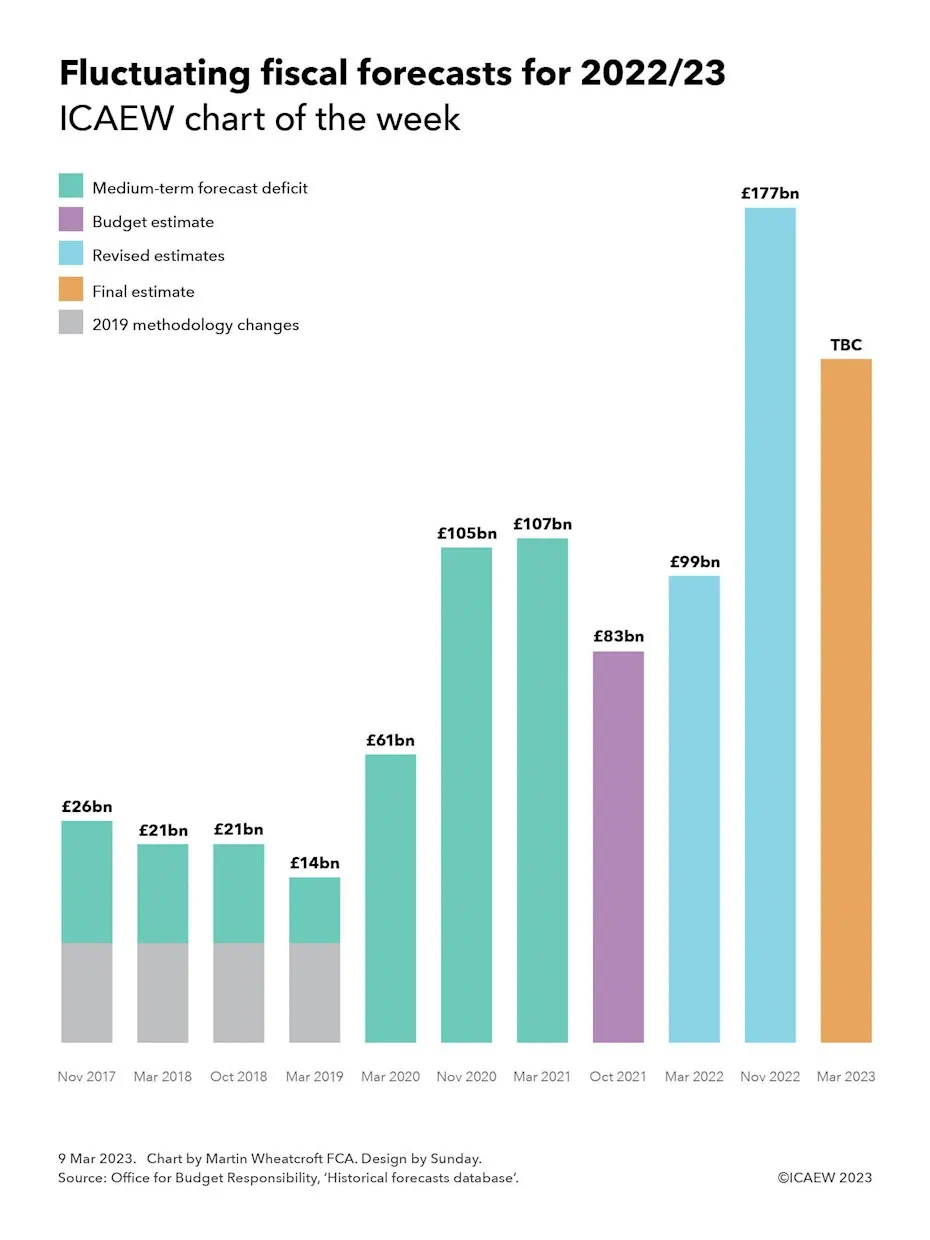
Ahead of the Spring Budget on 15 March, I take a look at how the official forecast for the 2022/23 fiscal deficit has fluctuated through successive forecasts.

Column chart showing the forecast fiscal deficit for the financial year 2022/23 over successive forecasts.

First four columns (*) have £21bn added to them for methodology changes.

Nov 2017 £26bn *
Mar 2018 £21bn *
Oct 2018 £21bn *
Mar 2019 £14bn *
Mar 2020 £61bn
Nov 2020 £105bn
Mar 2021 £107bn
Oct 2021 £83bn - Budget estimate
Mar 2022 £99bn - revised estimate
Nov 2022 £177bn - revised estimate
Mar 2023 TBC

My chart this week is on the topic of fiscal forecasting, and how the forecast deficit for the UK government’s financial year ending 31 March 2023 (2022/23) has changed over the course of five or so years of official forecasts. 

Our story starts with the Autumn Budget in November 2017, when the Office for Budget Responsibility (OBR) first published a medium-term fiscal forecast that extended to 2022/23. After plugging economic assumptions into its model and combining it with the government’s plans for public spending, it came up with a forecast of £26bn for the 2022/23 fiscal deficit, the shortfall between receipts and public spending calculated in accordance with statistical rules.

Then Chancellor Philip Hammond was at that time pretty positive about the economic prospects for the UK, despite weak productivity causing him to abandon the government’s medium-term plan to completely eliminate the budget deficit. Instead, he settled for a more modest objective of a balanced current budget and a falling debt-to-GDP ratio, extending austerity policies to cut public spending.

The next few fiscal events saw the OBR revise down its forecast for the 2022/23 deficit in the light of moderately better economic data each time. This saw the forecast for the 2022/23 deficit reduce to £21bn in the March 2018 forecast, stay at £21bn in October 2018 and fall to £14bn in the March 2019 forecast. 

The forecasts up to this point were before methodology changes announced in 2019 relating to the treatment of student loans and other items. According to the OBR these had the effect of increasing the forecast for the fiscal deficit in 2022/23 by an estimated £21bn.

The calling of a general election in December 2019 prevented Chancellor Sajid Javid from presenting a Budget in November 2019, so the OBR had to wait until March 2020 to publish its next forecast. At this point, 2022/23 was in the middle of the forecast period and Rishi Sunak’s first fiscal event as Chancellor saw a £26bn increase in the 2022/23 deficit to £61bn in an ‘end-to-austerity’ Budget that saw £46bn in extra planned spending compared with previous forecasts.

Frustratingly for the OBR, its forecasts that day were immediately out of date, as initial emergency pandemic measures were decided too late to be incorporated into its calculations. While these and subsequent temporary measures to support households and businesses through the pandemic primarily affected the 2020/21 and 2021/22 financial years, the economic hit caused by COVID-19 was the primary reason for the OBR increasing its forecast for the 2022/23 fiscal deficit to £105bn in November 2020.

March 2021 saw a small tweak to the forecast to £107bn, but the Autumn Budget and Spending Review in November 2021 saw an improvement to £83bn as the economy emerged from the lockdown phases of the pandemic in a slightly better place than was previously anticipated, with higher spending funded by planned tax rises.

This positive move went into reverse in March 2022 as the OBR revised its Budget estimate upwards to £99bn, reflecting rising interest rates on government debt and the government’s initial response to an emerging cost-of-living crisis. 

The OBR was not asked to produce an official forecast to accompany short-lived Chancellor Kwasi Kwarteng’s tax-cutting ‘mini-Budget’ in September. At £177bn the OBR forecast for the 2022/23 fiscal deficit in November 2022 was eye-watering enough, and that was after current Chancellor Jeremy Hunt’s Budget had reversed most of his predecessor’s tax cuts.

Lower than anticipated wholesale energy prices have led several commentators to suggest that the OBR’s final estimate for the fiscal deficit could be revised down by £30bn or more when it presents its medium-term forecasts up to 2027/28 to accompany the Spring Budget on 15 March 2023. As the chart suggests, this is not a ‘windfall’ as some commentators have claimed. Even if the gap between receipts and spending narrows, the deficit will still be significantly higher than the £83bn official estimate included in the Budget for 2022/23 presented to Parliament.

Fiscal forecasting is of course a very difficult task even in normal times. The deficit is the difference between two very large numbers – receipts of just over a trillion pounds and public spending of nearly £1.2trn – that can each move up or down significantly as economic conditions change, and policy choices are made. Add to that a global pandemic, a cost-of-living crisis and an uncertain policy outlook, and it is perhaps unsurprising that the forecasts have changed so much over the past five years. 

In an uncertain world, fiscal forecasts fluctuate.

This chart was originally published by ICAEW.

ICAEW chart of the week: UK business births and deaths

My chart this week illustrates the choppy economic waters facing UK businesses as more stopped trading than were created over the course of 2022.

Bar chart going down vertically from Q1 2017 to Q4 2022 showing business closures and creations on the left and the net decrease or net increase on the right.

Q1 2017 -78,950, +97,340, +18,390
Q2 2017 -96,390, +80,930, -15,460
Q3 2017 -82,555, +86,380, +3,825
Q4 2017 -67,655, -73,975, +6,320
Q1 2018 -86,775, +88,295, +1,520
Q2 2018 -80,550, +95,715, +15,165
Q3 2018 -65,660, +79,410, +13,750
Q4 2018 -72,375, +76,730, +4,355
Q1 2019 -77,990, +97,110, +19,120
Q2 2019 -91,410, +95,675, +4,265
Q3 2019 -74,440, +84,970, +10,530
Q4 2019 -67,990, +77,970, +9,980
Q1 2020 -96,660, +89,910, -6,750
Q2 2020 -72,665, +73,415, +16,170
Q3 2020 -60,415, +76,585, +16,170
Q4 2020 -78,965, +82,080, +3,115
Q1 2021 -86,600, +101,845, +15,245
Q2 2021 -88,515, +91,400, +2,885
Q3 2021 -83,235, +81,165, -2,070
Q4 2021 -87,040, +79,870, -7,170
Q1 2022 -110,515, +98,730, -11,785
Q2 2022 95,155, +89,225, -5,930
Q3 2022 -79,305, +67,390, -11,915
Q4 2022 -82,390, -69,445, -12,945

The Office for National Statistics (ONS) published its latest quarterly experimental statistics on business births and deaths on 2 February 2023. This reports that business closures have increased since before the pandemic at the same time as business creations have fallen, resulting in net reductions in the number of VAT- or PAYE-registered businesses operating in the UK over the past six quarters.

The statistics are taken from the government’s Inter-Departmental Business Register, a database of approximately 2.8m businesses registered for either PAYE or VAT, just over half of the estimated 5.5m businesses operating in the UK (according to the Department of Business & Trade). The difference principally relates to sole traders with turnover below the VAT threshold who have not voluntarily registered for VAT, or for PAYE if they trade through a company. There is also a time lag on reporting the closure of businesses where a business continues to be registered, with the ONS waiting for several periods of zero VAT or zero payrolls before recording a business as closed.

The statistics are labelled as experimental because they are not as rigorous as annual statistics, but the advantage is that they provide data on business births and deaths in 2022, for which we will not get a full set of annual numbers until towards the end of this year. 

As our chart illustrates, the quarterly net change in businesses in 2017 was +18,390, -15,460, +3,825 and +6,320 respectively, followed by +1,520, +15,165, +13,750, +4,365 in 2018, +19,120 and +4,265, +10,530 and +9,980 in 2019. The pandemic saw a fall in business closures as government support enabled businesses that would otherwise have stopped operating to stay alive, with a net decrease of -6,750 in Q1 2020 followed by net increases of +750, +16,170, +3,115 in the second, third and fourth quarters of 2020. 

A spurt in business creations in early 2021 saw net increases of +15,245 and +2,885 in the first two quarters, before net decreases of -2,070 and 7,170 in the last two quarters of 2021. With pandemic support measures coming to an end and the onset of the energy crisis, the trend moved further into negative territory with quarterly net closures of -11,785, -5,930, -11,915 and -12,945 in 2022.

Quarterly business deaths averaged around 81,400 in 2017, 76,300 in 2018, 78,000 in 2019, 77,200 in 2020, 86,300 in 2021 and 91,800 in 2022, while quarterly business births averaged around 84,700 in 2017, 85,000 in 2018, 88,900 in 2019, 80,500 in 2020, 88,600 in 2021 and 81,200 in 2022.

These numbers will not be pretty reading for Kemi Badenoch, the new Secretary of State for Business and Trade. With interest rates on the rise, energy costs still at very high levels and consumers cutting back on spending, the risks are that many more existing businesses will cease trading, while business creations may continue to be subdued.

One crumb of comfort is that businesses founded during downturns are believed to do better than those founded in good times. So, if you are thinking of striking out on your own with a new business idea, there may be no better time than now.

This chart was originally published by ICAEW.

ICAEW chart of the week: Autumn Statement

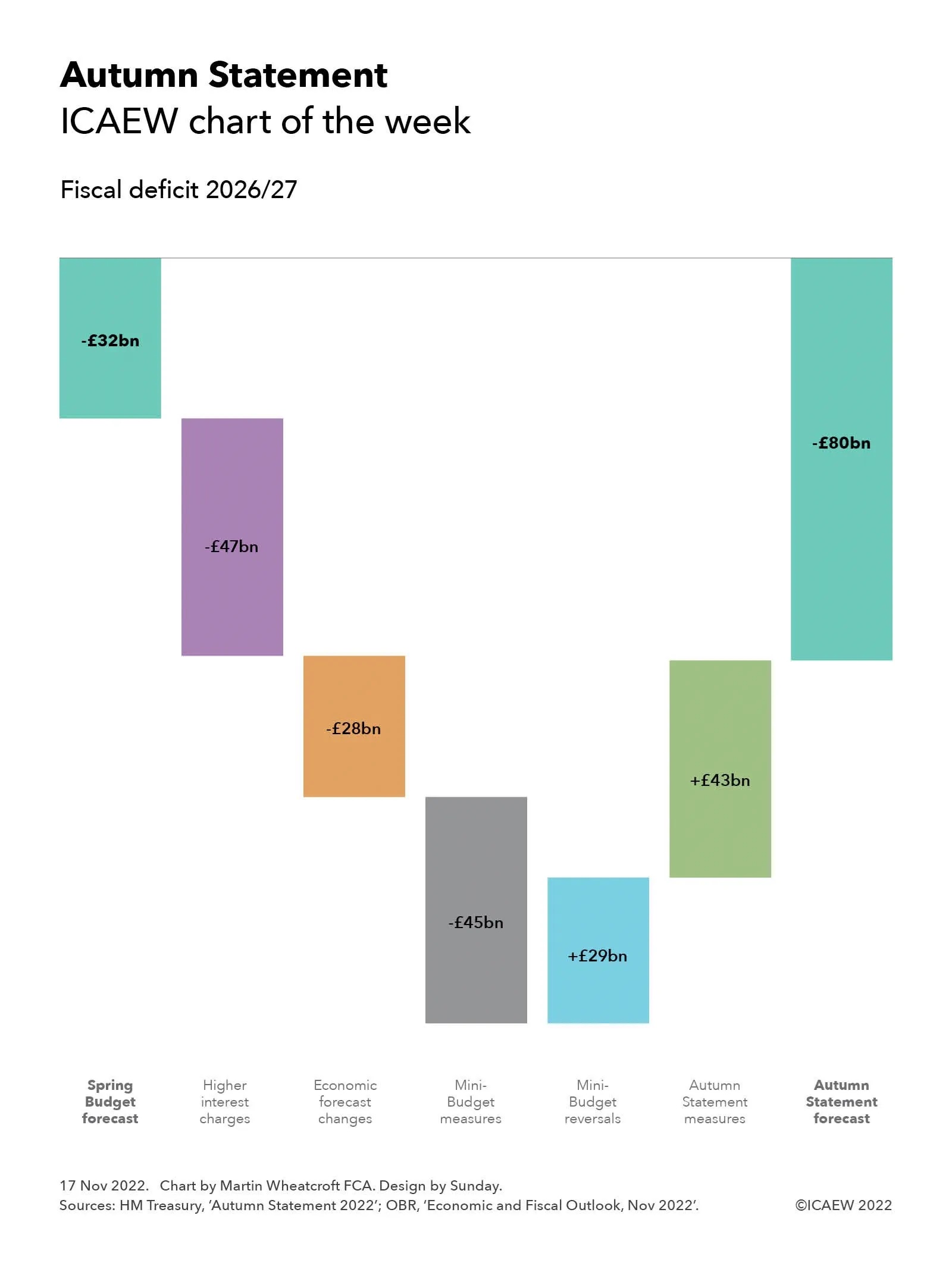
The public finances have been a rollercoaster ride over the last few months, as illustrated by this week’s chart showing how the forecast for the fiscal deficit in 2026/27 has changed since the Spring Budget.

Step chart showing changes in the forecast deficit for 2026/27:

Spring Budget forecast: -£32bn
Higher interest charges: -£47bn
Economic forecast changes: -£28bn
Mini-Budget measures: -£45bn
Mini-Budget reversals: +£29bn
Autumn Statement measures: +£43bn
= Autumn Statement forecast: -£80bn

Former Chancellor and now Prime Minister Rishi Sunak expressed some optimism back in March when he presented his Spring Budget, commenting how he remained committed to achieving a current budget surplus despite the huge amounts spent supporting individuals and businesses through the pandemic, and the support he was then offering to help with energy bills as they started to soar.

My chart this week illustrates how the fiscal situation has deteriorated significantly as rising interest rates, accelerating inflation, and an economy entering recession have adversely affected the public finances. Together with the additional energy support measures announced by then Prime Minister Liz Truss in September, the shortfall between receipts and expenditure is expected to be £270bn higher over a five-year period to 2026/27 than was forecast by the Office for Budget Responsibility back in March.

In 2026/27 itself (the year ending 31 March 2027), interest charges are expected to be £47bn higher than previously forecast, while tax receipts and other forecast changes are expected to require an extra £28bn in additional funding (of which £25bn relates to lower tax receipts). 

In theory this would result in a deficit of £107bn, which is why it was surprising that then Chancellor Kwasi Kwarteng decided to announce unfunded tax cuts amounting to £45bn a year by 2026/27. Although Kwarteng was hoping his planned tax cuts would help stimulate the economy, if they hadn’t then the deficit could have risen to more than £150bn, an unsustainable level that caused financial markets to take fright – even if they and we didn’t have the official numbers at that point.

Reversals to the mini-Budget followed as Chancellor Jeremy Hunt and Prime Minister Rishi Sunak attempted to reassure markets of their fiscal credibility, with £43bn in tax and spending changes to plug some of the gap. These comprise tax rises amounting to around £23bn a year (more than offsetting the £16bn of tax cuts retained from the mini-Budget), together with £20bn in lower levels of public spending than previously planned.

Together the forecast changes and government decisions give rise to a forecast deficit of £80bn in 2026/27, significantly higher than previously forecast. This is not a comfortable place for the public finances, with the Chancellor having to abandon the government’s previous commitment to achieving a current budget surplus in addition to, as expected, deferring the point at which he expects to see the underlying debt-to-GDP ratio start to fall from three to five years into the future.

Both tax and spending measures primarily involve fiscal drag, freezing tax allowances so that more people are brought into paying tax or paying tax at higher rates, and severely constraining public spending. Although it might be theoretically possible to hold the line on both tax and spending constraint for the next five years, there are likely to be some adjustments needed in the Spring Budget as pressures on public services mount, while the most difficult decisions have been postponed until after the next general election.
This week’s chart is not a pretty picture.

This chart was originally published by ICAEW.

ICAEW chart of the week: Provisional tax bands 2023/24

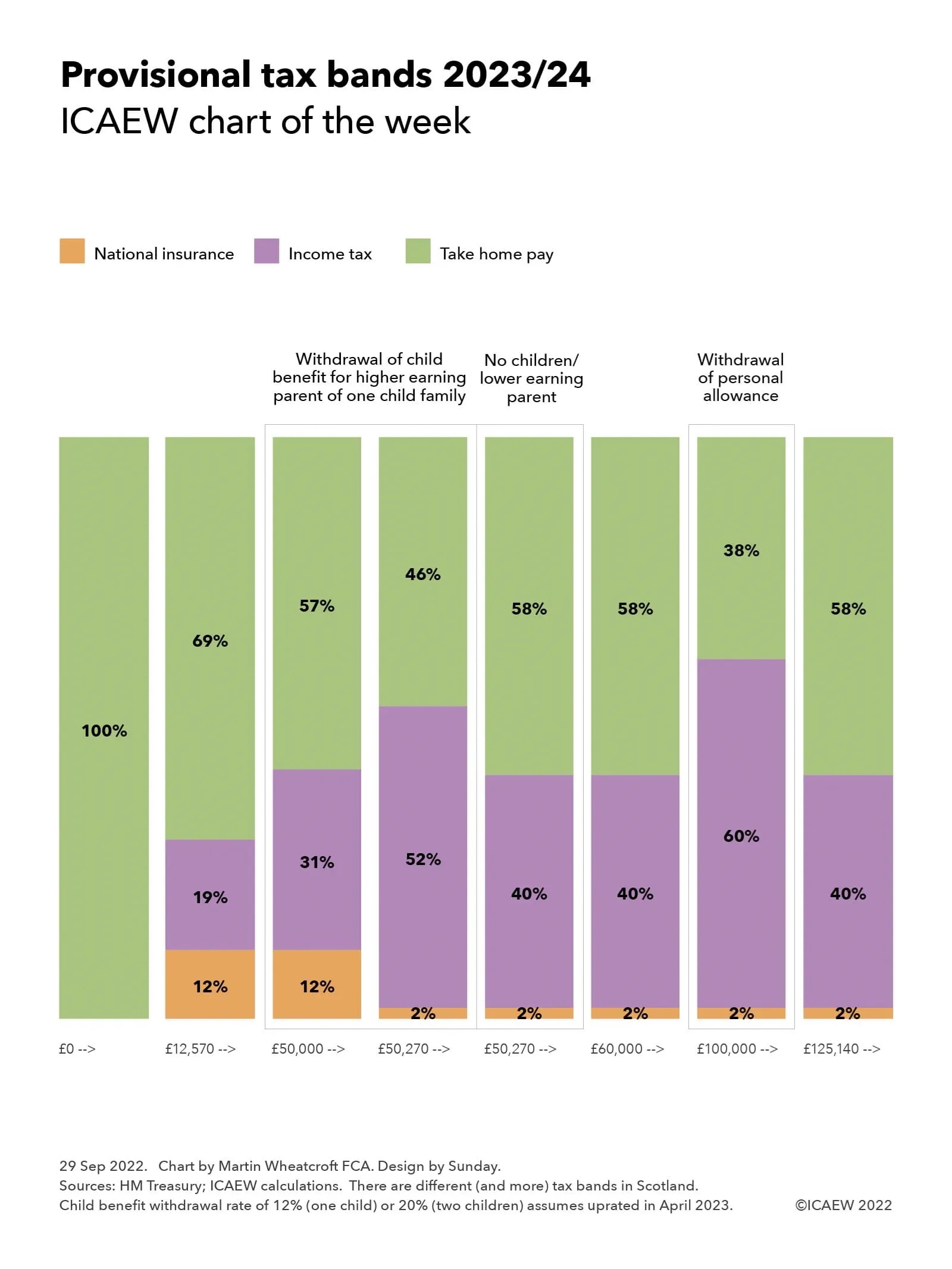
My chart this week illustrates how five or seven different personal tax bands are expected in the coming financial year, despite the top rate of income tax being abolished.

Column chart showing tax rates for 2023/24 by income level, based on the mini-Budget. 

£0 -> 100% take home pay
£12,570 -> 12% national insurance, 19% income tax, 69% take home pay

Box for withdrawal of child benefit
£50,000 -> 12% NI, 31% income tax, 57% take home pay
£50,270 -> 2% NI, 52% income tax, 46% take home pay

Box for no children / lower earning parent
£50,270 -> 2% NI, 40% income tax, 58% take home pay

End of boxes

£60,000 -> 2% NI, 40% income tax, 58% take home pay
£100,000 -> 2% NI, 60% income tax, 38% take home pay (withdrawal of personal allowance)
£125,140 -> 2% NI, 40% income tax, 58% take home pay

Amid market chaos it might be forgotten that the ‘mini’ Budget was primarily about reforming the personal tax system. In abolishing the 45% top rate of income tax from 6 April 2023 onwards, the Chancellor simplified the tax system by removing the personal tax band that currently applies to earnings above £150,000.

Despite that simplification, our chart this week highlights how the personal tax system remains quite complicated, much more than might be assumed based on just two rates of income tax (19% and 40%), two rates of national insurance (12% and 2%) and recent alignment in income tax and national insurance thresholds.

In practice, our chart is an oversimplification, as it does not attempt to incorporate welfare benefits and hence the full complexity of how people are ‘taxed’ as their incomes rise – for example the 55% taper rate at which universal credit is withdrawn from those on the lowest incomes. It also does not attempt to reflect the tax treatment on non-earned income such as dividends, interest and capital gains, nor the intricacies of how pension contributions or other tax reliefs are dealt with. 

Nor does it show the different rates of income tax applicable in Scotland, which currently has three more tax bands than elsewhere in the UK and is likely to continue to do so once the Scottish Budget establishes tax rates for next financial year.

Our chart assumes the thresholds for personal income tax and national insurance remain frozen as currently planned, illustrating how there is no tax to pay on the first £12,570 of earned income – the first band in the UK’s personal tax system.

From this point upwards, income tax of 19% (a 1% cut from the current rate) and employee national insurance of 12% (a reduction from the 13.25% in force until next month) are expected to apply in 2023/24, a combined rate of 31% that reduces take-home pay to 69% of each extra pound earned.

These rates apply to earnings up to £50,000, when a strange quirk of the tax system comes into play if you are a parent with a child or children receiving child benefit. Assuming child benefit is uprated by inflation in April, then the amount clawed back between £50,000 and £60,000 from the higher-earning parent is likely to be equivalent to somewhere in the region of an extra 12% (for one child) or 20% (for two children). The quirk is the misalignment between the £50,000 at which child benefit starts to be withdrawn through the tax system and the £50,270 point at which the 40% higher rate of income tax rate and 2% lower rate of national insurance of £50,270 come into force. 

This creates a small band where the higher-earning parent of one child faces a combined tax rate of 43%, followed by a band between £50,270 and £60,000 where a combined rate of 52% applies. Not shown in the chart is the even higher rates of tax for two children – 39% income tax + 12% national insurance and 60% income tax + 2% national insurance – or even higher for three or more children receiving child benefit.

For those without children, or for the lower-earning parent, there is a more straightforward jump as income exceeds £50,270, with an extra 21% taken as the income tax rate rises from 19% to 40%, partially offset by a 10 percentage-point reduction in national insurance from 12% to 2%.

Those without children and lower-earning parents should retain 58% of each pound of earnings over £50,270, as will higher-earning parents on incomes above £60,000. 

For earnings above £100,000 the personal allowance is withdrawn, creating an extra tax band between £100,000 and £125,140 where there is a marginal income tax rate of 60%, which with 2% of employee national insurance means retaining 38% of each additional pound earned within this band. The new top band is above £125,140, where income tax reverts to 40%, which combined with 2% of national insurance results in 58% being retained for each extra pound earned.

With the current 45% top rate of tax abolished, there is no further band for earnings above £150,000, meaning that all incomes above £125,140 are taxed at a combined rate of 42%, at least before taking account of tax reliefs that might apply.

There have been suggestions that the Chancellor intends to attempt to simplify personal tax bands further, perhaps by abolishing the 60% tax rate between £100,000 and £125,140 by allowing higher earners to retain the personal allowance rather than have it withdrawn. A less expensive option would be to align the child benefit withdrawal threshold with that for the higher income tax rate, getting rid of the mini-tax band for higher-earning parents on incomes between £50,000 and £50,270.

We will no doubt discover whether the government’s new-found zeal to simplify the tax system will continue, or if they will revert to the longer-term trend of adding in new complications to the tax system whenever a little extra money needs to be found.

This chart was originally published by ICAEW.

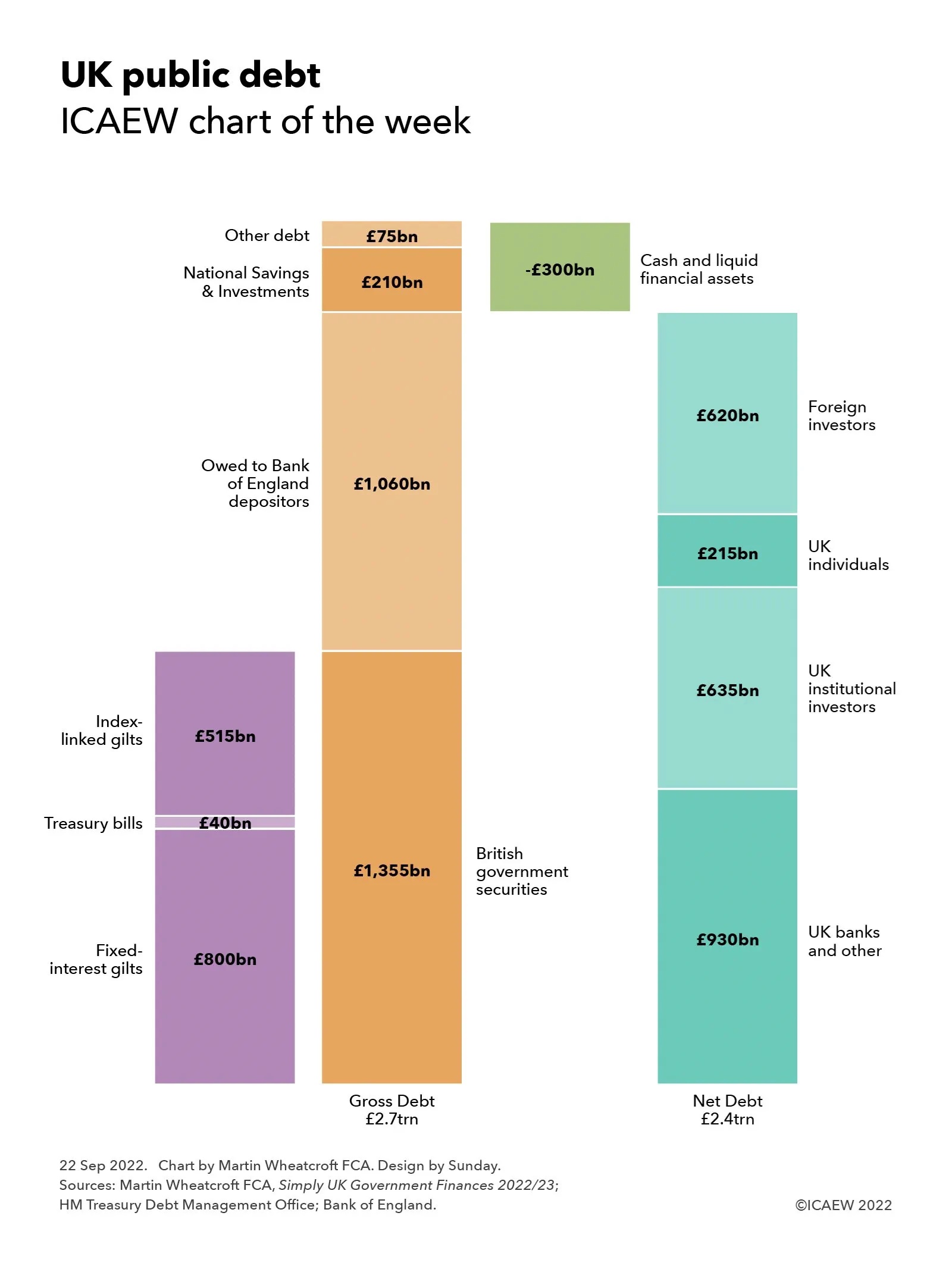
ICAEW chart of the week: UK public debt

We take a look at what makes up UK public debt and who it is owed to, before the Chancellor borrows hundreds of billions more in his emergency fiscal event.

Hybrid step chart showing gross debt of £2.7trn comprising £1,355bn of British government securities (of which £800bn is fixed-interest gilts, £40bn is treasury bills and £515bn is index-links gilts), £1,060bn owed to Bank of England depositors, £210bn for National Savings & Investments and £75bn in other debt. 

After deducting £300bn of cash and liquid financial assets, net debt is £2.4trn, which can be analysed as £930bn owed to UK banks and other, £635bn to UK institutional investors, £215bn to UK individuals, and £620bn to foreign investors.

We take a look at what makes up UK public debt and who it is owed to, before the Chancellor borrows hundreds of billions more in his emergency fiscal event.

Our chart this week is on public debt, illustrating how public sector gross debt is currently in the region of £2.7tn and public sector net debt is in the order of £2.4trn.

HM Treasury owes £2.1trn to holders of British government securities, of which approximately £745bn is owed to the Bank of England and £1,355bn to external investors. These securities are tradable on the London Stock Exchange, comprising fixed-interest bonds (‘gilts’) with an average maturity of 14 years, retail price index-linked gilts with an average maturity of 18 years and treasury bills that mature and roll over within six months or less.

The next largest public sector borrower is the Bank of England, which owes around £1,060bn to its depositors. This mostly comprises deposits created under its quantitative easing programme to support the economy, in the order of £850bn to finance fixed-interest gilt purchases, £20bn to finance corporate bond purchases and around £190bn to finance Term Funding Scheme loans.

The public is directly owed £210bn in the form of National Savings & Investments premium bonds and savings certificates.

The balance of £75bn comprises £25bn in Network Rail loans, £15bn in local authority external debt (local authorities owe £120bn in total, but £105bn is owed to central government) and £35bn in other sterling and foreign currency debt. These numbers do not include £21bn in central government leases and £10bn in other debts that have recently been added to the official measure for government debt following changes in methodology.

After deducting £300bn in cash and other liquid assets, this means public sector net debt stands at around £2.4trn, of which in the order of £930bn is owed to UK banks and other financial institutions, £635bn to UK institutional investors (pension funds and insurance companies), £215bn to UK individual investors, and £620bn to foreign investors, including foreign central banks and governments as well as private sector investors.

The chart illustrates how, despite the efforts of HM Treasury’s Debt Management Office to lock in fixed interest rates for long periods, the government is exposed to significant interest rate and inflation exposure, with the Bank of England having – in effect – swapped a significant proportion of government debt from fixed-rate gilts into variable rate central bank deposits through its quantitative easing programmes.

The consequence is that the majority of public debt is exposed to changes in interest rates or, in the case of index-linked gilts, to changes in retail price inflation, driving interest costs higher and higher each time the Bank of England raises its benchmark central bank deposit rate.

This provides a difficult backdrop for the Chancellor’s plans to borrow substantial sums to cut taxes, cap energy prices for households and businesses and increase defence spending. Most of the extra borrowing will be financed by issuing new British government securities at a time when the Bank of England is starting to put its quantitative easing programme into reverse and so selling some of its stock of fixed-interest gilts back into the market. 

There is no need for an official forecast to be confident of two things: public debt, and the cost of public debt, are both going up.

This chart was originally published by ICAEW.

ICAEW chart of the week: Receipts and spending by age

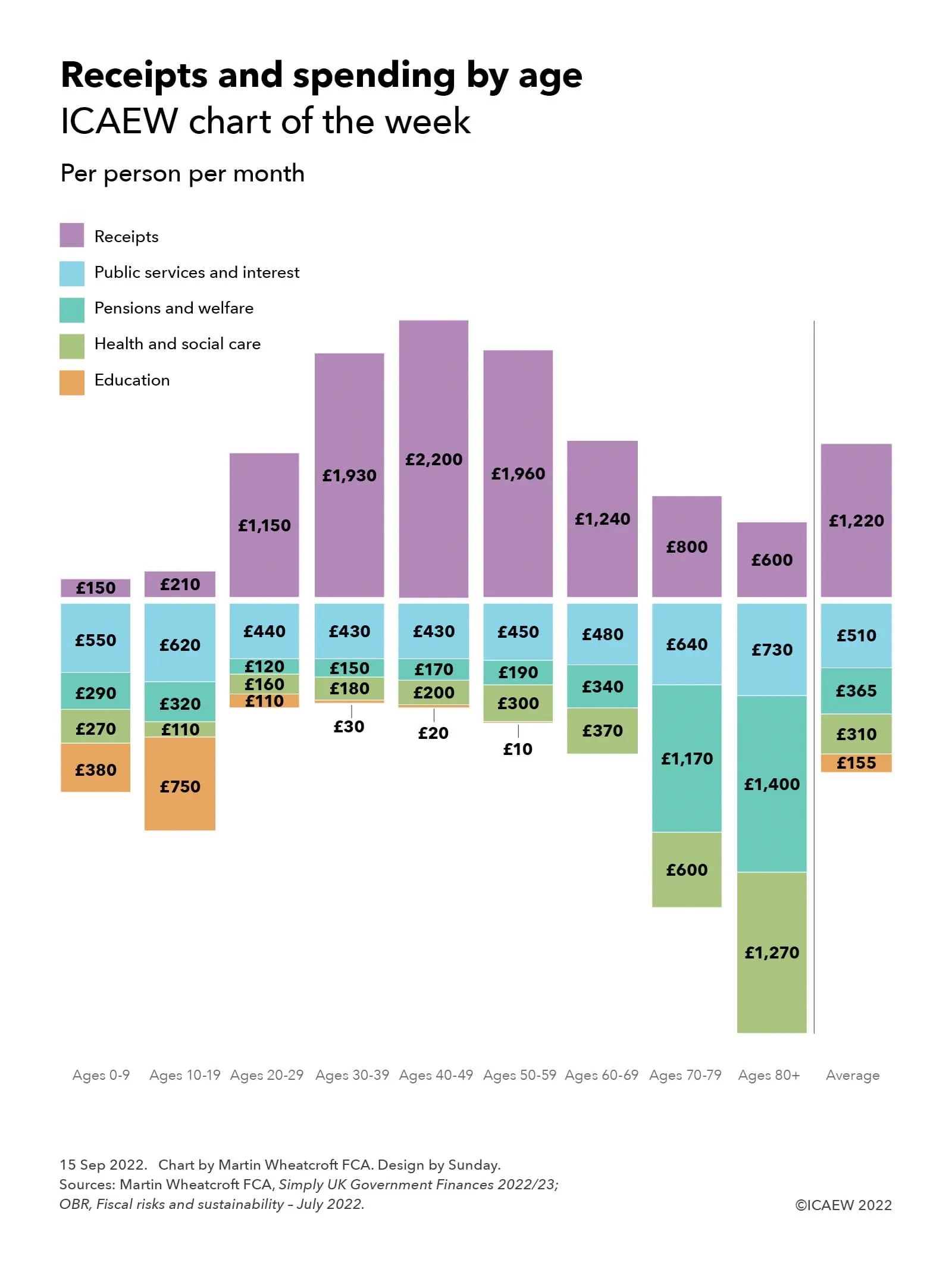
My chart this week looks at how receipts and spending vary by age, a key driver for public finances that new Chancellor Kwasi Kwarteng will need to factor into his fiscal plans.

Column chart - showing receipts by age group per person per month above the line and spending below the line.

0-9: £150 (receipts) - £550 (public services and interest), £290, (pensions and welfare), £270 (health and social care), £380 (education)

10-19: £210 - £620, £320, £110, £750

20-29: £1,150 - £440, £120, £160, £110

30-39: £1,930 - £430, £150, £180, £30

40-49: £2,200 - £430, £170, £200, £20

50-59: £1,960 - £450, £190, £300, £10

60-69: £1,240 - £480, £340, £370, -

70-79: £800 - £640, £1,170, £600, -

80+: £600 - £730, £1,400 - £1,270

Average: £1,220 - £510, £365, £310, £155

Kwasi Kwarteng’s first Budget will be an emergency one, not only setting out his plans for the financial year commencing on 1 April 2023, but also re-opening the budget for the current financial year. It will be dominated by the emergency support package for individuals and businesses already announced, alongside starting to deliver on Prime Minister Liz Truss’s commitments to cut taxes and ‘shrink the state’.

The new Chancellor is likely to find that cutting public spending is not going to be easy given the increasing financial commitments made by successive governments since the Second World War on education, pensions, health and social care, the areas that now dominate public spending. He supported adding to those commitments only a couple of years ago when then Prime Minister Boris Johnson decided to expand eligibility for social care, and former Chancellor Rishi Sunak re-committed to the ‘triple-lock’ that guarantees increases in the state pension every year.

As our chart this week illustrates, receipts and spending vary significantly across age groups, with spending on education higher on the young, who pay very little in taxes, and spending on pensions, health and social care much higher for older generations who contribute less than the average, especially after reaching retirement age. This contrasts with the profile for those of working age who pay the most into the system while on average taking the least out.

Derived from an analysis from the Office for Budget Responsibility’s fiscal risks and sustainability report published in July, the chart shows how – before the emergency Budget scheduled for 21 September – budgeted tax and other receipts for the current financial year 2022/23 are equivalent to £1,220 per person per month, based on forecast receipts of £988bn and a population of 67.5m. This is below budgeted public spending of £1,340 per person per month (£1,087bn/67.5m people/12 months), with the deficit of £120 per person per month (£99bn in total) funded by borrowing.

Average receipts per person per month by age group are estimated to be in the order of £150, £210, £1,150, £1,930, £2,200, £1,960, £1,240, £800 respectively for those aged 0-9, 10-19, 20-29, 30-39, 40-49, 50-59, 60-69, 70-79 and 80+ respectively. These numbers include £115 per person per month of non-tax receipts spread evenly across everyone. 

Spending on public services and interest in the order of £510 per person per month, or £550, £620, £440, £430, £430, £450, £480, £640, £730 by age group, is less variable across age groups because it much of this spending is incurred on behalf of everyone, including £125 in interest, £73 on defence and security and £53 on policing, justice and safety for example.

Spending on pensions and welfare of £365 per person per month is less evenly spread, with £290 and £320 per month spent on those in their first two decades and £440, £430, £430 and £450 on those in their twenties, thirties, forties and fifties respectively. This increases to average spending per person per month of £480, £640 and £730 on those in their sixties, seventies and eighties or over. 

Health and social care spending of £310 is biased towards older generations, with per person per month spending of £270, £110, £160, £180 and £200 for the first five decades of life contrasting with the £300, £370, £600 and £1,270 spent on average on those in their fifties, sixties, seventies and eighties or over. 

As you would expect, education spending of £155 per person per month on average is mostly spent on the young, with around £380 per person per month spent on the under-10s, £750 spent on those between 10 and 19, £110 spent on those in their twenties, and £30, £20 and £10 respectively spent on those in their thirties, forties and fifties.

The reason this chart is so critical is because demographics are not in a steady state, with the ONS projecting that there will be an additional 3.3m pensioners in 20 years’ time, a 27% increase. This will have significant cost implications for this and future governments over a period when the working-age population – who pay most of the taxes to fund public spending – is projected to grow by just 4% in total. 

While a declining birth rate might relieve some of the pressure on education spending over the next 20 years, spending on the state pension, the NHS and on social care will grow significantly if the commitments made by the current and previous governments to provide for income in retirement, universal free health care and an increasing level of social care provision are to be met, at the same time as running public services to the standard required.

Kwasi Kwarteng’s predecessors have been able to cover the expanding share of public spending going on pensions and health and social care without raising taxes above 40% of the economy by cutting spending on public services, in particular the defence budget, which has declined from in the order of 10% of GDP to around 2% over the last half century. However, with defence already at the NATO minimum, and many public services under significant pressure to improve delivery, there is much less scope to find savings than there has been in the past.

This poses a very big challenge for the Chancellor as he puts together his medium-term fiscal plans. Economic growth needs to be much higher than it has been in recent years, not only to cover the cost of tax cuts that he hopes will generate that growth, but also to generate the extra tax receipts needed to fund pensions and health and social care as more people live longer lives.

This chart was originally published by ICAEW.

ICAEW chart of the week: Energy price cap update

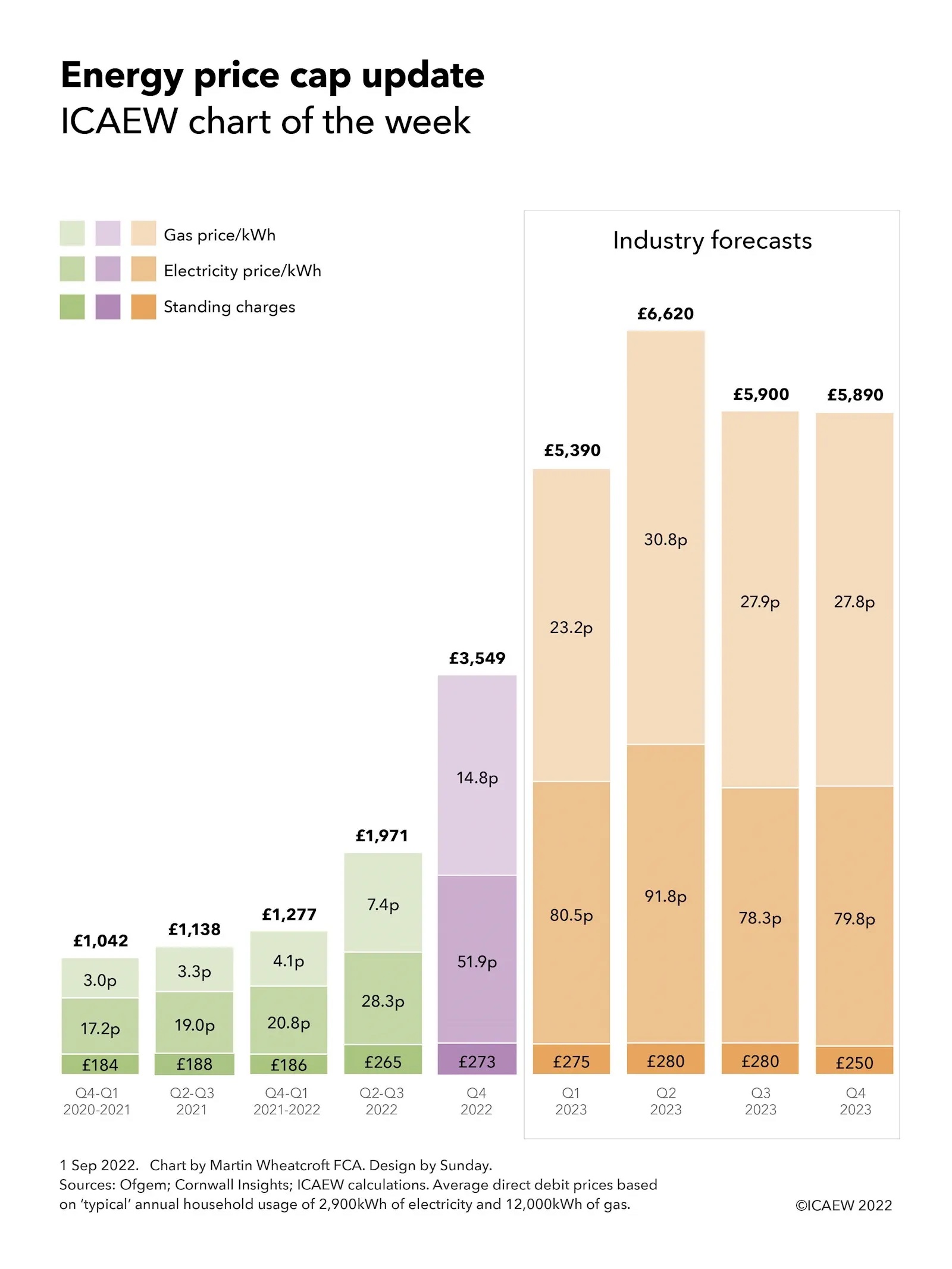
My weekly chart for ICAEW returns for a less than cheerful update on the energy price cap, highlighting how the massive 54% price rise back in April pales into insignificance in comparison with the recently announced 80% rise in October and the prospect of further big rises in the first half of 2023.

Column chart showing historical price caps for Q4 2020-Q1 2021, Q2-Q3 2021, Q4 2021-Q1 2022, Q2-Q3 2022, the recently announced price cap for Q4 2022, and industry forecasts for Q1, Q2, Q3 and Q4 2023.

Average typical price cap: £1,042, £1,138, £1,277, £1,971, £3,549 (Q4 2022), £5,390, £6,620, £5,590, £5,890.

Gas price/kWh: 3.0p, 3.3p, 4.1p, 7.4p, 14.8p (Q4 2022), 23.2p, 30.8p. 27.9p, £27.8p.

Electricity price/kWh: 17.2p, 19.0p, 20.8p, 28.3p, 51.9pm (Q4 2022), 80.5p, 91.8p, 78.3p, 79.8p.

Standing charge: £184, £188, £186, £265, £273 (Q4 2022), £275, £280, £280, £259.

Sources: Ofgem, Cornwall Insights, ICAEW calculations. Average direct debit prices based on 'typical' annual household usage of 2,900 kWh of electricity and 12,000kWh of gas.

My chart this week is on Ofgem’s cap on domestic electricity and gas prices, which increased from an annual average of £1,042 back in October 2020 for a ‘typical’ household using 2,900kWh of electricity and 12,000kWh of gas paying by direct debit, to £1,138 in April 2021, £1,277 in October 2021 and £1,971 in April this year.

Unless the new prime minister intervenes, the energy price cap will rise to £3,549 on 1 October, significantly more than was anticipated in our chart back in January on this topic . Divided by 12, this gives a monthly average bill of £296 (compared with £164 currently and £106 last winter), although as energy usage in winter is higher for most households the £400 or £66 per month rebate between October 2022 and April 2023 announced by the government earlier this year will not go very far.

The change to quarterly price caps from 2023 onwards means that households face a further rise in January, making the winter even more expensive given that research from Cornwall Insight suggests energy prices will continue to rise, to a likely cap of in the region of £5,390 on 1 January 2023 and potentially to as much as £6,620 on 1 April 2023, before falling to £5,900 on 1 July and £5,890 on 1 October 2023.

The energy price cap is technically a series of regional caps on the price per kilowatt-hour (kWh) for electricity and gas, and on the daily standing charge payable by domestic users. Larger or less energy-efficient households using more electricity or gas will pay a lot more than the amounts shown here, while smaller and more energy-efficient households will pay less. There are higher prices for those using prepayment meters (£3,608 from 1 October) and those paying by cash or cheque (£3,764 from 1 October).

The chart illustrates how the average annual standing charge was £184 in Q4 2020 and Q1 2021, £188 in Q2 and Q3 2021, £186 in Q4 2021 and Q1 2022 and £265 in the current price cap, the large increase principally to cover the costs of dealing with the 40 or so energy suppliers that went bust over the past year. The average standing charge will increase to £273 in October and then is expected to stabilise at around that level, potentially at £275, £280, £280, and £250 respectively for the four quarters in 2023, although this depends on how Ofgem chooses to allocate the costs that make up the cap between fixed and variable elements in the pricing structure.

The average per kWh price for electricity has increased from 17.2p (Oct 2020-Mar 2021) to 19.0p (Apr-Sep 2021) to 20.8p (Oct 2021-Mar 2020) to 28.3p currently and will rise to 51.9p in October. If Cornwall Insight’s predictions come to fruition, the price is likely to rise to somewhere around 80.5p per kWh in January and potentially to 91.8p in April, before falling to 78.3p in July and rising slightly to 79.8p in October 2023. The potential peak of 91.8p is more than five times the level back in October 2020 and is likely to be an even higher multiple for the many households who were on fixed price deals that were often significantly below the level of the price cap.

The average per kWh price for gas has increased from 3.0p (Oct 2020-Mar 2021) to 3.3p (Apr-Sep 2021) to 4.1p (Oct 2021-Mar 2020) to 7.4p currently and will rise to 14.8p in October. The gas price is likely to rise to 23.2p per kWh in January and potentially to 30.8p in April, followed by 27.9p and 27.8p in the final two quarters of 2023. The possible peak of 30.8p would be more than 10 times the level of 3.0p back in October 2020.

The price cap about to come into force of £3,549 is based on annually equivalent wholesale energy costs of £2,491, network costs of £372, operating costs of £214, social and environmental contributions of £152, other costs of £88 and a profit margin of £63, before adding on £169 of VAT at a rate of 5%. These are equivalent to £208, £31, £18, £13, £7, £5, and £14 in a ‘typical’ bill of £296 per month.

The sheer scale of these price rises will make energy unaffordable for millions of families across the UK at the same time as many other prices are rising sharply. This will mean real hardship for those on low and middle incomes without significant additional financial support from government, whether in the form of extra rebates on energy price rises or support through the benefit system. Other options include reforming the pricing mechanism for electricity generated by non-gas sources such as renewables or providing the energy suppliers with a long-term borrowing facility to enable the expected price rises to be spread out over a number of years.

Either way, the incoming prime minister faces some very difficult choices in how to respond, not only to the cost-of-living crisis but also to an emerging cost-of-doing-business crisis that could see many businesses forced to close as their energy prices (not covered by the domestic price cap) become unsustainable.

In January, I said: “There may be trouble ahead.” Unfortunately for all of us, trouble has arrived.

This chart was originally published by ICAEW.

July boost to public finances doesn’t stop red ink

Fiscal outlook worsens as mid-year self assessment receipts fail to outweigh higher debt interest and the cost of energy support packages.

The monthly public sector finances for July 2022 released on Friday 19 August 2022 reported a provisional deficit for the month of £5bn, compared with a deficit of £21bn in the previous month as self assessment receipts boosted the cash position, supplemented by growing VAT and PAYE receipts. The latter helped add £7bn to the top line compared with this time last year, bringing total receipts for the month to £84bn, while current expenditure excluding interest of £79bn and interest of £7bn were each £3bn higher. With net investment unchanged at £3bn, the net improvement in the deficit for July compared with the same month last year was £1bn.

The total deficit for the first four months of the 2022/23 financial year was £55bn following revisions to previous months. This was £12bn lower than this time last year and £99bn lower than the previous year during the first pandemic lockdown, but £33bn more than the deficit of £22bn for the first four months of 2019/20, the most recent pre-pandemic comparative period.

Public sector net debt was £2,388bn or 95.5% of GDP at the end of July, up £46bn from £2,342bn at the end of March 2022. This is £621bn higher than the £1,767bn equivalent on 31 March 2020, reflecting the huge sums borrowed over the course of the pandemic, although the increase in the debt-to-GDP ratio from 74.4% on 31 March 2020 is less than that reported in previous months as inflation has added to nominal GDP.

Tax and other receipts in the first four months to 31 July amounted to £313bn – £31bn, or 11%, higher than a year previously. This included higher income tax receipts from wage increases and bonuses as well as the new higher rate of national insurance, together with additional VAT receipts from inflation in retail prices.

Expenditure excluding interest and investment for these four months of £311bn was level with the same period last year, as reduced spending on the pandemic (including furlough programmes) was offset by the spending increases announced in last year’s Spending Review, together with support for households to help with energy bills.

Interest charges of £44bn were recorded for the four months – £21bn or 92% higher than the £23bn in the equivalent period in 2021 – with inflation driving up the cost of RPI-linked debt in addition to the effect of higher interest rates.

Cumulative net public sector investment was £14bn. This is £1bn or 9% lower than a year previously, potentially indicating a slowdown in capital programmes given that the Spending Review 2021 had pencilled in significant increases in capital expenditure budgets for the current year.

The increase in net debt of £46bn since the start of the financial year comprises the deficit for the four months of £55bn less £9bn in net cash inflows, as inflows from repayments of taxes owed and loans made to businesses during the pandemic exceeded outflows to fund student loans, other lending and working capital movements.

Alison Ring OBE FCA, Public Sector and Taxation Director at ICAEW, said: “The latest numbers highlight the extent to which the fiscal outlook is worsening as the cost of borrowing rises, with record high energy costs, rapidly increasing prices and an economy close to recession expected to further drive up public spending in this and the next financial year.

“The UK’s deteriorating fiscal situation will make it hard for the new prime minister to deliver on promised tax cuts, invest in energy resilience and support struggling families and businesses over the winter, without breaching fiscal rules intended to ensure the long-term health of the public finances.”

Table with cumulative receipts - expenditure - interest - net investment = deficit - other borrowing = debt movement for the first four months of the financial year, together with net debt and net debt / GDP.

Apr-Jul 2019 £bn: 268 - 257 - 23 - 10 = -22 deficit + 10 = -12 debt movement; 1,767 net debt, 78.3% net debt / GDP.

Apr-Jul 2020 £bn: 234 - 347 - 15 - 26 = -154 deficit - 40 = -194 debt movement; 1,987 net debt, 92.6% net debt / GDP.

Apr-Jul 2021 £bn: 281 - 310 - 23 - 15 = -67 deficit + 2 = -65 debt movement; 2,200 net debt, 94.1% net debt / GDP.

Apr-Jul 2022 £bn: 313 receipts - 310 expenditure - 44 interest - 14 net investment = -55 deficit + 9 = -46 debt movement; 2,388 net debt, 95.5% net debt / GDP.

Caution is needed with respect to the numbers published by the ONS, which are expected to be repeatedly revised as estimates are refined and gaps in the underlying data are filled.

The ONS made several revisions to prior period fiscal numbers to reflect revisions to estimates. These had the effect of reducing the reported fiscal deficit for the three months ended 30 June 2022 by £5bn from £55bn to £50bn and increasing the reported fiscal deficit for the 12 months to March 2022 by £2bn from £142bn to £144bn.

This article was originally published by ICAEW.