ICAEW writes to Chief Secretary on Spending Review priorities

16 November 2020: Alison Ring, ICAEW’s director for public sector, has written to the Chief Secretary to the Treasury ahead of the Spending Review to stress the importance of investment in infrastructure, data and financial management.

The government has announced that the Spending Review will take place on 25 November 2020 but with the uncertainties caused by coronavirus, it has decided to restrict this to only one year instead of the previously planned three-year time horizon.

In the letter to Steve Barclay MP, Chief Secretary to the Treasury, ICAEW stresses how vital it is the government moves forward with its ambitious programme of infrastructure investment, and that projects are not delayed by the postponement of the Budget until next year and the reduction of the scope of the Spending Review to one year.

Commenting on the letter Alison Ring OBE FCA, ICAEW’s director for public sector said: “The 2020 Spending Review comes at a critical time for the UK and its public finances and will quite rightly focus on the government’s current spending plans for the coming financial year starting in April 2021 and capital budgets for the following year. Well-targeted support will be critical to ensure as strong a recovery from the coronavirus pandemic as possible. 

Our letter to the Chief Secretary focuses on the importance of budgetary certainty to ensure infrastructure projects are green-lit now rather than risking further delays because of the restriction in Spending Review time horizon. The long-delayed National Infrastructure Strategy is urgently needed if the government’s ambitions to level up economic prosperity and deliver carbon neutrality are to be achievable.

The government also has ambitious plans to improve the way government works, with the recently published National Data Strategy setting out how digital innovation will be key. We comment in the letter how the importance of high-quality financial skills, finance processes and risk management to delivering better outcomes and ensuring value for money for taxpayers should not be underestimated. The government does not have the best of records in undertaking major transformation programmes, and we caution the Chief Secretary against under-resourcing the planning stages of these projects. 

Finally, we hope that the government will use the delays in the Budget and the later years of the Spending Review to think about the longer term and how to put the public finances on a sustainable path. Even before the pandemic and the huge amounts of additional borrowing being undertaken this year, the Office for Budget Responsibility had reported that the strains on public services, more people living longer, and growing debts and other public liabilities were not being addressed. A comprehensive long-term fiscal strategy is needed to look beyond the immediate and establish a sustainable framework for the public finances for the next quarter of a century.”

The letter to the Chief Secretary to the Treasury focuses on three key areas, all of which ICAEW believes are essential to re-balancing economic opportunity and performance across the UK and to achieving carbon neutrality, as well as being key to driving the post-pandemic economic recovery in 2021 and the decade ahead.

Sustainable infrastructure investment

The shortening of the Spending Review period risks causing uncertainty in departmental capital budgets and the potential for further delays in getting infrastructure projects underway. ICAEW believes that establishing capital budgets for 2023-24, as well as 2022-23, would help departments to be confident in carrying out the groundwork for these projects so that they can be implemented as soon as possible.

The National Infrastructure Strategy is more urgent than ever to reduce regional inequalities and deliver on the ‘levelling up’ agenda.

Data and financial management

ICAEW welcomes the publication of the recent National Data Strategy and the commitment to rethinking how government works set out in the Chief Secretary’s speech of 28 July – digital innovation and better use of data will be key to delivering improved public services at a lower cost. However, sufficient resources must be provided to the initial stages of these projects – the experience of ICAEW members is that underinvestment in planning is one of the major causes of project failure.

Relatively small amounts invested in improving the quality of financial information needed to support effective decision-making, in more efficient and effective finance systems and processes, and in enhancing financial controls such as fraud prevention and detection are likely to be paid back many times over.

A long-term fiscal strategy

One benefit of the delay in the Budget and the deferral of the second two years of the Spending Review is the additional time this will give the government time to think about the longer term and how to put the public finances on a sustainable path. 

This is more pressing than ever as strains on public services increase, people live longer, and debt and other public sector liabilities continue to grow. 

A comprehensive strategy setting out a framework for taxes, welfare and public services over the next quarter of a century would provide an opportunity for sustainable reform to deliver a robust public balance sheet, a more resilient government machine, and a stronger and more prosperous economy. 

This article was originally published on the ICAEW website.

ICAEW chart of the week: US federal deficit

30 October 2020: The US federal government spent $3.1tn more than it received in the year to 30 September 2020, more than three times the $1.0tn deficit incurred in 2019.

Chart showing US federal deficit for the year to 30 Sep 2020. Receipts £3.4tn, deficit $3.1tn and outlays $6.5tn.

The #icaewchartoftheweek is on the $3.1tn deficit incurred by the United States federal government, according to its preliminary financial results for the 2020 fiscal year published by the Bureau of the Fiscal Service, a unit of the US Department of the Treasury. 

Analysis by the US Congressional Budget Office reports that receipts of $3.4tn were 1% lower than in the previous financial year, which can broadly be split into a 6% increase in the first half from October 2019 to March 2020 and a 7% decrease in the second half of the year ending in September. 

As illustrated by the chart, the principal sources of revenue are $1.3tn in social security payroll tax deductions and $1.6tn in personal income taxes, together with $0.2tn in corporate income taxes and $0.3tn from excise taxes, customs duties, estate and gift taxes and other net receipts.

Outlays of $6.5tn in FY2020 were $2.1tn or 47% higher than in the FY2019, reflecting a 7% increase in the first half and an 87% increase in the second half. These increases were principally driven by the fiscal response to the coronavirus pandemic, including $0.6tn for small business furlough programmes, a $0.4tn increase in unemployment compensation, $0.3tn more in refundable tax credits, $0.2tn in emergency health measures and over $0.1tn for the Coronavirus Relief Fund. Other increases included $0.1tn in student loan subsidies, $0.3tn in federal reserve investments and $0.2tn in other increases, offset by a $0.1tn reduction in interest costs.

Outlays can broadly be split between $4.7tn of ‘mandatory’ spending on welfare, $0.3tn in interest costs and $1.5tn in ‘discretionary’ spending by the federal government. 

Welfare comprises spending on social security (principally pensions), Medicare and Medicaid (healthcare), veterans, income security (unemployment benefits and tax credits) and the Paycheck Protection Program for small businesses, while spending on the federal government is dominated by the $0.7tn spent on defence, followed by $0.2tn on education, $0.1tn on homeland security and justice, $0.1tn on transport and $0.4tn on everything else.

It is important to stress that these receipts and outlays relate only to the federal government and exclude what is normally in the region of $3tn in receipts and spending of state and local governments across the US. There is usually a surplus at the state and local level but this year is likely to be different as state and local tax revenues collapse and spending to tackle the pandemic locally continues to grow.

External public debt was $21.0tn at 30 September 2020, an increase of $4.2tn or 25% over the $16.8tn the US federal government owed a year previously, reflecting borrowing to fund the $3.1tn deficit and a net $1.1tn in lending, principally to businesses as part of the coronavirus response.

Even more borrowing is probable irrespective of which candidate wins the presidential election next week as the US struggles to get the pandemic under control and the increasing likelihood that Congress will pass a multi-trillion dollar stimulus bill after the election is over.

This chart was originally published on the ICAEW website.

ICAEW chart of the week: Half year public spending and receipts

23 October 2020: The gap between spending and receipts widened to £208bn in the half-year to September 2020, significantly greater than the £80bn in the first half of 2009-10 at the height of the financial crisis.

Line chart showing half-yearly spending and receipts with a shaded gap between them highlighting the deficit. A huge widening occurs in the most recent half year.

The #icaewchartoftheweek is on UK public spending and receipts in the light of the September 2020 public finance release that reported a fiscal deficit of £208bn for the six months ended 30 September 2020, comprising public spending of £567bn less receipts of £359bn.

The chart illustrates how the shortfall in receipts and public spending of £26bn (public spending £289bn – receipts £263bn) and £14bn (£303bn – £289bn) in the first and second halves of 2006-07 increased to £80bn (£347bn – £267bn) and £78bn (£375bn – £297bn) in 2009-10 before gradually declining to £31bn (£421bn – £390bn) and £8bn (£433bn – £425bn) in the first and second halves of 2018-19 respectively.

The chart highlights how deficits added up over a decade (a cumulative £1.1tn between 1 April 2008 and 31 March 2018) even as the gap between spending and receipts narrowed as well as how much the shortfall has widened in the first half of 2020-21. With a further £140bn or so shortfall expected in the second of the financial year, it will take a strong economic rebound to prevent another trillion of deficits accumulating over the coming decade.

Although the Spending Review in November will now only cover the 2021-22 financial year for current expenditure, it is expected to set capital expenditure budgets for 2022-23 as well. This will be important in giving departments confidence to get infrastructure spending projects underway as quickly as possible next year if there is to be an investment-led economic recovery.

Read more about the September 2020 public finances: Half-year deficit reaches £208bn as COVID costs continue to accumulate.

This chart was originally published on the ICAEW website.

Half-year deficit reaches £208bn as COVID costs accumulate

22 October 2020: Public finances remain on track for the worst peace-time deficit ever, thanks to lower receipts and large-scale coronavirus interventions.

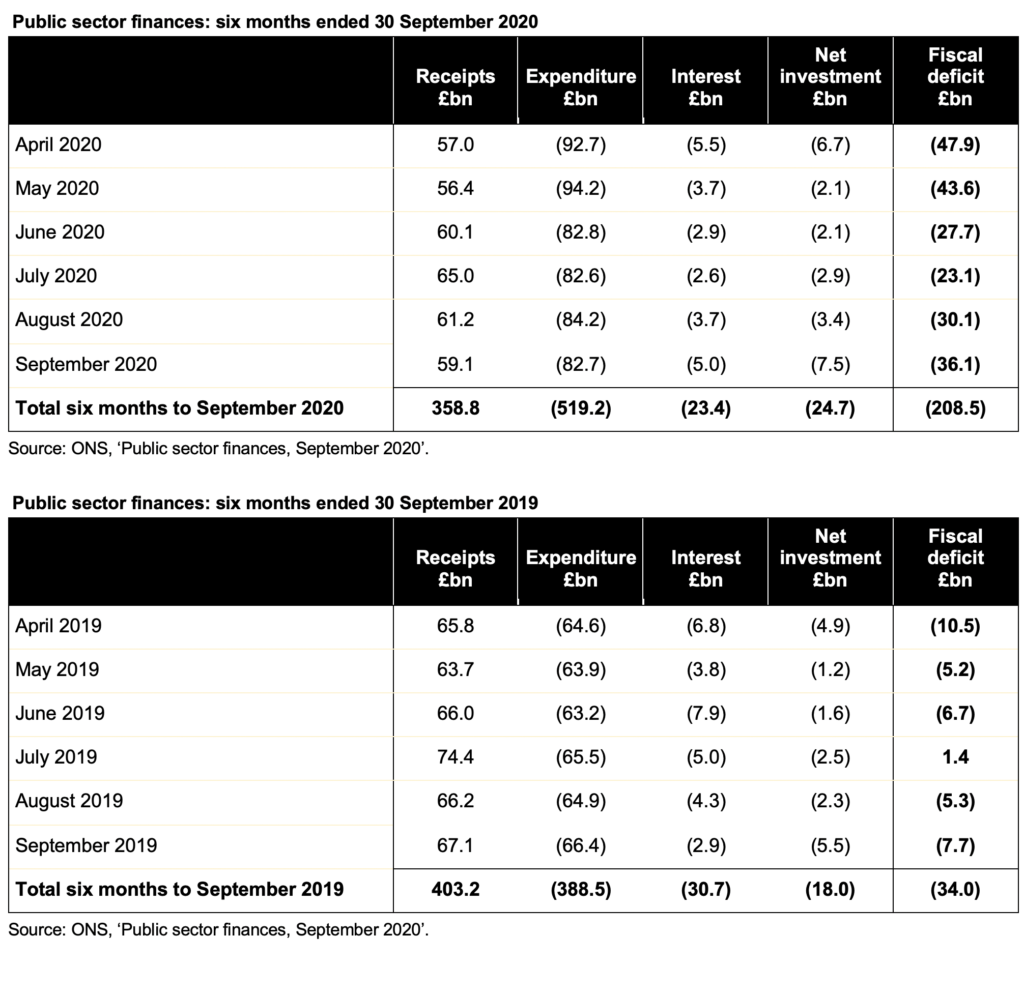
The latest public sector finances reported a deficit of £36.1bn in September 2020, a cumulative total of £208.5bn for the first six months of the financial year.

Falls in VAT, corporation tax and income tax drove lower receipts, while large-scale fiscal interventions resulted in much higher levels of expenditure. Net investment is greater than last year, as planned, while the interest line has benefited from ultra-low interest rates.

Public sector net debt increased to £2,059.7bn or 103.5% of GDP, an increase of £259.2bn from the start of the financial year and £274.0bn higher than in September 2019. This reflects £50.7bn of additional borrowing over and above the deficit, most of which has been used to fund coronavirus loans to business and tax deferral measures.

Commenting on the figures Alison Ring, ICAEW Director for Public Sector, said: “The deficit of £208bn is already more than the full-year deficit at the height of the financial crisis a decade ago and remains on track to be the largest ever outside the two world wars. 

“The economic damage caused by the pandemic in the first half of the fiscal year was not as bad as originally feared, thanks in part to the extraordinary level of financial support provided by the Chancellor. However, the second wave is putting further strain on the public finances as new regional restrictions are placed on economic activity.

To help the recovery the Chancellor must take the opportunity at the Autumn Statement and Spending Round to invest in preparing infrastructure projects to start as soon as possible.”

Image of table showing public finances for month of September and six months to September together with variances from last year. Click on link to the article on the ICAEW website for a readable version.

The combination of receipts down 11%, expenditure up 34% and net investment up 37% has resulted in a deficit for the six months to September 2020 that is approaching four times the budgeted deficit of £55bn for the whole of the 2020-21 financial year set in the Spring Budget in March. This is despite interest charges being lower by 24%. The cumulative deficit is more than six times as much as for the same six-month period last year.

Cash funding (the ‘public sector net cash requirement’) for the six months was £257.8bn, compared with £7.1bn for the same period in 2019.

Interest costs have fallen despite much higher levels of debt, with extremely low interest rates benefiting both new borrowing to fund government cash requirements and borrowing to refinance existing debts as they have been repaid.

The Institute for Fiscal Studies’ recent IFS Green Budget 2020 annual pre-Budget report indicated that the deficit for the full year to March 2021 could reach £350bn or 17% of GDP.

Some caution is needed with respect to the numbers published by the ONS, which are expected to be repeatedly revised as estimates are refined and gaps in the underlying data are filled. In particular, the OBR points out that the ONS has yet to record any allowance for losses that might arise on the more than £100bn of tax deferrals, loans and guarantees provided to support businesses through the pandemic.

Image of table showing public finances for each month to September 2020 and for each month to September 2019. 

Click on link to the article on the ICAEW website for a readable version.

The ONS made a number of revisions to prior month and prior year fiscal numbers to reflect revisions to estimates and changes in methodology. These had the effect of reducing the reported fiscal deficit in the first five months from the £173.7bn reported last time to £172.4bn and reducing the reported deficit for 2019-20 from £55.8bn to £54.5bn.

For further information, read the public sector finances release for September 2020.

This article was originally published on the ICAEW website.

ICAEW chart of the week: UK debt financing requirement

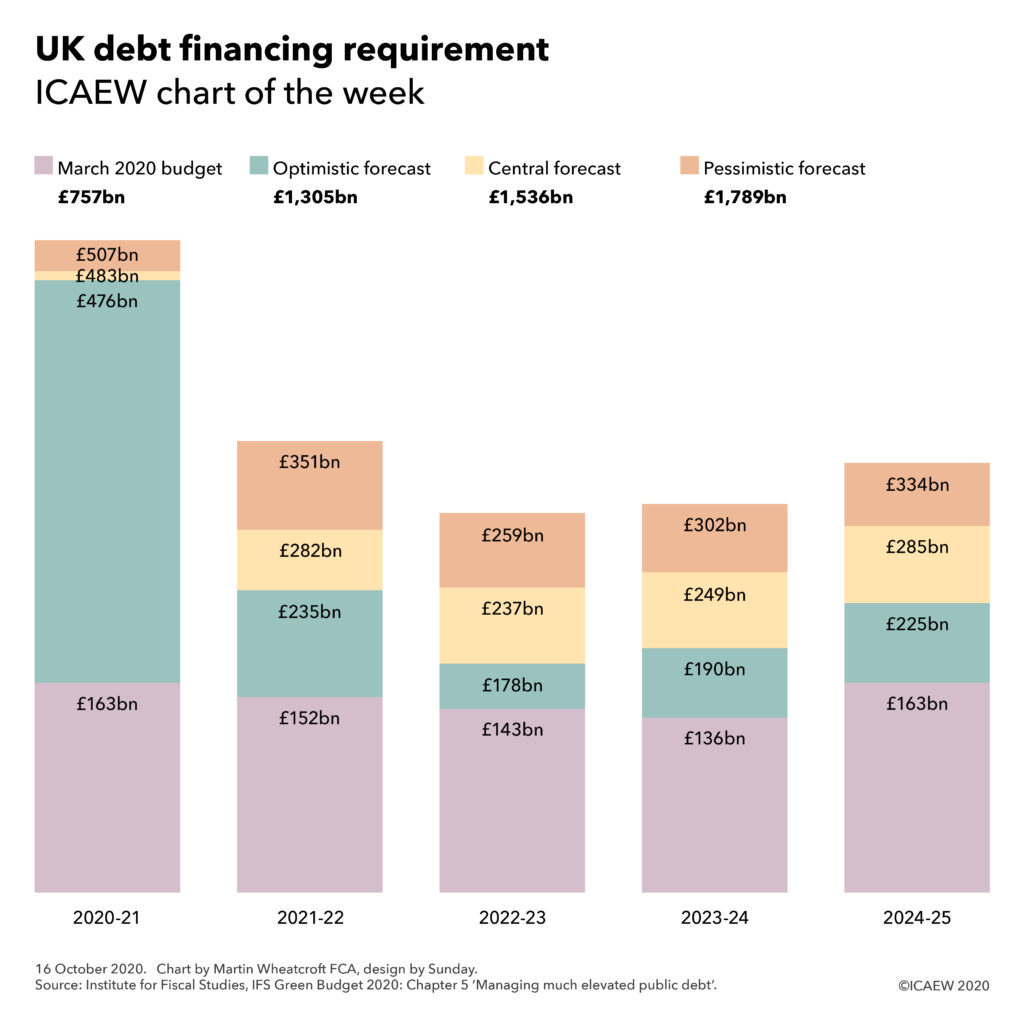
16 October 2020: The Institute for Fiscal Studies annual pre-Budget report forecasts a doubling to £1.5tn in the amount of debt to be raised by the UK Government over the next five years.

UK debt financing requirement by year from 2020-21 to 2024-25, adding up to £757bn (March 2020 budget), £1,305bn (optimistic), £1,536bn (central) and £1,789bn (pessimistic forecast).

Although the Budget itself may have been delayed, the IFS Green Budget 2020 has been published on schedule, with a wealth (if that is the right word in the current context) of analysis on the economy and the public finances. 

With £201bn in discretionary measures and a £95bn economic impact from the coronavirus pandemic, the IFS is forecasting that the deficit will reach £350bn in the current financial year. At 17% of GDP, this is a level never before seen in the UK outside of the two world wars. 

Unfortunately, the effect of the pandemic on public finances will not be restricted to this financial year. Even if the economy recovers in 2021, or more likely in 2022, tax revenues will be significantly lower and spending significantly higher than they were previously expected to be.

This is perhaps best highlighted by looking at the UK Government’s gross financing requirement – the amount that the UK Debt Management Office (DMO) will be tasked with raising from external debt investors over the next five years to finance the shortfall in taxes compared with spending (the deficit), to finance business and other lending and to repay existing debts as they fall due. This is forecast by the IFS to double to £1.5tn in their central forecast, within a range from £1.3tn in a more optimistic scenario to £1.8tn in a more pessimistic scenario.

As the IFS points out, the enormous amount of debt being issued means that even small differences in financing costs will have a very large impact on the public finances. This is despite the sizeable proportion of debt being issued with long maturities (as long as 50 years in some case) that are locking in extremely low interest rates for decades to come.

Reducing interest costs on debt has provided the Chancellor with room to provide the unprecedented levels of financial support to the UK economy that we saw over the summer. The prospect of negative nominal rates could see investors paying the Government rather than the other way round, providing headroom for further interventions.

There is a downside, of course. The ‘good times’ of ultra-low interest rates may not last for ever, and with a central debt forecast at 31 March 2025 of 112% of GDP significantly higher than the 35% of GDP before the financial crisis a dozen years ago the exposure to changes in interests is that much more significant.

To find out more about the latest forecasts for the economy and the impact that will have on the public finances, please do read the IFS Green Budget 2020.

This chart was originally published by ICAEW.

Cancelled Budget must not be allowed to delay infrastructure plans

29 September 2020: Recently published figures show that the Government burnt through £224bn in the five months to August 2020. This should not stand in the way of an investment-led economic recovery, according to ICAEW’s Public Sector team.

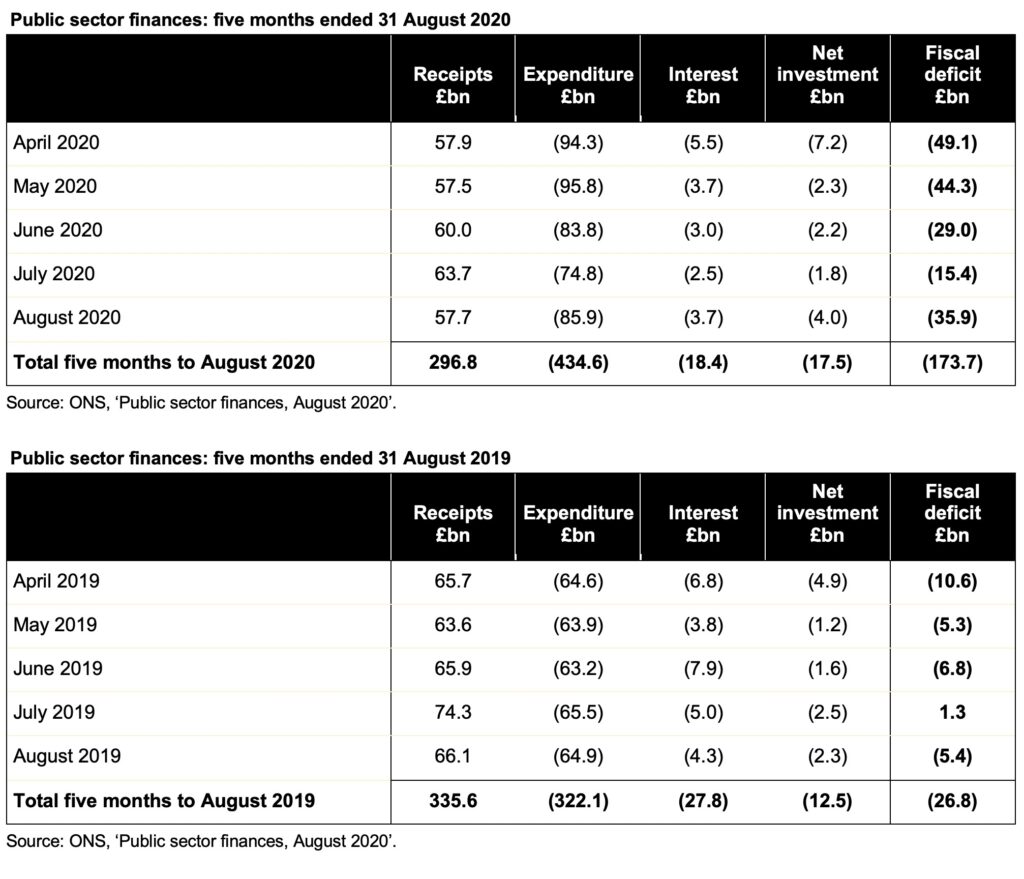
The latest public sector finances for August 2020 published by the Office for National Statistics (ONS) on Friday 25 September 2020 reported a deficit of £35.9bn in August 2020, a cumulative total of £173.7bn for the first five months of the financial year.

Falls in VAT, corporation tax and income tax drove lower receipts, while large-scale fiscal interventions resulted in much higher levels of expenditure. Net investment is greater than last year, as planned, while the interest line has benefited from ultra-low interest rates.

Public sector net debt increased to £2,023.9bn or 101.9% of GDP, an increase of £223.4bn from the start of the financial year and £249.5bn higher than in August 2019. This reflects £49.7bn of additional borrowing over and above the deficit, most of which has been used to fund coronavirus loans to business and tax deferral measures.

Image of table showing public sector finances for month of August and for 5 months to August 2020, together with variances against last year. Click on the link at the end of the article for a readable version.

The combination of receipts down 12%, expenditure up 35% and net investment up 40% has resulted in a deficit for the five months to August 2020 that is more than three times the budgeted deficit of £55bn for the whole of the 2020-21 financial year set in the Spring Budget in March, despite interest charges being lower by 34%. The cumulative deficit is more than six times as much as for the same five-month period last year.

Cash funding (the ‘public sector net cash requirement’) for the five months was £224.0bn, compared with £5.8bn for the same period in 2019.

Interest costs have fallen despite much higher levels of debt, with extremely low interest rates benefiting both new borrowing to fund government cash requirements and borrowing to refinance existing debts as they have been repaid.

Some caution is needed with respect to the numbers published by the ONS, which are expected to be repeatedly revised as estimates are refined and gaps in the underlying data are filled. In particular, the OBR points out that the ONS has yet to record any allowance for losses that might arise on the more than £100bn of tax deferrals, loans and guarantees provided to support businesses through the pandemic. 

Alison Ring FCA, director for public sector at ICAEW, commented: “The government continued to haemorrhage cash in August, despite furloughed employees returning to work and the warm weather encouraging people to spend money outside their homes. The Chancellor’s Eat Out to Help Out subsidy may have hit the headlines, but at £522m it was only a fraction of the total spending in the year to date of £470.5bn. Large sums were also spent on Test & Trace and PPE, as well on fiscal interventions such as the coronavirus job retention scheme.

While the decision to postpone the Budget until the Spring is understandable given the economic uncertainties as we enter the next phase of the pandemic, we hope that this will not mean further delays for the National Infrastructure Strategy and the green-lighting of infrastructure projects across the country, which will be vital for an investment-led economic recovery.”

Image of table showing public sector finances for each month to August 2020 and to August 2019. 

Click on the link at the end of the article for a readable version.

The ONS made several revisions to prior month and prior year fiscal numbers to reflect revisions to estimates and changes in methodology and classification. These had the effect of reducing the reported fiscal deficit in 2019/20 from £59.7bn to £55.8bn and in 2018/19 from £41.0bn to £38.8bn. There was a reduction of £12.7bn in the estimated deficit in the first four months of the current financial year from that reported last month primarily because of overestimating central government procurement in those months.

This article was originally published by ICAEW.

Plastic is the future for cash – one way or another

22 September 2020: Physical cash use is declining fast, leaving the fixed cost base for processing cash transactions at risk of stranding. As cards and digital forms of payment become more prevalent, what will happen to those who still need access to cash?

The National Audit Office (NAO) issued a report on 18 September 2020 on the production and distribution of cash. It looks at what the Bank of England, the Royal Mint, HM Treasury and financial regulators are doing in response to a 59% decline in the volume of cash transactions between 2008 and 2019, as well as efforts to improve the efficiency of cash production and reduce counterfeiting.

According to data from UK Finance, cash payment values fell from £267bn in 2008 to £141bn in 2019 and were (prior to the pandemic) forecast to fall to £59bn by 2028.

Coin production has fallen significantly, with 383m coins manufactured for circulation in 2019-20 compared with 1.1bn in 2010-11. Notes in circulation have continued to increase (to 4.4bn notes with a monetary value of £76.5bn in July 2020), but only around 20%-24% of these are used for cash transactions and 5% used for savings, leaving over £50bn whose location is uncertain – a point which the NAO believes deserves further investigation.

A key finding from the report is that there is no single body in government responsible for overseeing how well the cash system is performing, despite the establishment of a Joint Authorities Cash Strategy Group (JCAS) focused on access to cash for those that need it, in particular for the million or so UK adults who do not have a bank or building society account.

The UK’s entire cash infrastructure across the public and private sectors is estimated to cost around £5bn a year, with many of these being fixed costs that with declining usage are putting pressure on the cash system. 

The number of ATMs fell by 12% over the two years to December 2019 to around 60,000, with a fall of 17% in the number that were free-to-use to around 45,000. The Payment Systems Regulator (PSR) has been working with the industry to maintain free-to-use ATMs in geographic areas where provision is most limited, although the NAO recommends greater attention is given to more deprived areas.

Demand for notes and coins declined by 71% between early-March and mid-April 2020 during the COVID-19 lockdown but has since recovered. The NAO believes it is still too early to assess the longer-term impact on cash access and usage but moves amongst some retailers to suspend acceptance of cash during the pandemic could further accelerate the switch to non-cash forms of payment.

The NAO is positive about the steps the Royal Mint and the Bank of England have taken against counterfeiting. In 2016, about one in 30 £1 coins was a counterfeit, but surveys since 2018 have found very low counterfeiting rates for the new £1 coin. The introduction of the polymer £20 note, traditionally the denomination favoured by counterfeiters, should also help reduce the cost of fraud to consumers and businesses.

The Royal Mint reported a reduced loss of £3.9m on its coin-making activities in 2019-20, with actions to improve efficiency including a 22% headcount reduction within its currency division and the mothballing of two of its six plating lines. The Bank of England has also worked with De La Rue to improve efficiency, albeit each polymer banknote costs 60% to 80% more than a paper one, even if they are expected to last at least 2.5 times longer. 

The NAO recommends that HM Treasury takes another look at the roles and responsibilities of the bodies involved in the cash system, setting out more clearly the specific outcomes it wants to deliver for consumers and small businesses and how this should be balanced against the cost of doing so. It also believes that a plan is needed to take action if some groups become left behind as the cash system changes.

Martin Wheatcroft FCA, adviser to ICAEW on public finances, commented: “The NAO has provided some extremely useful insights into how the UK’s cash system is coping with declining usage and it makes a number of sensible recommendations for improvements. 

“However,” continued Wheatcroft, “the report does not answer the more fundamental issue of whether cash has a long-term future at all, and in particular whether the multi-billion costs of running cash and other legacy payment systems could be better deployed.

“Ultimately, is it now time to look beyond a managed decline of the cash system and explore more radical options?”

Front cover: NAO report 'The production and distribution of cash'. Click on the image to go to the NAO website.

This article was originally published on the ICAEW website.

Pandemic costs add up to a very big number

21 September 2020: The National Audit Office COVID-19 cost tracker provides critically important data about the current £210bn cost of the pandemic but disappoints in the way it presents this financial information.

Page 10 of the NAO covid-19 cost tracker

The National Audit Office (NAO) has published a COVID-19 cost tracker comprising details of over 190 different measures announced by government departments in response to the coronavirus pandemic. This is an extremely valuable exercise in seeking to track the huge amounts being spent in the absence of any centrally collated financial tracking by the Government itself.

As of 7 August 2020, the NAO has identified around £210bn of measures, of which around £70bn has been confirmed as having been incurred. A number of the measures are unquantified and many of the numbers are broad-brush estimates that may individually turn out to be significantly different.

The largest items in the list are the £47bn estimated cost of the coronavirus job retention scheme (CJRS), £16bn in bounce back loans, £15bn for the self-employed income support scheme, £15bn on personal protection equipment, £13bn for the devolved administrations under the Barnett formula, £12bn on business grants, £12bn in waived business rates and £10bn on testing and tracing. Together these eight items amount to around two-thirds of the total.

Unfortunately, the NAO has provided this data as a 22-page table with very limited summarisation or categorisation, making it extremely challenging to analyse the information which it provides. For example, costs are not analysed between tax cuts, public spending or lending activities, making it difficult to work out their impact on the public finances.

Admittedly, the NAO has had to put this information together itself, which it shouldn’t have had to do. A well-run central government finance function would have already collated and analysed this information, allowing the auditors to concentrate on providing assurance on the data through their audit work.

Despite those criticisms, the NAO COVID-19 cost tracker will help improve the quality of our understanding of the financial impact of the pandemic and will no doubt inform the next iteration of the Office for Budget Responsibility (OBR) coronavirus analysis.

This article was originally published on the ICAEW website.

Magnox contract exit cost: a small price to pay?

16 September 2020: The National Audit Office has issued a report on the £20m cost of exiting the failed Magnox contract to decommission nuclear research sites and power stations.

The National Audit Office (NAO) report covers the handling by the Nuclear Decommissioning Authority (NDA) of the failed Magnox contract to decommission two nuclear research sites and 10 Magnox power stations and the estimated £20m cost incurred on exiting the contract.

The NDA is a statutory body established in 2005 to take ownership of the decommissioning programme for the UK’s oldest fleet of nuclear power stations and other nuclear facilities. At 31 March 2020, the NDA had an estimated liability of £135bn in its accounts for the costs of decommissioning still to be incurred.

The NDA has awarded a series of contracts to clean up nuclear sites and deal with radioactive materials, including fuel. This includes the 14-year Magnox contract awarded in 2014 to Cavendish Fluor Partnership (CFP) which the High Court decided was wrongly awarded, with the NDA agreeing a £97m settlement with a bidder in 2017.

The NDA then decided to terminate the contract with CFP nine years early, and an earlier report by the NAO stated how £122m had been lost by that point. The Public Accounts Committee reported in 2018 that the NDA needed to improve its understanding of the state of the sites, its ability to monitor work carried out on them, and the capability and expertise of its executive team.

Since 2017, a revised contract has been agreed with CFP and further litigation avoided, with £2.7bn of decommissioning work completed before the contract ended in August 2019.

The NAO says there have been further costs to the taxpayer, including an estimated termination cost of £20m to negotiate the early exit from the contract and incentivise a smooth handover of sites without further legal challenge. This is a relatively small amount in the context of the £6.9bn to £8.7bn estimated cost for decommissioning the Magnox sites.

The NAO report stated: “With the NDA now taking more direct control over the management of its sites, it will be critically important that it builds and retains better knowledge of the condition of its sites to enable it to plan and deliver decommissioning work efficiently and effectively. The NDA considers that it will be better placed to achieve this under its revised delivery model, but it is too early for us to assess the effectiveness of these arrangements.”

Martin Wheatcroft FCA, adviser to ICAEW on public finances, commented: “The huge sums being spent on decommissioning nuclear facilities can hide many sins, but we are fortunate that the National Audit Office is able to dig around and analyse what is going on.

“On this occasion, the £20m cost of exiting the Magnox contract appears a relatively small price to pay for a second chance at getting the decommissioning of the Magnox fleet right. There are much larger sums – in the billions – riding on the as-yet unproven new delivery model being put in place by the Nuclear Decommissioning Authority.”

Image of front cover of NAO report 'Progress report: Terminating the Magnox contract'. Click on the image to go to the NAO website to download the report.

This article was originally published on the ICAEW website.

ICAEW chart of the week: Foreign, Commonwealth & Development Office

11 September 2020: The UK’s highly regarded diplomatic service in the FCO was combined last week with the UK’s highly respected international development department DfID to form a new government department – the FCDO.

Chart on net expenditure 2019-20 FCDO £2,750m + DfID £10,350m = £13,100m.

The newly established Foreign, Commonwealth & Development Office (FCDO) is the subject of the #icaewchartoftheweek, illustrating the amounts spent by its predecessor departments in the financial year ended 31 March 2020. The Foreign & Commonwealth Office (FCO) incurred net expenditure in the order of £2,750m, while the Department for International Development (DfID) spent £10,350m, a combined total of £13.1bn.

Although DfID was the bigger department in financial terms, the FCO was larger operationally with 13,751 staff in 2019-20 (5,263 in the UK and 8,488 abroad) compared with the 3,535 employed by DfID (2,628 in the UK and 773 abroad). As a consequence, net operational spending amounted to somewhere in the region of £1,250m for the FCO, while DfID cost in the order of £350m to run.

The FCO spent approximately £700m in 2019-20 on international programmes, including grants to the British Council and the BBC World Service amongst others. The other big element of its spending of just under £800m was on conflict prevention, stability and peacekeeping.

DfID spent around £2,150m on international development programmes and organisations, policy, research and evidence and humanitarian aid and £750m on conflict, security and stabilisation. Around £3,000m was spent on economic development, while £4,100m went to regional programmes, including approximately £900m in west and southern Africa, £1,300m in east and central Africa, £850m in the Middle East and north Africa and £1,050m in Asia and elsewhere in the world.

DfID has provisionally calculated that total development spending across the UK Government, including by the FCO, DfID, Home Office, Business, Energy & Industrial Strategy and Department for Environment, Food and Rural Affairs departments, amounted £15.2bn in total in the 2019 calendar year. This was in line with the UK Government’s legally binding commitment to spend 0.7% of Gross National Income on development. This includes a proportion of the EU’s spending on international development but excludes the UK’s contributions towards development within the EU, in particular in eastern European member states.

The coronavirus pandemic has reduced the size of the economy this year and hence the 0.7% calculation will result in a smaller amount to spend in 2020-21, hence the combined budget for the FCDO will be smaller than the amount spent in the last financial year.

The new department is abbreviated to FCDO in writing, which the Government is insisting should be spoken out loud as ‘focado’ (similar to the online grocery store), no doubt in a valiant attempt to prevent other forms of short-form pronunciations becoming popular.

This chart was originally published on the ICAEW website.