11 September 2020: The UK’s highly regarded diplomatic service in the FCO was combined last week with the UK’s highly respected international development department DfID to form a new government department – the FCDO.
The newly established Foreign, Commonwealth & Development Office (FCDO) is the subject of the #icaewchartoftheweek, illustrating the amounts spent by its predecessor departments in the financial year ended 31 March 2020. The Foreign & Commonwealth Office (FCO) incurred net expenditure in the order of £2,750m, while the Department for International Development (DfID) spent £10,350m, a combined total of £13.1bn.
Although DfID was the bigger department in financial terms, the FCO was larger operationally with 13,751 staff in 2019-20 (5,263 in the UK and 8,488 abroad) compared with the 3,535 employed by DfID (2,628 in the UK and 773 abroad). As a consequence, net operational spending amounted to somewhere in the region of £1,250m for the FCO, while DfID cost in the order of £350m to run.
The FCO spent approximately £700m in 2019-20 on international programmes, including grants to the British Council and the BBC World Service amongst others. The other big element of its spending of just under £800m was on conflict prevention, stability and peacekeeping.
DfID spent around £2,150m on international development programmes and organisations, policy, research and evidence and humanitarian aid and £750m on conflict, security and stabilisation. Around £3,000m was spent on economic development, while £4,100m went to regional programmes, including approximately £900m in west and southern Africa, £1,300m in east and central Africa, £850m in the Middle East and north Africa and £1,050m in Asia and elsewhere in the world.
DfID has provisionally calculated that total development spending across the UK Government, including by the FCO, DfID, Home Office, Business, Energy & Industrial Strategy and Department for Environment, Food and Rural Affairs departments, amounted £15.2bn in total in the 2019 calendar year. This was in line with the UK Government’s legally binding commitment to spend 0.7% of Gross National Income on development. This includes a proportion of the EU’s spending on international development but excludes the UK’s contributions towards development within the EU, in particular in eastern European member states.
The coronavirus pandemic has reduced the size of the economy this year and hence the 0.7% calculation will result in a smaller amount to spend in 2020-21, hence the combined budget for the FCDO will be smaller than the amount spent in the last financial year.
The new department is abbreviated to FCDO in writing, which the Government is insisting should be spoken out loud as ‘focado’ (similar to the online grocery store), no doubt in a valiant attempt to prevent other forms of short-form pronunciations becoming popular.
21 August 2020: The fiscal deficit of £150.5bn for the four months to July 2020 is almost triple the £55bn budgeted for the entire financial year.
The latest public sector finances for July 2020 published by the Office for National Statistics (ONS) on Friday 21 August 2020 reported a deficit of £26.7bn in July 2020, following on from £123.8bn for the three months to June 2020 (revised from £127.9bn reported last time).
Public sector net debt increased to £2,004.0bn or 100.5% of GDP, an increase of £198.3bn from the start of the financial year and £227.6bn higher than in July 2019. This is the first time this measure has exceeded £2tn, a major milestone that has arrived several years earlier than anticipated as a consequence of the pandemic.
The combination of lower tax receipts and much higher levels of public spending has resulted in a deficit for the four months to July 2020 that is almost triple the budgeted deficit of £55bn for the whole of the 2020-21 financial year set in the Spring Budget in March, and almost seven times as much as the same period last year.
Cash funding (the ‘public sector net cash requirement’) for the four months was £199.1bn, compared with £5.4bn for the same period in 2019.
Interest costs have fallen despite much higher levels of debt, with extremely low interest rates benefiting both new borrowing to fund government cash requirements and borrowing to refinance existing debts as they have been repaid.
Some caution is needed with respect to the numbers published by the ONS, which are expected to be repeatedly revised as estimates are refined and gaps in the underlying data are filled. In particular, the OBR points out that the ONS has yet to record any allowance for losses that might arise on the more than £100bn of tax deferrals, loans and guarantees provided to support businesses through the pandemic.
Commenting on the latest figures Alison Ring FCA, director for public sector at ICAEW, said:
“The positive news for the Government is that despite debt reaching £2tn, low interest rates have reduced its cost, and its growth is slowing as the exceptional support measures to deal with the pandemic are withdrawn and furloughed employees return to work.
“The big question is how much permanent damage is being done to the economy, with accelerating job losses a concerning sign as we approach the autumn. How quickly debt continues to grow will also depend on any additional support that the Government might provide to sectors that are still struggling.”
21 August 2020: Ministers insulated older employees from public sector pension reforms in 2015, despite advice saying not to. The courts found this was age discrimination, resulting in a £31bn charge in the Whole of Government Accounts.
When the Hutton review on public sector pensions reported in 2011, it recommended retaining the defined-benefit pensions provided to public sector employees. However, it wanted to reform how public sector pensions are calculated to reduce the cost to taxpayers, while at the same making them fairer for lower-paid employees.
Recommendations included switching from final salary to career average for calculating pension entitlements, aligning the retirement age for most public sector employees with the state pension age, and increasing employee contributions.
The Hutton reforms followed a major cost saving already achieved in switching from RPI to CPI-linked increases for pensions in retirement, which resulted in a one-off gain of £126bn in the 2010-11 Whole of Government Accounts (equivalent to a 10% reduction in the gross pension liability at that time) as well as reducing the cost of providing pensions going forward.
To protect existing employees, Hutton recommended that accrued rights at the date of the switch should still be calculated on final salaries, with only subsequent years of service accruing on an average salary basis. Retaining existing rights meant there was no significant gain or loss recorded when the reforms to existing pension arrangements were implemented in 2014 and 2015, with any cost savings arising in future years.
Despite the Hutton report explicitly stating that “age discrimination legislation … means that it is not possible in practice to provide protection from change for members who are already above a certain age”, the Government decided to provide transitional protection for older members. Full transitional protection was offered to workers 10 years or less away from retirement in 2012, with partial protection on a sliding scale tapering away to zero for those with 14 or more years to go until retirement at that point.
As might have been expected, given the clear advice in the Hutton review that this would constitute unlawful age discrimination, the UK Government lost in the Supreme Court in 2019 in the McCloud and Sargeant cases. As a consequence, employees that have lost out because the transitional protections did not apply to them will receive an uplift in their pensions when they reach retirement.
Illustrative example
To illustrate the issue, consider the case of fictional civil servants Sarah and Maxine who were 20 and 10 years away from retirement respectively in 2012 and who were moved into the new career-average ‘alpha’ pension scheme in 2015. Each is expected to retire with 30 years’ service on a final year salary of £80,000, following rapid promotions in their final 10 years of service.
In this illustration, Maxine, who in 2012 had 10 years to go before retirement, should receive an initial pension of £40,000 a year when she retires in 2022, including a £500 transitional protection uplift.
Without transitional protection, Sarah would expect to receive £34,000 a year when she retires in 2032. Although the precise details of the remedy in response to the court judgements is still being worked out (see HM Treasury consultation), it is likely that Sarah will now receive a transitional protection uplift covering the period from 2015 to 2022, potentially adding around £4,000 (based on our illustrative assumptions) to her pension on retirement, but still below what she would have received without the changes.
The court ruling will only affect employees who would have got more under the final salary arrangements. For a significant proportion of public sector workers, the faster accrual rate on a career average basis will provide them with a higher pension than they would have received under the slower accrual rate applied to final salary under the old arrangements. They will not have lost out from not having had transitional protection.
Spotlight on the £2.2tn public sector pension liability
The £31bn past service cost recorded in the Whole of Government Accounts in 2018-19 added 1.4% to the amounts owed to current and former public sector employees for their accrued pension rights, increasing the gross liability recorded to £2.2tn at 31 March 2019. (The Government separately reported that the court judgements would cost £17bn but did not explain how this number reconciled with the £31bn reported in the accounts.)
£2.2tn is a huge amount of money, equivalent to around £80,000 for each household in the UK. Most public sector schemes are unfunded (£1,756bn out of the £2,244bn gross liability) with pension payments funded out of future taxation. Local authority and other funded public sector schemes (£488bn) do have pension fund investments (£350bn at 31 March 2019) set aside to pay pensions, but they will need to increase their contributions to those funds to cover the cost of extending transitional protections to affected employees.
There are no doubt many morals to be drawn from this story, but what it does highlight is the sheer scale of the pension obligations that public sector employers have built up over the years, and just how much a single ministerial decision can end up costing taxpayers.
3 August 2020: Chief Secretary to the Treasury Steve Barclay delivered his first speech last week, providing fresh detail on the plan for the Spending Review.
Steve Barclay’s first speech as Chief Secretary, delivered to thinktank Onward on Tuesday 28 July 2020, set out how he believes Treasury can be an accelerator of change in government.
He sees the Spending Review as a significant moment in the lifecycle of any government, but with the current review being conducted against the backdrop of the most challenging peacetime economic circumstances in living memory.
Despite that, the Government believes the recovery from this pandemic can be a moment for national renewal, with the Spending Review acting as the mechanism to deliver the Prime Minister’s ambition to ‘level up’ the country.
As a constituency MP, Barclay said he has run up against a system that is slow and siloed. By way of an example, he asked why there is a seven-year gap between funding being agreed for a road scheme and the first digger arriving? Or why it takes a decade to decide to produce a full business case on whether to re-open eight miles of railway track?
The lack of upfront clarity on outcomes, the slow speed of delivery and the variable quality of data within government are all areas the Spending Review provides an opportunity to challenge.
The Chief Secretary stressed that to ‘level up’ the country properly, the Government needs to ensure that Treasury decision-making better reflects the UK’s economic geography, with more balanced judgments taking into consideration the transformative potential of investment to drive localised growth.
He drew on the speed of change during the pandemic, with the furlough scheme taking just one month from being announced to being opened for applications when normally such schemes take months – years even – to deliver.
He asked if the wheels of government can be made to spin this fast in a crisis, with all the added pressures of lockdown, why can’t it happen routinely?
Time to level up
The Chief Secretary stated that the actions being taken to support businesses and jobs during the pandemic are the right thing to do, even though it comes at a cost. The cost of inaction would be far greater, he claimed.
Even though the Prime Minister has made it clear that austerity is not the answer to navigating a much-changed economic landscape, departments will have to make tough choices in the months ahead.
The commitment to reviewing the Green Book investment manual was reiterated with changes planned to allow room for more balanced judgments on investments to reduce inequality and drive localised growth.
During the speech, Barclay listed several priorities for government in the Spending Review:
accelerating the UK’s economic recovery;
levelling-up opportunity across the country;
improving public services; and
making the UK a scientific superpower.
Outcomes, speed and data
To achieve these objectives, the Chief Secretary focused on three key approaches: outcomes, speed and data.
On outcomes, the Spending Review would try to tie expenditure and performance more closely together, with Treasury having clearer sight of both intended outcomes and subsequent evaluation of their delivery.
For some of the most complex policy challenges, this will involve breaking the silos between departments, and pilot projects are currently being used to test innovative ways of bringing the public sector together.
On speed, Barclay noted that this is a ‘hallmark of the digital era’. Programmes need to start with robust goals and the temptation to repeatedly change plans has to be resisted if the UK is to bring down capital costs that are typically between 10% and 30% higher than in other European countries. A new Infrastructure Delivery Task Force (known as Project Speed) will be established to cut down the time it takes to develop, design and deliver vital projects.
This will involve more standardisation and modularisation between projects, for example in speeding housing construction. The Spending Review will seek to accelerate the adoption of Modern Methods of Construction and explicitly link funding decisions to schemes that priorities it.
On data, the Chief Secretary believes that government is behind the curve when it comes to obtaining, analysing, and enabling access to open data. It remains the case that decisions still rely heavily on spreadsheets from departments rather than data directly sourced in real time. Work has already begun to incentivise departments and arms-length bodies to supply higher quality standardised data and to support the Treasury to better interrogate this data.
Building this will involve sorting out the data architecture as well as the data sets, and the Spending Review will focus on addressing legacy IT and investing in the data infrastructure needed to become a “truly digital government”.
The new radicals
Barclay concluded with stressing the importance of taking risks, setting ambitious goals and experimenting with ways of delivery, even if failure is a possibility. He wants to move beyond a simple yes/no approach to public spending and instead bring together people, ideas and best practice from inside and outside government.
He concluded: “This is an opportunity for the Treasury to capture the ‘can do’ attitude shown by civil servants during the COVID pandemic and make it permanent. To be the new radicals, leading change across government.
“Done well, we can move on from an era of spreadsheets. We can create a smarter and faster culture in Whitehall. And we can ensure that Britain does indeed bounce back from this crisis stronger and better than before.”
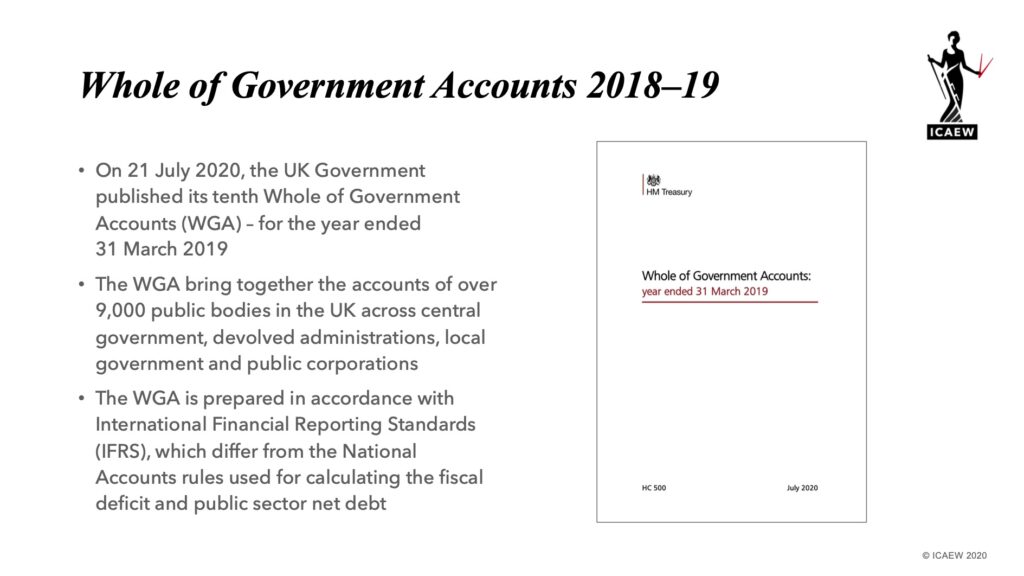
24 July 2020: The UK celebrated 10 years of consolidated financial statements for the public sector with the publication of the Whole of Government Accounts for 2018-19.
The UK Government published its 10th Whole of Government Accounts (WGA) on Tuesday 21 July 2020, the day before Parliament packed up for the summer. The WGA is one of the most important public documents there is, but it was overshadowed by being put out on the busiest day for the year for government announcements, as departments rushed to finalise reports and get them out of the door while they still could.
Meeting this deadline was even more important this year, as a further delay until after the summer recess would have been extremely embarrassing. At just over 15½ months, the time taken to publish the WGA is substantially longer than the two to three months usually taken to prepare the annual reports of comparable private sector organisations. Even taking account of the additional three months caused by the pandemic, it takes a lot longer than the six to nine months that might be reasonably possible given the structure and reporting timescales applicable to public sector bodies in the UK.
Despite that, the WGA remains one of the most critical documents published by the government each year, providing a comprehensive report on the financial performance and position of the UK public sector for the 2018-19 financial year. In particular, it includes a full set of consolidated financial statements prepared under International Financial Reporting Standards (IFRS) instead of the much more limited headline fiscal measures of deficit and deficit normally used by the government when it reports on the public finances.
The WGA for 2018-19 reported revenue of £796bn and expenditure of £896bn before taking account of a £102bn credit from a change in discount rates. This gave rise to loss before the discount rate change of £100bn and an overall accounting surplus of £2bn for the year.
Total assets recorded in the balance sheet amounted to £2.1tn, including £1.3bn in fixed assets, £0.6tn of investments, cash and other financial assets, and £0.2bn in receivables and other assets. Total liabilities amounted to £4.6tn, including £2.2tn of financial liabilities, £1.9tn of employee pension obligations, £0.3tn in provisions and £0.2tn of payables and other liabilities. This means the balance sheet is in a substantially negative position, with net liabilities attributable to taxpayers of £2.5tn.
The financial statements, presented in the standard format familiar to readers of corporate reports, are accompanied by an extensive financial commentary analysing revenue, expenditure, assets and liabilities, as well as financial commitments and contingent liabilities. The overall WGA document is 200 pages long, similar in length to many corporate reports, albeit it has been expanded a little with disclosures on two major events after the balance sheet date: the withdrawal agreement with the European Union and the financial effects of the coronavirus pandemic.
The audit opinion on the financial statements continues to be qualified by the Comptroller & Auditor-General for a number of reasons, including the recurring decision not to consolidate the government-controlled Royal Bank of Scotland (now NatWest Group), a major inconsistency between central and local government in accounting for roads, the failure by the Ministry of Defence to look for embedded leases in its contracts, and using August 2018 rather than March 2019 numbers for academy schools. There are two matters of emphasis relating to the valuation of nuclear decommissioning provisions and the calculation of fair value disclosures on the Hinkley Point C nuclear electricity contract for difference.
ICAEW has put together a short summary analysis highlighting the key elements of the WGA, which you can read here.
24 July 2020: Liabilities of £4.6tn exceeded assets of £2.1tn at 31 March 2019 in the latest set of consolidated financial statements for the UK public sector.
The topic for the #icaewchartoftheweek is the Whole of Government Accounts (WGA) published on Tuesday. Despite taking 15½ months to prepare (way too long, even with the additional delays caused by the pandemic), this is still one the most important documents published by the Government each year.
The good news is that the UK is one of the leading countries in the world in providing fiscal transparency, with this being the tenth WGA, incorporating the financial results of over 9,000 public bodies for the 2018-19 financial year. While many countries are working to adopt accruals-accounting for their public finances, the UK is still the only major economy to publish a full set of accounts covering all levels of government in accordance with internationally recognised accounting standards.
The bad news is the financial position presented by those financial statements, highlighting the weaknesses in the public finances that existed even before the coronavirus pandemic. Total liabilities of £4.6tn at 31 March 2019 were substantially higher than the £1.8bn reported for the headline measure of debt in the National Accounts, prepared in accordance with statistical standards.
20 July 2020: The Office for Budget Responsibility suggests tax rises or spending cuts of more than £60bn a year may be needed if the UK public finances are to be put onto a sustainable path.
The Office for Budget Responsibility (OBR) has reported that the public finances are unsustainable over the next 25 to 50 years, given expected levels of economic growth and pressures on public spending from more people living longer. Fiscal risks have also increased significantly with two ‘once-in-a-lifetime’ economic shocks occurring in just over a decade.
Without action to increase taxes or cut spending over the next few decades, the OBR projects that the gap between receipts and public spending before interest will widen from around 1% of GDP in 2019-20 to between 10% and 15% in 2069-70, depending on how quickly the UK recovers from the coronavirus pandemic. Public sector net debt could increase to between 320% of GDP and 520% of GDP, based on the assumptions made.
The OBR has highlighted how the coronavirus pandemic has not only worsened the immediate prospects for the UK and global economies, but ‘economic scarring’ will permanently damage the expected level of tax receipts over the next 50 years. The vulnerability of the public finances to potential future economic shocks has also increased significantly.
The OBR believes that a V-shaped economy is still possible, but this is now considered to be an upside scenario, with the OBR’s central scenario based on a much slower recovery from the pandemic. The downside scenario takes even longer for the economy to recover.
Economic activity, as measured by GDP, and tax receipts are both expected to be lower in all scenarios than in previous forecasts.
Prospects for the public finances in the current financial year have continued to deteriorate with the OBR now forecasting a fiscal deficit between 15% and 23% of GDP, with a central scenario of £372bn (19% of GDP). This reflects a total of £192bn in fiscal interventions in 2020-21 announced by the Government to date to support the UK economy through the pandemic.
The OBR projects that in its central scenario the gap between receipts and expenditure excluding interest will widen to almost 13% of GDP by 2069-70 if no actions are taken, equivalent to almost £300bn in 2019-20 terms. With much higher levels of debt, and interest rates likely to be higher in the medium to long-term, this could cause the fiscal deficit to increase to over 30% of GDP in 50 years time.
The OBR has calculated that ‘fiscal tightening’ in the order of 2.9% of GDP (£64bn a year) would be required based on a target level for public sector net debt of 75% of GDP. This is subject to a number of fiscal risks, including that no further significant changes are made to the planned profile of spending on health and social care – a key source of policy risk.
Closing this gap could require potentially very significant levels of tax increases or cuts in public spending, especially if difficult decisions, such as on how to fund social care, continue to be deferred.
Martin Wheatcroft FCA, adviser to ICAEW on public finances, commented: “The Office for Budget Responsibility has yet again assessed the public finances and concluded that they are not sustainable, even before taking account of the eye-watering levels of borrowing being added to the national debt as a consequence of the coronavirus pandemic.
Although we should expect tax cuts and spending increases in the immediate future as the Government looks to provide stimulus to the economy, the need to reduce the gap between tax receipts and public spending over the medium- to long-term means that tax rises or further cuts in public spending are likely in the years to come.
Despite this, there are actions that could be taken to improve the outlook for the public finances by developing a long-term fiscal strategy to put the public finances onto a sustainable path.”
Table 1 – OBR projections for the public finances: central scenario
CENTRAL SCENARIO
2019-20 % OF GDP
2020-21 % OF GDP
2024-25 % OF GDP
2044-45 % OF GDP
2069-70 % OF GDP
Receipts excluding interest
36.1
36.3
36.6
36.6
36.4
Expenditure excluding interest
(37.2)
(54.4)
(40.3)
(43.9)
(49.1)
Primary deficit
(1.1)
(18.1)
(3.7)
(7.3)
(12.7)
Net interest
(1.5)
(0.8)
(0.9)
(6.2)
(17.8)
Fiscal deficit
(2.6)
(18.9)
(4.6)
(13.5)
(30.5)
Public sector net debt
(88.5)
(106.6)
(102.1)
(173.7)
(418.4)
Source: OBR, ‘Fiscal sustainability report July 2020’. 2020-21 amounts adjusted for £50bn (2.5% of GDP) of additional fiscal interventions announced on 8 July 2020. Subsequent periods not adjusted.
Table 2 – OBR projections for the public finances: upside and downside scenarios
DIFFERENCES FROM CENTRAL SCENARIO
2020-21 % OF GDP
2024-25 % OF GDP
2044-45 % OF GDP
2069-70 % OF GDP
Upside scenario
Primary deficit
3.6
2.1
2.2
2.3
Fiscal deficit
3.6
2.2
3.8
6.5
Public sector net debt
9.3
14.1
45.7
98.2
Downside scenario
Primary deficit
(4.3)
(2.2)
(2.3)
(2.4)
Fiscal deficit
(4.3)
(2.2)
(3.9)
(6.9)
Public sector net debt
(9.1)
(14.5)
(47.9)
(103.5)
Sources: OBR, ‘Fiscal sustainability report July 2020’; ICAEW calculations. Positive differences = lower deficit or lower debt in percentage points of GDP; (negative) differences = higher deficit or higher debt.
10 July 2020: Fiscal interventions reach £190bn as the Chancellor Rishi Sunak pours even more money into the economy in an attempt to keep it from stalling.
The Chancellor’s summer statement is the subject of this week’s #icaewchartoftheweek, with the £30bn ‘plan for jobs’ being the latest in a series of fiscal interventions in response to the coronavirus pandemic.
The measures announced included £9bn for a £1,000 job retention bonus for furloughed workers, £4bn for work placements and boosting work searching, skills training and apprenticeships, a £5bn boost for the hospitality and leisure industries in the form of a cut in VAT and discounts on eating out, and £12bn in economic stimulus. The latter includes over £5bn on infrastructure projects (as announced by the Prime Minister last week), £3bn to make homes energy-efficient and £4bn for a temporary cut in SDLT on housing sales under £500,000.
This brings the total amount of fiscal interventions to £190bn or around 9% of GDP, once an extra £33bn in spending on health and other public services is incorporated. This was also ‘announced’ yesterday, albeit by means of a small footnote buried inside one of the accompanying documents!
As a consequence, the fiscal interventions can be broadly split between £77bn being spent on supporting household incomes (£54bn on the furlough scheme, £15bn on the self-employed income support scheme and £8bn on universal credit), £30bn to support businesses (£13bn in business rates and other tax reliefs and £17bn in grants and other support), £53bn for public services and other (£39bn on health and social care and £14bn on public services and other spending), and £30bn in economic stimulus through the ‘plan for jobs’.
Businesses have also benefited from support with their cashflows through the deferral of £50bn in tax payments and £73bn of loans and guarantees.
This is not the end of the story for fiscal interventions. Not only are there are a number of sectors such as local government, universities, and manufacturing where rescue packages may be needed, but the Chancellor made clear that this announcement only covered the second of a three-phase response.
The third phase – rebuilding the economy – will be set out later in the year. How much additional money will be involved is anyone’s guess.
9 July 2020: Chancellor announces £30bn in new measures to support, protect and create jobs, bringing total fiscal interventions to £190bn.
The Chancellor used his summer statement speech to set out a phased approach to the UK Government’s response to the coronavirus pandemic.
The first phase – the existing measures already taken during the pandemic – was about the protection of the economy during lockdown, while the second phase – the subject of yesterday’s announcement – is about jobs. The third phase – to be announced later in the year – will be about rebuilding the economy and investing for the future.
As anticipated, the summer statement promised substantial sums to support the economy as it emerges from lockdown, with the Plan for Jobs including £30bn in additional funding measures to support, protect and create jobs through economic stimulus.
£9.4bn – Job Retention Bonus: £1,000 for keeping furloughed staff on until January
£2.1bn – Kickstart work placements for those aged 16-24
£1.6bn – boosting work searching, skills and apprenticeships
£4.1bn – temporary cut in VAT on hospitality, accommodation and attractions
£0.5bn – discounts on eating out
£5.6bn – infrastructure investment announced by the Prime Minister last week
£1.1bn – public sector and social housing decarbonisation
£2.0bn – grants to make private homes more energy-efficient
£3.8bn – six-month cut in stamp duty to stimulate the housing market
This takes total fiscal interventions announced by the government to around £190bn, including the £1.3bn for cultural institutions announced a few days ago.
When combined with lower tax revenues, this is expected to result in a fiscal deficit in 2020-21 in excess of £300bn. A better estimate should be available next week from the Office for Budget Responsibility when it updates its short and long-term forecasts.
The amounts above do not include tax deferrals and business loans and guarantees, which have now reached a total of £123bn.
It is as yet unclear whether there will be any statements about the planned third phase on rebuilding the economy before the Budget and spending review later in the autumn when plans for 2021-22 and beyond will be set out in more detail.
There was significant disappointment in some quarters that the National Infrastructure Strategy, originally scheduled to be published in March, has still not been published.
For those trying to track the fiscal position this year, this is unlikely to be the last fiscal announcement that will move the dial. The government has indicated that further funding is likely to be made available later in the year to local government on top of the £2bn package announced last week. Rescue packages may also be needed for vulnerable sectors such as universities.
2 July 2020: Secretary of State Robert Jenrick has announced a new £2bn package for English councils to replace lost income and cover spending pressures.
The government has announced additional funding for local authorities in England to help alleviate the financial pressures they are under. This follows on from our previous article on council funding pressures, which reported that total lost income and additional expenditure could amount to £9.4bn by next March.
The funding package announced today comprises £500m to cover incremental expenditures being incurred by councils – adding to the £3.2bn already provided – together with a reimbursement scheme covering up to 71% of lost income from sales, fees and charges.
The reimbursement scheme kicks in where losses are more than 5% of a council’s planned income from sales, fees and charges. The government will cover 75% of the lost income above 5%, meaning that councils will need to cover around 29% of the shortfall from their own resources. Depending on the final details, councils could receive somewhere in the order of £1.5bn and £2bn to replace lost income.
The Ministry of Housing, Communities & Local Government (MHCLG) also announced that councils would be able to phase repayments of council tax and business rates deficits over three years rather than one, reducing cashflow pressures on councils. However, the apportionment of irrecoverable council taxes and business rates will not be decided until the Spending Review in the autumn.
This announcement should significantly reduce the risk of councils needing to issue s114 ‘bankruptcy’ notices – for the next few months at least.
Commenting on the announcement Alison Ring, ICAEW Public Sector Director, said: “Although the new funding won’t cover all the expenditure and lost income councils have suffered due to coronavirus, it should be enough to help most get through the rest of the summer, and the prospects of some having to declare themselves bankrupt with s114 notices should recede for now.
However, we’re concerned that councils will still have to cut back spending to cover the lost income from areas such as car parking, leisure centres, planning fees and other charges that are not being covered by central government. This has the potential to damage local economies just as they are trying to recover.”