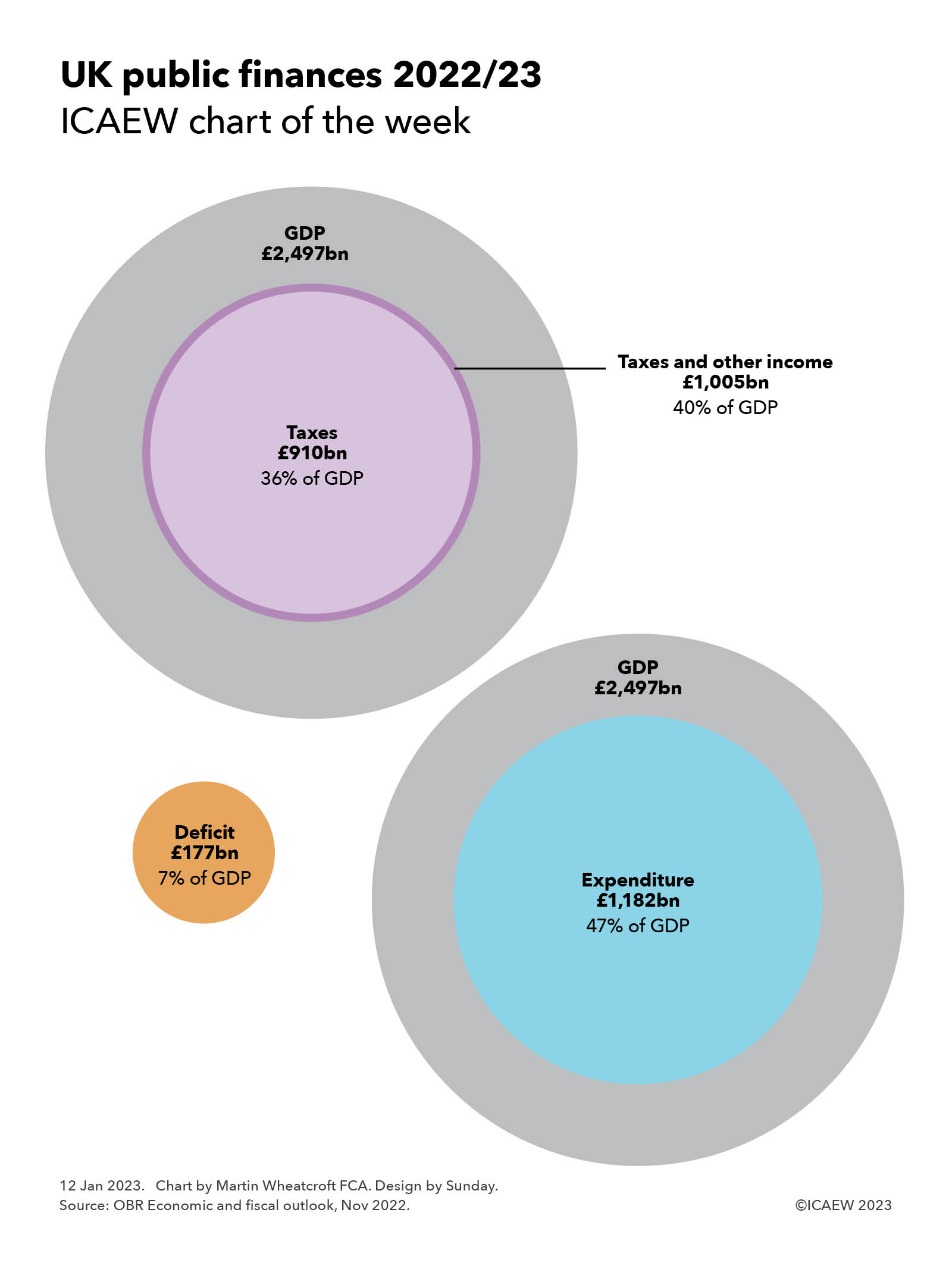
ICAEW chart of the week: UK public finances 2022/23

Our chart this week compares the UK public finances for the current fiscal year with the overall size of the economy, illustrating how taxes are expected to amount to 36% of GDP and expenditure 47% of GDP.

Graphic using circles to illustrate the latest official forecast for UK public finances for 2022/23:

1. A circle for taxes of £910bn (36% of GDP), inside a circle of taxes and other income of £1,005bn (40% of GDP) which in turn is inside a circle of GDP of £2,497bn.

2. A circle for expenditure of £1,182bn (47% of GDP), inside a circle of GDP of £2,497bn.

3. An adjacent circle for the deficit of £177bn (7% of GDP).

The latest official forecast from the Office for Budget Responsibility (OBR) for the current fiscal year ending 31 March 2023 is for a shortfall (or ‘deficit’) of £177bn between receipts of £1,005bn and expenditure of £1,182bn. The largest component of receipts is taxation, which is forecast to amount to £910bn.

Our chart puts these numbers into context by comparing them with the forecast for Gross Domestic Product (GDP) of £2,497bn in 2022/23, highlighting how taxes are expected to amount to 36% of GDP, receipts including other income to 40% of GDP, and expenditure to 47% of GDP, resulting in a deficit amounting to 7% of GDP.

As many commentators have noted, taxes are at a historically high level, with taxation at its highest level as a share of economic activity since 1949. This is unsurprising given the combination of many more people living longer lives and the financial commitments made by successive governments to pay for pensions, health and (to an extent) social care.

Expenditure is also at historically high levels, with energy support packages adding to recurring expenditure of around 43% or 44% of GDP. This is below the peak of 53% of GDP a couple of years ago at the height of the pandemic.

As a consequence, the shortfall between receipts and expenditure of 7% of GDP is elevated compared with the 2% to 3% of GDP ‘normal’ range, although still below the 15% of GDP seen in 2020/21 during the pandemic and 10% of GDP in 2009/10 during the financial crisis.

The increase in the corporation tax rate to 25% from April means that receipts are expected to increase to 37% of GDP over the next few years, leading to the total of taxes and other receipts rising to 41%. At the same time total expenditure is expected to stay at 47% of GDP in 2023/24 before falling back to 45% in 2024/25, 44% in 2025/26 and 2026/27, and 43% in 2027/28. 

Unlike in previous generations, the government is restricted in its ability to cut other areas of spending to cover expected further rises in spending on pensions, health and social care as the number of pensioners continues to grow. Savings in the defence and security budgets are no longer possible now that spending has fallen to not much more than the NATO minimum of 2% of GDP, down from in excess of 10% back in the day, while pressures across many other areas of the public sector will make achieving the cost savings already assumed in the forecasts a significant challenge.

This chart was originally published by ICAEW.

Ideas on fiscal devolution clash as economic progress stalls

Gordon Brown’s constitutional commission calls for greater fiscal devolution, going much further than the government’s gradual rollout of levelling-up devolution deals.

There appears to be a growing belief among policymakers across the political spectrum that regional and local authorities need greater financial powers if economic outcomes are to be improved across the UK. However, while there appears to be some consensus around extending the fiscal powers of the devolved administrations in Wales, Scotland and Northern Ireland, there is much less agreement on how far to go in devolving financial powers for the 84% of the UK’s population that live in England.

Levelling-up ‘devolution deals’ cover almost half of England

The government has adopted a gradualist approach to fiscal devolution that has principally revolved around ‘devolution deals’, part of its wider Levelling Up agenda to spread prosperity across England outside London and the South East. These deals generally provide an agreed stream of investment funding over several decades, greater control over the adult education and transport budgets, and some additional powers (eg, over second homes in Cornwall), in exchange for agreeing to direct elections for combined authority mayors or county leaders.

Regional devolution deals were announced in 2022 for the North EastYork and North Yorkshire, and the East Midlands, together with county devolution deals for SuffolkNorfolk and Cornwall. The government is also working on ‘trailblazer’ devolution deals along similar lines with existing city-regions, starting with Greater Manchester and the West Midlands combined authorities.

The devolution deals do not provide any additional tax-raising powers for regional combined authorities or local authorities, and the majority of local government funding in England continues to be determined by central government. It is also unclear whether the government will attempt to extend the coverage of devolution deals across the rest of England beyond the existing areas covered and the Devon and East Yorkshire deals that are still being negotiated.

Gordon Brown constitutional commission

The Labour Party has also been thinking about devolution as part of a wider debate on the UK constitution, with a review led by former Prime Minister Gordon Brown into the UK’s constitution. While many of the headlines about the review focused on reform of the House of Lords, most of the report focused on devolution and intergovernmental cooperation, including the role played by English regions. This included recommending greater long-term financial certainty and new fiscal powers for local government in England, in addition to deepening the devolution settlements in Scotland, Wales and Northern Ireland.

Several of the Gordon Brown commission’s proposals align with recommendations made by ICAEW to HM Treasury at the time of the last Spending Review. ICAEW called for stable funding for local authorities, rationalisation of funding streams, investment in fiscal resilience and strengthening financial management.

At the same time as advocating for greater fiscal flexibility for local government, the review stresses the need for scrutiny and accountability to ensure money is spent wisely. One option might be for the proposed Office for Value for Money to expand to cover local government, further developing the ideas put forward in a Fabian Society report, Prizing the Public Pound, produced in collaboration with ICAEW. Other ideas include the piloting of local public accounts committees.

Although clear in the reforms to the UK’s constitutional arrangements that the review would like to see, the report lacks detail on how it intends to achieve its proposals – for example in identifying individual taxes that could be devolved to regional and local authorities. 

The report is ambitious in aiming to implement reforms within just one parliamentary term, meaning there will be a lot of work and consultation required to design the new arrangements, establish public support and then develop and pass the necessary legislation.

Fabian Society-ICAEW round table 

A joint Fabian Society-ICAEW round table last year explored some of the practical challenges involved in devolving fiscal powers to regional and local government in England. The group, which included members and contributors to the Gordon Brown commission, looked at the proposed trailblazer deals being negotiated by Greater Manchester and the West Midlands combined authorities, as well as existing ideas that have been put forward for devolved taxes, such as on tourism.

The participants discussed how existing disparities in tax bases between different parts of the country meant some form of redistribution or central government funding was still likely to be needed, as illustrated by the cities of Westminster and Hull that each serve populations of around 250,000 or so, but which have very different levels of prosperity and hence local tax capacity. 

The approach adopted in Germany of shared national taxes was also discussed, a key element in how regional governments (Länder) are funded. This is further explored in a separate Fabian Society report: Levelling Up? Lessons from Germany.

While there were a variety of views around the funding mechanisms that could be used to pay for local public services, there was general agreement on the need to rationalise funding streams, for long-term funding certainty to enable local authorities to plan ahead, and an end to the process of submitting multiple bids to central government for incremental funding.

Martin Wheatcroft FCA, external adviser on public finances to ICAEW, commented: “While there appears to be an emerging political consensus on the need to devolve much greater fiscal powers to regional and local tiers of government in England, the proposals so far have been relatively limited in their ambition.

“This may be because national politicians find it difficult to let go of the purse strings, but it is also the case that delivering fiscal devolution is not that easy in practice. Economic disparities between different places mean that needs are often greater in areas with less in the way of tax-generating ability, while redistributive mechanisms are challenging to design in a way that all parties deem to be fair. This is not helped by a patchwork quilt of differing regional and local government structures that would make it difficult to implement a single standardised model for funding local public services across England.”

This article was originally published by ICAEW.

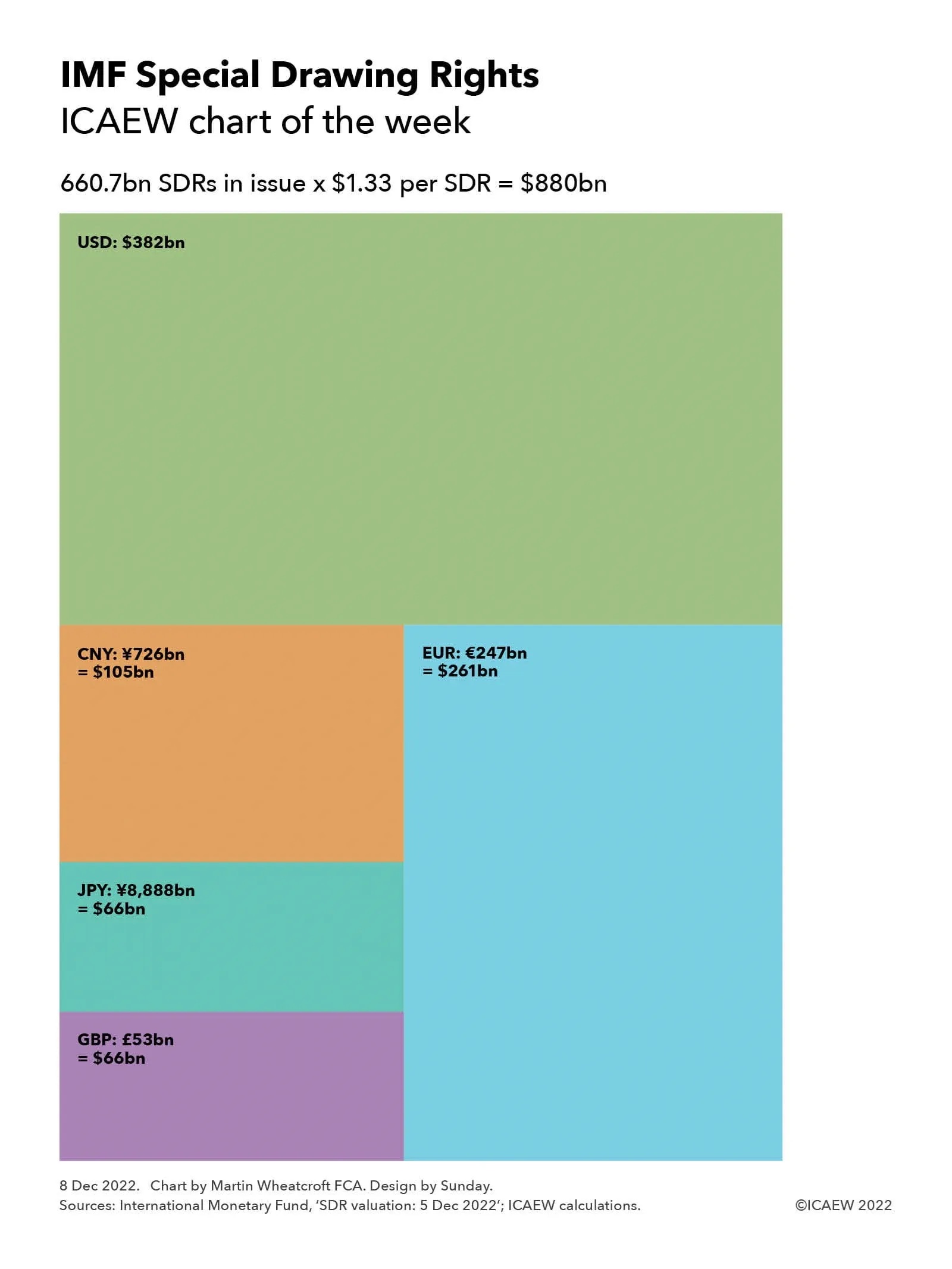
ICAEW chart of the week: IMF Special Drawing Rights

My chart this week looks at the reserve currency assets that comprise the 660.7bn SDRs issued by the International Monetary Fund.

IMF Special Drawing Rights

Treemap chart showing the breakdown by currency of the 660.7bn SDRs in issue x $1.33 per SDR = $880bn.

USD: $383bn
EUR: €246bn = £261bn
CNY: ¥726bn = £105bn
JPY: ¥8,888bn = $66bn
GBP: £53bn = $66bn

Special Drawing Rights (SDRs) are reserve assets issued by the International Monetary Fund (IMF), the ‘international central bank’ for central banks. 

Just as national central banks create money by issuing currency in exchange for debt, the IMF creates its own form of ‘international money’ in the form of SDRs, balanced by long-term debt owed to the IMF by its member countries. 

To date, the IMF has issued 660.7bn SDRs, most recently in August 2021 when 456.5bn SDRs were issued to provide additional liquidity to member countries during the pandemic.

Countries are able to exchange the SDRs they are issued with for the underlying currencies that make up each SDR, providing them with international liquidity when they need dollars, euros, yuan renminbi, yen or pounds sterling or – in many cases – just dollars. According to the latest five-year currency weightings determined in July 2022, 1 SDR should be exchangeable for 0.57813 US dollars, 0.37379 euros, 1.0993 Chinese yuan, 13.452 Japanese yen and 0.08087 UK pounds. 

The chart illustrates what this means for the total of 660.7bn of SDRs in issue, which as of 5 Dec 2022 was calculated to be worth approximately $880bn in total based on a value of $1.33 per SDR. The total comprised $382bn in US dollars, €247bn in euros (worth $261bn at 5 Dec 2022), ¥726bn Chinese yuan ($105bn), ¥8,888bn Japanese yen ($66bn) and £53bn in UK pounds ($66bn).

In effect, 43.4% of the currency basket making up each SDR was US dollars, 29.7% was euros, 11.9% was Chinese yuan, 7.5% was Japanese yen and 7.5% was UK pounds.

Despite SDRs being an ‘international reserve asset’ that central banks and member countries can use to manage their own currencies, the IMF insists that SDRs are not a currency in their own right. Instead, it stresses that SDRs are merely an ‘accounting unit’ to be used for IMF transactions. However, despite these protestations, the IMF has concluded that SDRs are the functional currency for the purposes of its financial statements prepared in accordance with International Financial Reporting Standards.

The strength of the dollar means that SDRs at $1.33 each are worth $56bn less than the blended average rate of $1.42 each when they originally issued. This is because the non-dollar components of the currency basket, especially the euro and sterling, have fallen in value in relation to the US dollar in recent years.

At less than a trillion dollars, SDRs may seem quite small in comparison with the vast flows of money around the world. However, their importance to the international monetary system cannot be understated, keeping the financial wheels turning and providing central banks (especially those in smaller nations) with essential liquidity when they need it most.

This chart was originally published by ICAEW.

ICAEW chart of the week: Autumn Statement

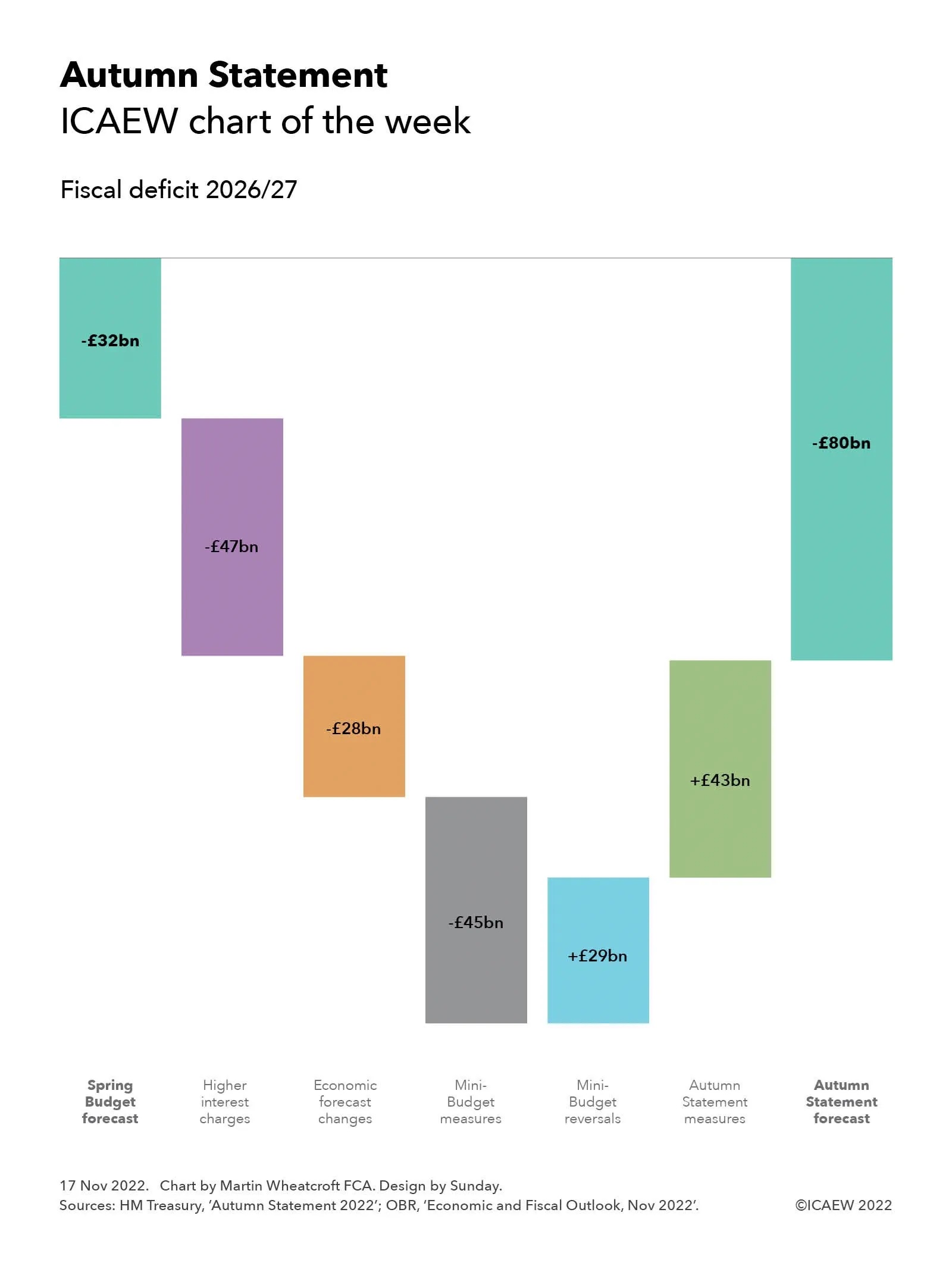
The public finances have been a rollercoaster ride over the last few months, as illustrated by this week’s chart showing how the forecast for the fiscal deficit in 2026/27 has changed since the Spring Budget.

Step chart showing changes in the forecast deficit for 2026/27:

Spring Budget forecast: -£32bn
Higher interest charges: -£47bn
Economic forecast changes: -£28bn
Mini-Budget measures: -£45bn
Mini-Budget reversals: +£29bn
Autumn Statement measures: +£43bn
= Autumn Statement forecast: -£80bn

Former Chancellor and now Prime Minister Rishi Sunak expressed some optimism back in March when he presented his Spring Budget, commenting how he remained committed to achieving a current budget surplus despite the huge amounts spent supporting individuals and businesses through the pandemic, and the support he was then offering to help with energy bills as they started to soar.

My chart this week illustrates how the fiscal situation has deteriorated significantly as rising interest rates, accelerating inflation, and an economy entering recession have adversely affected the public finances. Together with the additional energy support measures announced by then Prime Minister Liz Truss in September, the shortfall between receipts and expenditure is expected to be £270bn higher over a five-year period to 2026/27 than was forecast by the Office for Budget Responsibility back in March.

In 2026/27 itself (the year ending 31 March 2027), interest charges are expected to be £47bn higher than previously forecast, while tax receipts and other forecast changes are expected to require an extra £28bn in additional funding (of which £25bn relates to lower tax receipts). 

In theory this would result in a deficit of £107bn, which is why it was surprising that then Chancellor Kwasi Kwarteng decided to announce unfunded tax cuts amounting to £45bn a year by 2026/27. Although Kwarteng was hoping his planned tax cuts would help stimulate the economy, if they hadn’t then the deficit could have risen to more than £150bn, an unsustainable level that caused financial markets to take fright – even if they and we didn’t have the official numbers at that point.

Reversals to the mini-Budget followed as Chancellor Jeremy Hunt and Prime Minister Rishi Sunak attempted to reassure markets of their fiscal credibility, with £43bn in tax and spending changes to plug some of the gap. These comprise tax rises amounting to around £23bn a year (more than offsetting the £16bn of tax cuts retained from the mini-Budget), together with £20bn in lower levels of public spending than previously planned.

Together the forecast changes and government decisions give rise to a forecast deficit of £80bn in 2026/27, significantly higher than previously forecast. This is not a comfortable place for the public finances, with the Chancellor having to abandon the government’s previous commitment to achieving a current budget surplus in addition to, as expected, deferring the point at which he expects to see the underlying debt-to-GDP ratio start to fall from three to five years into the future.

Both tax and spending measures primarily involve fiscal drag, freezing tax allowances so that more people are brought into paying tax or paying tax at higher rates, and severely constraining public spending. Although it might be theoretically possible to hold the line on both tax and spending constraint for the next five years, there are likely to be some adjustments needed in the Spring Budget as pressures on public services mount, while the most difficult decisions have been postponed until after the next general election.

This week’s chart is not a pretty picture.

This chart was originally published by ICAEW.

Why is cutting public spending so difficult?

Martin Wheatcroft FCA, external adviser on public finances to ICAEW, assesses what options the government has to reduce the gap between receipts and expenditure.

Despite rolling back £32bn out of the £45bn of tax cuts announced in the mini-Budget, Chancellor of the Exchequer Jeremy Hunt is expected to announce tax rises as well as spending cuts when he sets out the Government’s Autumn Statement and medium-term fiscal plan on 17 November. 

The consensus is that he needs to find around £50bn a year to reduce the gap between receipts and expenditure if he wants to get the public finances back under control and provide himself with some headroom in case the situation deteriorates further. This could include extending beyond April 2026 the freeze in personal tax allowances announced by Prime Minister Rishi Sunak when he was Chancellor, as well as scaling back the ‘levelling up’ agenda of former Prime Minister Boris Johnson.

You’d think trimming 3% or so off an annual public spending bill of over a trillion pounds a year wouldn’t be that difficult, but each of the main options for cutting spending in the medium term are unpalatable and politically challenging:

  • Real-terms cuts in pensions and welfare are possible but difficult to deliver politically during a cost-of-living crisis, as previous Prime Minister Liz Truss discovered when she was forced to deny she was planning to abandon the triple-lock mechanism. 
  • Real-terms cuts in public sector pay are likely but come with the prospect of much greater disruption from industrial action and increasing difficulties in recruiting and retaining staff. 
  • Cutting investment in infrastructure and capital programmes is the easiest option to achieve but comes with risks to future economic growth and business investment.
  • Greater efficiency is possible but practically difficult to deliver, with significant project delivery risks and the need for sufficient capital investment to be successful.
  • Higher fees and charges are possible but risk a political backlash.
  • Lowering public service outputs or quality is possible but there are practical limits to how far you can continue to cut funding for many public services without adverse effects.

Forecasts for public spending

Total managed expenditure is budgeted to amount to £1,087bn in the current financial year ending 31 March 2023 (2022/23), equivalent to approximately £1,340 per month for each of the 67.5m people who live in the UK, or £3,220 per month for each of the 28.1m UK households.

Based on inflation assumptions decided on back in March, the Office for Budget Responsibility (OBR) projected that total spending would experience a real-terms cut of 1.2% to £1,100bn in 2023/24, and then real-terms increases of 0.5% to £1,127bn in 2024/25, 1.4% to £1,166bn in 2025/26 and 1.4% to £1,206bn in 2026/27. 

Forecasts for total spending are expected to be revised upwards by the OBR when it reports on 17 November. They will need to reflect higher rates of inflation, significantly higher interest rates, and the cost of the energy support packages announced in May and September 2022 (amended in October). The Institute for Fiscal Studies’ high-level forecast following the mini-Budget suggested that these factors could increase total spending to £1,185bn in 2022/23, £1,201bn in 2023/24, £1,165bn in 2024/25m £1,192bn in 2025/26 and £1,233bn in 2026/27, up £98bn, £101bn, £38bn, £26bn and £27bn respectively from the OBR March forecast.

Fiscal targets

When former Chancellor Kwasi Kwarteng announced on 23 September that he was scrapping the fiscal targets approved by the House of Commons in January this year, he was continuing a pattern of abandoning a succession of fiscal targets as it becomes clear that they have not been, or cannot be, met. Abandoning the existing targets without announcing new ones to take their place is likely to have been one of several contributory factors to the adverse reaction by markets to his proposals.

The latest set of abandoned fiscal targets required each five-year fiscal plan to aim for both a current budget surplus and for a falling debt to GDP ratio by the third year of each forecast period. Kwarteng had been under pressure to replace these with a more realistic fiscal target based on the debt to GDP ratio starting to fall by the fifth year of each forecast period. It is likely that the new Chancellor will adopt this or an even stricter set of targets in the hope of regaining credibility lost by the UK Government over the past few weeks.

Assuming that £43bn of the £45bn annual tax cuts announced in the mini-Budget were implemented, the Institute for Fiscal Studies (IFS) estimated that achieving a falling debt to GDP ratio after 2026/27 would require annual tax rises or public spending cuts of £62bn by 2026/27, equivalent to 5% of total spending that year. On 17 October, the Chancellor brought this estimate down by £27bn, reversing a further £21bn of the mini-Budget tax measures and adding back £6bn a year by cancelling the previously planned one percentage point cut in the rate of basic income tax from April 2024. 

This would suggest that the gap remaining to be filled with other tax and spending measures could be in the order of £35bn a year, equivalent to around 3% of total public spending in 2026/27. Adding in a further £10bn to £15bn of tax rises to provide headroom brings this to around £50bn in total.

The IFS highlighted significant risks in its forecast, which assumes that inflation does not persist in the medium term and that economic growth remains below 2%, consistent with the post-financial crisis trend. The IFS also based its forecast on a relatively shallow recession and highlighted how dependent it was on the level of interest rates, which at that point had spiked in response to the mini-Budget. These risks could easily increase the size of the gap between forecast receipts and spending that the Chancellor needs to fill. The Chancellor will be hoping that government borrowing costs continue to moderate following the appointment of Rishi Sunak as Prime Minister, providing the Government with some headroom in the official fiscal forecast.

What makes up public spending?

Budgeted public spending of £1,087bn in the current financial year ending 31 March 2023 can be broadly split between £295bn (27%) on pensions and welfare, £252bn (23%) on health and social care, £436bn (40%) on public services, and £104bn (10%) on debt and other interest. 

Spending on public services other than health and social care is budgeted to comprise £126bn (12% of total spending) on education, £59bn (5%) on defence and security, £47bn (4%) on transport, £43bn (4%) on public order and safety and £161bn (15%) on all the other services that central and local government provide.

These numbers are on a fiscal basis as presented in the National Accounts, in accordance with statistical standards that include capital expenditure net of depreciation. They exclude long-term expenditures such as accrued public sector pension obligations that are reported in the IFRS-based Whole of Government Accounts. They are also net of approximately £55bn in fees and charges and £5bn from the proceeds of asset sales.

Hands tied on spending

As the Prime Minister and Chancellor look for potential savings, they are finding that their hands are tied by the financial commitments made by successive governments, especially since the second world war. These commitments created the welfare state we know today, with pensions, welfare benefits, health and social care together now making up half of total public spending. Since the last general election this government has added to these commitments, including a significant expansion in eligibility for adult social care and increasing the value of state pensions through the triple lock mechanism. 

Under the long-standing ‘pay-as-you-go’ approach to funding government activities, no money is set aside to meet financial commitments made. Instead, tax receipts, cost savings or additional borrowing are used to pay for financial commitments as they fall due each year. There is no sovereign wealth fund to cushion the blow or to dip into.

The principal challenge for the Chancellor in looking for savings is that more people are living longer. The number of pensioners is expected to increase by 3.3m or 27% from 12.2m to 15.5m over the next 20 years, despite an increase in the state pension age from 66 to 67 over that time. This is driving up the cost of the largest line items within the overall budget: the state pension, the NHS, and social care budgets, over a period when the working age population, the group that pays the most in taxes, is projected to increase by just 4%.

The impact of a growing number of pensioners makes the job of finding savings that much harder, as the savings need to be proportionately larger from other parts of the budget. 

Any savings are also on top of hoped-for efficiency savings that have already been incorporated into departmental budgets to stay within the existing spending envelope, as well as dealing with rising procurement costs, higher energy bills and pressure to increase public sector salaries.

Pensions and welfare – £295bn or 27% of budgeted spending

Pensions and welfare spending can be broken down between £121bn for the state pension and pensioner benefits, £48bn in incapacity and disability benefits, and £126bn in working age, child and other welfare benefits and social protection.

Pensions spending is expected to increase over the next five years from a combination of a 1.1m or 9% increase in the number of pensioners and the ratchet effect of the Government’s triple-lock manifesto commitment to raise the state pension in line with whichever is higher: earnings, inflation or 2.5% .

One option to save money compared with existing forecasts would be to restrict the increase in state pensions to below inflation, either by abandoning the triple lock in this Parliament or not re-committing to it beyond the next general election. However, while Rishi Sunak was able to suspend the triple lock in April 2022 on a one-off basis, it is likely to be extremely difficult to find the political support needed to cut the state’s contribution to pensioner incomes in real terms sufficiently to offset a 9% increase in pensioner numbers over the next five years, or a 27% increase over 20 years.

The government could accelerate planned increases in the state pension age, currently set to go from 66 to 67 by 2028 and to 68 by 2046, although to do so might break a promise to give at least 10 years’ notice to those affected. Another option might be to reformulate the triple-lock mechanism, removing the ratchet effect by making it cumulative. This would see above-earnings rises in one year offset by below-earnings rises in subsequent years, subject to not falling below inflation or 2.5% in any particular year.

Real-term cuts in incapacity and disability benefits would also be politically unpalatable, as would further restricting eligibility criteria, even if pencilled in for subsequent years. Several commentators have suggested that the recent rise in the number of people suffering from health conditions and withdrawing from the workforce is because of NHS treatment backlogs that have been exacerbated by the pandemic. One way of cutting the cost of these benefits would be to provide additional funding to the NHS in the short to medium term, which would add rather than subtract from spending in the next few years, even if there is a positive financial benefit in the longer term.

That leaves welfare benefits for those of working age and children, where the IFS has suggested that indexing the uprating of working-age benefits in April 2023 and April 2024 to earnings rather than inflation could reduce the annual welfare bill by £13bn by 2026/27 when compared with existing forecasts. The risk here is that a recession could see the number of claimants rise significantly even if it were possible to cut the amount paid out to each claimant in real terms. Again, proposing real-terms cuts in the financial support offered to the poorest households of this scale during a cost-of-living crisis is likely to be politically challenging.

Another option would be to increase the minimum wage given that more than half of any wage increase would be recovered from claimants on universal credit. This is likely to be difficult to implement in the next couple of years given the current cost-of-doing-business crisis, but it might be possible to pencil in a rise in the second half of the fiscal period. 

One area where money could be saved is in tackling fraud and error, with the Department for Work and Pensions estimating that overpayments amounted to £8.6bn in 2021/22, partly offset by underpayments of £2.6bn. However, to do so effectively would likely require a significant simplification of the welfare system, a politically challenging task given this would involve both winners and losers.

Health and social care – £252bn or 23% of total spending

The budget for health and social care this year comprises £211bn for the NHS and other health care, and £41bn for social care, which are both driven by the number of pensioners and the level of long-term health conditions in the adult population in particular.

The focus in recent years has been to constrain the rise in spending on health care on a per patient basis through a combination of greater efficiency and constraining staff pay, while social care funding has been restricted to constrain supply. This has seen a decline in service standards in both health and social care, exacerbated by the pandemic. While there are opportunities to find savings by tackling waste and improving efficiency further, this will be difficult without greater capital investment in hospitals, primary care facilities and digital technology.

In practice, staff shortages, rising drug prices, and a weak pound are likely to add to cost pressures on the health budget, at the same time as calls grow to address poor performance across all areas of service delivery, including ambulance waiting times, long waiting lists for treatment and inadequate cancer outcomes, as well as expanding coverage in areas such as mental health.

Social care spending is also under pressure, not only because of rising pensioner numbers but also because of an expansion of eligibility for adult social care announced by former Prime Minister Boris Johnson. His successor, Prime Minister Liz Truss, made a commitment to retain this expansion despite abolishing the health and social care levy that was going to fund it, adding to size of the problem. There are strong arguments for increasing spending on social care in the near-term to relieve pressure on the NHS.

Potential savings in the short-term are likely to be through pay restraint, and in the medium-term through greater use of technology and consolidation of services. Deferring the introduction of the social care cap could ease funding pressures for a time but would not help the Chancellor achieve his targets in the longer-term. He could save some money compared with existing plans by indexing or otherwise increasing eligibility thresholds for social care over time. 

Risks include a further worsening of health outcomes and service standards, a potential collapse in services over this and subsequent winters, and industrial action.

Education – £126bn or 12% of budgeted spending

Education spending this year is estimated to comprise £53bn on secondary education, £34bn or so on primary and pre-school, £27bn on universities and higher education, and £12bn on training, further education, and other education services. 

While the falling birth rate is expected to reduce the numbers attending primary schools by around 10% or so over the next five years, the numbers going through (more expensive) secondary schooling are still increasing. In the near term, primary and secondary schools are already struggling to cope with a national pay settlement this year that was higher than allowed for in their existing budgets.

Restraining staff pay and constraining staff numbers are likely to be the main focuses of any cost savings that might be achievable from the schools’ budget, for example by increasing class sizes or merging schools – particularly at primary level. However, teacher shortages, particularly in science, technology, engineering, and mathematics, may make cutting pay in real terms difficult to achieve. 

University student numbers are expected to grow by around 6% over the next five years, although the per head cost should come down as inflation increases the numbers who earn over student loan repayment thresholds. The changes in student loan terms that extend the period over which repayments are made should also reduce the cost per student, although these are already built into the existing forecasts.

Capping student numbers and reducing the eligibility of some courses for student loans are being explored as one way of cutting the cost of higher education. However, higher inflation also makes the cash freeze in the cap on university student tuition fees increasingly unsustainable, especially as there are limits on how much further universities can continue to recruit sufficient numbers of international students to make up for real-term cuts in funding for UK students.

The challenge for a government looking for economic growth is that the general consensus is that more not less investment in skills is needed. Investment is especially required in technical education at secondary level and in further education and training for adults. There is also a strong case for extending pre-school provision to support parents back into the workforce (in addition to its educational benefits). 

Potential savings in the short term are through pay restraint, in the medium term through school consolidation, and in the longer term as a function of a lower birth rate. Risks and challenges include the competitiveness of the UK economy.

Defence and security – £59bn or 5% of total spending

Defence and security spending in 2022/23 comprises £52bn on defence and armed forces, £5bn on the security services and counter-terrorism policing, and £2bn on war and armed forces pensions.

Over the last fifty years, successive governments have been able to ‘raid’ the defence budget to find money for the rising costs of pensions, health and social care. This is no longer possible given the UK’s commitment to NATO since 2006 to spend a minimum of 2% of national income on defence and security.

In practice, defence spending is expected to increase in the near-term to cover the effect of higher-than-forecast inflation and a weaker pound on the procurement budget, in addition to the costs of providing military aid to Ukraine. These cost pressures are likely to absorb the first stages of the commitment made by former Prime Minister Liz Truss to increase spending on defence and security to 3.0% of national income by 2030.

Pay restraint could help offset some of the rise in spending a little in the short-term but would be politically difficult to sustain over the medium- to long-term, especially if the armed forces continue to struggle to recruit the new soldiers, sailors and aircrew they need. Theoretical savings from better procurement are always discussed, but rarely achieved – at least not in aggregate as cost overruns tend to outweigh any cost savings realised.

There are unlikely to be any potential savings in defence spending. In an increasingly unstable global security situation, most risks primarily relate to not spending enough.

Transport – £47bn or 4% of total spending

Transport spending in 2022/23 is budgeted to comprise £25bn on the railways, £13bn on roads, £6bn on local transport and £3bn in other transport-related expenditures. This includes significant amounts of capital expenditure and is net of passenger fares.

Capital investment in transport infrastructure was a big component of the levelling-up agenda, with a 10% uplift in capital budgets in the 2021 Spending Review. Unfortunately, inflation in construction costs has more than offset this boost in spending, imposing a scaling back of levelling-up ambitions and the potential returns from economic growth unless the government decides to increase the budget to compensate.

Governments looking for spending cuts have often looked at the transport budget as it is relatively easy to defer or cancel capital programmes or cut back on road maintenance in order to achieve a particular financial outcome. With the train companies back in public ownership, cutting back on train services is also an option, as would raising fares on public transport by more than inflation later in the forecast period. 

Further reductions in the scope of HS2 and other rail investment programmes have been mooted as options to save money, or at the very least restrict the level of budget overruns that would otherwise require additional funding. 

The problem with cutting back on investment in transport is that it is one of the key levers available to government to unlock private sector investment and drive economic growth. There is also a risk to business confidence (and hence business investment) if the UK is not able to deliver major infrastructure programmes it has previously committed to.

Potential savings include pay restraint, cutting back on road maintenance, fewer train services, cutting back on road and rail investment programmes, and potentially cutting back or means testing free public transport provided to pensioners. Road charging and higher train fares are also options. Risks are the economic damage of continued industrial action and weaker economic growth, particularly in regional economies outside London and the South East.

Public order and safety – £43bn or 4% of total spending

Spending on public order and safety in 2022/23 is budgeted to comprise £23bn on policing, £8bn on the court system, £7bn on prisons, £3bn on fire and rescue services, and £2bn on border control. 

Cuts in spending on police, courts, prisons and fire services delivered over the past decade were in the context of falling crime and a preceding decade of rising pay and investment. The current context is very different, with crime rising, significant delays in the courts, severe prison overcrowding, and heightened concerns about fire safety since the Grenfell fire. 

The existing budget includes funding for reversing cuts in police numbers since 2010 but significant problems in the court system is likely to need additional funding. Police and prison staff recruitment challenges mean it will be difficult to restrain pay rises into the medium term.

Potential savings include pay restraint, cuts in planned police numbers, and greater use of technology. Risks include rising crime, failed prosecutions, issues with prison safety and the quality of rehabilitation, and underperforming emergency services.

Other public services – £161bn or 15% of total spending

Spending on ‘everything else’ goes across a large number of budget headings, including £30bn on industry and agriculture, £19bn on research and development, £12bn on international development and aid, £11bn on housing, £10bn on waste management, £9bn on the EU exit settlement (which will reduce significantly in future years), £8bn on culture, recreation and sport, £5bn on the BBC and Channel 4, and £2bn on foreign affairs among numerous other public services. These budget headings include most local public services outside of social care and transport, in addition to central government departments, the devolved administrations and around 500 other public bodies.

Despite a decade or so of ‘austerity’ spending restraint, there should be plenty of opportunity to find savings in many public services. Better use of technology could help improve services as well as enable them to be delivered at lower cost. However, delivering services at significantly lower cost typically requires the successful delivery of technology and restructuring programmes that carry significant financial and political risks, as well as requiring additional investment in the short-term. The more that is attempted, the higher the risk of overruns or failed attempts.

There are also significant opportunities to reduce losses incurred from fraud or waste, although this also requires investment in improving governance, processes, and financial controls at all levels of government.

Even where savings are achieved, the impact on overall government spending is limited – even if you could cut every single budget in this category by 5%, this would only reduce total spending by 0.75%.

Some budget headings are discretionary and so could in theory be reduced by much greater amounts, for example spending on research and development or funding for the arts. However, these types of spending tend to be important to delivering on other government objectives, such as fostering economic development, regenerating deprived communities, or supporting key industries such as tourism – in addition to being considered important activities in their own right.

There has been some discussion about cutting the size of the civil service, which at 510,000 is about 9% of the overall public sector workforce. Bringing total numbers down by 91,000 or 18% to the pre-Brexit position as mooted by some in government is likely to be extremely challenging to deliver in practice. Not only does the government need to deliver additional requirements such as for customs and border control, international trade negotiation, and other previously shared responsibilities that have reverted to the UK, but the events of the past few years have highlighted how government has struggled to deliver on its policy priorities. 

The three largest departmental workforces are the Department for Work & Pensions (DWP) at 94,000, the Ministry of Justice (MoJ) at 87,000 and HM Revenue & Customs (HMRC) at 71,000. In theory, the automation of manual processes and the replacement of systems that currently require extensive manual intervention could enable cuts to be made in staff at all three departments, especially the DWP. However, the risks of making major systems changes, a court system under extreme pressure, and the risks to tax revenue of cutting staff significantly in the near-term, as well increased risks of fraud and error, makes this far from a cost-free choice.

There are also political difficulties in cutting non-staff areas of these budgets, such as agricultural subsidies where there are vocal constituencies likely to object to significant reductions in the amounts paid.

One budget heading that has already been cut is spending on international development, which is now set at 0.5% of national income, with a plan to return to the previous level of 0.7% of national income once the public finances are in better shape. Some members of the governing party have suggested reducing this below 0.5%, despite a manifesto commitment to keep to the 0.7% target. There have also been suggestions that the accounting goalposts could be moved to include existing domestic spending in the UK to be classified as international development, enabling the government to reduce the amount spent outside the UK.

Another area where costs are rising are public sector pensions, as former public servants are also living longer, with pensions-in-payment contractually linked to rises in the consumer prices index. Ironically, the switch in the last decade from final salary to average salary calculations reduces the effect that constraining public sector pay has on the eventual bill. Public sector pensions are relatively generous compared with the private sector and cutting the accrual rate for pension entitlements could save substantial amounts in the longer-term, assuming this could be successfully negotiated with the unions. This would allow for higher base salaries, which might help with recruitment given pensions benefits are often undervalued by recipients.

Potential savings again include pay restraint, cutting staff numbers, cutting public sector pension benefits, procurement savings, property consolidation (already underway), technology, cutting discretionary spending, greater use of outsourcing, cutting capital programmes including infrastructure. Risks include a further deterioration in the quality of public services, problems in delivering technology and transformation programmes, failure to achieve key government objectives that depend on effective public services, poor morale affecting the effective delivery of services, and the potential that any cuts in staff numbers will be reversed as governments make new commitments.

Interest – £104bn or 10%

The interest budget in 2022/23 comprises £83bn of debt interest and £21bn of other interest, principally on local authority and other funded public sector pensions. (No interest is recorded in the fiscal numbers on the much larger amount of unfunded pension obligations).

Public sector net debt has more than quadrupled over the last fifteen years from £0.5tn in 2008 to £2.4tn today, but ultra-low borrowing costs over that time has kept the cost of servicing that debt down to historically low levels.

The Debt Management Office within HM Treasury has been able to extend maturities to an average of around 15 years, locking in very low interest rates as it has raised or refinanced debt over the last decade. However, the Bank of England’s quantitative easing programme of gilt purchases has in effect swapped a substantial proportion of this fixed rate debt into variable rate central bank deposits, making the public finances much more sensitive to increases in official interest rates. The Debt Management Office has also been successful in hedging the low levels of inflation we have experienced over the last decade through the issue of bonds that rise in line with the retail prices index. However, this goes the other way in periods of higher inflation, with increasing liabilities on index-linked gilts offsetting the inflationary benefit of a faster growing denominator on the debt to GDP ratio.

The IFS expects debt interest to increase by £23bn to £106bn in the current financial year, primarily as a consequence of higher interest rates and higher inflation on index-linked debt. Even with inflation coming down in the next year or two, it still expects debt interest in 2026/67 to be £106bn, more than double the £51bn forecast by the OBR in March.

The two main levers for restricting rises in the debt interest bill are to keep borrowing down, which implies higher taxes or lower spending compared with the current path and to keep interest rates at the lowest level possible by regaining credibility with the markets, which also implies higher taxes or lower spending. Some commentators have estimated the benefit of the change in Prime Minister as being between £6bn and £12bn in lower annual interest charges than they might otherwise have been the case.

Some commentators have suggested that the Bank of England could implement non-interest paying tiered reserves, in effect arbitrarily ceasing or reducing the base rate payable on a proportion of deposits held by (mostly UK) banks and financial institutions. This would reduce the cost of borrowing on that element of the public debt, but one risk is that the overall interest bill might end up being higher depending on how banks and debt markets responded to such a significant change in monetary policy.

One ‘creative accounting’ approach would be to change the debt measure in the debt to GDP ratio used in fiscal targets. This was amended a few years ago to exclude the rising amounts of debt being taken on by the Bank of England to fund quantitative easing and Term Funding Scheme low-cost loans for high-street banks. Reverting to the headline measure for public sector net debt would contribute to the debt to GDP ratio falling as quantitative easing is unwound and Term Funding Scheme loans are repaid.

Potential savings – none compared with current plans, absent the more radical suggestion of tiered reserves. However, the extent of the cost increase can be limited through improved fiscal credibility and constraining the amount of borrowing.

Other options

More radical options are possible, but these are likely to be extremely difficult without substantial political support from the public, such as that provided by a general election mandate.

For example, privatisation could move responsibility for some taxpayer funded services that are currently provided by public bodies to the private sector. The challenge here is that some public subsidy may still be needed even after privatisation, reducing the amount of any saving to the taxpayer. This would likely increase the burden on those of working age who would have to pay to use any service that was privatised, while still paying through their taxes for pensioners, children and the less well-off to use that service. There is also a risk that the overall cost to the public is higher, given that the bulk purchasing effect of procuring services collectively could be lost depending on the business model chosen.

Historical precedence is not helpful here, in particular the privatisation of the railways in Great Britain in 1996. This ended up being renationalised unintentionally following track-owner Railtrack’s collapse in 2002 and the failure of the train operating company franchise system in 2020. Trying again would be a ‘brave’ choice politically even if it might be possible to reduce the level of public subsidy required with a different financial model.

Other radical options include ending the provision of some public services or scaling them back significantly, but in most cases the political backlash could be significant in comparison with the level of savings that might be possible.

Long-term reform

One of the reasons the UK is in a difficult fiscal situation is the short-term focus of successive governments that have continued to add to the nation’s financial commitments without setting aside funding to pay for them. This has made the public finances increasingly less resilient to face economic shocks such as that seen in the financial crisis a decade and a half ago, the pandemic over the past two and a half years, and the cost-of-living crisis that we are currently going through.

While finding savings in the short-term is likely to be extremely difficult, over a long period there are more options to reduce the cost of the state. A good example is social care, where it might be possible to establish long-term insurance arrangements for those currently in their 20s and 30s that would eventually – in 40 to 50 years’ time – significantly reduce the level of public funding required. Similarly, the state pension could be replaced for those now entering the workforce by collective defined contribution pension funds such as those seen in other countries.

For example, Australia has strengthened its public finances significantly with reforms such as replacing unfunded defined benefit pension schemes for federal employees with defined contribution pension funds, and the establishment of a sovereign wealth fund to support the payment of pensions and welfare benefits.

Conclusion

Prime Minister Rishi Sunak and Chancellor of the Exchequer Jeremy Hunt have a difficult task in trying to reduce the gap between receipts and expenditure. Politically it will be difficult to raise taxes, but there will also be political, financial and operational consequences and risks in how they choose to cut spending. And with an increased focus by the markets on the credibility of their plans, there will be less room to pencil in optimistic ‘anticipated’ savings into the later years of the five-year forecast period.

The first challenge they face will be in how to reengineer the energy support schemes for both households and businesses from April 2023 onwards. As these are time limited, this won’t help bridge the gap in later years, but it will enable them to be more targeted in how support is provided over the next couple of years, as well as potentially reducing the overall cost that needs to be funded by long-term borrowing.

Each of the main options for cutting spending in the medium-term are unpalatable and politically challenging:

  • Real-terms cuts in pensions and welfare are possible but difficult to deliver politically during a cost-of-living crisis, as previous Prime Minister Liz Truss discovered when she was forced to deny she was planning to abandon the triple-lock mechanism. 
  • Real-terms cuts in public sector pay are likely but come with the prospect of much greater disruption from industrial action and increasing difficulties in recruiting and retaining staff. 
  • Cutting investment in infrastructure and capital programmes is the easiest option to achieve but comes with risks to future economic growth and business investment.
  • Greater efficiency is possible but practically difficult to deliver, with significant project delivery risks and the need for sufficient capital investment to be successful.
  • Higher fees and charges are possible but risk a political backlash.
  • Lowering public service outputs or quality is possible but there are practical limits to how far you can continue to cut funding for many public services without adverse effects.

Over the last fifteen years, successive governments have been able to borrow their way out of trouble even as debt has mounted, and the resilience of the public finances has weakened. That era is no more, with providers of finance to the UK Government now asking much more challenging questions about how the government can pay its way.

Tough choices will need to be made.

Martin Wheatcroft FCA is a strategy consultant, adviser on public finances, and the author of Simply UK Government Finances 2022/23.

This article was originally published by ICAEW.
ICAEW chart of the week: IFS forecast deficit

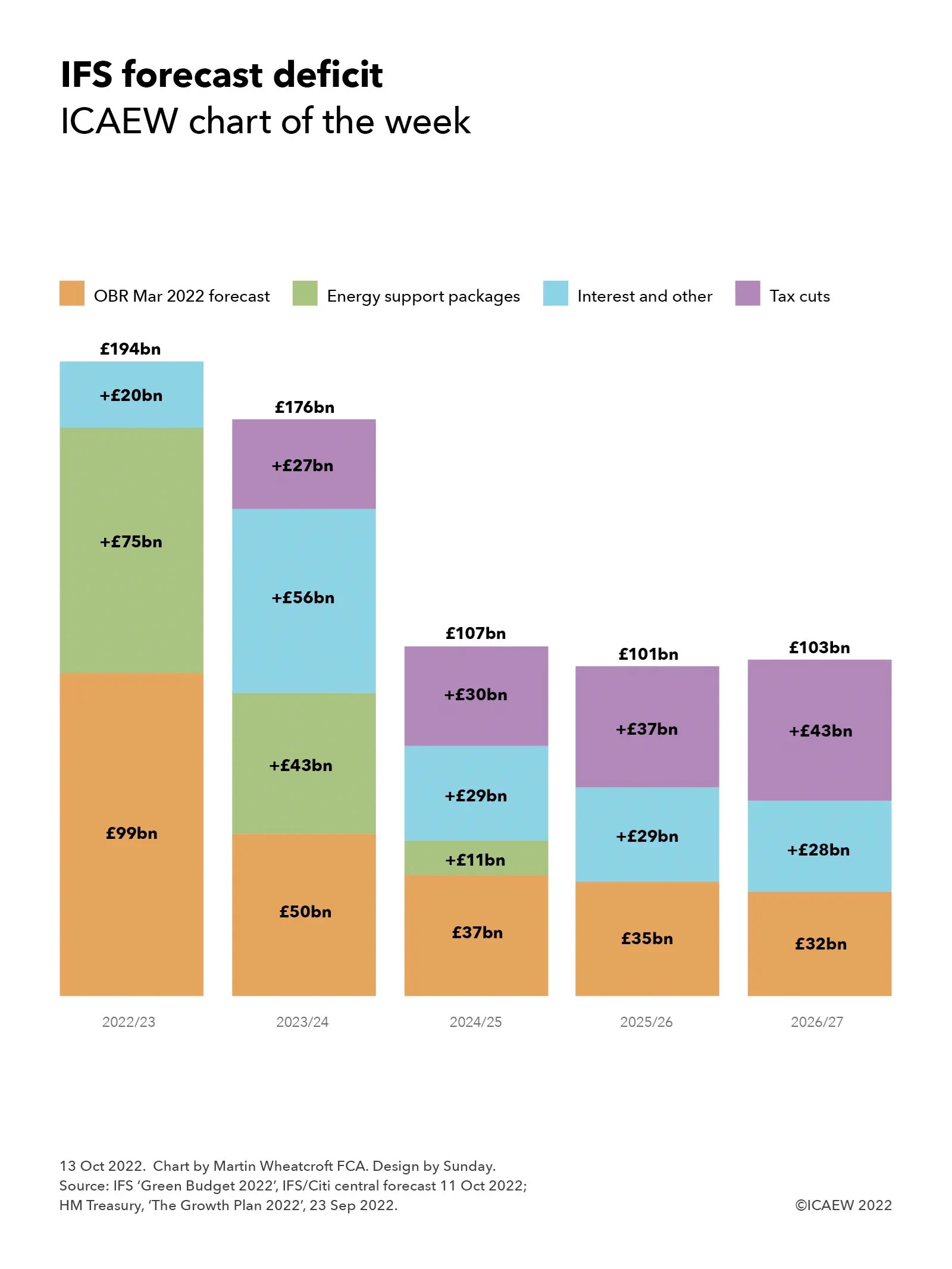
My chart this week illustrates how tax cuts, higher interest charges and energy support packages contribute to the Institute for Fiscal Studies forecast of big increases in the fiscal deficit over the next few years.

Column chart showing changes between the OBR March 2022 forecast deficit and the IFS post-miniBudget forecast (after top-rate tax reversal)

2022/23: £99bn (OBR forecast) +£75bn (energy support packages) +£20bn (interest and other) = £194bn (IFS forecast)

2023/24: £50bn + £43bn (energy) +£56bn (interest and other) + £27bn (tax cuts) = £176bn

2024/25: £37bn + £11bn (energy) + £29bn (interest) + £30bn (tax cuts) = £107bn

2025/26: £35bn + £29bn (interest and other) + £37bn (tax cuts) = £101bn

2026/27: £32bn (OBR) + £28bn (interest and other) + £43bn (tax cuts) = £103bn (IFS).

The Institute for Fiscal Studies (IFS) published its annual Green Budget pre-Budget report on Tuesday 11 October. My chart this week summarises how the government’s energy support packages, higher interest rates and planned tax cuts contribute to a big jump in the fiscal deficit for the next few years up until the financial year ending 31 March 2027 (2026/27).

The chart starts with the Office for Budget Responsibility’s March 2022 Economic and Fiscal Outlook forecast for the deficit of £99bn in 2022/23, £50bn in 2023/24, £37bn in 2024/25, £35bn in 2025/26 and £32bn in 2026/27.

Forecasts from the IFS suggest that the deficit will almost double to £194bn in the current financial year, principally as a consequence of the £75bn cost-of-energy support packages announced by the government in May and September 2022, together with £20bn from higher interest and other forecast changes. The £7bn in lost tax revenue from cancelling the national insurance rise from November onwards and £1bn from cutting stamp duty is offset by £8bn in anticipated receipts from the energy windfall tax introduced by Rishi Sunak in May. 

In the next financial year 2023/24, the IFS has forecast a £126bn increase in the forecast deficit from the OBR’s £50bn back in March to £176bn. This comprises an estimated £43bn cost of the domestic energy price guarantee, an extra £56bn from the effect of higher interest costs and other forecast changes, and £27bn in lower receipts as a consequence of the tax cuts announced by Chancellor of the Exchequer Kwasi Kwarteng on 23 September and partially reversed on 4 October. 

The IFS emphasises that the forecast for the cost of domestic energy price guarantee is highly uncertain given how volatile energy prices are; it could vary up or down by tens of billions of pounds. There is also nothing in the forecast for an extension of the temporary energy support package for businesses that is due to expire on 31 March 2023, despite the potential that this may be required if energy prices remain elevated.

Higher interest charges are driven by a number of factors, including higher Bank of England base rates over the next few years, an increase in the yields on government borrowing when debt is refinanced, the effect of higher inflation on gilts linked to the retail prices index and the higher level of debt consequent on running bigger deficits. Other forecast changes principally relate to the effect of higher inflation on receipts and spending.

The effect of the tax cuts in 2023/24 has been estimated by HM Treasury to reduce receipts by £18bn from the cancellation of the national insurance rise, £11bn from cancelling the previously legislated increase in corporation tax from 19% to 25% from 1 April 2023, £5bn from implementing the cut in the income tax base rate from 20% to 19% a year early, £1bn from cutting stamp duty, £1bn from permanently setting the annual investment allowance for businesses to £1m and £1bn from rolling back IR35, net of £10bn generated by the energy profits levy.

In 2024/25, the forecast assumes energy prices continue to reduce, resulting in a cost for the final six months of the energy price guarantee to £8bn to add to the £37bn forecast by the OBR back in March. Higher interest and other forecast changes should add £29bn, while the government’s tax cuts should add a further £30bn, resulting in a new forecast for the deficit that year of £107bn. Similarly in 2025/26, the OBR’s spring forecast of £35bn has been revised up to £101bn, comprising £29bn from higher interest and other forecast changes and £37bn from tax cuts. 

In 2026/27, the IFS forecasts the deficit to be £103bn, with the OBR March forecast of £32bn being increased by £28bn for higher interest charges and other forecast changes and £43bn from the effect of tax cuts. The latter comprises £19bn from the cancellation of the health and social care levy, £18bn from the cancellation of the corporation tax rise to 25%, £2bn from the cut in stamp duty, £2bn from a VAT-free shopping scheme for tourists, and £2bn in other tax measures.

While the huge cost of the government’s energy support packages is the largest contributor to the increase in the deficit in the first two years of the forecast, it is the persistent effect of higher interest rates combined with tax cuts that is the bigger concern for the IFS. Based on its calculation, it suggests that public spending cuts of £62bn a year might be necessary to achieve a falling ratio of debt to GDP by the fifth year of the forecast period – a not insignificant sum.

This chart was originally published by ICAEW.
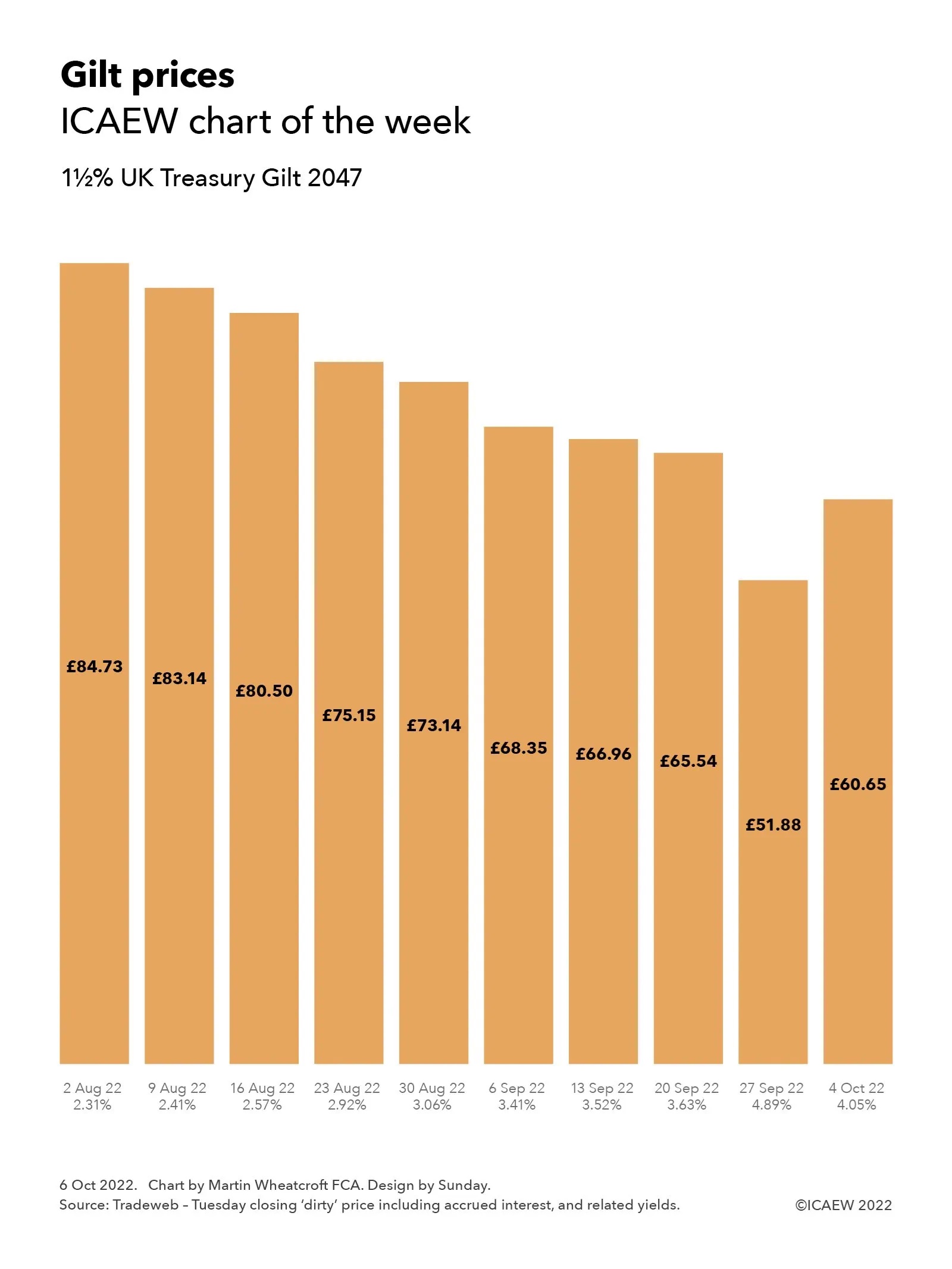
ICAEW chart of the week: Gilt prices

Our chart this week looks at how the price of the 1½% UK Treasury Gilt 2047 has changed over a nine-week period, falling from £84.73 for a £100 gilt on 2 August to £51.88 on 27 September, before recovering to £60.65 on 4 October.

Column chart showing weekly price for the 1% UK Treasury Gilt 2047

2 Aug: £84.73 (yield 2.31%)
9 Aug: £83.14 (2.41%)
16 Aug: £80.50 (2.57%)
23 Aug: £75.15 (2.92%)
30 Aug: £73.14 (3.06%)
6 Sep: £68.35 (3.41%)
13 Sep: £66.96 (3.52%)
20 Sep: £65.54 (3.63%)
27 Sep: £51.88 (4.89%)
4 Oct: £60.63 (4.05%)

Recent events in the government bond markets have been featuring on the front pages since the mini-Budget. As our chart illustrates, gilt prices – that had already been falling as interest rates increased – dived to their lowest level for many years following the Chancellor’s announcement of unfunded tax cuts at the same time as an unprecedented intervention in energy markets.

The chart is based on the Tuesday closing price of a long-dated gilt, the 1½% UK Treasury Gilt 2047 (GB00BDCHBW80), which is due to mature on 22 July 2047. Originally a 30-year gilt issued in 2016, 2017 and 2018 at a weighted average price of £93.90 and a weighted average accepted yield of 1.8%, there are around 249m £100 gilts with a total nominal value of £24.9bn traded on the London Stock Exchange.

Debt investors that purchased at that price would have made a tidy profit if they had sold when the price peaked at £125.41 on 9 March 2020 (when the yield was 0.51%) but the price has fallen over the last couple of years as interest rates have risen, dropping to £84.73 at the close of business on Tuesday 2 August, providing a yield of 2.31% to a debt investor intending to hold this gilt over the remaining 25 years until it matures. 

Worsening inflation expectations since then have caused the yields demanded by investors to rise, resulting in the price falling by 14% over a four-week period to £83.14 on 9 August, £80.50 on 16 August, £75.15 on 23 August and £73.14 on 30 August, as the yield rose to 2.41%, 2.57%, 2.92% and 3.06% respectively. The slide continued in September as the price fell by a further 10% to £68.35 on 6 September, £66.96 on 13 September and £65.54 on 20 September as the yield rose to 3.41%, 3.52% and 3.63%, bring the cumulative fall since the first Tuesday in August to 23%. 

The price plunged to £51.88 in the wake of the mini-Budget, causing the yield to spike to 4.89%, a 21% fall in one week that brought the cumulative fall over eight weeks to 39%. The Bank of England’s intervention managed to stabilise the gilt market, with the price increasing by 17% to £60.65 over the week to Tuesday 4 October. This has brought the yield back down to 4.05% and reduces the cumulative fall in price over nine weeks between 2 August and 4 October to 28%.

The turmoil in the gilt markets has shone a light on the risks associated with investing in what is often described as a ‘very safe’ investment in gilt-edged government securities issued by one of the world’s largest economies. While the creditworthiness of the British government remains unquestioned, recent events have demonstrated just how quickly debt markets can move in response to changing economic conditions and prospects.

Whether you are invested in bonds directly, or indirectly through your pension, recent events have confirmed, in an all-too-dramatic way, the truism that stock prices can – and do – go down as well as up. 

This chart was originally published by ICAEW.
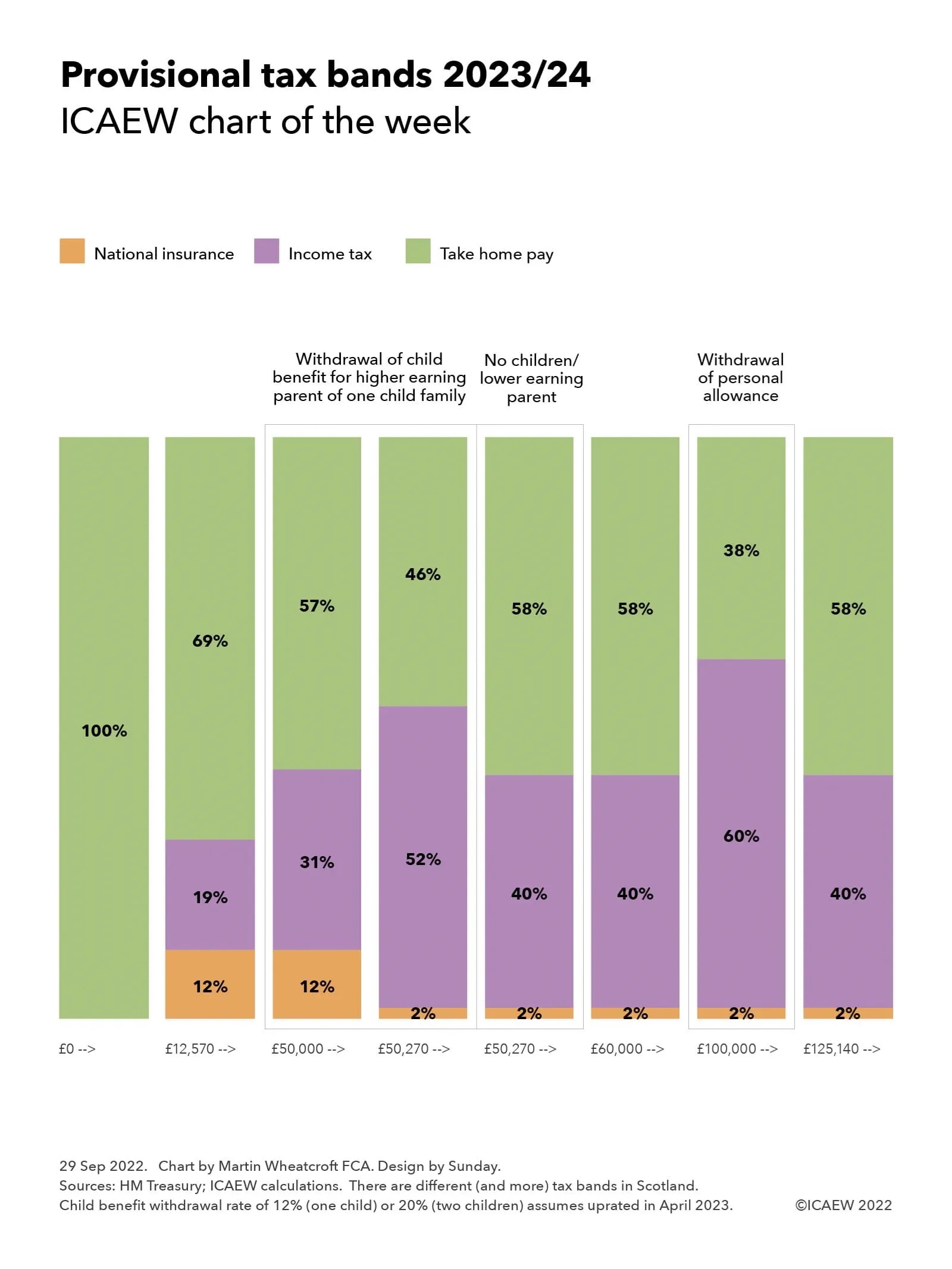
ICAEW chart of the week: Provisional tax bands 2023/24

My chart this week illustrates how five or seven different personal tax bands are expected in the coming financial year, despite the top rate of income tax being abolished.

Column chart showing tax rates for 2023/24 by income level, based on the mini-Budget. 

£0 -> 100% take home pay
£12,570 -> 12% national insurance, 19% income tax, 69% take home pay

Box for withdrawal of child benefit
£50,000 -> 12% NI, 31% income tax, 57% take home pay
£50,270 -> 2% NI, 52% income tax, 46% take home pay

Box for no children / lower earning parent
£50,270 -> 2% NI, 40% income tax, 58% take home pay

End of boxes

£60,000 -> 2% NI, 40% income tax, 58% take home pay
£100,000 -> 2% NI, 60% income tax, 38% take home pay (withdrawal of personal allowance)
£125,140 -> 2% NI, 40% income tax, 58% take home pay

Amid market chaos it might be forgotten that the ‘mini’ Budget was primarily about reforming the personal tax system. In abolishing the 45% top rate of income tax from 6 April 2023 onwards, the Chancellor simplified the tax system by removing the personal tax band that currently applies to earnings above £150,000.

Despite that simplification, our chart this week highlights how the personal tax system remains quite complicated, much more than might be assumed based on just two rates of income tax (19% and 40%), two rates of national insurance (12% and 2%) and recent alignment in income tax and national insurance thresholds.

In practice, our chart is an oversimplification, as it does not attempt to incorporate welfare benefits and hence the full complexity of how people are ‘taxed’ as their incomes rise – for example the 55% taper rate at which universal credit is withdrawn from those on the lowest incomes. It also does not attempt to reflect the tax treatment on non-earned income such as dividends, interest and capital gains, nor the intricacies of how pension contributions or other tax reliefs are dealt with. 

Nor does it show the different rates of income tax applicable in Scotland, which currently has three more tax bands than elsewhere in the UK and is likely to continue to do so once the Scottish Budget establishes tax rates for next financial year.

Our chart assumes the thresholds for personal income tax and national insurance remain frozen as currently planned, illustrating how there is no tax to pay on the first £12,570 of earned income – the first band in the UK’s personal tax system.

From this point upwards, income tax of 19% (a 1% cut from the current rate) and employee national insurance of 12% (a reduction from the 13.25% in force until next month) are expected to apply in 2023/24, a combined rate of 31% that reduces take-home pay to 69% of each extra pound earned.

These rates apply to earnings up to £50,000, when a strange quirk of the tax system comes into play if you are a parent with a child or children receiving child benefit. Assuming child benefit is uprated by inflation in April, then the amount clawed back between £50,000 and £60,000 from the higher-earning parent is likely to be equivalent to somewhere in the region of an extra 12% (for one child) or 20% (for two children). The quirk is the misalignment between the £50,000 at which child benefit starts to be withdrawn through the tax system and the £50,270 point at which the 40% higher rate of income tax rate and 2% lower rate of national insurance of £50,270 come into force. 

This creates a small band where the higher-earning parent of one child faces a combined tax rate of 43%, followed by a band between £50,270 and £60,000 where a combined rate of 52% applies. Not shown in the chart is the even higher rates of tax for two children – 39% income tax + 12% national insurance and 60% income tax + 2% national insurance – or even higher for three or more children receiving child benefit.

For those without children, or for the lower-earning parent, there is a more straightforward jump as income exceeds £50,270, with an extra 21% taken as the income tax rate rises from 19% to 40%, partially offset by a 10 percentage-point reduction in national insurance from 12% to 2%.

Those without children and lower-earning parents should retain 58% of each pound of earnings over £50,270, as will higher-earning parents on incomes above £60,000. 

For earnings above £100,000 the personal allowance is withdrawn, creating an extra tax band between £100,000 and £125,140 where there is a marginal income tax rate of 60%, which with 2% of employee national insurance means retaining 38% of each additional pound earned within this band. The new top band is above £125,140, where income tax reverts to 40%, which combined with 2% of national insurance results in 58% being retained for each extra pound earned.

With the current 45% top rate of tax abolished, there is no further band for earnings above £150,000, meaning that all incomes above £125,140 are taxed at a combined rate of 42%, at least before taking account of tax reliefs that might apply.

There have been suggestions that the Chancellor intends to attempt to simplify personal tax bands further, perhaps by abolishing the 60% tax rate between £100,000 and £125,140 by allowing higher earners to retain the personal allowance rather than have it withdrawn. A less expensive option would be to align the child benefit withdrawal threshold with that for the higher income tax rate, getting rid of the mini-tax band for higher-earning parents on incomes between £50,000 and £50,270.

We will no doubt discover whether the government’s new-found zeal to simplify the tax system will continue, or if they will revert to the longer-term trend of adding in new complications to the tax system whenever a little extra money needs to be found.

This chart was originally published by ICAEW.
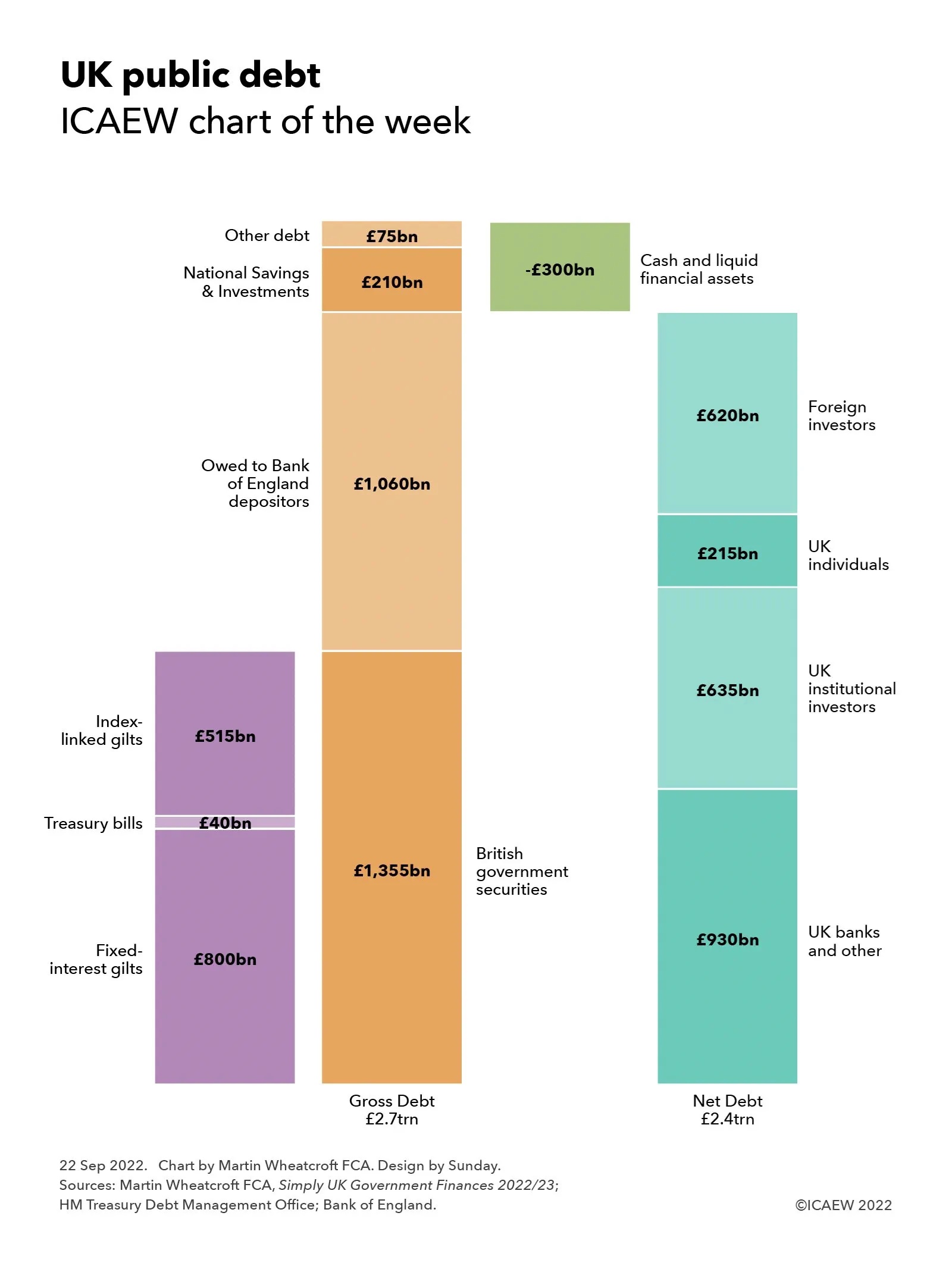
ICAEW chart of the week: UK public debt

We take a look at what makes up UK public debt and who it is owed to, before the Chancellor borrows hundreds of billions more in his emergency fiscal event.

Hybrid step chart showing gross debt of £2.7trn comprising £1,355bn of British government securities (of which £800bn is fixed-interest gilts, £40bn is treasury bills and £515bn is index-links gilts), £1,060bn owed to Bank of England depositors, £210bn for National Savings & Investments and £75bn in other debt. 

After deducting £300bn of cash and liquid financial assets, net debt is £2.4trn, which can be analysed as £930bn owed to UK banks and other, £635bn to UK institutional investors, £215bn to UK individuals, and £620bn to foreign investors.

We take a look at what makes up UK public debt and who it is owed to, before the Chancellor borrows hundreds of billions more in his emergency fiscal event.

Our chart this week is on public debt, illustrating how public sector gross debt is currently in the region of £2.7tn and public sector net debt is in the order of £2.4trn.

HM Treasury owes £2.1trn to holders of British government securities, of which approximately £745bn is owed to the Bank of England and £1,355bn to external investors. These securities are tradable on the London Stock Exchange, comprising fixed-interest bonds (‘gilts’) with an average maturity of 14 years, retail price index-linked gilts with an average maturity of 18 years and treasury bills that mature and roll over within six months or less.

The next largest public sector borrower is the Bank of England, which owes around £1,060bn to its depositors. This mostly comprises deposits created under its quantitative easing programme to support the economy, in the order of £850bn to finance fixed-interest gilt purchases, £20bn to finance corporate bond purchases and around £190bn to finance Term Funding Scheme loans.

The public is directly owed £210bn in the form of National Savings & Investments premium bonds and savings certificates.

The balance of £75bn comprises £25bn in Network Rail loans, £15bn in local authority external debt (local authorities owe £120bn in total, but £105bn is owed to central government) and £35bn in other sterling and foreign currency debt. These numbers do not include £21bn in central government leases and £10bn in other debts that have recently been added to the official measure for government debt following changes in methodology.

After deducting £300bn in cash and other liquid assets, this means public sector net debt stands at around £2.4trn, of which in the order of £930bn is owed to UK banks and other financial institutions, £635bn to UK institutional investors (pension funds and insurance companies), £215bn to UK individual investors, and £620bn to foreign investors, including foreign central banks and governments as well as private sector investors.

The chart illustrates how, despite the efforts of HM Treasury’s Debt Management Office to lock in fixed interest rates for long periods, the government is exposed to significant interest rate and inflation exposure, with the Bank of England having – in effect – swapped a significant proportion of government debt from fixed-rate gilts into variable rate central bank deposits through its quantitative easing programmes.

The consequence is that the majority of public debt is exposed to changes in interest rates or, in the case of index-linked gilts, to changes in retail price inflation, driving interest costs higher and higher each time the Bank of England raises its benchmark central bank deposit rate.

This provides a difficult backdrop for the Chancellor’s plans to borrow substantial sums to cut taxes, cap energy prices for households and businesses and increase defence spending. Most of the extra borrowing will be financed by issuing new British government securities at a time when the Bank of England is starting to put its quantitative easing programme into reverse and so selling some of its stock of fixed-interest gilts back into the market. 

There is no need for an official forecast to be confident of two things: public debt, and the cost of public debt, are both going up.

This chart was originally published by ICAEW.
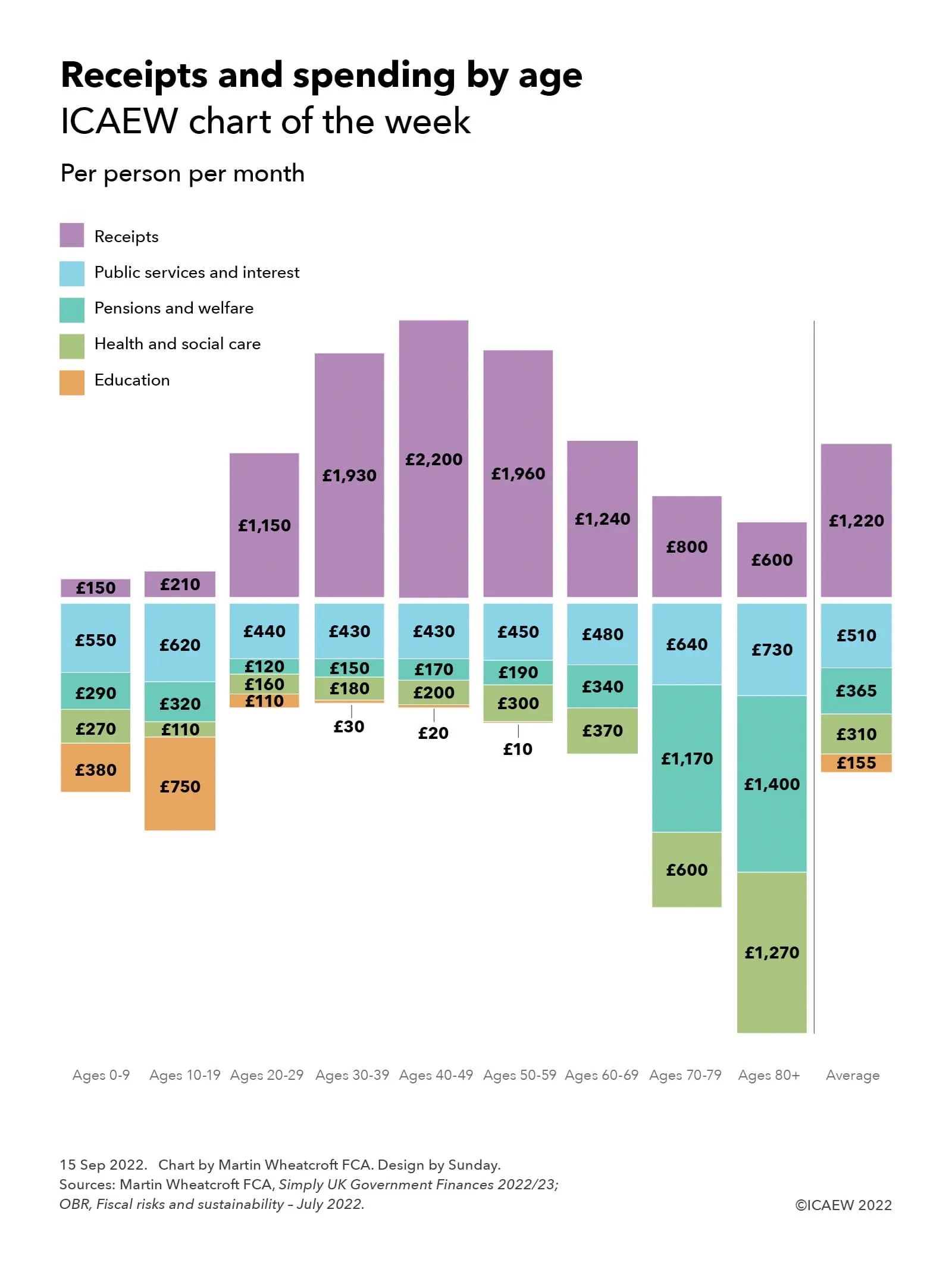
ICAEW chart of the week: Receipts and spending by age

My chart this week looks at how receipts and spending vary by age, a key driver for public finances that new Chancellor Kwasi Kwarteng will need to factor into his fiscal plans.

Column chart - showing receipts by age group per person per month above the line and spending below the line.

0-9: £150 (receipts) - £550 (public services and interest), £290, (pensions and welfare), £270 (health and social care), £380 (education)

10-19: £210 - £620, £320, £110, £750

20-29: £1,150 - £440, £120, £160, £110

30-39: £1,930 - £430, £150, £180, £30

40-49: £2,200 - £430, £170, £200, £20

50-59: £1,960 - £450, £190, £300, £10

60-69: £1,240 - £480, £340, £370, -

70-79: £800 - £640, £1,170, £600, -

80+: £600 - £730, £1,400 - £1,270

Average: £1,220 - £510, £365, £310, £155

Kwasi Kwarteng’s first Budget will be an emergency one, not only setting out his plans for the financial year commencing on 1 April 2023, but also re-opening the budget for the current financial year. It will be dominated by the emergency support package for individuals and businesses already announced, alongside starting to deliver on Prime Minister Liz Truss’s commitments to cut taxes and ‘shrink the state’.

The new Chancellor is likely to find that cutting public spending is not going to be easy given the increasing financial commitments made by successive governments since the Second World War on education, pensions, health and social care, the areas that now dominate public spending. He supported adding to those commitments only a couple of years ago when then Prime Minister Boris Johnson decided to expand eligibility for social care, and former Chancellor Rishi Sunak re-committed to the ‘triple-lock’ that guarantees increases in the state pension every year.

As our chart this week illustrates, receipts and spending vary significantly across age groups, with spending on education higher on the young, who pay very little in taxes, and spending on pensions, health and social care much higher for older generations who contribute less than the average, especially after reaching retirement age. This contrasts with the profile for those of working age who pay the most into the system while on average taking the least out.

Derived from an analysis from the Office for Budget Responsibility’s fiscal risks and sustainability report published in July, the chart shows how – before the emergency Budget scheduled for 21 September – budgeted tax and other receipts for the current financial year 2022/23 are equivalent to £1,220 per person per month, based on forecast receipts of £988bn and a population of 67.5m. This is below budgeted public spending of £1,340 per person per month (£1,087bn/67.5m people/12 months), with the deficit of £120 per person per month (£99bn in total) funded by borrowing.

Average receipts per person per month by age group are estimated to be in the order of £150, £210, £1,150, £1,930, £2,200, £1,960, £1,240, £800 respectively for those aged 0-9, 10-19, 20-29, 30-39, 40-49, 50-59, 60-69, 70-79 and 80+ respectively. These numbers include £115 per person per month of non-tax receipts spread evenly across everyone. 

Spending on public services and interest in the order of £510 per person per month, or £550, £620, £440, £430, £430, £450, £480, £640, £730 by age group, is less variable across age groups because it much of this spending is incurred on behalf of everyone, including £125 in interest, £73 on defence and security and £53 on policing, justice and safety for example.

Spending on pensions and welfare of £365 per person per month is less evenly spread, with £290 and £320 per month spent on those in their first two decades and £440, £430, £430 and £450 on those in their twenties, thirties, forties and fifties respectively. This increases to average spending per person per month of £480, £640 and £730 on those in their sixties, seventies and eighties or over. 

Health and social care spending of £310 is biased towards older generations, with per person per month spending of £270, £110, £160, £180 and £200 for the first five decades of life contrasting with the £300, £370, £600 and £1,270 spent on average on those in their fifties, sixties, seventies and eighties or over. 

As you would expect, education spending of £155 per person per month on average is mostly spent on the young, with around £380 per person per month spent on the under-10s, £750 spent on those between 10 and 19, £110 spent on those in their twenties, and £30, £20 and £10 respectively spent on those in their thirties, forties and fifties.

The reason this chart is so critical is because demographics are not in a steady state, with the ONS projecting that there will be an additional 3.3m pensioners in 20 years’ time, a 27% increase. This will have significant cost implications for this and future governments over a period when the working-age population – who pay most of the taxes to fund public spending – is projected to grow by just 4% in total. 

While a declining birth rate might relieve some of the pressure on education spending over the next 20 years, spending on the state pension, the NHS and on social care will grow significantly if the commitments made by the current and previous governments to provide for income in retirement, universal free health care and an increasing level of social care provision are to be met, at the same time as running public services to the standard required.

Kwasi Kwarteng’s predecessors have been able to cover the expanding share of public spending going on pensions and health and social care without raising taxes above 40% of the economy by cutting spending on public services, in particular the defence budget, which has declined from in the order of 10% of GDP to around 2% over the last half century. However, with defence already at the NATO minimum, and many public services under significant pressure to improve delivery, there is much less scope to find savings than there has been in the past.

This poses a very big challenge for the Chancellor as he puts together his medium-term fiscal plans. Economic growth needs to be much higher than it has been in recent years, not only to cover the cost of tax cuts that he hopes will generate that growth, but also to generate the extra tax receipts needed to fund pensions and health and social care as more people live longer lives.

This chart was originally published by ICAEW.