Half-year deficit reaches £208bn as COVID costs accumulate

22 October 2020: Public finances remain on track for the worst peace-time deficit ever, thanks to lower receipts and large-scale coronavirus interventions.

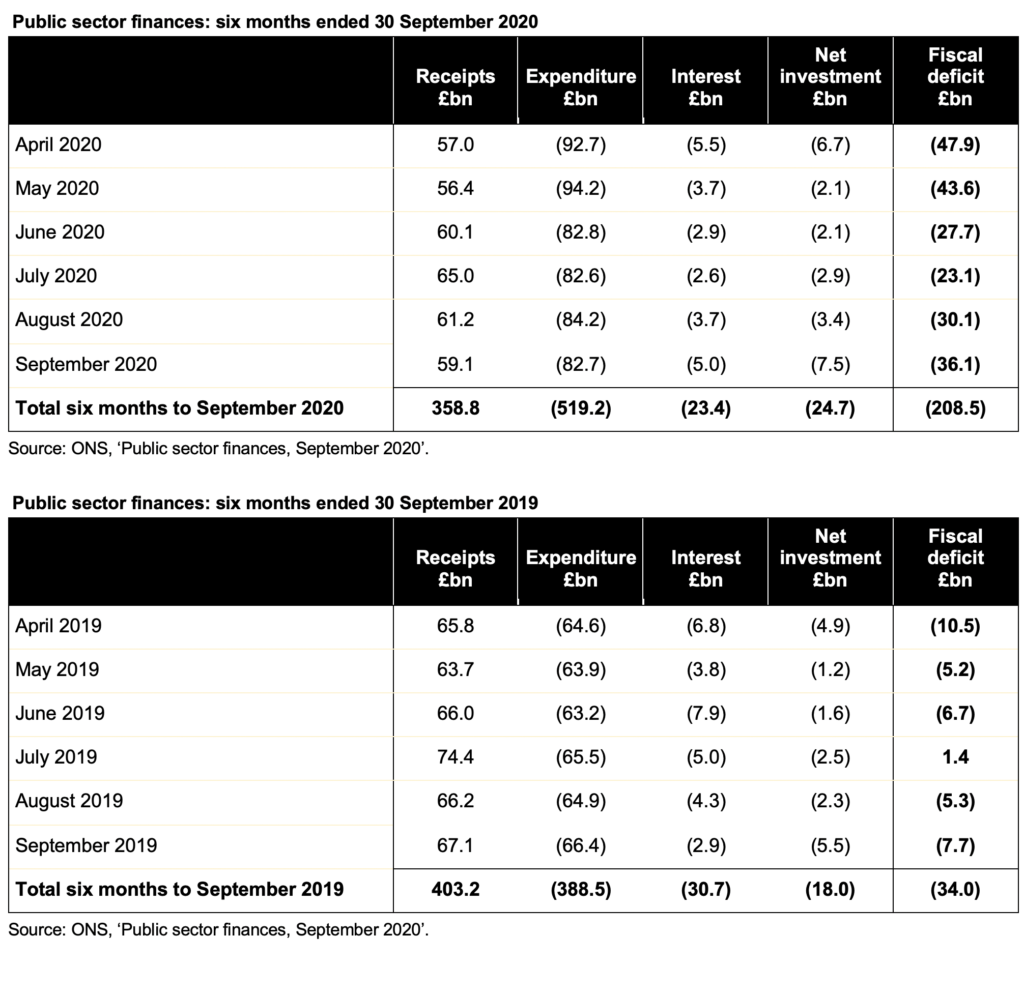
The latest public sector finances reported a deficit of £36.1bn in September 2020, a cumulative total of £208.5bn for the first six months of the financial year.

Falls in VAT, corporation tax and income tax drove lower receipts, while large-scale fiscal interventions resulted in much higher levels of expenditure. Net investment is greater than last year, as planned, while the interest line has benefited from ultra-low interest rates.

Public sector net debt increased to £2,059.7bn or 103.5% of GDP, an increase of £259.2bn from the start of the financial year and £274.0bn higher than in September 2019. This reflects £50.7bn of additional borrowing over and above the deficit, most of which has been used to fund coronavirus loans to business and tax deferral measures.

Commenting on the figures Alison Ring, ICAEW Director for Public Sector, said: “The deficit of £208bn is already more than the full-year deficit at the height of the financial crisis a decade ago and remains on track to be the largest ever outside the two world wars. 

“The economic damage caused by the pandemic in the first half of the fiscal year was not as bad as originally feared, thanks in part to the extraordinary level of financial support provided by the Chancellor. However, the second wave is putting further strain on the public finances as new regional restrictions are placed on economic activity.

To help the recovery the Chancellor must take the opportunity at the Autumn Statement and Spending Round to invest in preparing infrastructure projects to start as soon as possible.”

Image of table showing public finances for month of September and six months to September together with variances from last year. Click on link to the article on the ICAEW website for a readable version.

The combination of receipts down 11%, expenditure up 34% and net investment up 37% has resulted in a deficit for the six months to September 2020 that is approaching four times the budgeted deficit of £55bn for the whole of the 2020-21 financial year set in the Spring Budget in March. This is despite interest charges being lower by 24%. The cumulative deficit is more than six times as much as for the same six-month period last year.

Cash funding (the ‘public sector net cash requirement’) for the six months was £257.8bn, compared with £7.1bn for the same period in 2019.

Interest costs have fallen despite much higher levels of debt, with extremely low interest rates benefiting both new borrowing to fund government cash requirements and borrowing to refinance existing debts as they have been repaid.

The Institute for Fiscal Studies’ recent IFS Green Budget 2020 annual pre-Budget report indicated that the deficit for the full year to March 2021 could reach £350bn or 17% of GDP.

Some caution is needed with respect to the numbers published by the ONS, which are expected to be repeatedly revised as estimates are refined and gaps in the underlying data are filled. In particular, the OBR points out that the ONS has yet to record any allowance for losses that might arise on the more than £100bn of tax deferrals, loans and guarantees provided to support businesses through the pandemic.

Image of table showing public finances for each month to September 2020 and for each month to September 2019. 

Click on link to the article on the ICAEW website for a readable version.

The ONS made a number of revisions to prior month and prior year fiscal numbers to reflect revisions to estimates and changes in methodology. These had the effect of reducing the reported fiscal deficit in the first five months from the £173.7bn reported last time to £172.4bn and reducing the reported deficit for 2019-20 from £55.8bn to £54.5bn.

For further information, read the public sector finances release for September 2020.

This article was originally published on the ICAEW website.

Where is the infrastructure for delivering infrastructure?

19 October 2020: How can the UK deliver on its ambitious infrastructure plans without a national infrastructure strategy, a comprehensive multi-year spending review, or an infrastructure investment bank?

It seems that everyone agrees that investing more in infrastructure is critical to the future prosperity of the UK, but how do we actually deliver those ambitions on the ground? 

After decades of underinvestment that has seen the UK fall behind many other developed, and even some developing countries, there is a great deal of consensus that a substantial amount of new investment is needed in both economic and social infrastructure right across the country. An investment-led recovery is also increasingly seen as essential to repair the economic damage caused by the coronavirus pandemic.

The UK does not score that well with only one relatively short high-speed railway, low broadband speeds across most of the country, severely congested roads, poor public transport networks outside London and the South East, a collapsing nuclear energy programme, underinvestment in hospitals, schools and care homes, and a failure to deliver enough houses. The fading glory of the on-time and on-budget delivery of the 2012 Olympics seems a long-time ago, as does the admittedly controversial PFI investment boom of the early 2000s.

A successful infrastructure programme requires many elements, starting with a clear national strategy setting out what needs to be built and how. Budget allocations for publicly funded infrastructure and a financial framework for privately funded infrastructure need to be in place well in advance. Financial institutions are required to provide finance for major infrastructure projects and to the businesses constructing them. An efficient planning system is needed that balances the economic benefits of building new assets with other interests.

Despite the enthusiasm for new investment from across the political spectrum, many of the building blocks are not yet in place. The National Infrastructure Strategy has been delayed several times and is still not published. The coronavirus pandemic has delayed the planned three-year Spending Review by yet another year, with a more limited one-year Spending Round expected this November instead. Similarly, we are still awaiting the outcome of the Infrastructure Finance Review that is expected to provide a new financial framework for private sector participation in infrastructure projects, as well as an anticipated UK successor to the European Investment Bank (EIB).

Despite this, there are some bright spots. Behind the scenes, there is a major upgrade underway of the UK’s energy transmission and distribution networks that is seeing tens of billions invested in improving the resilience and flexibility of the UK’s energy plumbing. And the UK has become a world leader in offshore wind power, with decisions taken a decade ago starting to bear fruit.

How can the UK deliver on ambitious plans to achieve carbon-neutrality while ensuring a reliable and secure energy supply, become a digital superpower and ‘level up’ deprived regions all at the same time? 

This is one of the more important debates we need to have – after all the very future of the country is at stake.

Join Katie Black, Director for Policy at the National Infrastructure Commission, Melanie Onn, Deputy Chief Executive for Renewable UK, Iain Wright, Director for Business and Industrial Strategy at ICAEW and Alison Ring, Director for Public Sector at ICAEW, to discuss the UK’s infrastructure plans at an ICAEW webinar on Thursday 22 October at 11am.

To read ICAEW’s submission to the Infrastructure Finance Review click here.

This article was originally published on the ICAEW website.

ICAEW chart of the week: UK debt financing requirement

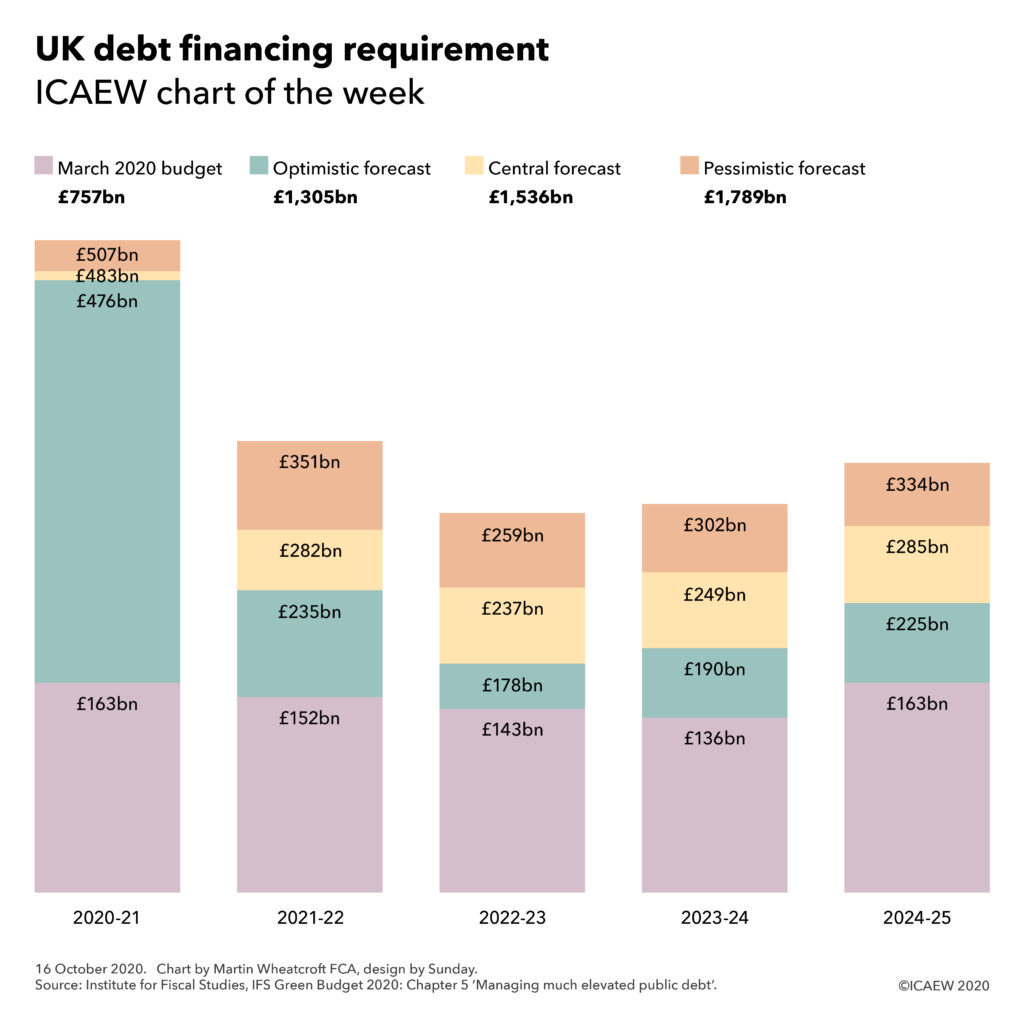
16 October 2020: The Institute for Fiscal Studies annual pre-Budget report forecasts a doubling to £1.5tn in the amount of debt to be raised by the UK Government over the next five years.

UK debt financing requirement by year from 2020-21 to 2024-25, adding up to £757bn (March 2020 budget), £1,305bn (optimistic), £1,536bn (central) and £1,789bn (pessimistic forecast).

Although the Budget itself may have been delayed, the IFS Green Budget 2020 has been published on schedule, with a wealth (if that is the right word in the current context) of analysis on the economy and the public finances. 

With £201bn in discretionary measures and a £95bn economic impact from the coronavirus pandemic, the IFS is forecasting that the deficit will reach £350bn in the current financial year. At 17% of GDP, this is a level never before seen in the UK outside of the two world wars. 

Unfortunately, the effect of the pandemic on public finances will not be restricted to this financial year. Even if the economy recovers in 2021, or more likely in 2022, tax revenues will be significantly lower and spending significantly higher than they were previously expected to be.

This is perhaps best highlighted by looking at the UK Government’s gross financing requirement – the amount that the UK Debt Management Office (DMO) will be tasked with raising from external debt investors over the next five years to finance the shortfall in taxes compared with spending (the deficit), to finance business and other lending and to repay existing debts as they fall due. This is forecast by the IFS to double to £1.5tn in their central forecast, within a range from £1.3tn in a more optimistic scenario to £1.8tn in a more pessimistic scenario.

As the IFS points out, the enormous amount of debt being issued means that even small differences in financing costs will have a very large impact on the public finances. This is despite the sizeable proportion of debt being issued with long maturities (as long as 50 years in some case) that are locking in extremely low interest rates for decades to come.

Reducing interest costs on debt has provided the Chancellor with room to provide the unprecedented levels of financial support to the UK economy that we saw over the summer. The prospect of negative nominal rates could see investors paying the Government rather than the other way round, providing headroom for further interventions.

There is a downside, of course. The ‘good times’ of ultra-low interest rates may not last for ever, and with a central debt forecast at 31 March 2025 of 112% of GDP significantly higher than the 35% of GDP before the financial crisis a dozen years ago the exposure to changes in interests is that much more significant.

To find out more about the latest forecasts for the economy and the impact that will have on the public finances, please do read the IFS Green Budget 2020.

This chart was originally published by ICAEW.

ICAEW chart of the week: Local government in England

9 October 2020: The complex structure of regional and local authorities in England is just begging for reform, but will the rumoured plan to abolish county and district councils fix it for good?

Chart with three rings: regional tier, county or unitary tier and then district council tier, showing lots and lots of councils in England.

Local government in England, as illustrated by the #icaewchartoftheweek, is pretty complex with eight different types of regional or principal authority and a patchwork quilt of different tiers of government across the country.

This complex system comprises areas without a regional tier of government involving unitary authorities or county & district councils, and those with combined authorities atop unitary authorities or metropolitan boroughs (and one county and its districts) and the Greater London Authority atop 32 London boroughs and the City of London. (This excludes the 9,000 or so town, village and other forms of parish councils in England, mostly outside the major urban areas).

This complexity makes it very difficult for the Government to interact with local authorities in the absence of a consistent model of local government or a country-wide regional tier of government to act as intermediary. This contrasts (for example) with the federal system in Germany, where Chancellor Angela Merkel regularly speaks to the leaders of the 16 German states, who in turn deal with the local authorities in their areas. Similarly (although not formally federal), France has 13 mainland and 5 overseas regional administrations that President Emmanuel Macron and Prime Minister Jean Castex can talk to and who will deal with their constituent provinces.

The UK Government can and does communicate with London Mayor Sadiq Khan, Greater Manchester Mayor Andy Burnham, West Midlands Mayor Andy Street, West Yorkshire Chair Susan Hinchcliffe, Liverpool City Region Mayor Steve Rotherham, Sheffield City Region Mayor Dan Jarvis, North East Chair Iain Malcolm, West of England Mayor Tim Bowles, Cambridgeshire & Peterborough Mayor James Palmer, North of Tyne Mayor Jamie Driscoll and Tees Valley Mayor Ben Houchen, each of whom can represent their constituent local authorities. But, they only represent 44% of the English population, with a further 24 county council leaders and 46 unitary authority leaders to speak to cover the remaining 56%. That is a pretty big Zoom call, assuming borough and unitary leaders within the regional authority areas don’t also insist on joining in.

The delayed announcement of a plan to abolish the 25 county and 188 district councils and replace them with between 25 and 40 new unitary authorities (perhaps with some mergers with existing unitary authorities) will go some way to rationalising the existing system by going to a single tier of principal local authorities. This would bring local public services together under one roof and save money, albeit there are some concerns about whether some of the new authorities would be too remote from the local citizenry.

However, this is still likely to leave English local government reform unfinished with over half the country without a regional tier of government. Will the Government want to continue with its existing organic approach of combined authority formation or go for a more comprehensive programme to establish regional authorities across the whole country, similar to the French reforms of the 1980s?

This chart was originally published by ICAEW.

ICAEW chart of the week: Quarterly GDP

2 October 2020: The latest statistics for the UK economy generate a grim graphic for the #icaewchartoftheweek.

Chart showing GDP by quarter from 2018 Q1 to 2020 Q2: £528bn, £533bn, £539bn, £542bn, £548bn, £551bn, £556bn, £558bn, £556bn, £476bn.

According to latest numbers from the Office for National Statistics (ONS) released on 30 September 2020, GDP for the second quarter to June 2020 fell to £476bn, a 14.5% fall in economic activity compared with the previous quarter, which in turn was 0.5% lower than the last quarter of 2019.

This week’s chart not only illustrates the damage done by the coronavirus pandemic to the economy in the first half of 2020, but also highlights how poorly the economy was performing in past couple of years, with seasonally-adjusted GDP increasing by an average of 0.8% a quarter from £528bn in the first quarter of 2018 to £558bn in the fourth quarter of 2019.

These percentage changes do not take account of the effect of inflation, with the ONS reporting a headline fall of 19.8% in real GDP in the second quarter and a 2.5% drop in the first quarter on a chained volume basis (the method used by the statisticians at the ONS to adjust for the effects of changing prices and output levels across the economy). Average quarterly real economic growth in the seven quarters to Q4 2019 was just 0.3% and around half that on a per capita basis.

The two pieces of good news are that the decline in GDP in the second quarter was less steep than originally feared, while we also know that the economy has recovered to a significant extent in the third quarter to 30 September, although we won’t know by how much until the statistics are published in November. Unfortunately, with local lockdowns across the country, the likelihood is that it will be sometime before our lives return to normal.

This chart was originally published on the ICAEW website.

Cancelled Budget must not be allowed to delay infrastructure plans

29 September 2020: Recently published figures show that the Government burnt through £224bn in the five months to August 2020. This should not stand in the way of an investment-led economic recovery, according to ICAEW’s Public Sector team.

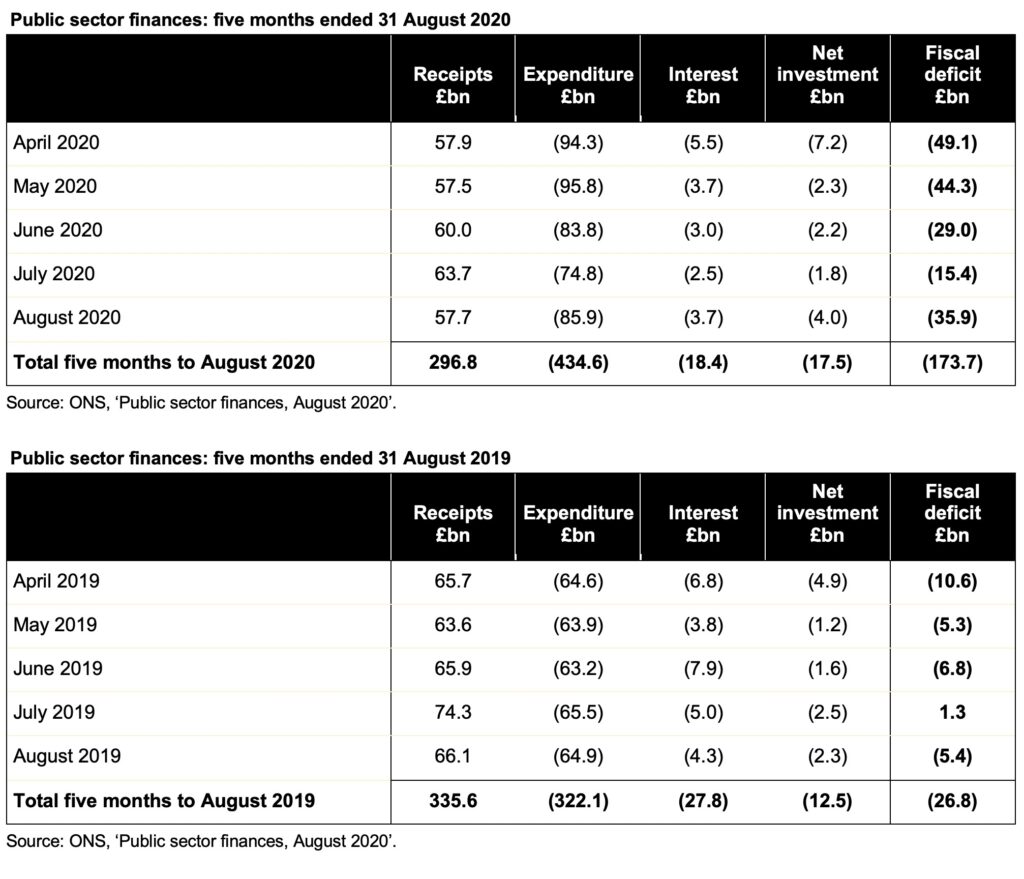
The latest public sector finances for August 2020 published by the Office for National Statistics (ONS) on Friday 25 September 2020 reported a deficit of £35.9bn in August 2020, a cumulative total of £173.7bn for the first five months of the financial year.

Falls in VAT, corporation tax and income tax drove lower receipts, while large-scale fiscal interventions resulted in much higher levels of expenditure. Net investment is greater than last year, as planned, while the interest line has benefited from ultra-low interest rates.

Public sector net debt increased to £2,023.9bn or 101.9% of GDP, an increase of £223.4bn from the start of the financial year and £249.5bn higher than in August 2019. This reflects £49.7bn of additional borrowing over and above the deficit, most of which has been used to fund coronavirus loans to business and tax deferral measures.

Image of table showing public sector finances for month of August and for 5 months to August 2020, together with variances against last year. Click on the link at the end of the article for a readable version.

The combination of receipts down 12%, expenditure up 35% and net investment up 40% has resulted in a deficit for the five months to August 2020 that is more than three times the budgeted deficit of £55bn for the whole of the 2020-21 financial year set in the Spring Budget in March, despite interest charges being lower by 34%. The cumulative deficit is more than six times as much as for the same five-month period last year.

Cash funding (the ‘public sector net cash requirement’) for the five months was £224.0bn, compared with £5.8bn for the same period in 2019.

Interest costs have fallen despite much higher levels of debt, with extremely low interest rates benefiting both new borrowing to fund government cash requirements and borrowing to refinance existing debts as they have been repaid.

Some caution is needed with respect to the numbers published by the ONS, which are expected to be repeatedly revised as estimates are refined and gaps in the underlying data are filled. In particular, the OBR points out that the ONS has yet to record any allowance for losses that might arise on the more than £100bn of tax deferrals, loans and guarantees provided to support businesses through the pandemic. 

Alison Ring FCA, director for public sector at ICAEW, commented: “The government continued to haemorrhage cash in August, despite furloughed employees returning to work and the warm weather encouraging people to spend money outside their homes. The Chancellor’s Eat Out to Help Out subsidy may have hit the headlines, but at £522m it was only a fraction of the total spending in the year to date of £470.5bn. Large sums were also spent on Test & Trace and PPE, as well on fiscal interventions such as the coronavirus job retention scheme.

While the decision to postpone the Budget until the Spring is understandable given the economic uncertainties as we enter the next phase of the pandemic, we hope that this will not mean further delays for the National Infrastructure Strategy and the green-lighting of infrastructure projects across the country, which will be vital for an investment-led economic recovery.”

Image of table showing public sector finances for each month to August 2020 and to August 2019. 

Click on the link at the end of the article for a readable version.

The ONS made several revisions to prior month and prior year fiscal numbers to reflect revisions to estimates and changes in methodology and classification. These had the effect of reducing the reported fiscal deficit in 2019/20 from £59.7bn to £55.8bn and in 2018/19 from £41.0bn to £38.8bn. There was a reduction of £12.7bn in the estimated deficit in the first four months of the current financial year from that reported last month primarily because of overestimating central government procurement in those months.

This article was originally published by ICAEW.

ICAEW chart of the week: public sector employment

25 September 2020: The #icaewchartoftheweek is on headcount in the public sector, which increased by 115,000 to 5,508,000 in the year to June 2020.

Chart showing change in headcount from June 2019 to 2020: NHS +88k, other health & social work -7k, education -9k, police +12k, forces +4k, civil service +11k, public admin +8k, other +8k = +115k.

Employment on a full-time equivalent (FTE) basis also increased over the last year, with an increase of 118,000 from 4,485,000 FTEs in June 2019 to 4,603,000 FTEs in June 2020.

The NHS workforce jumped by 55,000 in the first six months of 2020 and by 88,000 in the year to June as the coronavirus pandemic accelerated recruitment of health workers. The NHS is the one part of the public sector that has seen consistent headcount growth over the last decade, with 1,782,000 employees at June 2020 compared with 1,558,000 a decade ago. This has been partly offset by a fall in other health and social workers of 7,000 to 208,000 in the year to June, which is 191,000 lower than the 399,000 employed in June 2010.

Public employees working in education also fell by 9,000 to 1,487,000 in June 2020, bringing the total fall over the last decade to 198,000, driven by a combination of cuts in education funding and the reclassification of further education colleges to outside the public sector.

Police numbers (including civilian staff) have started to increase again, with a headcount of 261,000 in June 2020, up 12,000 over a year previously. However, this is still significantly below the 292,000 that were employed in June 2010. HM Forces numbers also started to increase again after a long period of decline, with the approximately 4,000 service personally added to reach 156,000 still substantially less than the 197,000 serving in June 2010.

Civil Service numbers increased by 11,000 over the year to 459,000, with Brexit being a major contributor to the increase from the low-point of 416,000 employed in June 2016, by still significantly below the 517,000 civil servants working in June 2010. Other public administration headcount increased by 8,000 to 614,000 in June 2020, down from 682,000 a decade previously.

The number of other public sector workers increased by 8,000 in the year to 541,000. This is substantially below the 1,105,000 employed in other categories in June 2010, principally because ten years ago the public sector included housing associations, Royal Mail, Direct Line, Lloyds Banking Group and Northern Rock all of which have since been reclassified to the private sector. (Royal Bank of Scotland and Bradford & Bingley remain in the public sector).

Adjusted for reclassifications, total public sector headcount is 215,000 lower than it was a decade ago, reflecting an increase of 224,000 in NHS employees and a net decline of 439,000 across the rest of the public sector.

With Brexit preparations accelerating and the NHS under severe pressure as we approach winter, it is likely public sector employment will continue to rise in the near future.

This chart was originally published on the ICAEW website.

Plastic is the future for cash – one way or another

22 September 2020: Physical cash use is declining fast, leaving the fixed cost base for processing cash transactions at risk of stranding. As cards and digital forms of payment become more prevalent, what will happen to those who still need access to cash?

The National Audit Office (NAO) issued a report on 18 September 2020 on the production and distribution of cash. It looks at what the Bank of England, the Royal Mint, HM Treasury and financial regulators are doing in response to a 59% decline in the volume of cash transactions between 2008 and 2019, as well as efforts to improve the efficiency of cash production and reduce counterfeiting.

According to data from UK Finance, cash payment values fell from £267bn in 2008 to £141bn in 2019 and were (prior to the pandemic) forecast to fall to £59bn by 2028.

Coin production has fallen significantly, with 383m coins manufactured for circulation in 2019-20 compared with 1.1bn in 2010-11. Notes in circulation have continued to increase (to 4.4bn notes with a monetary value of £76.5bn in July 2020), but only around 20%-24% of these are used for cash transactions and 5% used for savings, leaving over £50bn whose location is uncertain – a point which the NAO believes deserves further investigation.

A key finding from the report is that there is no single body in government responsible for overseeing how well the cash system is performing, despite the establishment of a Joint Authorities Cash Strategy Group (JCAS) focused on access to cash for those that need it, in particular for the million or so UK adults who do not have a bank or building society account.

The UK’s entire cash infrastructure across the public and private sectors is estimated to cost around £5bn a year, with many of these being fixed costs that with declining usage are putting pressure on the cash system. 

The number of ATMs fell by 12% over the two years to December 2019 to around 60,000, with a fall of 17% in the number that were free-to-use to around 45,000. The Payment Systems Regulator (PSR) has been working with the industry to maintain free-to-use ATMs in geographic areas where provision is most limited, although the NAO recommends greater attention is given to more deprived areas.

Demand for notes and coins declined by 71% between early-March and mid-April 2020 during the COVID-19 lockdown but has since recovered. The NAO believes it is still too early to assess the longer-term impact on cash access and usage but moves amongst some retailers to suspend acceptance of cash during the pandemic could further accelerate the switch to non-cash forms of payment.

The NAO is positive about the steps the Royal Mint and the Bank of England have taken against counterfeiting. In 2016, about one in 30 £1 coins was a counterfeit, but surveys since 2018 have found very low counterfeiting rates for the new £1 coin. The introduction of the polymer £20 note, traditionally the denomination favoured by counterfeiters, should also help reduce the cost of fraud to consumers and businesses.

The Royal Mint reported a reduced loss of £3.9m on its coin-making activities in 2019-20, with actions to improve efficiency including a 22% headcount reduction within its currency division and the mothballing of two of its six plating lines. The Bank of England has also worked with De La Rue to improve efficiency, albeit each polymer banknote costs 60% to 80% more than a paper one, even if they are expected to last at least 2.5 times longer. 

The NAO recommends that HM Treasury takes another look at the roles and responsibilities of the bodies involved in the cash system, setting out more clearly the specific outcomes it wants to deliver for consumers and small businesses and how this should be balanced against the cost of doing so. It also believes that a plan is needed to take action if some groups become left behind as the cash system changes.

Martin Wheatcroft FCA, adviser to ICAEW on public finances, commented: “The NAO has provided some extremely useful insights into how the UK’s cash system is coping with declining usage and it makes a number of sensible recommendations for improvements. 

“However,” continued Wheatcroft, “the report does not answer the more fundamental issue of whether cash has a long-term future at all, and in particular whether the multi-billion costs of running cash and other legacy payment systems could be better deployed.

“Ultimately, is it now time to look beyond a managed decline of the cash system and explore more radical options?”

Front cover: NAO report 'The production and distribution of cash'. Click on the image to go to the NAO website.

This article was originally published on the ICAEW website.

Pandemic costs add up to a very big number

21 September 2020: The National Audit Office COVID-19 cost tracker provides critically important data about the current £210bn cost of the pandemic but disappoints in the way it presents this financial information.

Page 10 of the NAO covid-19 cost tracker

The National Audit Office (NAO) has published a COVID-19 cost tracker comprising details of over 190 different measures announced by government departments in response to the coronavirus pandemic. This is an extremely valuable exercise in seeking to track the huge amounts being spent in the absence of any centrally collated financial tracking by the Government itself.

As of 7 August 2020, the NAO has identified around £210bn of measures, of which around £70bn has been confirmed as having been incurred. A number of the measures are unquantified and many of the numbers are broad-brush estimates that may individually turn out to be significantly different.

The largest items in the list are the £47bn estimated cost of the coronavirus job retention scheme (CJRS), £16bn in bounce back loans, £15bn for the self-employed income support scheme, £15bn on personal protection equipment, £13bn for the devolved administrations under the Barnett formula, £12bn on business grants, £12bn in waived business rates and £10bn on testing and tracing. Together these eight items amount to around two-thirds of the total.

Unfortunately, the NAO has provided this data as a 22-page table with very limited summarisation or categorisation, making it extremely challenging to analyse the information which it provides. For example, costs are not analysed between tax cuts, public spending or lending activities, making it difficult to work out their impact on the public finances.

Admittedly, the NAO has had to put this information together itself, which it shouldn’t have had to do. A well-run central government finance function would have already collated and analysed this information, allowing the auditors to concentrate on providing assurance on the data through their audit work.

Despite those criticisms, the NAO COVID-19 cost tracker will help improve the quality of our understanding of the financial impact of the pandemic and will no doubt inform the next iteration of the Office for Budget Responsibility (OBR) coronavirus analysis.

This article was originally published on the ICAEW website.

ICAEW chart of the week: China

18 September 2020: The #icaewchartoftheweek is on China: with 1.4bn people, the largest country in world by population.

Following up on our chart on the United States of America a couple of weeks ago, this time we are looking at China, which has more than four times as many people as the USA and more than 20 times as many as the UK.

There are a number of different ways of allocating China’s 33 first-level administrative divisions (excluding Taiwan) into wider regions, but for this particular chart we have gone with the five military districts used by the People’s Liberation Army, which divides up the provinces into Western, Southern, Central, Eastern and Northern China.

Three regions are similar in population size to the USA, with the 346m population of Central China and 337m of Southern China exceeding the USA’s 332m, while Eastern China with 315m people is not far behind. Northern China with 235m people has about 70% of the numbers in the USA, while Western China with 183m has just over half as many. They all substantially exceed the UK’s 69m population.

At 9.60m square kilometres China is marginally smaller than the USA’s 9.84m, although if inland waters are excluded this turns around with China’s 9.33m square kilometre land area exceeding the USA’s 9.15m. Hence, there is around four times as much space per person in the USA than in China, which in turn has twice as much space per person as for the UK.

Economically, China was around 30% bigger than the USA on a ‘purchasing power parity’ (PPP) basis in 2019, when US GDP was $21.4tn. However, based on actual exchange rates, China’s economy was around two-thirds of the size. Economic activity per person in China in 2019 was around $20,000 on a PPP basis and $10,000 on an actual exchange rate basis, compared with the $64,000 or so per person that was generated in the USA. This compares with the UK, where economic activity in 2019 was in the order of $45,000 per person using PPP and $41,000 using actual exchange rates.

China is not expected to remain the largest country by population for much longer, with India’s just under 1.4bn people expected to grow at a faster rate to overtake China within the next decade.

Image of table showing population by province within each region. For readable version of the table please go to the original ICAEW chart using the link at the end of this post.

This chart was originally published on the ICAEW website.