ICAEW chart of the week: Public investment

My chart for ICAEW this week looks at how public investment in assets is expected to increase over the next couple of years as the government seeks to stimulate the economy and “build build build”.
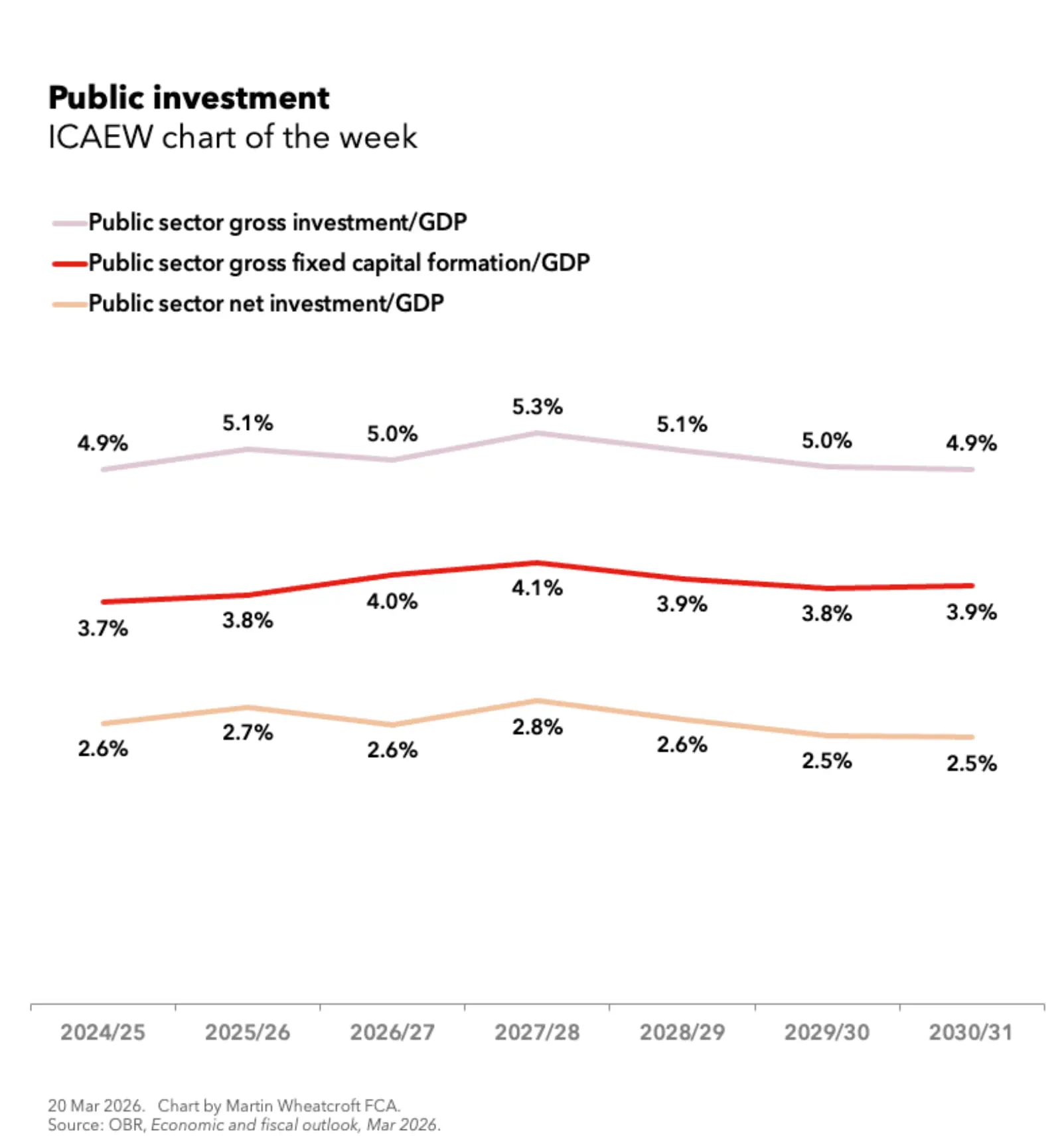
ICAEW chart of the week: Public investment. 

A line chart showing three measures of public sector investment in relation to the size of the economy between 2024/25 and 2030/31.

Public sector gross investment/GDP (in purple): 4.9%, 5.1%, 5.0%, 5.3%, 5.1%. 5.0% and 4.9%. 

Public sector gross fixed capital formation/GDP (in ICAEW red): 3.7%, 3.8%, 4.0%, 4.1%, 3.9%, 3.8% and 3.9%. 

Public sector net investment/GDP (in orange): 2.6%, 2.7%, 2.6%, 2.8%, 2.6%, 2.5% and 2.5%. 

20 Mar 2026. Chart by Martin Wheatcroft FCA. 
Source: OBR, Economic and fiscal outlook, Mar 2026.

According to the Office for Budget Responsibility’s latest fiscal forecasts, public sector gross capital formation – the statistical equivalent of capital expenditure – is expected to increase as a share of the economy from 3.7% and 3.8% of GDP in the years ending 31 March 2025 and 2026 (2024/25 and 2025/26 respectively) to 4.0% and 4.1% in 2026/27 and 2027/28, before falling to 3.9%, 3.8% and 3.9% in 2028/29, 2029/30 and 2029/31.

My chart for ICAEW this week shows this trend, together with the headline percentages of public sector gross investment/GDP and public sector net investment/GDP. The former is expected to bounce around 5% of GDP – going from 4.9% in 2024/25 to 5.1%, 5.0%, 5.3%, 5.1%, 5.0% and then 4.9% in 2030/31. The latter is expected to go from 2.6% in 2024/25 to 2.7%, 2.6%, 2.8%, 2.6%, 2.5% and 2.5% in 2030/31.

Public sector gross investment is higher than gross capital formation because it also includes capital grants, research and development funding, and student loan impairments in addition to capital expenditure on infrastructure and other fixed assets.

Public sector net investment is equal to public sector gross investment less depreciation, to give an idea of much is new investment after taking account of the usage of existing assets.

The increase in public sector gross fixed capital formation – from £116bn in 2025/26 to £125bn in the coming financial year starting on 1 April 2026 (2026/27) and then to £134bn in the following financial year (2027/28) – is a substantial expansion in the level of public sector capital expenditure. 

These increases, of 6% and 5% respectively over the next two years after adjusting for inflation, should be positive for an economy that needs every boost that it can get. If it can help unlock incremental private sector investment too, the economic benefit could be even greater.

The challenge is that while additional investment is welcome, this is not a transformative change, especially as the increase as a share of the economy is not expected to be sustained beyond the first couple of years of the forecast period.

The expectation of many commentators was that the Chancellor was hoping for improvements in the economy to allow her to pencil in further increases in 2028/29 and beyond. Recent events suggest this hope may be less likely than it once was.

This chart was originally published by ICAEW.

PAC slams Ministry for local commercial investment failures

13 July 2020: The Public Accounts Committee has severely criticised central government for complacency as local authorities put £7.6bn into risky commercial property investments.

In a hard-hitting report, the Public Accounts Committee (PAC) has severely criticised the Ministry of Housing, Communities and Local Government (MHCLG) for failing to properly oversee the local government prudential framework in England.

The National Audit Office (NAO) reported earlier this year on the huge rise in local authority investment going into commercial property, with £1.8bn invested in 2016-17, £2.6bn in 2017-18, £2.2bn in 2018-19 and £1bn in the first half of 2019-20. This compares with the £200m spent on commercial properties in 2015-16.

ICAEW submitted evidence to the inquiry.

Key findings and recommendations from the PAC report include:

  • More active oversight of the prudential framework is needed, including publicly challenging local authorities where there are concerns.
  • MHCLG’s failure to ensure local authorities adhere to the spirit of the framework has led to some local authorities taking on extreme levels of debt.
  • Requirements to set aside money each year to service debt (the Minimum Revenue Provision) should be strengthened.
  • Actions taken to address risky and non-compliant behaviour have been too little and too late.
  • A ‘soft’ approach of guidance changes has not worked, and ‘hard’ more timely and effective interventions are needed, with rigorous post-implementation reviews.
  • The local government prudential framework has been impaired and now requires a fundamental review.
  • MHCLG does not have access to the data it needs to carry out its oversight responsibilities.
  • External audit has a role to play, but more important is real-time scrutiny of commercial investment strategies and investment decisions.
  • Local governance arrangements are not robust enough, with investments not being properly transparent or subject to adequate scrutiny and challenge.

The PAC is particularly critical of the Ministry for taking four years between identifying that local authorities were starting to ‘borrow for yield’ to making more substantive changes to Public Loan Work Board lending rules. This was despite NAO and PAC reports highlighting the issue in 2016.

The PAC also highlights significant shortcomings in data, with MHCLG ‘flying blind’ as local authorities borrowed billions of pounds. It also doesn’t feel that lessons have been learned about capturing data on emerging and future commercial investment activities and not just about investments that have already been made.

Commenting on the report Alison Ring, Director for Public Sector at ICAEW, said: “This is a hard-hitting report from the Public Accounts Committee that severely criticises the Ministry for Housing, Communities and Local Government for complacency about the huge expansion in debt-financed commercial property investment by English local authorities over the last four years.

The PAC rightly focuses on the importance of data in carrying out central government’s oversight role, enabling better understanding and analysis of risks in local authority balance sheets. Stronger governance at a local level is also needed, with improved transparency and scrutiny needed both before, and after, investments are made.

However, it is important that any changes to the prudential framework do not prevent local authorities in making essential investments in local infrastructure and in encouraging local economic activity as the country emerges from lockdown.

Supporting the economic recovery may involve councils taking on more – rather than less – balance sheet risk, making the PAC’s recommendations about strengthening both local governance and central oversight even more critical.”

This article was originally published by ICAEW.