My chart for ICAEW this week celebrates the start of a new financial year by looking at the average level of council tax across England.
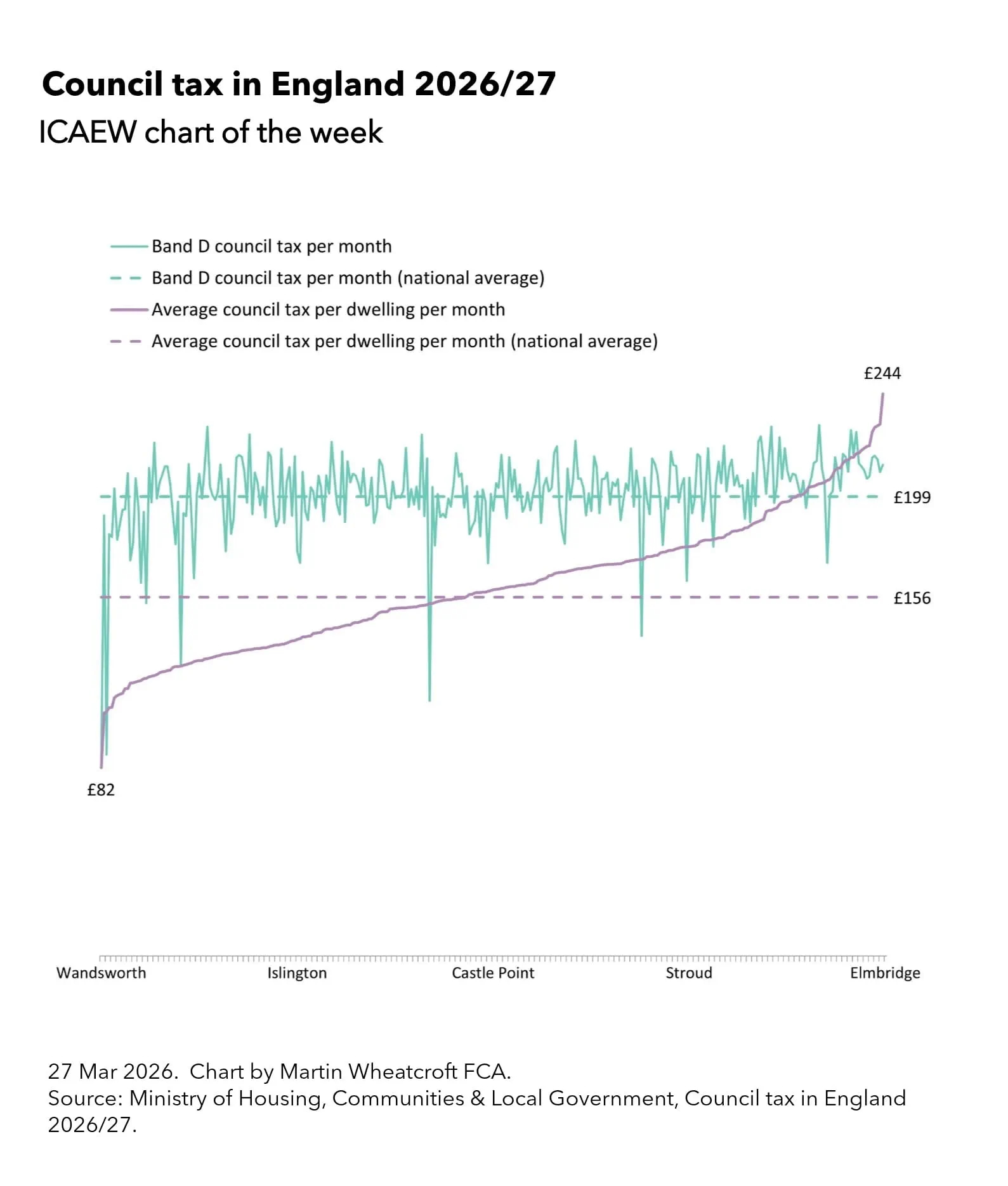
My chart for ICAEW this week illustrates the average council tax payable per dwelling by local billing authority in 2026/27, ranging from £82 per month in Wandsworth, £137 per month in Islington, £159 per month in Castle Point in Essex, £178 per month in Stroud, Gloucestershire, and £244 per month (£2,927 for the year) in Elmbridge in Surrey.
These compare with an average council tax per dwelling across England in 2026/27 of £156 per month, a 5.5% increase over 2025/26. This is based on a total amount of council tax of £46.8bn to be raised by 296 local billing authorities divided by approximately 25.1m residential dwellings in England.
Our chart also illustrates how the relationship between the average council tax per dwelling in each local authority area and the amount payable on a Band D property can vary significantly based on the proportions of residential properties in each band (based on 1991 property values). In some areas there are more Band E, F, G and H properties, which pay 22%, 44%, 67% and twice the amount payable on a Band D property respectively, while in others there are more Band A, B and C properties that pay 33%, 22% and 11% less respectively.
Overall, the national average per dwelling amount is 22% less than the headline rate of council tax on a Band D property of £199 per month, reflecting the approximately two-thirds of properties that are in Bands A to C nationally.
In the five highlighted local authorities, the average council tax per dwelling is 5% less, 22% less, 18% less, 14% less and £15% more respectively than their Band D rates of £86 per month in Wandsworth, £176 in Islington, £193 in Castle Point, £208 in Stroud, and £213 per month in Elmbridge.
The 296 billing authorities comprise 32 London boroughs and the City of London, 36 metropolitan boroughs, 62 unitary authorities and the Isle of Scilly, and 164 district councils. They raise council tax on behalf of themselves and (as appropriate) the Greater London Authority, 37 territorial police forces outside London, 29 fire and rescue authorities outside London, 12 regional combined authorities, and 21 county councils. They also raise precepts for just under 9,000 town and parish councils, mostly in rural areas.
Council tax in Wales
Not included in the chart are council tax bills for 2026/27 in Wales, where the average council tax per dwelling is £173 per month for its 22 principal councils, which raise £3.0bn in council tax from 1.4m dwellings for themselves, the four Welsh territorial police forces and around 730 community councils.
The average council tax per dwelling ranges from £137 per month in Caerphilly to £175 per month in Wrexham and £226 per month in Monmouthshire, respectively 21% less, 9% less and 12% more than the Band D rates in those councils of £174, £192 and £201 per month respectively. The national average of £173 per month is 9% less than the average Band D rate across Wales of £190 per month.
The variations reflect the differing proportions of residential properties in each band in each principal council area (based on 2003 property values), as well as the Welsh additional Band I that pays 17% more than a Band H property.
Changes ahead for councils
Back in England, the big development is the planned abolition over the next three years of the remaining county and district councils. The replacement of these two tiers with unitary authorities should establish a single principal tier of local government across the whole of England, while the gradual extension of regional combined authorities to cover more of the country should enable further devolution of responsibilities from Whitehall to the regions.
Although the rise in council bills will be unwelcome to many, the reality is that many if not most local authorities in both England and Wales are struggling financially, with the growing cost of local welfare provision (especially adult social care, child social care and homelessness) combined with limits on funding from central government continuing to squeeze budgets for local public services.
Whether the Chancellor’s proposed devolution of a share of income tax receipts to the English regions will make a significant difference to the financial health of local government remains to be seen.
For further information on council tax by local authority in England and Wales in 2026/27 visit the MHCLG council tax webpage and the Welsh government council tax webpage respectively.