ICAEW chart of the week: A square root-based recovery?

17 July 2020: Debate rages about which symbol to attribute to the shape of the economic recovery.

Chart on OBR Real GDP growth forecast. Shows huge economic hit in the first half of 2020 with potential recovery paths to Q1 2025. Upside scenario returns to previous trend by 2021, central scenario recovers but not fully, and downside is even worse.

The #icaewchartoftheweek is on the economy this week, with the Office for Budget Responsibility indicating that hopes of a sharp V-shaped recovery have receded. Instead, their central scenario is for a square root-based recovery – with economic activity recovering less quickly than originally hoped and not to the same level predicted before the pandemic took hold in the UK.

According to the OBR, quarterly GDP fell from £558bn in the fourth quarter of 2019 to £432bn before inflation in the second quarter of this year, a drop of almost 23% in the level of economic activity. Under the OBR’s central scenario GDP in real-terms is not expected to get back to where it was until the fourth quarter of 2022. At a predicted £584bn (excluding inflation) in the first quarter of 2025, GDP would be 3% lower than where it was predicted to be prior to the pandemic.

The OBR hasn’t completely ruled out a V-shaped recovery as a possibility and their upside scenario would see the economy returning to the previous trend by the second quarter of 2021. However, with job losses starting to accelerate, such a speedy return to trend seems increasingly unlikely.

The good news is that the OBR’s downside scenario, for which no symbol has yet been assigned, is not as shallow as the dreaded U-shaped recovery that some economists are worried about. In the downside scenario, economic activity recovers by the middle of 2024, unlike a U-shaped recovery that might extend into the second half of the 2020s.

In practice, the fortunes of different sectors of the economy are likely to vary, with some suggesting the recovery is more likely to be K-shaped, with some sectors stalling just as others emerge to grow back strongly following the end of the lockdown. The Government will be hoping that the fiscal interventions it has announced to support the hospitality, leisure and housing sectors in particular will help prevent the ‘full K’.
This chart of was originally published by ICAEW.

ICAEW chart of the week: Post-GE2019 fiscal deficits

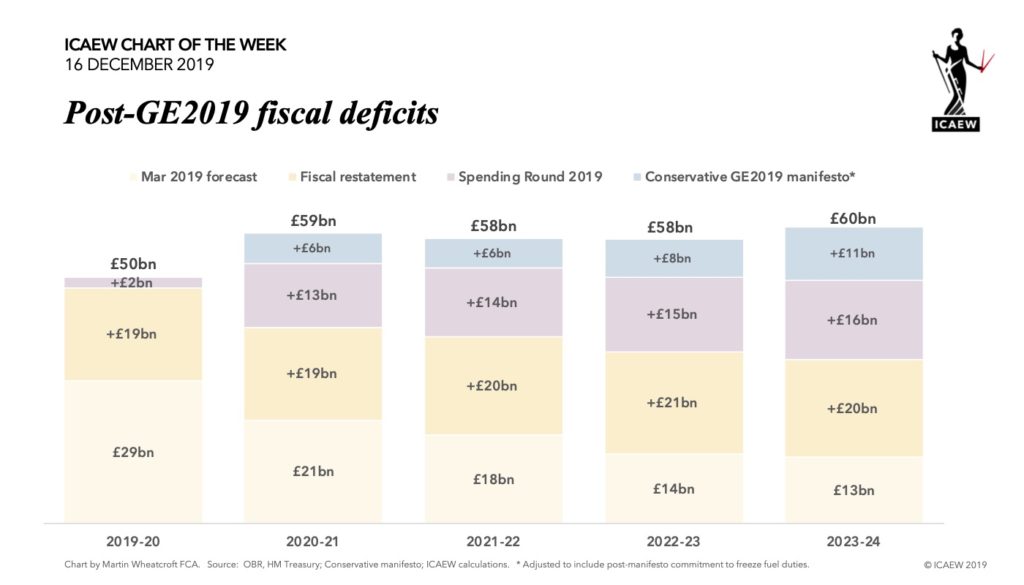
With the General Election now complete, the Office for Budget Responsibility (OBR) was able to release a restated version of its March 2019 fiscal forecasts this morning, reflecting technical revisions to the way the fiscal numbers are calculated, in particular that of student loans. This enables us to update the numbers set out our GE2019 Fiscal Insight on the party manifestos as best we can, given that the OBR has not deigned to include either the changes to public spending announced in the Spending Round 2019 nor the tax and spending changes in the Conservatives manifesto.

As illustrated by the #icaewchartoftheweek, the revised baseline forecast for the fiscal deficit is now £50bn for the current fiscal year, followed by £59bn next year in 2020-21, £58bn in 2021-22 and 2022-23 and £60bn in 2023-24.

It was frustrating that the OBR scheduled their publication of these revised numbers for the first day of the General Election purdah period making it vulnerable – as happened – to being pulled. A day earlier and that would not have happened! Ideally, these revisions would have been published as soon as practical after the publication by the ONS of their revisions to historical numbers in September.

It would have been even better if the OBR had been able to update their economic forecast too, given that the current baseline is still based on an economic and fiscal analysis from nine-months ago. With weak economic growth over the first half of the financial year, it is likely that the OBR will cut its forecasts for tax revenues over the forecast period when it does get round to updating them, resulting in higher deficits – even before taking account of suggestions that the Conservative GE2019 winners plan to announce a splurge of more capital expenditures in the Spring Budget in February.

Unfortunately, we won’t see an updated long-term forecast until at least July 2020, when the OBR is scheduled to publish its next fiscal sustainability report on the prospects for the public finances.