ICAEW chart of the week: ECB balance sheet

Our chart this week takes a look at the balance sheet of the European Central Bank, the central bank for the Eurozone.
ICAEW chart of the week: European Central Bank

Balance sheet at 31 December 2024

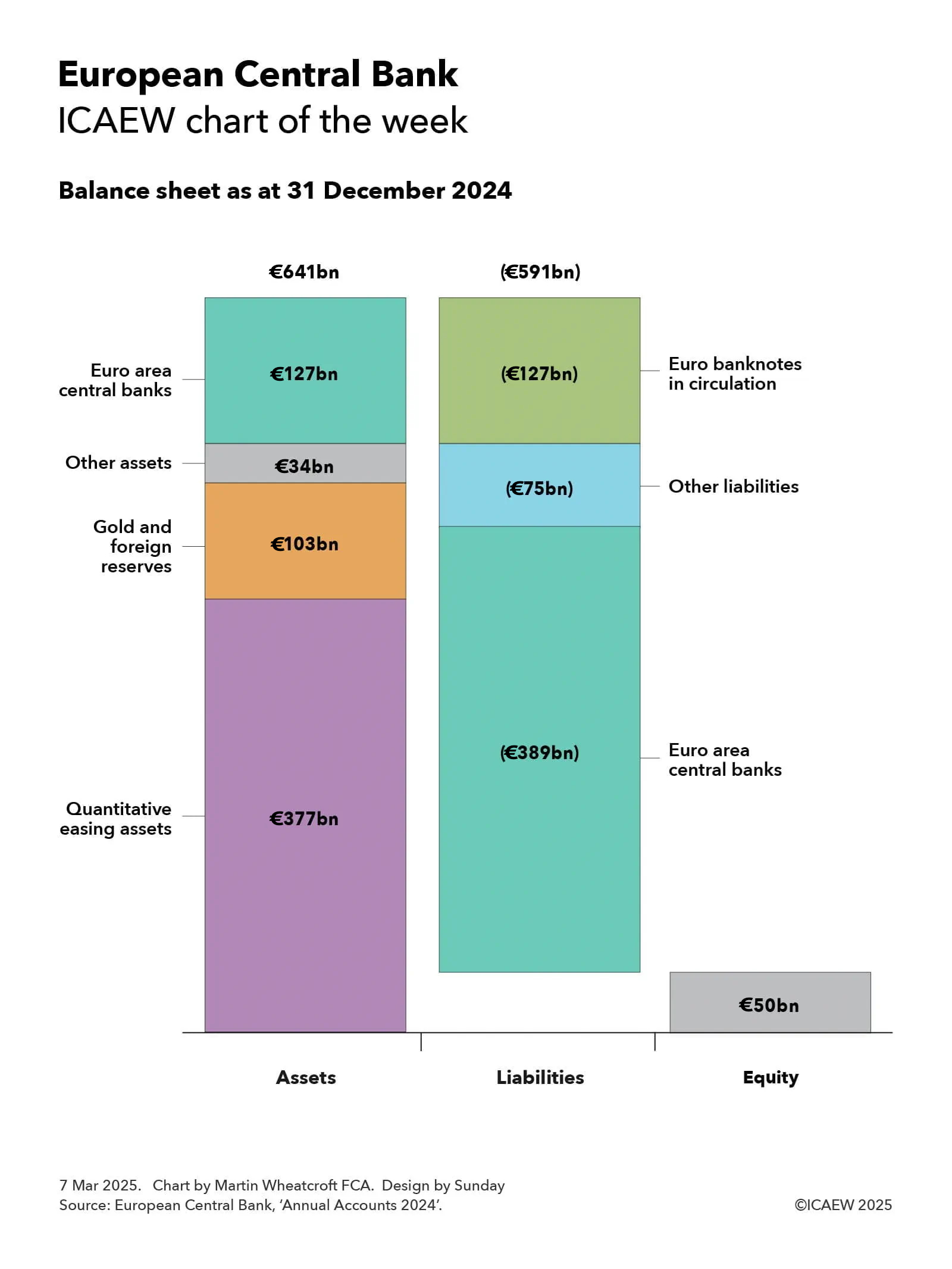
Assets €641bn: €127bn Euro area central banks + other assets €34bn + €103bn gold and foreign reserves + €377bn quantitative easing assets. 

Liabilities: (€591bn) = (€127bn) Euro banknotes in circulation + (€75bn) other liabilities + (€389bn) Euro area central banks. 

Equity: €50bn. 

7 Mar 2025. Chart by Martin Wheatcroft FCA.
Source: European Central Bank, 'Annual Accounts 2024'.

The latest annual report for the European Central Bank (ECB) presents a balance sheet with €641bn in assets, €591bn in liabilities and €50bn in equity. 

As our chart illustrates, the ECB’s assets on 31 December 2024 comprised €377bn in quantitative easing assets, €103bn in gold and foreign reserves, €34bn in other assets, and €127bn in amounts owed by central banks in exchange for euro banknotes in circulation.

Liabilities comprised €127bn in euro banknotes in circulation, €75bn in other liabilities, and €389bn in net amounts owed to central banks.

Quantitative easing (QE) assets of €377bn comprise €349bn in government securities and €28bn in private sector securities purchased as part of the ECB’s QE programme to support the European economy during and following the financial crisis (of which €221bn remains on the ECB balance sheet) and during the pandemic (€156bn). These are recorded at amortised cost and so do not reflect mark-to-market losses of €35bn at the balance sheet date. This is just a small part of the overall QE programme involving euro area national central banks that amounted to €4.3tn at the end of 2024.

Gold and foreign reserve assets of €103bn comprised 506.5 tonnes of gold valued at €41bn, €56bn in foreign currency deposits and securities, a €2bn receivable from the IMF, and €4bn in foreign currency deposits with commercial banks in the euro area.

Other assets of £34bn comprised €23bn in ‘own fund’ investments, €9bn in accrued interest, €1bn in net derivative and collateral balances, and €1bn in tangible fixed assets.

The ECB’s €127bn in banknotes in circulation represents the ECB’s 8% share of the €1,588bn total that was in circulation on 31 December 2024, with the balance recorded in national central bank balance sheets. According to the ECB, the overall total comprised 238m €500 notes in circulation worth €119bn, 850m €200 notes worth €170bn, 4.1bn €100 notes worth €408bn, 15bn x €50 euro notes worth €750bn, 4.9bn €20 notes worth €99bn, 3.2bn €10 notes worth €32bn, and 2.3bn €5 notes worth €11bn (numbers don’t add due to rounding).

Other liabilities of €75bn comprised €34bn in European Commission deposits, €25bn in commercial bank and other non-central bank deposits, €3bn owed to non-euro area national central banks, €5bn relating to monetary operations, and €8bn in accruals, deferred income, pension obligations and sundry liabilities.

Amounts owed to euro area central banks of €389bn consisted of €41bn owed for foreign reserve assets transferred to the ECB from when countries joined the euro, and €348bn in net deposits held by national central banks (€1,593bn in deposits offset by €1,245bn in negative balances).

Equity of €50bn comprised paid-in capital of €9bn, mainly from eurozone central banks, but with a small amount from non-euro area central banks too, €37bn in revaluation gains on the ECB’s gold holdings, and €13bn in translation gains on foreign currency assets (principally the US dollar), less accumulated losses of €9bn.

The balance sheet has shrunk since the previous year, with assets lower by €32bn and liabilities down €37bn, a net gain of €5bn to equity during 2024 that consisted of revaluation gains of €13bn less a loss of €8bn. The shrinkage primarily relates to the winding down of quantitative easing holdings, principally through a ‘passive’ strategy of not reinvesting the principal as each security matures.

The ECB lost money in 2023 and 2024 as a consequence of rising interest rates on deposit liabilities, following many years of profitability during which member central banks received dividends. These losses are expected to fall as interest rates reduce and the unwinding of QE reduces the level of deposits on which interest is payable. It is likely to be a while before dividends resume as the ECB is expected to prioritise rebuilding its risk provisions first.
This chart was originally published by ICAEW.

ICAEW chart of the week: UK public debt profile

Our chart this week shines a spotlight on the UK’s public debt, focusing on the Government’s debt strategy ahead of the fast approaching Spending Review.

A big worry for the Chancellor of the Exchequer in putting together the Budget and Spending Review this month is the possibility that higher inflation and interest rate rises will hit the public finances, restricting the amounts he has available to meet his policy objectives. Our chart this week illustrates just how exposed the UK’s public debt is to changes in inflation and interest rates.

UK public debt profile - column chart

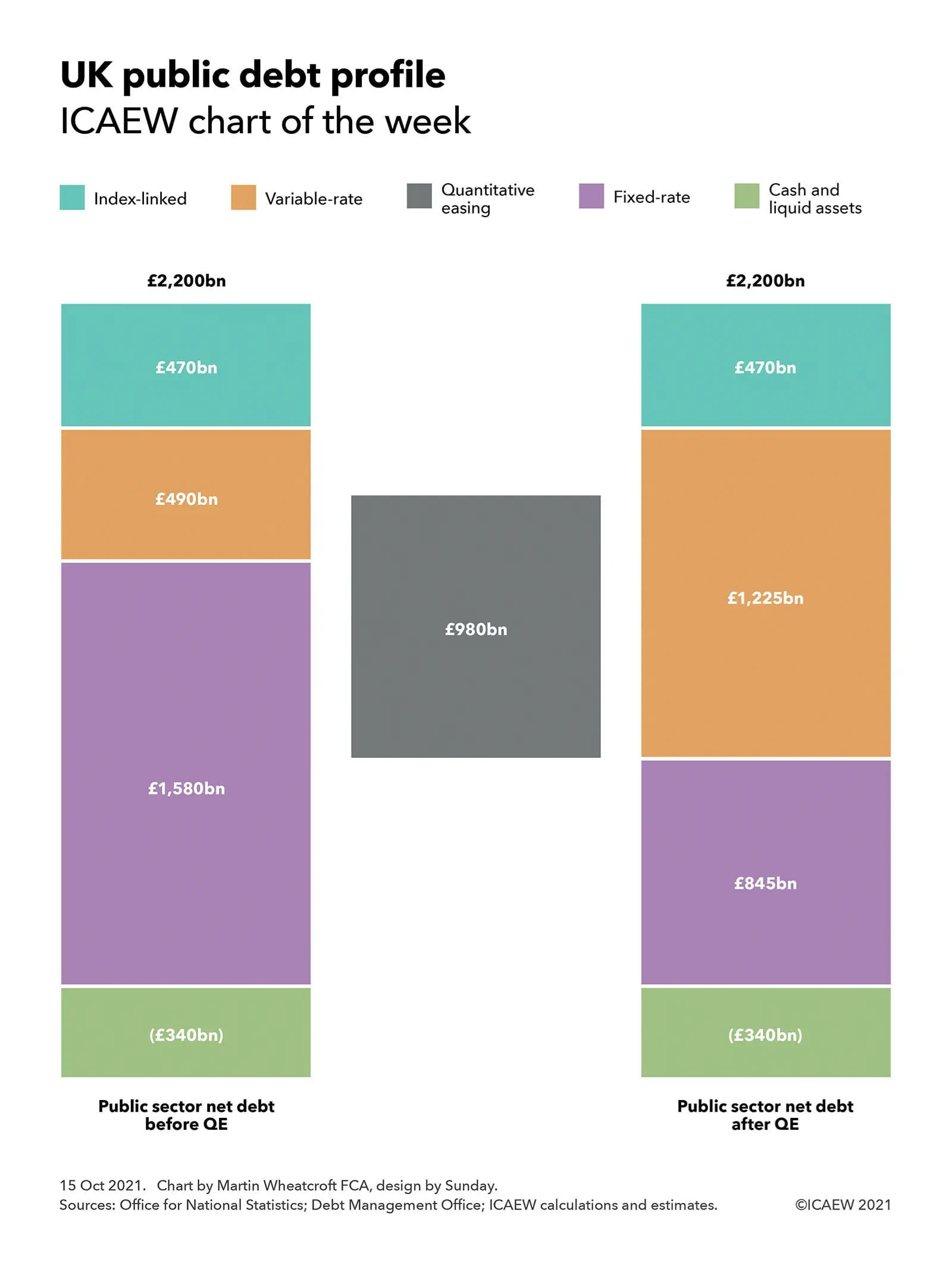
UK public sector net debt before QE: Index-linked £470bn + Variable-rate £490bn + Fixed-rate £1,580bn - Cash and liquid assets £340bn = £2,200bn

Quantitative easing: £980bn (£735bn overlaps with fixed-rate and £245bn overlaps with variable-rate.

UK public sector net debt after QE: Index-linked £470bn + Variable-rate £1,225bn + Fixed-rate £845bn - Cash and liquid assets £340bn = £2,200bn

Sources: Office for National Statistics, Debt Management Office, ICAEW calculations and estimates.

UK public sector net debt was marginally over £2.2tn at the end of August 2021, comprising in the order of £2,540bn in gross debt less £340bn in cash and liquid assets. As ICAEW’s chart of the week illustrates using approximate numbers, this can be broadly divided into fixed-rate, variable-rate and index-linked debt, reflecting the Government’s debt strategy as executed by the UK Debt Management Office and by National Savings & Investments.

What the chart highlights is how quantitative easing (QE) has changed the profile of UK public debt significantly. This tool has been used by the operationally independent Bank of England to ease monetary policy by pumping money into the economy in response to the financial crisis a decade ago and the coronavirus pandemic more recently, but has the effect of switching fixed-rate government securities into variable-rate central bank deposits, contributing to falling interest costs even as public sector net debt has risen from less than £0.5tn in 2007 before the financial crisis to £1.8tn in March 2020 before the pandemic and £2.2tn currently.

Fixed-rate debt of £1,580bn comprises approximately £1,490bn in government bonds or gilts repayable over periods generally ranging from five to 30 years, together with £75bn in other central and local government loans net of intra-government holdings (which we have assumed are mostly fixed-rate in nature) and up to £15bn in fixed-rate savings certificates sold to individual investors by National Savings & Investment.

Variable-rate debt of £490bn comprises around £185bn of variable-rate National Savings & Investments deposits and certificates, £60bn in short-term Treasury bills, and £245bn in Bank of England liabilities relating to QE (see below). The balance of £470bn is in the form of index-linked gilts, where the amounts owed increase in line with the retail prices index (RPI).

This is before deducting £340bn in cash and liquid assets, comprising around £150bn of official reserves (much of which is currency deposits with foreign central banks) and £115bn, £40bn and £35bn in bank, building society and other liquid financial asset holdings held by central government, local government and other parts of the public sector respectively.

In practice, the sterling work of the UK Debt Management Office (DMO) to create a balanced portfolio of public debt has been upended by the Bank of England’s Monetary Policy Committee, albeit with the agreement of successive Chancellors. The spread of inflation-, variable- and fixed-rate exposure combined with extended maturities to manage refinancing requirements over longer periods has been offset by £980bn of QE purchases and lending that has replaced £735bn (or around half) of the fixed-rate gilts in issue at nominal value with central bank deposits that pay interest at the Bank of England base rate – reducing the net fixed rate exposure to £845bn. This is in addition to the QE-related liabilities of £245bn already included in variable-rate debt, of which £110bn was used to finance Term Funding Scheme low-cost business loans, £20bn to fund corporate bond purchases, and £115bn to finance premiums on gilt purchases (in effect prepaying some of the interest that would have gone to external investors over time if the gilts had not been purchased by the Bank of England).

The consequence is a public debt portfolio that is currently being financed much more cheaply than anyone ever expected, but which is much more sensitive to changes in inflation and interest rates than was ever planned.

With inflation now expected to rise to in the order of 5% (or even higher) over the next few months, and suggestions that the Bank of England may start to increase the base rate in early 2022, the gains the public finances have experienced from ultra-low borrowing costs look as if they will start to go into reverse. This is likely to put additional pressure onto the public finances at a time of elevated economic uncertainty, making for even tougher choices for the Chancellor on both tax and spending in the Spending Review and Autumn Budget in a couple of weeks’ time.

This chart was originally published by ICAEW.