ICAEW chart of the week: UK trade in goods

With less than a month to go before the UK leaves the EU Single Market and Customs Union, trade is high on the agenda as negotiations between the UK and the EU go down to the wire.
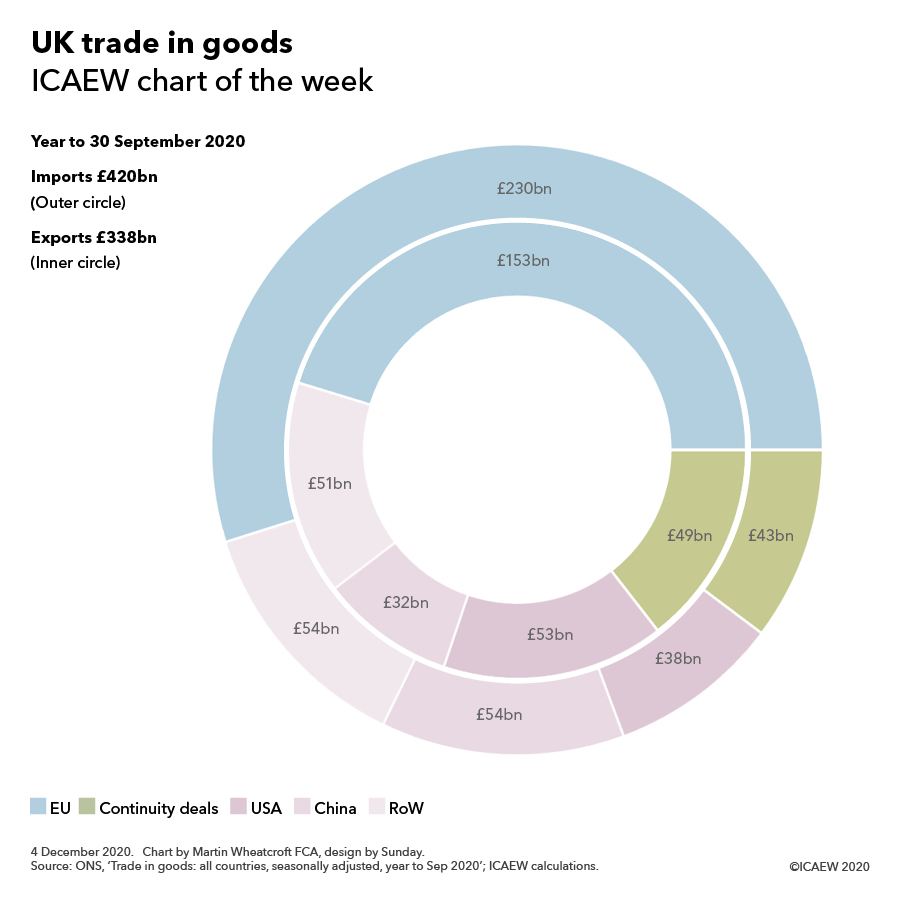
UK trade in goods in the year to September 2020: exports £338bn & imports £420bn

EU: £153bn & £230bn
Continuity deals: £49bn & £43bn
USA: £53bn & £38bn
China: £32bn & £54bn
Other: £51bn & £54bn

The #icaewchartoftheweek this week is on international trade, illustrating how exports and imports of goods amounted to £338bn and £420bn respectively in the year to 30 September 2020. This excludes £289bn and £181bn of services exports and imports over the same period that are also extremely important, but which are not the principal subjects of the free trade deal currently being negotiated.

The UK’s largest trading partnership for goods is with the members of the EU Customs Union (together with Turkey for non-agricultural products), with the UK exporting £153bn (45% of total goods exports) and importing £230bn (55% of total goods imports). 

This is followed by a further £49bn (15%) of exports to and £43bn (10%) of imports from 52 countries that have trade deals with the EU that the UK has been able to agree replacement trade arrangements with. These include Norway, Switzerland, Japan, South Korea, Canada and South Africa, with discussions underway to roll-over trade deals with a further 13 countries not included in these numbers, in particular with Singapore and Vietnam.

The UK’s two largest individual trading partners are the USA and China, where the UK will continue to trade on World Trade Organisation (WTO) terms. The UK exported £53bn (16%) of goods to the USA and imported £38bn (9%) in the year to September, while it exported £32bn (9%) to China and imported £54bn (13%).

The balance of goods trade, comprising exports of £51bn (15%) and imports of £54bn (13%), is with over 130 other countries and territories where the UK does not have a trade deal in place for after 1 January 2021, including India, Russia, Vietnam, Taiwan, the UAE, Saudi Arabia, Qatar, Thailand, Singapore, Australia, Malaysia and Nigeria.

Both exports and imports of goods have reduced in the year to September 2020 compared with a year previously, with exports down 7% and imports down 18%. The principal driver of the fall is the coronavirus pandemic, although reconfiguration of cross-border supply chains ahead of the end of the transition period may also be a factor.

Although global trade is expected to pick up in 2021 once covid-19 vaccines are widely available, there is significant uncertainty as to the effect on trade of the UK’s departure from the Single Market and Customs Union – with or without a deal. Either way, increased trade frictions are likely to have at least some impact, while the imposition of tariffs in the event of no deal could cause significant additional problems for key sectors such as car manufacturing and agriculture.

The size and closeness of the EU economy means that it will continue to be the most important trading partner for the UK whatever is agreed. If only we knew on what terms we are going to be trading in less than a month’s time and what the major changes that are coming in January will mean for the future!

This chart was originally published on the ICAEW website.

ICAEW chart of the month: UK international trade

Imports £718bn: EU £369bn, EFTA £34bn, USA £87bn, Other Americas £26bn, Asia-Pacific £138bn, Other £64bn. Exports £673bn: EU £297bn, EFTA £29bn, USA £133bn, Other Americas £29bn, Asia-Pacific £108bn, Other £77bn.

With recent changes in ICAEW communications, the ICAEW Public Sector team has started an #icaewchartofthemonth to complement the #icaewchartoftheweek.

The first #icaewchartofthemonth was published on the ICAEW’s Insights Hub (icaew.com/insights) on Friday 31 January 2020 and is on the UK’s international trade. It highlights how important the £718bn in imports and £673bn in exports in the year to 30 September 2019 are to the economy of the UK.

As the UK Government starts to negotiate new trade arrangements with countries around the world, the EU will be the highest priority. Imports into the UK of £369bn represent 51% of total imports and exports to the 27 EU countries of £297bn are 44% of total exports. This is followed by the USA, where imports of £87bn and exports of £133bn represent 12% and 20% respectively.

Trade relationships with countries in the Asia-Pacific region will also be very important, in particular China (imports £60bn and exports £39bn), Japan (£17bn and £15bn) and the 10-country Association of South East Asian Nations (£22bn and £19bn).

https://www.icaew.com/insights/features/2020/jan-2020/uk-international-trade

ICAEW chart of the week: Balance of payments

Chart: Balance of payments 2018. Current account -£93bn (trade -£38bn, primary income -£29bn, secondary income -£26bn), capital account -£3bn, financial account +£96bn (investment +£77bn, errors and omissions +£19bn).

Although most of the focus on the balance of payments is on trade, i.e. imports and exports of goods and services, it is not the only element in the balance of payments equation, as the #icaewchartoftheweek illustrates.

Based on the 2019 Pink Book published by the Office for National Statistics last week, the balance of payments between the UK and the rest of the world in 2018 comprised a current account deficit of £93bn and a capital account deficit of £3bn, balanced by net inward investment of £77bn and errors and omissions of £19bn.

The current account deficit remains high by historical standards and was equivalent to 4.3% of GDP in 2018, up from 3.5% of GDP in 2017.

The current account deficit incorporates a trade deficit of £38bn, with imports of £680bn exceeding exports of £642bn. This reflects a surplus in services of £104bn that was more than outweighed by a deficit in goods of £142bn.

The primary income deficit of £29bn reflected £242bn in outflows – mainly investment income paid to foreign investors – less £213bn coming into the UK, while the secondary income deficit of £26bn reflects contributions to international institutions (including the EU), international development assistance, remittances and other net transfers.

Capital flows of £3bn reflect both sales of non-financial assets, and capital grants to other countries.

Inward investment of £178bn comprised direct investment in UK businesses of £28bn and £151bn of equity and debt investments, less a net £1bn movement in other forms of investment. Outward investments amounted to £101bn, with direct investments in foreign businesses of £29bn and £204bn in other movements (including currency changes), less net sales of £132bn of equity and debt investments.

Unfortunately, getting the balance of payments to actually balance is quite difficult and so the ONS has plugged the difference between the current, capital and financial accounts with £19bn in ‘errors and omissions’. The ONS will continue to revise the statistics over time, with the aim of improving the accuracy of the components reported.

Although the precise numbers will continue to be refined, the overall picture presented by the ONS is unlikely to change. The UK continues to buy more than it sells, pays out more to foreign investors than is earned from foreign investments, and transfers money to the rest of the world; with finance provided by foreign investors.

For more information about the Balance of Payments, visit UK Balance of Payments, The Pink Book: 2019.

Table: Balance of payments 2018