ICAEW chart of the week: Tax burden rising

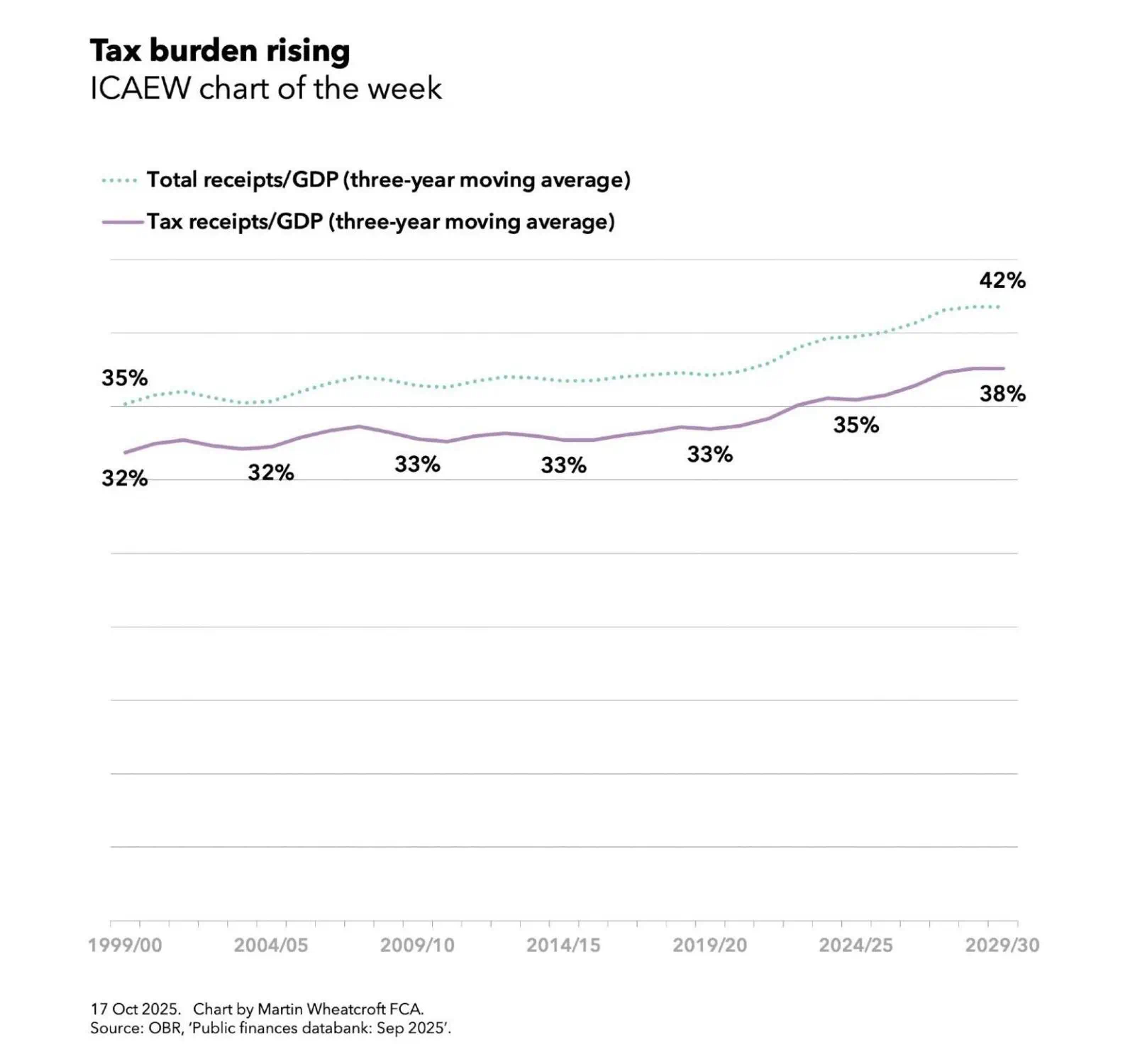
My chart for ICAEW this week shows how tax receipts as a proportion of national income have risen significantly since the turn of the century, begging the question as to whether taxes are too high or the UK economy is too small?
ICAEW chart of the week: Table burden rising. 

A line chart with a solid purple line for tax receipts/GDP (three-year moving average) and a dotted teal line for total receipts/GDP (three-year moving average). 

Tax receipts/GDP (solid purple line) zigs and zags between 32% in 1999/00 to 32% in 2004/05 to 33% in 2009/10 to 33% in 2014/15 to 33% in 2019/20 to 35% in 2024/25 to 38% in 2029/30. 

Total receipts/GDP (dashed teal line) broadly tracks the purple from 35% in 1999/00 to 42% in 2029/30. 

17 Oct 2025. Chart by Martin Wheatcroft FCA. 
Source: OBR, 'Public finances databank: Sep 2025'.

My chart of the week for ICAEW illustrates how tax receipts as a percentage of GDP averaged 32% over the three years to 1999/00, 32% to 2004/05, 33% to 2009/10, 33% to 2014/15, 33% to 2019/20, 35% to 2024/25 and are projected to hit 38% over the three years to 2029/30, based on data from the Office for Budget Responsibilities’ public finances databank for September 2025.

The chart also shows how total receipts including non-tax income averaged 35% in the three years to 1999/00 and a projected 42% to 2029/30.

The one caveat to these percentages is that they do not reflect recent revisions by the Office for National Statistics that increase GDP by the order of 1% across multiple years, which will cause the reported percentages to be a little smaller when they are recalculated by the OBR for the Autumn Budget 2025.

Either way, a projected rise of approaching 20% in the proportion of the economy taken in taxes since the end of last century is pretty significant, even if the projected tax burden will be lower than those of many countries in Europe. 

The chart doesn’t show public spending as a proportion of national income. This averaged 35% of GDP over the three years to 1999/00 and 45% of GDP over the three years to 2024/25, with more people growing older driving up the cost of pensions, health and social care significantly and a much higher bill for debt interest being two of the main factors driving up costs.

Public spending as a share of national income is projected to fall slightly to an average of 44% over the three years to 2029/30 as the government tries to reduce the shortfall between total receipts and spending (aka the deficit) through a combination of higher taxes (as announced in the Autumn Budget 2024) and some constraint in public spending over the next five years.

Unfortunately, a lack of fiscal headroom, a disappointing economic outlook, and cost pressures are now expected to lead the Chancellor to increase taxes even further in the Autumn Budget 2025. This suggests that taxes may be too low, at least if the government is to deliver the level of public services and welfare provision it is committed to.

If taxes are not too high, then the problem must be that the economy is too small. This is evidenced by low productivity growth since the financial crisis and successive economic shocks that have together resulted in a UK economy that has not grown at anywhere near the speed it might have.

If tax cuts are unlikely, at least in the medium-term, the principal route to reduce the tax burden must be to drive up economic growth, as called for in ICAEW’s business growth campaign. This calls for the government to focus on business growth by addressing the many factors that make it too uncertain, too difficult and too expensive to do business in the UK.
This chart was originally published by ICAEW.

ICAEW chart of the week: Autumn Budget 2024

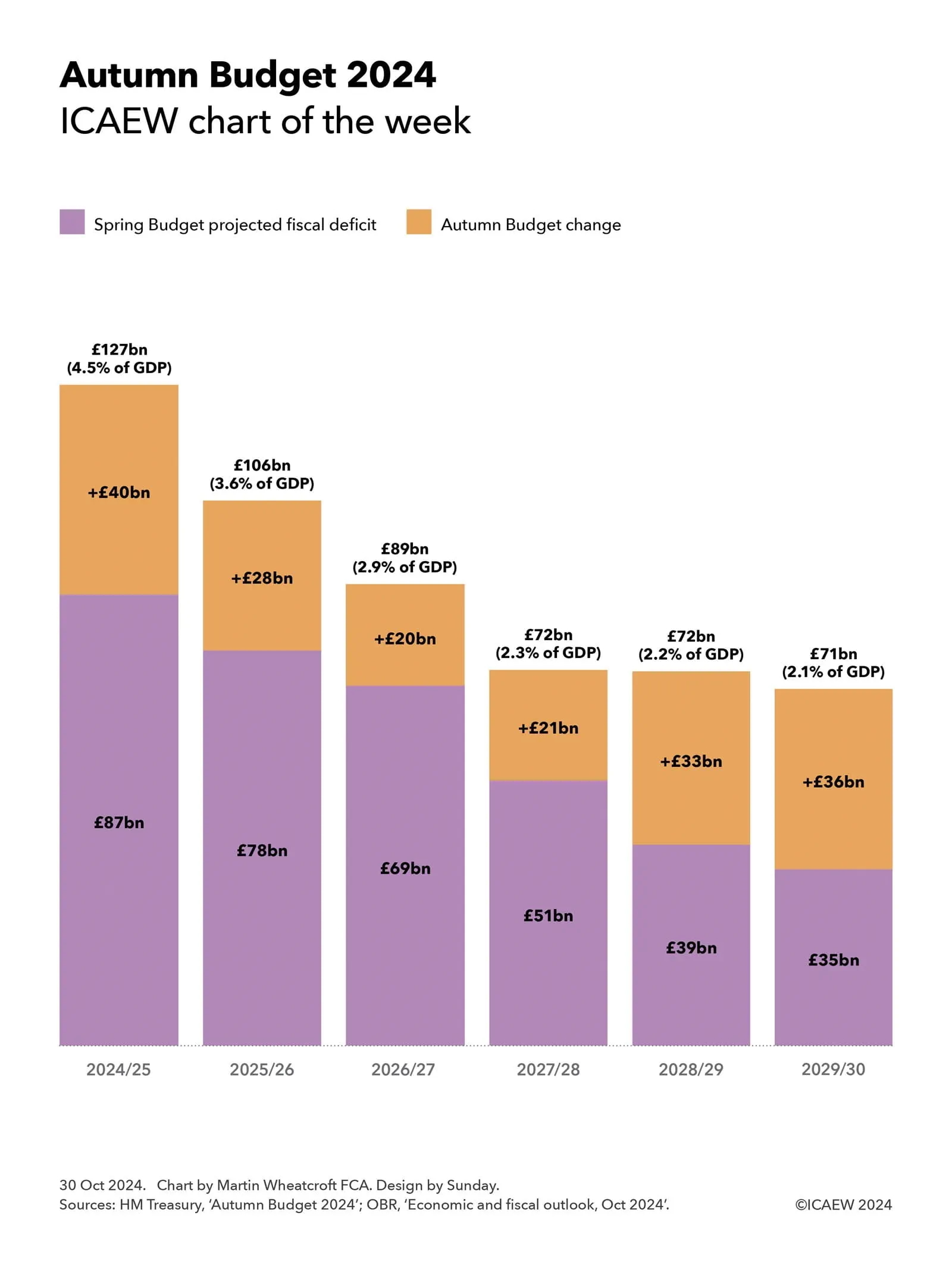
My chart for ICAEW this week looks at how the fiscal baseline inherited by the Chancellor has changed as a consequence of the Autumn Budget, with higher capital investment driving up borrowing needed to fund the deficit over the next five years.

Column chart showing Spring Budget fiscal deficit and the Autumn Budget change over the forecast period. 

2024/25: Spring Budget forecast £87bn + Autumn Budget change £40bn = £127bn (4.5% of GDP). 

2025/26: £78bn + £28bn = £106bn (3.6% of GDP). 

2026/27: £69bn + £20bn = £89bn (2.9% of GDP). 

2027/28: £51bn + £21bn = £72bn (2.3% of GDP). 

2028/29: £39bn + £33bn = £72bn (2.2% of GDP). 

2029/30: £35bn + £36bn = £71bn (2.1% of GDP).

Our chart of the week sets out the changes in fiscal projections calculated by the Office for Budget Responsibility (OBR) in its October 2024 economic and fiscal outlook compared with the numbers at the time of the Spring Budget seven months ago. 

These form a revised baseline for the public finances that will form the basis of the Chancellor’s spending and investment plans over the rest of the Parliament.

As our chart highlights, the fiscal deficit – the shortfall between tax and other receipts and public spending calculated in accordance with statistical standards – was forecast to amount to £87bn in 2024/25, but this has increased by £40bn to £127bn, or 4.5% of GDP. 

The projections for the following five years were also revised upwards between 2025/26 and 2029/30 have increased from £78bn, £69bn, £51bn, £39bn and £35bn by £28bn, £20bn, £21bn, £33bn and £36bn to result in a revised profile of £106bn (3.6% of GDP), £89bn (2.9% of GDP), £72bn (2.3% of GDP), £72bn (2.2% of GDP) and £71bn (2.1%). 

This contrasts with the previous government’s plan to bring down the deficit in relation to the size of the economy to 1.2% of GDP by 2028/29.

Perhaps the biggest surprise was the £40bn upward revision to the budgeted deficit of £87bn for the current financial year ending in March 2025. This reflects a combination of £14bn in higher debt interest and £6bn in other forecast revisions, £23bn in higher spending (most of which is the £22bn ‘black hole’ identified by the incoming government over the summer) and £2bn in additional capital investment, less £1bn in tax measures and £4bn from the indirect economic effect of policy decisions. 

In later years, the principal driver of the increases in the deficit is higher capital investment as the Chancellor replaced the previous government’s plan to cut public sector net investment by almost a third over the next five years (from 2.5% to 1.7% of GDP) to a profile that sees net investment increase to 2.7% of GDP in 2025/26 and 2026/27 before returning to 2.5% of GDP in 2029/30.

The changes in the deficit between 2025/26 and 2029/30 can be summarised as follows:

2025/26: £28bn increase = £18bn higher capital investment + £10bn net other changes (£42bn additional spending – £25bn tax rises – £6bn indirect effects of decisions – £1bn forecast changes).

2026/27: £20bn = £23bn capital – £3bn net other changes (£44bn – £35bn – £5bn – £7bn).

2027/28: £21bn = £26bn capital – £5bn net other changes (£47bn – £40bn – £2bn – £10bn)

2028/29: £33bn = £27bn capital + £6bn net other changes (£49bn – £40bn + £2bn – £5bn)

2029/30: £36bn = £25bn capital + £11bn net other changes (£47bn – £42bn + £6bn – not published).

The increases in taxation, spending and capital investment won’t avoid the need for difficult choices in the Spending Review next year as departmental budgets will remain tight.