ICAEW chart of the week: Welsh Government Budget

Chart: Welsh Government Budget 2019-20. Funding £20.6bn, Spending £20.6bn

This week’s #icaewchartoftheweek is on the subject of the Welsh Government’s Budget for the current financial year.

Officially a £19.4bn Budget to cover £16.3bn in Resource spending and £3.1bn in Capital investment, there is a further £1.2bn of spending funded by EU grants and other income to make a total of £20.6bn overall for 2019-20.

The largest element of funding comes from Whitehall in the form of a £13.7bn block grant, together with £1.3bn from the National Insurance Fund and £1.1bn in business rates. The block grant is lower than it used to be as the Welsh Government is now entitled to a £2.1bn share of income taxes and £0.3bn in other devolved taxes, which is supplemented by £0.2bn in borrowing and £0.7bn in other resources, before taking account of £0.7bn or so in grants from the EU and £0.5bn in other income.

The Welsh NHS takes the majority of the £8.6bn health and social care budget, with the balance supplementing local council budgets for social care, while grants of £5.5bn to local government, include the redistribution of the £1.1bn of business rates income.

The education budget of £2.7bn does not include the main schools’ funding streams (which in Wales is provided by local authorities), but it does include a substantial proportion of post-16 education funding, including £0.8bn in student loans, £0.4bn in student support grants and £0.4bn for further education.

Around half of the £1.4bn economy and transport budget is on capital investment in infrastructure, while the £0.8bn of spending by other departments comprises £0.6bn on environment, energy and rural affairs, and £0.2bn on international relations and the Welsh language. Central services and administration expenditure of £0.9bn includes £86m for the Welsh Assembly, Ombudsman and Audit Office, while the Welsh Government has £0.6bn in unallocated reserves that it can deploy if needed.

While the Chancellor has indicated that there will be more money in 2020-21, that is a still half a year away, and the use of the term ‘First Supplementary Budget’ could be an indication that the Welsh Government might be looking to submit a further budget request before the end of the financial year!
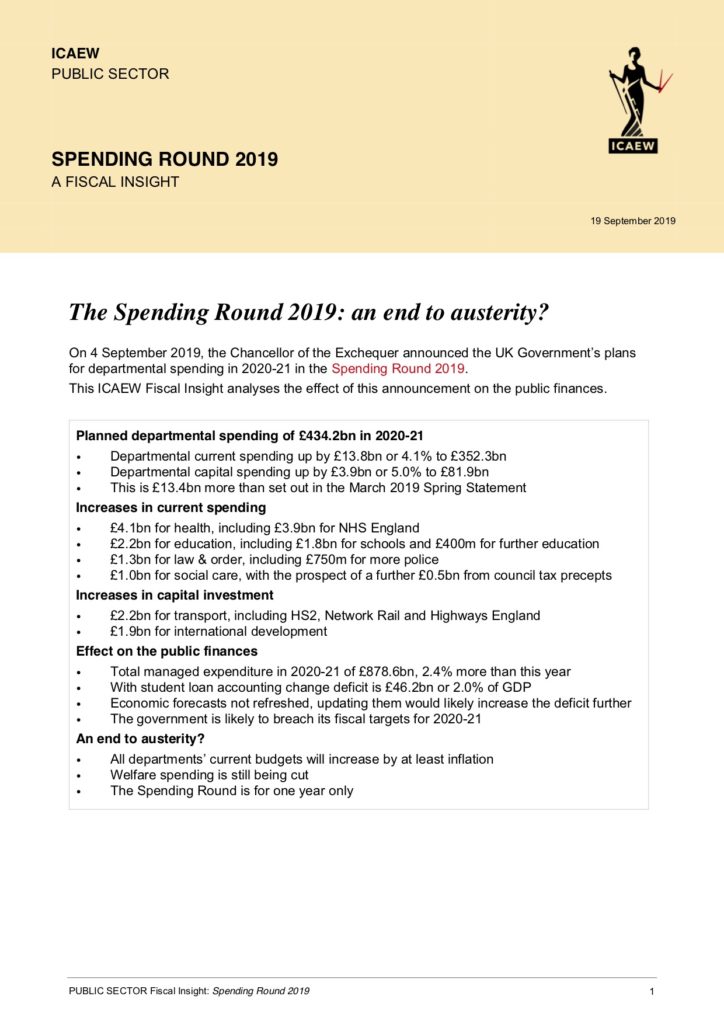
ICAEW Fiscal Insight: Spending Round 2019

Cover photo with link to a pdf - ICAEW Fiscal Insight on the Spending Round 2019: an end to austerity?

Fiscal Insight – Spending Round 2019

On 4 September 2019, the Chancellor of the Exchequer announced the UK Government’s plans for departmental spending in 2020-21 in the Spending Round 2019.

This ICAEW Fiscal Insight analyses the effect of this announcement on the public finances and what this means for public services. Headlines include:

Planned departmental spending of £434.2bn in 2020-21

  • Departmental current spending up by £13.8bn or 4.1% to £352.3bn
  • Departmental capital spending up by £3.9bn or 5.0% to £81.9bn
  • This is £13.4bn more than set out in the March 2019 Spring Statement

Increases in current spending

  • £4.1bn for health, including £3.9bn for NHS England
  • £2.2bn for education, including £1.8bn for schools and £400m for further education
  • £1.3bn for law & order, including £750m for more police
  • £1.0bn for social care, with the prospect of a further £0.5bn from council tax precepts

Increases in capital investment

  • £2.2bn for transport, including HS2, Network Rail and Highways England
  • £1.9bn for international development

Effect on the public finances

  • Total managed expenditure in 2020-21 of £878.6bn, 2.4% more than this year
  • With student loan accounting change deficit is £46.2bn or 2.0% of GDP
  • Economic forecasts not refreshed, updating them would likely increase the deficit further
  • The government is likely to breach its fiscal targets for 2020-21

An end to austerity?

  • All departments’ current budgets will increase by at least inflation
  • Welfare spending is still being cut
  • The Spending Round is for one year only

The Spending Round marks a turning point for spending on public services, with all departmental budgets increasing by inflation at the very least. This is a significant change after a decade of cuts in most department budgets.

Click here to read the ICAEW Fiscal Insight on the Spending Round 2019.

ICAEW chart of the week: Spending Round 2019: an ‘end to austerity’?

Spending Round 2019 £330.8bn + inflation £6.1bn + reclass £1.6bn + increases £13.8bn = £352.3bn

On 4 September 2019, the Chancellor of the Exchequer announced the UK Government’s plans for departmental spending for the next financial year, 2020-21; as illustrated by the #ICAEWchartoftheweek. 

This was unusual, as the announcement was not accompanied by a Budget setting out how those plans would be funded, nor by updated economic forecasts to indicate the expected effect on the overall public finances. This is also the second year running that the three-year Spending Review has been delayed and replaced by a one-year plan.

The primary announcement was for an increase of £13.8bn in departmental current spending in the next financial year (2020-21), a 4.1% real-terms increase over the current financial year. This was £11.7bn more than had been previously included in public finance forecasts and increases ‘Resource DEL excluding depreciation’ to £352.3bn.

There is an extra £4.1bn for health, £1.0bn for social care, £2.2bn for education, £1.3bn for law & order, £0.7bn for defence and security, £0.6bn for devolved administrations, and £1.3bn in other increases. The latter includes £0.4bn for transport, £0.2bn for the Nuclear Decommissioning Authority, £0.1bn for international development, £0.1bn for the next census, £0.1bn for the Department for Work & Pensions, £68m for air quality, biodiversity and animal health, £54m to tackle homelessness, and £46bn for the Birmingham Commonwealth Games. 

The Chancellor also announced that departmental capital spending would increase by £3.9bn or 5.0% in real terms. This is £1.7bn more than had previously been announced and increases ‘Capital DEL’ to £81.9bn. There is £2.2bn for transport infrastructure (including HS2, other rail projects and road building), £1.9bn in additional international development investment, £0.5bn for the defence equipment programme, and £0.5bn for Scotland, Wales and Northern Ireland, partially offset by £1.2bn in lower reserves and other changes.

Although department current spending is expected to rise by 4.1%, and capital spending by 5.0%, the overall increase in total managed expenditure in 2020-21 is a 2.4% rise to £865.2bn, with annually managed expenditure (‘AME’) relatively flat in real-terms. With the cost of pensions rising ahead of inflation, this implies further cuts in the welfare budget, and so this may not be the full ‘end to austerity’ claimed by the Chancellor.

The uncertain economic outlook also causes concern. A recession, whether or not induced by Brexit, could have adverse consequences for the public finances, raising the worrying prospect of a return to austerity in the three-year Spending Review now scheduled for next year.

ICAEW chart of the week: Schools budget up £14bn, or is it £1.2bn?

English schools budget 2020-21 +£2.6bn, 2021-22 +£4.8bn, 2022-23 +£7.1bn

The Prime Minister’s announcement of a ‘£14bn package’ of more money was welcome news for English schools as they prepare to re-open their doors after the summer holidays.

Unfortunately, as is common with government announcements, there is a tendency to add several years together to give a bigger headline, exacerbated this time by the inclusion of inflation to make the headline even bigger! 

In reality the announcement is a lot less exciting, as illustrated by the #ICAEWchartoftheweek. The announced increase in the 5-16 schools’ budget in three years’ time of £7.1bn (from £45.1bn in 2019-20 to £52.2bn in 2022-23) turns out to be £3.6bn, or an average of £1.2bn a year after taking account of inflation and the expected growth in the number of school pupils of around 2% over that time.

This is still very good news for schools trying to manage within constrained budgets, but (as the IFS and others have reported) the increase will still be insufficient to restore real-terms per pupil funding to the levels seen before the financial crisis. A 12% increase in pupil numbers since 2009-10 has seen budgets squeezed as funding has been constrained to inflation-only increases for most of the last decade.

Ironically, the Chancellor wasn’t able to take advantage of the same trick in his announcement the following day of £400m for further education and sixth forms, despite the fact that this was proportionately a bigger increase. The announcement was only for one year, so he couldn’t add multiple years together to create a bigger headline, and HM Treasury no doubt held the line about not adding in inflation.

Either way, these announcements are indication of how the fiscal approach is changing after a decade of austerity and struggling public services. This week’s Spending Review will give us a few more clues about the direction of public spending, although if (as rumoured) the Budget is postponed then we may not find out what the plans for taxes and borrowing to fund these increases until the Spring.