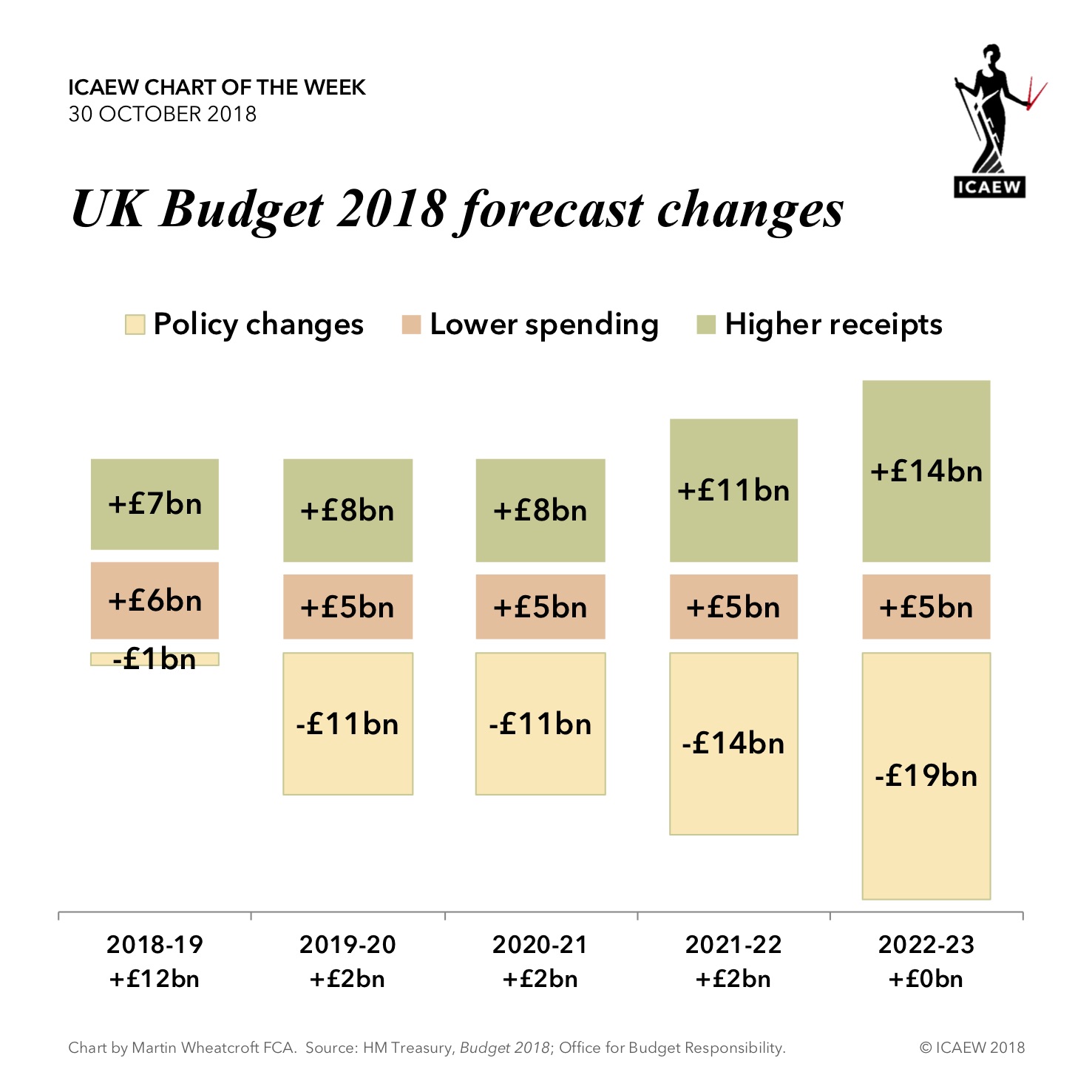
ICAEW chart of the week – UK Budget 2018

The Chancellor was in a positive mood yesterday as he presented a budget to deliver the commitment to increase NHS spending without large tax increases.

The reason was an improvement in the OBR’s fiscal forecasts. As illustrated by our chart of the week on the 2018 budget, forecast receipts have been revised up by around 1%, and previously planned spending revised down by 0.6%, to give an additional £13bn a year in this and the next two years, rising to £16bn and £19bn in the two years after that. 

This is not due to significant changes in the economy. Lower unemployment and some additional revenues from higher oil prices have delivered an extra £1bn. A long period of very low interest rates and court wins on tax rules has also helped, but much of the improvement is from things not turning out as badly as forecast back in 2016. 

This has let him sprinkle a little extra cash to ease some of the pressure on public services, not to mention spending a penny or two on improving public conveniences. 

With the mantra of government changing from ‘austerity’ to ‘fiscal discipline’ it is clear that we are not out of the woods yet, especially with £1.8tn in net debt and £4.3tn in total liabilities weighing on the public finances for a long time to come.

ICAEW chart of the week – NATO

With the budget less than a week away our two chapters in this year’s IFS Green Budget are proving highly relevant. 

While the Chancellor will benefit from prudence in previous forecasts, the underlying position remains extremely challenging. Total public liabilities are £4.3tn or 214% of GDP, while an increasingly long-lived population places ever greater demands on the state. 

One area where spending pressure may be unavoidable is Defence where a higher level of perceived threat, may result in higher spending. The Defence Select Committee has even suggested an extra £20bn a year may be needed. 

The burden would be less if all NATO members met the 2% defence and security spending commitment. This would lead to an extra £83bn of spending across NATO. The UK meets this threshold: spending £43bn, or 2.1% of GDP. Persuading our allies to meet this target would boost our collective defence with no extra funding by the UK taxpayer. 

Less likely to gain traction is President Trump’s suggestion that NATO members spend 4% of GDP. This implies a £38bn increase in defence spending by the UK and proportionately much greater increases by most NATO members. 

Watch this space and stay in touch with the Budget with ICAEW at https://www.icaew.com/technical/economy/uk-budget-2018.

IFS Green Budget 2018 – ICAEW: Defence

Ross Cambell of ICAEW and Martin Wheatcroft have co-authored a chapter on defence resources and spending in this year’ IFS Green Budget.

Go to www.icaew.com/technical/economy/ifs-green-budget-2018 to find out more.

In 2017–18, the UK spent £43 billion on defence and security, just meeting the target among NATO members to spend 2% of national income on defence. However, there are growing questions as to whether this level of spending is sufficient to provide for the defence of the UK, with calls from the Defence Committee of the House of Commons and the Secretary of State for Defence to increase spending. These questions reflect the UK’s changing strategic position amid greater international tensions, together with significant cost pressures on the defence budget that could mean cutting existing defence capabilities if not addressed.

This chapter considers how the evolving defence and security position may affect defence resources and spending, and the pressure that this could put on the public finances. We provide an overview of the UK’s defence arrangements in light of the ongoing update to the 2015 National Security Strategy and Strategic Defence and Security Review (the 2015 SDSR) and explore what that might mean for defence spending and for the public finances. We also analyse the finances and financial management of the Ministry of Defence. We highlight several risks going forward, including the management of multi-year complex programmes to procure new equipment and the currency and other risks of multi-year capital programmes.

Key findings

  • The UK has enjoyed a substantial post-Cold-War peace dividend that has effectively been used to fund the growing welfare state. The proportion of UK public spending going on defence and security has decreased from 15% fifty years ago to just over 5% today. Over the same period, spending on social security and health has increased from around a quarter to over half of the total.
  • Further cuts to the defence budget to fund other spending priorities are no longer possible if the UK is to meet its commitment as a member of NATO to spend 2% of national income on defence. Defence and security spending in 2017–18 of 2.1% of GDP only marginally exceeded the 2% NATO threshold.
  • Changing perceptions of potential threats could lead to higher defence spending over the next few years, adding to the pressure on the public finances. The UK’s national security strategy is under review in response to increasing international tensions. The Defence Committee of the House of Commons believes the Armed Forces need to be larger and better equipped for the UK to maintain its leading position within NATO and has called for defence spending to rise by £20 billion a year, or an extra 1% of national income.
  • The UK needs to match its aspirations for a global military role to the amount it is willing to spend on defence. UK defence spending of £36 billion in 2017–18 was higher as a fraction of national income than that of most G7 countries, though a smaller share than the US. And, in cash terms, it was less than 8% of the £470 billion spent by the US in 2017 and around a fifth of the amount spent by China.
  • There is a significant potential for cost overruns in the procurement budget. The National Audit Office has identified risks that could lead to additional costs of between £5 billion and £21 billion in the 2017 to 2027 Equipment Plan.
  • The 10-year Equipment Plan would cost an extra £4.6billion at an exchange rate of $1.25 to £1 instead of the $1.55 to £1 rate originally forecast. This could adversely affect defence capabilities if additional funding is not found. Denominating a proportion of parliamentary funding for defence in dollars would reduce the risk of having to make cuts to personnel or equipment if sterling weakens, or the incentive to spend currency gains if sterling strengthens.

Figure. UK defence and security spending over time

UK defence and security spending over time

Source: NATO; Office for Budget Responsibility.

IFS Green Budget 2018 – ICAEW: Public sector assets

Ross Campbell and Martin Wheatcroft have co-authored a chapter in this year’s IFS Green Budget on public sector assets.

To find out more go to https://www.icaew.com/technical/economy/ifs-green-budget-2018.

Public assets are integral to both the government’s balance sheet and the functioning of the UK. Some of these assets, such as schools and hospitals, are essential in delivering public services. Others, such as the road network, are part of the economic, social and legal infrastructure that supports economic activity and hence the tax revenues needed to pay for public services.

The government is undertaking a Balance Sheet Review, considering how it can use public assets in the most effective way to advance its policy priorities, and how it manages its liabilities and other financial commitments. In advance of the progress report expected with the 2018 Autumn Budget, this chapter provides an overview of the assets owned by the UK public sector and discusses how the Balance Sheet Review can be used to improve the utilisation of public assets and the prospects for a comprehensive investment and asset management strategy.

Key findings

  • HM Treasury is conducting a Balance Sheet Review that is due to report alongside the 2018 Autumn Budget. This provides an opportunity to develop a comprehensive investment and asset management strategy, going beyond ad hoc initiatives such as the recent establishment of the Government Property Agency to improve the management of offices and other general-purpose central government property.
  • Public sector assets are less than half the size of public sector liabilities. At 31 March 2017, the government reported assets of £1.9 trillion (94% of national income), compared with total liabilities of £4.3 trillion (214% of national income). Most public sector assets are not readily saleable and could not easily be used to settle liabilities, although the public sector’s most significant resource – the ability to levy taxes – is excluded.
  • Capital investment is a relatively small component of public spending and has declined since 2009–10, although the government plans to increase investment next year and the year after. Capital expenditure in 2016–17 of £55 billion (2.8% of national income) was less than 7% of non-capital expenditure of £819 billion (41.2% of national income) and 9% lower in real terms than in 2009–10. Net additions to fixed assets after depreciation and disposals were just £18 billion (0.9% of national income).
  • The government is reliant on future tax revenues to fund its financial commitments, with public debt currently standing at close to £2 trillion. There are no social security or social care funds. No money has been set aside for £1.9 trillion in unfunded public service pensions, nuclear decommissioning or clinical negligence liabilities.
  • Labour party proposals for nationalisation would add to public sector assets, but the borrowing required would add considerably to liabilities. Higher revenues would follow, but there is a risk of underinvestment in the future without a change in capital allocation approach. Nationalising utilities, train operations, the Royal Mail and PFI contracts could potentially increase public debt by more than £200 billion.

Figure. Total assets, March 2010 to March 2017 (£ billion and % of GDP)

Total assets, March 2010 to March 2017 (£ billion and % of GDP)

Source: HM Treasury, Whole of Government Accounts 2016–17 and earlier years.

ICAEW chart of the week – UK Armed Forces

Our #ICAEW #chartoftheweek is about defence this week – the subject of our second chapter in this year’s #IFSGreenBudget. This examines how the evolving defence and security position might affect defence resources and spending, and the pressure this could put on the public finances.

Our chart reflects the ‘peace dividend’ following the end of the Cold War, with the UK’s regular forces falling by more than half from 320,700 in 1980 to 146,560 in 2018.

The savings were used to fund a growing welfare state – with defence falling from 15% to 5% of total public spending over the last fifty years just as health and welfare spending has increased from around 25% to over half. Defence and security spending now stands at 2.1% of GDP.

This long-term decline will have to end if the UK is to meet its commitment as a member of NATO to spend at least 2% of GDP on defence and security. Indeed, changing perceptions of potential threats may lead to defence spending starting to increase. To read all about defence – and public sector assets (our first chapter), go to www.icaew.com/technical/economy/ifs-green-budget-2018. See the launch presentation online, read the full report or find out more at our follow up webinar on 25 October at 1pm – to register go to events.icaew.com/pd/11508.

ICAEW chart of the week – Public assets

Next Tuesday, ICAEW will host the launch of the Institute for Fiscal Studies’ 2018 Green Budget. This is the authoritative pre-Budget report on the outlook for the UK economy supported by in-depth analysis on the options available to the Chancellor.

The ICAEW has again contributed two chapters, the first of which is on the subject of public assets, complementing the chapter we did last year on liabilities. In the past the government focused on a narrow range of fiscal measures, however with the advent of the Whole of Government Accounts it has started to think about the wider public balance sheet.

This year’s Budget is scheduled to include a progress report on the Balance Sheet Review being undertaken by HM Treasury to look at ways public assets can be used more effectively, be freed up for other uses, or generate better returns. As our chart of the week illustrates, the UK’s £1.9 trillion (94% of GDP) of public assets are dwarfed by £4.3 trillion (214% of GDP) in public liabilities. With many public assets not readily saleable, effective asset management is more important than ever.

You can find out more about the 2018 IFS Green Budget event next Tuesday and register for your free place to attend at: https://lnkd.in/gu-PKEU.

ICAEW chart of the week – Oil prices

Today’s chart of the week is on the recent increase in the oil price to above $80 a barrel. Given the potential impact on the global economy, this rise is the cause of some concern. A sudden spike in oil prices has been linked to a number of past recessions.

The last time that the one-month forward price for Brent Crude was above $80 was in October 2014, when it cost $85.93 to buy a barrel of mixed hydrocarbons (with free sulphur included).

Just 15 months later in January 2016 the price was down to less than $35, but since then the price has bounced back and was up to $82.69 at 30 September 2018, reaching $84.79 at the close yesterday – just 1.3% below the 31 October 2014 price.

From a US perspective, this is a return to the position of four years ago, but for the UK it is different. With Sterling weaker against USD, the price yesterday was £65.34, over 20% higher than the £53.71 a barrel it would have cost in October 2014.

This effect is even more pronounced for emerging economies with weakening domestic currencies. The price of oil in Brazilian Reals is now over 50% higher that it was four years ago.

For growing economies, higher oil prices are unhelpful. For economies that are struggling, markedly higher oil prices might prove devastating.

ICAEW chart of the week – RPI

With suggestions that the retail prices index (RPI) may be on its way out, our chart this week is on the subject of inflation.

RPI is consistently higher than the consumer price index (CPI), with RPI on average 0.8% higher than CPI since 2010. Similarly, RPI was on average 1.0% higher than CPIH (CPI including housing), the even more preferred inflation measure of the statistical world (not shown in the chart).

The Office for National Statistics would dearly like to get rid of RPI given the known methodological flaws in its calculation. They might describe RPI as ‘Not a National Statistic’, but legally they have to publish it every month.

The problem is that RPI is used in many financial contracts, including £410bn of index-linked gilts issued by the government. Using CPI or CPIH instead would result in lower returns for investors and (no doubt) consequent litigation.

Statisticians and economics tend to joke about RPI as “inflation +1”, as it is close to 1% higher than CPIH. That joke could provide a solution – while a straight replacement of RPI with CPI or CPIH might not be feasible, perhaps redefining RPI as CPIH + 1% could be a starting point for a discussion with debt investors.

A potential route to sparing the statisticians’ blushes at last.

ICAEW chart of the week – What we do

Our chart this week is on the subject of what the 66.6 million people that live in the United Kingdom do.

31.6m (47%) of UK citizens, are in full or part time work, not including 0.9m students in part-time jobs. About 4.8m of those working are self-employed, while the remaining 26.8m are employees. Although 47% may sound a relatively low share of the total, children and students make up a quarter of the population and a further 11.7m (18% of the population) are retired.

Just under 10% of the working age population are not in work. With 2.0m (3%) not working because of illness or disability and 3.2m (5%) who are homemakers or who have chosen not to work for other reasons that leaves just 1.2m who are registered as unemployed and looking for work.

Many are likely to find jobs within a relatively short period – 0.7m have been unemployed for less than six months – meaning that around half a million people have been unemployed for longer. Less than 1% of the population.

This is almost full employment. What is surprising is we have yet to see any significant upward pressure on wages. Whether you blame structural changes in the labour market, Brexit or wider economic uncertainties, something is up with the usual demand and supply dynamic.

ICAEW chart of the week – Fuel duties

Our choice of chart this week is based on the news that the government is considering increasing fuel duties.

This tax is a good example of the dilemma faced by government. It is a valuable source of revenue – £28bn this year – but government environmental policy is to ban petrol and diesel cars in around 20 years’ time.

The point there will be no fuel to tax might be reached even sooner as the financial incentive for drivers to switch to electric cars is considerable.

As our chart highlights, we estimate that fuel for a small petrol car to drive 460 miles might cost £52 at current pump prices, around twice the cost of charging an equivalent electric car.

The difference is almost entirely down to tax, with around 60% of the pump price going to the exchequer in fuel duty and full-rate VAT, as opposed to the 22% of domestic electricity charges going in levies for environmental and social obligations and lower-rate VAT.

So the Chancellor’s decision will not just be about the politics of lifting an eight-year freeze in an unpopular tax. Increasing fuel duty might actually accelerate the switch to electric cars and hence the volume of fuel sold.

Suggestions for replacement taxes on a postcard (or electronic equivalent) please.